Showing posts with label children. Show all posts

Monday, July 22, 2024

Messaging campaign to encourage back to school vaccines is underway; Kentucky vaccination rates are below U.S. average

Lexington-Fayette County Health Department graphic
By Melissa Patrick
Kentucky Health News

With just weeks left before school starts, it's time to make sure your school-aged children are up to date on required immunizations.  

Toward this effort, the Kentucky Association of Health Plans, the trade group for health insurers in the state, and Kentucky Voices for Health, a coalition of health advocacy groups, have partnered to roll out a messaging campaign to help educate families and improve student immunization rates. The partnership involves a 3-year, $360,000 grant from KAHP to be used toward building a stronger safety net in Kentucky.

"This back-to-school season is the perfect opportunity to talk to a provider and ensure that your family is caught up on recommended immunizations. If you or someone in your family has fallen behind, trust me, you are not alone," Kelly Taulbee, director of communications and development at KVH, said at a press conference to announce the partnership. " We encourage families today to work with providers and get the additional resources and an immunization schedule that's right for you and your children." 

Taulbee said the messaging campaign will involve TV commercials, radio ads and occasionally print. Asked if they would be targeting any certain region of the state, Taulbee said, " It's a relatively equal approach across the board as far as how we're messaging." 

Many Kentucky children are still catching up with routine vaccinations that were missed during the pandemic. The state's vaccination rates remain below the national average. 

"That puts our children at unnecessary risk and it strains our healthcare system," Tom  Stephens, president and CEO of KAHP, said at a press conference. 

Stephens noted that the recent outbreak of whooping cough in Lexington "underscored the urgency of this issue."  Last week, the state Department for Public Health reported 138 cases of whooping cough, known medically as pertussis, and said this level of infection had not been seen in Kentucky since 2016-17. 

"This outbreak is a stark reminder of what can happen when immunization rates fall," Stephens said. "It's not just about individual protection. It's about community immunity."

"Community immunity" occurs when enough people have been immunized against a disease to protect others who are not immunized. Some can't get vaccinations because their immune systems are too weak to allow them to get vaccinated, or because they are too young. 

Children can get their routine vaccinations at health clinics, health departments, pharmacies and doctor's offices, but it's important to make those appointments soon because school typically starts in August and students are required to provide up-to-date immunization records at the beginning of each school year, unless exempted for religious or medical reasons.

Taulbee noted that a law passed during the last legislative session allows pharmacists to continue administering immunizations down to the age of 5. "It's such a simpler access point that we want families to keep in mind," she said. 

Families can find a provider, including those that offer free immunizations through the Vaccines for Children program, by calling the Kentucky Infectious Disease & Vaccine Call Center at 855-598-2246, Monday-Friday, 8 a.m. to 5 p.m. ET 

Asked about vaccine hesitancy, which has been fueled by the Covid-19 vaccine, Taulbee and Stephens both encouraged families to talk to their provider if they have any questions or concerns about immunizations. 

A recent Pew Research Center survey of more than 10,000 adults found that 88% of Americans believe the overall benefits of the measles, mumps and rubella vaccine outweighs the risks, compared to 62% who believed the Covid-19 vaccine benefits outweigh the risks. Further, the survey found a drop in support for vaccine requirements for healthy children in schools, with 70% of those surveyed supporting the requirement, down from 82% in 2019 and 2016. 

Data from the School Immunizations Survey dashboard, which includes data for each school, show that during the 2023-24 school year, nearly 85% of kindergartners were up to date with all vaccines, 80% of seventh graders were, and nearly 54% of 11th graders were. 

The KAHP-KVH partnership will also focus on keeping children signed up for Medicaid as Medicaid renewals resume for them.  

"The renewal process is going to begin soon for the first time in four years for our children," Taulbee noted. "We encourage families to take this very seriously. Check your mail, watch and make sure you understand eligibility standards and keep your children covered." 

Wednesday, July 3, 2024

How to keep your family safe in pools, lakes, streams and oceans

Photo by Marina Kuzminykh, iStock/Getty Images Plus
By Sherri Hannan
Safe Kids Fayette County

Ask any child about the best part of summer, and chances are many will say it’s going to the pool or beach. And even though parents are aware of the risk of drowning, it remains the number one cause of death in children ages 1-4, as well as a leading cause of death among teens. Nearly 1,000 children drown each year, and more than 8,700 children were hospitalized for a near-drowning event. It’s quick and silent, and it can happen to any family.

The American Academy of Pediatrics recommends swimming lessons as a layer of protection against drowning; that can begin for many children starting at age 1. Even if your child has had lessons, they should never be unsupervised in water. Toddlers are the highest risk for drowning; their curious nature will lead them to explore areas that are dangerous for them but seem innocuous to adults. A good rule is “touch supervision,” meaning young children should always be close enough to touch when around water.

Other tips include:
  • Choose a safe place to swim. Ensure that swimming pools are enclosed by a fence on all sides. In oceans, be aware of strong currents and waves.
  • Instead of “floaties,” have your child wear a Coast Guard-approved life jacket in and around water.
  • Watch kids when they are in or around water without being distracted. Young children can drown in as little as one inch of water, so it’s important to keep them within an arm’s reach of an adult. Assign a “water watcher,” an adult who will pay constant attention to children in the water. Switch off with another adult for breaks.
  • Children should wear brightly colored swimsuits that contrast against the water, such as yellow, orange and pink.
  • Empty small kiddie pools immediately after use. Store them upside down and out of children’s reach.
Kentucky’s numerous lakes are a fun summer getaway. However, teens and adolescents have a greater risk of death or injury in natural bodies of water because they overestimate their abilities and underestimate dangerous situations. They may feel pressure from their friends even if they don’t have strong swim skills or experience. They may also seek out unsafe areas such as waterfalls and rivers. Encourage them to only swim where lifeguards are present.

Familiarize yourself with the signs of drowning. It’s not the dramatic splashing you see in movies but is actually subtle and silent. If you see someone vertical in the water with their mouths near the surface, and they appear to be “climbing an invisible ladder,” get them out of the water as soon as possible.

One of the best ways to prepare for summer safety is to learn CPR. Contact your local community center or the Red Cross to find certification courses near you.

This is the latest weekly health column provided by the University of Kentucky Office of Public Relations and Strategic Communications.

Saturday, June 22, 2024

FDA OKs menthol e-cigs made by firm Altria recently bought, thus supporting its smoking-cessation claims; health advocates object

By Matthew Parrone
Associated Press

The Food and Drug Administration on Friday authorized the first menthol-flavored electronic cigarettes for adult smokers, acknowledging that vaping flavors can reduce the harms of traditional tobacco smoking.

Njoy menthol product
The FDA said it authorized four menthol e-cigarettes from Njoy, the vaping brand recently acquired by tobacco giant Altria, which also sells Marlboro cigarettes.

The decision lends new credibility to vaping companies’ longstanding claim that their products can help blunt the toll of smoking, which is blamed for 480,000 U.S. deaths annually due to cancer, lung disease and heart disease. E-cigarettes have been sold in the U.S. since 2007 but in recent years their potential benefits for smokers have been overshadowed by their use by adolescents and teens.

Parents and anti-tobacco groups immediately criticized the decision, which follows years of advocacy efforts to keep menthol and other flavors that can appeal to teens off the market.

“This decision could mean we’ll never be able to close the Pandora’s box of the youth vaping epidemic,” said Meredith Berkman, co-founder of Parents Against Vaping E-cigarettes. “FDA has once again failed American families by allowing a predatory industry to source its next generation of lifetime customers — America’s children."

Youth vaping has declined from all-time highs in recent years, with about 10% of high schoolers reporting e-cigarette use last year. Of those who vaped, 90% used flavors, including menthol.

In Kentucky polling in 2021, 45% of high-school students said they had used an electronic vapor product, 22% were current users, 8% were frequent users, and 7% used the products daily. Among Kentucky middle-school students, 24% said they had used an electronic vapor product, 11% said they were current users, nearly 3% said they were frequent users, and 2% said they used daily.

All the e-cigarettes previously authorized by the FDA have been tobacco, which isn't widely used by young people who vape.

Njoy is one of only three companies that previously received FDA's OK for vaping products. Two of the four FDA-approved products are "sealed, pre-filled, non-refillable pods that are used with a previously authorized Njoy device, and two are disposable e-cigarettes with a prefilled, non-refillable e-liquid reservoir," reports Jessica Karins reports of Inside Health Policy.

Njoy’s products accounted for less than 3% of U.S. e-cigarette sales in the past year, according to Nielsen. Vuse, owned by Reynolds American, and Juul control about 60% of the market, while hundreds of disposable brands account for the rest.

Most teens who vape use disposable e-cigarettes, including brands like Elf Bar, which come in flavors such as watermelon and blueberry ice.

Altria's data showed Njoy e-cigarettes helped smokers reduce their exposure to the harmful chemicals in traditional cigarettes, the FDA said. The agency stressed the products are neither safe nor “FDA approved,” and that people who don’t smoke shouldn’t use them.

Friday’s action is part of a sweeping FDA review intended to bring scientific scrutiny to the multibillion-dollar vaping market after years of regulatory delays. The U.S. market includes thousands of fruit- and candy-flavored vapes that are technically illegal but are widely available in convenience stores, gas stations and vape shops.

The FDA faced a self-imposed court deadline at the end of this month to wrap up its yearslong review of major vaping brands, including Juul and Vuse.

Those brands have been sold in the U.S. for years, awaiting FDA action on their scientific applications. To stay on the market, companies must show that their e-cigarettes provide an overall health benefit for smokers, without significantly appealing to kids.

“Based upon our rigorous scientific review, in this instance, the strength of evidence of benefits to adult smokers from completely switching to a less harmful product was sufficient to outweigh the risks to youth,” said Matthew Farrelly of FDA’s Center for Tobacco Products.

Richmond-based Altria previously took a $13 billion stake in Juul in 2018, when the brand controlled most of the U.S. vaping market. But Juul's value plummeted after it was hit with lawsuits and investigations over its role in sparking a national spike in underage vaping.

Several longtime health-advocacy groups criticized the decision.

American Lung Association CEO Harold Wimmer wrote, “The tobacco industry has been using menthol and other flavors to attract kids for decades - this opens up a legal pathway for Njoy to market their highly addictive products.”

Lisa Lacasse, president of the American Cancer Society Cancer Action Network, noted that the move comes less than two months after the Biden adminisration announced an indefinite delay in FDA’s proposed rule to ban menthol cigarettes and flavored cigars, which had bene pending for two years.

"FDA has been more closely scrutinized by Congress over its e-cigarette regulation approach in recent months," Karins notes. "Lawmakers in both parties agree FDA isn’t doing enough to combat illegally imported e-cigarettes, but a partisan divide is emerging on whether the agency should respond by approving more domestic products. Some Republicans have suggested the agency should approve more applications for American companies’ products while Democrats largely want those products off the market as well."

In its announcement, "FDA appeared to respond to criticisms," Karins writes. Center for Tobacco Products Director Brian King said, “This action is further reinforcement that authorization of an e-cigarette product is possible when sufficient scientific evidence has been submitted to the agency to justify it.” 

King said Njoy submitted evidence "showing a benefit to adult smokers relative to the company’s previous tobacco-flavored products that is sufficient to outweigh risks of the products, including potential appeal to youth."

Karins notes, "FDA’s statement says authorization of the products does not mean they are safe, adding that people who do not use nicotine products shouldn’t start. It also says the agency remains concerned about youth vaping. It will monitor the marketing of the Njoy products levels of use of the products among youth and former smokers, and the number of smokers who are able to completely switch to the products."

Under the FDA rule, Njoy may not "use most advertising methods," and ads "cannot include cartoon images, images of food or fruit, or depictions of people who appear to be younger than 45," Karins reports. "Retailers must place Njoy products only in non-self-service areas of stores."

Monday, June 17, 2024

Surgeon general wants health warnings on social-media platforms, which he blames for mental illnesses among youth

Surgeon General Vivek Murthy (AP photo by Susan Walsh)
By Michelle Chapman
Associated Press

The U.S. surgeon general has called on Congress to require warning labels on social media platforms and their effects on young people’s lives, similar to those now mandatory on cigarette boxes.

In a Monday opinion piece in the The New York Times, Dr. Vivek Murthy said that social media is a contributing factor in the mental-health crisis among young people.

“It is time to require a surgeon general’s warning label on social-media platforms, stating that social media is associated with significant mental health harms for adolescents. A surgeon general’s warning label, which requires congressional action, would regularly remind parents and adolescents that social media has not been proved safe,” Murthy said. “Evidence from tobacco studies show that warning labels can increase awareness and change behavior.”

Murthy said that the use of just a warning label wouldn’t make social media safe for young people, but would be a part of the steps needed.

Social media use is prevalent among young people, with up to 95% of youth ages 13 to 17 saying that they use a social media platform, and more than a third saying that they use social media “almost constantly,” according to 2022 data from the Pew Research Center.

“Social media today is like tobacco decades ago: It’s a product whose business model depends on addicting kids. And as with cigarettes, a surgeon general’s warning label is a critical step toward mitigating the threat to children,” Josh Golin, executive director at Fairplay, an organization that is dedicated to ending marketing to children, said in a statement.

Actually getting the labels on social media platforms would take congressional action — and it’s not clear how quickly that might happen, even with apparent bipartisan unity around child safety online. Lawmakers have held multiple congressional hearings on child online safety and there’s legislation in the works. Still, the last federal law aimed at protecting children online was enacted in 1998, six years before Facebook’s founding.

“I am hoping that would be combined with a lot of other work that Congress has been trying to do to improve the safety and design and privacy of social media products,” said Dr. Jenny Radesky, a developmental behavioral pediatrician at the University of Michigan and leader at the American Academy of Pediatrics. “Those two things would have to go hand in hand, because there’s so much that Congress can do to follow the steps of the United Kingdom and the European Union in passing laws that take into account what kids need when they’re interacting with digital products.”

Even with Congressional approval, warning labels would likely be challenged in the courts by tech companies.

“Putting a warning label on online speech isn’t just scientifically unsound, it’s at odds with the constitutional right to free speech,” said Adam Kovacevich, CEO of the tech-industry policy group Chamber of Progress. “It’s surprising to see the U.S. surgeon general attacking social media when teens themselves say it provides an important outlet for social connection.”

Last year, Murthy warned that there wasn’t enough evidence to show that social media is safe for children and teens. He said at the time that policymakers needed to address the harms of social media the same way they regulate things like car seats, baby formula, medication and other products children use.

To comply with federal regulation, social media companies already ban kids under 13 from signing up for their platforms — but children have been shown to easily get around the bans, both with and without their parents’ consent.

Other measures social platforms have taken to address concerns about children’s mental health can also be easily circumvented. For instance, TikTok introduced a default 60-minute time limit for users under 18. But once the limit is reached, minors can simply enter a passcode to keep watching.

Murthy believes the impact of social media on young people should be a more pressing concern.

“Why is it that we have failed to respond to the harms of social media when they are no less urgent or widespread than those posed by unsafe cars, planes or food? These harms are not a failure of willpower and parenting; they are the consequence of unleashing powerful technology without adequate safety measures, transparency or accountability,” he wrote.

In January the CEOs of Meta, TikTok, X and other social media companies went before the Senate Judiciary Committee to testify as parents worry that they’re not doing enough to protect young people. The executives touted existing safety tools on their platforms and the work they’ve done with nonprofits and law enforcement to protect minors.

Murthy said Monday that Congress needs to implement legislation that will protect young people from online harassment, abuse and exploitation and from exposure to extreme violence and sexual content.

“The measures should prevent platforms from collecting sensitive data from children and should restrict the use of features like push notifications, autoplay and infinite scroll, which prey on developing brains and contribute to excessive use,” Murthy wrote.

Sens. Marsha Blackburn (R-Tenn.) and Richard Blumenthal (D-Conn.) supported Murthy’s message Monday.

“We are pleased that the surgeon general — America’s top doctor — continues to bring attention to the harmful impact that social media has on our children,” the senators said in a prepared statement.

The surgeon general is also recommending that companies be required to share all their data on health effects with independent scientists and the public, which they currently don’t do, and allow independent safety audits.

Murthy said schools and parents also need to participate in providing phone-free times and that doctors, nurses and other clinicians should help guide families toward safer practices.

While Murthy pushes for more to be done about social media in the United States, the European Union enacted groundbreaking new digital rules last year. The Digital Services Act is part of a suite of tech-focused regulations crafted by the 27-nation bloc — long a global leader in cracking down on tech giants.

The DSA is designed to keep users safe online and make it much harder to spread content that’s either illegal, like hate speech or child sexual abuse, or violates a platform’s terms of service. It also looks to protect citizens’ fundamental rights such as privacy and free speech.

Officials have warned tech companies that violations could bring fines worth up to 6% of their global revenue — which could amount to billions — or even a ban from the EU.

Murthy’s focus is on teens and social media, but Radesky noted that adults could use a warning label too.

“What we’ve heard from teens is that they want their parents to be on social media less and on their devices less,” she said. “That’s another behavior change we hope that parents will reflect on and think about — ‘where could I cut down or create some boundaries to create more family time or sleep time?’ — and not only hyper-focusing on what teens are doing, but really what all of us as a society are doing in terms of healthy relationships with technology.”

UPDATE, June 19: "
Some scientists who study youth mental health say the evidence does not support the notion that social media is harmful per se," The New York Times reports.

Learning CPR for children and infants could help save a little life

(Photo from Prostock-Studio, via iStock/Getty Images Plus)
By Dr. Callie L. Rzasa
University of Kentucky

More than 23,000 children in the United States suffer an out-of-hospital cardiac arrest annually. Although the reported number of infant out-of-hospital cardiac arrests varies widely, only 6.5% for children less than 1 year old who experience an out-of-hospital cardiac arrest survive to hospital discharge.

According to the National Center for Injury Prevention and Control, unintentional choking and suffocation are a leading cause of all injury deaths for infants less than a year old. Nearly 3,500 infants die each year in the U.S. from sleep-related infant deaths such as suffocation, entrapment, strangulation and sudden infant death syndrome.

Make safety a habit at home by implementing safe sleep practices, such as making sure babies sleep in their own crib or bassinet on a firm, flat surface without potential suffocation hazards such as blankets, stuffed animals or crib bumpers.

New parents, grandparents, babysitters and caregivers should take the time to learn infant- and child-specific CPR (cardiopulmonary resuscitation). It’s important to remember if the child is unresponsive, not breathing or only gasping, call 911 and start CPR immediately.

For a child 1 or older:
  • Push on the middle of the chest 30 times at a depth of 2 inches with one or two hands at a rate of 100 to 120 compressions per minute.
  • Provide 30 compressions and then give two rescue breaths.
  • Repeat cycles.
For an infant younger than 1:
  • Push on the middle of the chest 30 times at a depth of 1½ inches with two fingers at a rate of 100 to 120 compressions per minute.
  • Provide 30 compressions and then give two rescue breaths.
  • Repeat cycles.
If you have access to an automated external defibrillator, use it as soon as possible. Most AEDs are equipped with child- and infant-sized pads. They can help guide CPR and provide treatment for certain heart arrhythmias. Continue compressions until emergency services arrives.

For more information about CPR for adults, children and infants, find a class or training center near you.

Callie L. Rzasa, M.D., is medical director of Kentucky Children's Hospital Congenital Heart Clinic and American Heart Association board president in Central and Eastern Kentucky.

Friday, June 14, 2024

Kentucky ranks 38th in child well-being, two slots higher than in 2023; latest report shows big jump in child and teen deaths in '22

Table from Kids Count 2024 Data Book
By Melissa Patrick
Kentucky Health News

Kentucky, where nearly one in four people are children, ranked 38th among states for the overall well-being of its children, rising two slots from the last report, according to the 2024 Kids Count Data Book. 

The 35th annual Data Book, released June 10 by Kentucky Youth Advocates and the Annie E. Casey Foundation, rates children's overall well-being through 16 indicators in four major domains: health, economic security, education and family and community.

Overall, Kentucky improved in six of the 16 indicators, but went backward in six others, including all four indicators used to measure education. The most recent data are from 2022. Here's a look at each domain:

Health: Kentucky's health ranking improved to 36th in this year's Data Book, up from 40th last year, even though two of the indicators used to measure health worsened. 

The latest report shows a big increase in the rate of deaths of children aged 2 through 18. It rose to 37 deaths per 100,000 residents in 2022, up from 29 per 100,000 in 2019.

The percentage of low birth-weight babies (less than 5.5 pounds at birth) also inched up to 8.9% in 2022, from 8.7% in 2019. The national average was 8.6% in 2022. 

New data were not available for the percentage of Kentucky's children and teens who are overweight or obese. That rate was 38% in 2021-22, much higher than the national average of 33%. 

As in some prior years, the only good news in the health category was that the percentage of children without health insurance stayed the same in 2022, at 4%. The national rate is 5%, reflecting the fact that 10 states have still not expanded Medicaid as Kentucky has.

For larger, clearer versions of these tables, click on them.
Economic well-being
: Kentucky ranked 36th in the Economic Well-Being domain, up from 41st last year. Kentucky's children remained the same in two of the indicators used to measure economic well-being, including children living in households with a high housing-cost burden (23%) and teens not in school and not working (8%). The state saw  improvements in the percentage of children living in poverty (21%) and the share of children whose parents lack secure employment (28%). 

Family and Community
:  Kentucky ranked 43rd in this domain, down one slot from last year. The state showed improvement in all indicators, including children living in single-parent homes (34%), children in families where the household head lacks a high school diploma (10%), children living in high-poverty areas (11%) and teen births per 1,000. In 2022, there were 22 teen births per 1,000 females aged 15-19. In 2018, that number was 25 per 1,000. In 2022, the national rate was 14 per 1,000. 

Education
: Kentucky ranked 33rd in the Education domain, down from 29th in the last report. All four of the indicators used to measure education worsened. 

The biggest change was seen in the percentage of eighth graders not proficient in math, increasing to 79% in 2022, up from 71% in 2019. The percentage of fourth-graders not proficient in reading also increased, to 69%, up from 65%. The report also shows that the percentage of children ages 3 and 4 not in school also increased slightly, to 61% in 2018-22, up from 59% in 2013-17. 

“To meet educational milestones, kids of all ages must have what they need to learn – from enough food and sleep, to a safe way to get to school, to supports such as tutoring and mental-health services," Terry Brooks, executive director of KYA said in a news release. "And they must be in schools where there is a qualified and well-supported teacher in every classroom. ” 

The release says learning losses from the Covid-19 pandemic have cost the state decades of progress in education. 

Brooks points to a time in Kentucky when public education was a place where Kentuckians found common ground and that Kentucky schools were the "envy of the nation" in the early 90s. 

"We need to re-claim that legacy. We need to move from where we are – when seemingly public education is the most politized and divisive policy issue in Frankfort – and reclaim the ethos of Kentuckians joining together when it comes to K-12 classrooms,” he said in the release. “That kind of common ground agenda is essential for our children and just as critical in building a strong workforce and economy for the future. That means resources for sure, but it also means engagement by us all and a fundamental restructuring of how we do ‘school’ in Kentucky.”

Further, it points to chronic absences that have increased, particularly among children living in poverty. The Data Book shows that 25% of  the state's children were chronically absent in 2021-22. 

Adverse childhood experiences also effect a child's ability to learn. In Kentucky, the report says 47% of the state's children in 2021-22 had experienced one or more ACEs.

And while the percentage of the state's high-school students graduating on time dropped one percentage point, to 90% in 2020-21, from 91% in 2018-19, that's still better than the national rate of 86%. 

This year's report focuses on how to help children get back on track when it comes to education. 

KYA and the Casey Foundation offer recommendations for how to make sure children can thrive in the classroom, including the need for "access to low- or no-cost meals, a reliable internet connection, a place to study, and time with friends, teachers, and counselors." 

Other recommendations are to deepen investments in school wraparound services to address chronic absences, to expand access to intensive tutoring and to utilize all of the allocated pandemic relief funding to prioritize the social, emotional, academic and physical well-being of students.

Thursday, May 30, 2024

Expert panel finds screen use impairs the sleep health of youth; National Sleep Foundation offers advice to reduce impact

Getty Images photo via Stony Brook University
Kentucky Health News

An expert look at research around screen use at bedtime, which has ballooned since the emergence of smartphones in 2007, found that pre-bedtime use of the devices impairs the sleep health of children and adolescents. 

The international panel of sleep experts, led by Professor Lauren Hale of Stony Brook University in New York, were selected by the National Sleep Foundation. After assessing 574 peer-reviewed published studies on screen time and its effects on children, adolescent and adult sleep, the panel created a consensus statement about digital screen use and sleep, says a university news release. 

The consensus statement, titled “The Impact of Screen Use on Sleep Health Across the Lifespan: A National Sleep Foundation Consensus Statement,” is published in Sleep Health, the journal of the NSF. 

The release said the consensus found that "on general, screen use impairs sleep health among children and adolescents; the content of screen use before sleep impairs sleep health of children and adolescents, and behavioral strategies and interventions may attenuate the negative effects of screen use on sleep health." 

“Upon review of the current literature, our panel achieved consensus on the importance of reducing pre-bedtime digital media to improve sleep health, especially for children and adolescents,” Hale said in the release. “We also identified the gaps in the literature and the need for future research.”

The NSF offers recommendations for best practices to reduce the impact of screen use on sleep, including: 
  • Near bedtime, avoid material thay is stimulating or upsetting
  • Have early, regular, and relaxing bedtime routines without screens
  • Set time limits on screen use, especially in evening and at night
  • Talk with kids about how using tech and screens can impact sleep
  • Model appropriate nighttime screen use for children

Friday, May 10, 2024

17 Ky. schools have free online mental health wellness course

Kentucky Health News map; for a larger version, click on it
More than 1,500 students in 17 Kentucky schools recently gained access to a free digital course on mental wellness, provided by the Medicaid program of Anthem Inc., one of the health insurers that manages the federal-state health program in Kentucky.

"The announcement comes during Mental Health Awareness month and as more adolescents, especially girls, report depressive symptoms," notes Sarah Ladd of the Kentucky Lantern.

The 17 schools in the program are Clay County Middle School, Daviess County High School, Estill County High School, Grant County Middle School, Graves County High School, Grayson County Middle School, Hazard Middle School, Henderson County High School, Bazzell Middle School in Allen County, Jenkins Independent School in Letcher County, Lewis County Central Elementary School, Marion County High School, Murray Middle School in Calloway County, Ohio County Middle School, Owensboro Middle School, Russell High School in Greenup County and Webster County High School.

The program has been launched in these schools and will continue into the 2024-25 academic school year, according to Quin Welch, media contact for Anthem Medicaid.

“Understanding Mental Wellness” is a course for students in grades 8, 9 and 10. It has six 15-minute lessons, according to Blackbaud, the digital-services firm that designed the course. 

Anthem says the course exposes students “to the experiences of others in order to develop awareness and empathy, reduce stigma, and provide facts on the prevalence and symptoms of mental health conditions.”

Students then “explore their own mental health, identify challenges they may face, and develop concrete strategies for managing those challenges while increasing their awareness of resources and empowering them with the knowledge, skills, and language necessary to identify and support a peer in need or at risk.”

Ladd reports, "Online previews of the course show a tour of mental health through the program, starting with a lesson on what mental health is and ending with the chance to create a personal wellness plan.

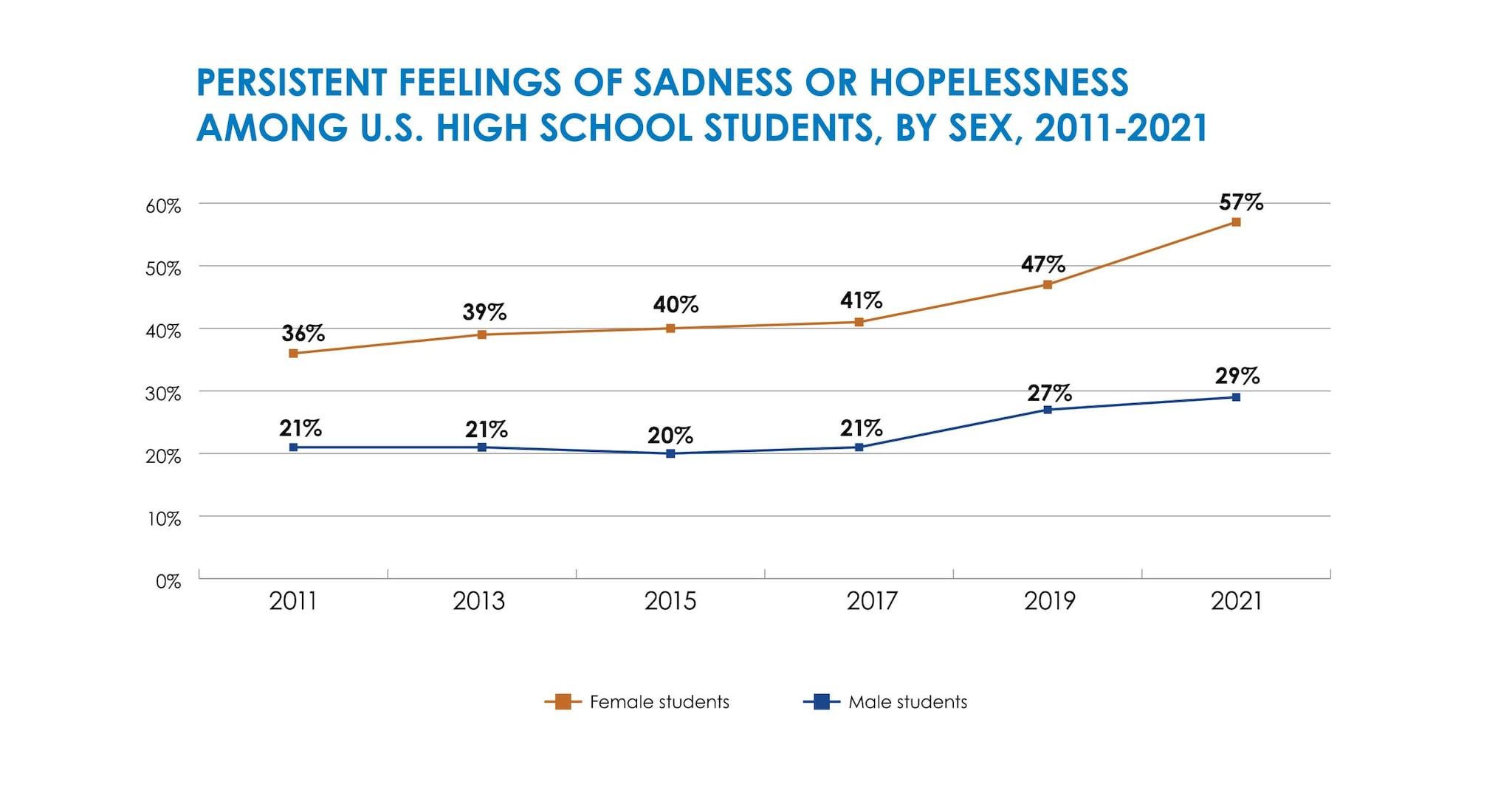
"Since the onset of Covid-19, mental health has worsened. In 2021, the Centers for Disease Control and Prevention found that sadness and hopelessness had increased from pre-pandemic levels, especially for teen girls. In 2017, 41% of female high school students and 21% of male high school students felt sad or hopeless. By 2021, those statistics were at 57% and 29%, respectively."

“Young people need resources and education from trusted sources to protect their mental health,” said Leon Lamoreaux, market president for Anthem Medicaid. He said the program “will help us reach students from all over the Commonwealth and equip them with tools and strategies that will make a positive difference in their lives for years to come.”

Tom Davidson, the CEO of Everfi, said the goal of the program is to help “those who are impacted by mental-health challenges, those who want to build and maintain positive mental health and those who have the opportunity to positively impact the mental health of a friend or peer.”

Friday, May 3, 2024

2% fewer Ky. children were on Medicaid a year after pandemic re-enrollment began; total enrollment, including adults, dropped 9.5%

Top half of Georgetown University table, adapted by Ketucky Health News; to enlarge, click on it.
By Melissa Patrick
Kentucky Health News

Medicaid enrollment of Kentucky's children fell 1.6 percent since the continuous-coverage protections of the pandemic were lifted last year. That was one of the smallest declines in the nation.

Coverage of U.S. children fell 10% in the "unwinding" process, says the report from the Georgetown University Center for Children and Families, based on data from the Centers for Medicare and Medicaid Services.

Kentucky hasn't started the re-enrollment process for children yet because, unlike most states, it worked with the federal government to delay the restart of renewals for children until this September. So did North Carolina.

"The story of Georgetown's report is an incredible good news story that speaks to how well Kentucky did things for kids," said Priscilla Easterling, outreach coordinator for Kentucky Voices for Health, a coalition of health-care advocacy groups.

Nationwide, 4.16 million children were dropped from from Medicaid and the Children's Health Insurance Program, and most would likely still be eligible, says the report. The numbers do not reflect individual children, but the change in total enrollment, which fluctuates from month to month for various reasons.

In Kentucky, 10,477 fewer children were covered than the 648,865 who were enrolled in either Medicaid or KCHIP before the unwinding -- the gradual resumption of annual Medicaid coverage renewals. Renewals in Kentucky began in April 2023.

Overall, Kentucky's Medicaid rolls have declined 9.5 percent in the last year. The number enrolled in April was 1,561,400. County-by-county figures are available from the Cabinet for Health and Family Services.

Cabinet spokesperson Brice Mitchell told Kentucky Health News in an email that Kentucky was the first state to request and get approval to automatically grant children 12 months of continuous coverage, without needing to go through a renewal during the unwinding. 

"The state sought this flexibility to ensure our children kept access to the coverage they need and deserve," Mitchell said. 

The only way a child may be disenrolled during the 12-month continuous coverage period is if the child turns 19, a parent or guardian requests disenrollment, or if the child moves out of state, Mitchell said. 

Easterling said it is expected that the children's renewal period that begins in September will go smoothly since the state will have already processed the adult renewals. 

She also noted that it would be great if the state took advantage of an existing program that would allow continuous coverage for children up to age 3 as some other states have done.  

"We know that kids losing coverage and being uninsured negatively impacts their health and their family's finances, with the risk of big medical bills . . . that a family can't afford to pay," Easterling said.

Monday, April 15, 2024

Legislature rejects pleas, cuts tobacco-prevention spending; passes vape bill that some say could spur youth smoking

Letter requesting much more state funding of tobacco prevention
UPDATE, April 16: Senate President Robert Stivers and Majority Floor Leader Damon Thayer told Kentucky Health News that no one spoke to them about more money for tobacco prevention, and they had no duscussions with the tobacco industry during the session.

By Sarah Ladd
Kentucky Lantern

In a year when the American Cancer Society asked the Kentucky legislature to greatly increase spending on tobacco prevention, lawmakers cut it and passed an anti-vaping bill that some say could increase cigarette use in the state.

The allocation for tobacco prevention in the next two-year state budget — about $8 million shy of advocates’ ask — “certainly is not” enough to combat use in the state, said Doug Hogan, the government relations director in Kentucky for the cancer society and its Cancer Action Network.

The cancer society and others — including the Kentucky Hospital Association, Foundation for a Healthy Kentucky and the Kentucky Chamber of Commerce — signed onto a letter in January asking for a $10 million investment in the state’s Tobacco Prevention and Cessation Program.

Also writing in support of the $10 million for prevention and cessation were Dr. B. Mark Evers, director of the Markey Caner Center at the University of Kentucky, and Jason Chesney, director of the Brown Cancer Center at the University of Louisville.

“A well-funded fact-based tobacco control program is needed to counteract the $251 million per year that tobacco companies are spending to market their deadly and addictive products in Kentucky,” that letter stated. “As Big Tobacco has been working hard to addict future generations with e-cigarettes and other tobacco products, the need for more funding for tobacco prevention programs has never been greater.”

According to that letter, Kentucky sees $55 savings for every $1 it spends on tobacco control programs.

This session, lawmakers passed a bill touted as a way to curb underage vaping. The bill limits vaping products that can be sold in Kentucky to those that have approval from the U.S. Food and Drug Administration, have applied for FDA approval or are challenging denial of FDA approval.

Advocates said that by limiting available vaping products, the bill could result in more Kentuckians turning to cigarettes. Tobacco cigarettes are worse for bodily health.

Vaping has eclipsed traditional smoking among Kentucky youth, advocates say, though Kentucky’s rates for both are higher than the national average.

“The only effective strategy is to adequately fund evidence-based programs,” the Cancer Society’s Hogan said, “that have a meaningful, measurable track record of success.”

Alicia Whatley, policy and advocacy director for Kentucky Youth Advocates, said the state needs a “comprehensive” battle against nicotine use in general. The roughly $2 million going toward cessation is “not nearly enough” to accomplish that goal.

“​​We don’t just want a database of who’s selling vape products,” she said. “We want something comprehensive that tells us who’s selling any of those products” — traditional cigarettes, chew tobacco, nicotine patches, vapes, she said.

Under a new law, the Kentucky secretary of state is required to keep a list of retailers that sell vaping products. That law, HB 11, is meant to curb underage vaping by limiting sales to “authorized products” or those that have “a safe harbor certification” based on their FDA status.

In the final days of the session, this bill absorbed Senate Bill 344, which created an e-cigarette registry. The combined bill was signed into law by Gov. Andy Beshear on April 5. It goes into effect Jan. 1.

“It really should be more comprehensive, but I did not see that that was the case this year,” Whatley said. “I saw a lot of people just talking about vaping.”

Another new law, HB 142, directs boards of education to distribute tobacco prevention and cessation materials to students every year. It also requires schools to confiscate tobacco and vaping products and allows them to suspend students for subsequent violations of the ban on smoking and vaping on school property. It was delivered to Beshear in late March and he signed it on April 9. 

What’s in the state budget for tobacco prevention?

The legislature’s two-year budget slightly cut funding for tobacco control in 2025, according to Cara Stewart, the director of policy advocacy at Kentucky Voices for Health. The funding then flattens out in 2026.

Right now, there’s about $2 million per year set for tobacco prevention efforts, said Hogan. That number drops by about $130,000 for the first year of the new budget. Then, for 2025-2026, it is restored to $2 million.

“Quite frankly, it’s outrageous that lawmakers ignored the urgent need for a significant investment in tobacco prevention and cessation,” Hogan told the Lantern in early April. “Lives are at stake. The health of our next generation is at stake with e-cigarettes and other products.”

Citing Centers for Disease Control and Prevention data, Stewart said Kentucky should be putting closer to $56.4 million every year into tobacco control, considering the state’s population and smoking rate.

Two bills that did not advance this session — HB 813 and SB 335 — would have assisted that goal by moving Juul settlement dollars from the General Fund to the Department for Public Health to support the Smoking and Vaping Cessation Program. Both were dead on arrival.

Public health advocates think that money should indeed be spent on tobacco prevention.

“Tobacco use is our number one preventable cause of disability, disease and death,” said Stewart. “Every single county in the state has a smoking rate above the national average.” 

‘All smokers want to quit’

The CDC reports that “most” vaping products have nicotine in them, an “addictive” chemical that is “toxic to developing fetuses.”

Vaping products can also harm lungs and brain development in youth, the CDC says. E-cigarettes are not safe, the CDC says, though they’re safer than smoking traditional cigarettes, which the CDC reports is a leading cause of preventable death in the country.

Some research suggests vaping can help people quit traditional smoking. That hope helped push Louisville businessman Troy LeBlanc into the vape business.

About 11 years ago, it worked in getting — and keeping — him off cigarettes.

“All smokers want to quit,” LeBlanc said. “I went through Chantix. I did the gum. I did the patches. I did cold turkey. I did all these different things that never worked. Well, you know what did work? Vaping.”

“The whole point of electronic cigarettes” is to get people weaned off, he said, by tapering down their intake over time, eventually stopping.

“I cannot say that every person that walks into my store is doing it with this specific plan to quit vaping,” he said. But he has seen “multiple people quit vaping completely.”

LeBlanc told a legislative committee that the new law’s limits on vaping products “is essentially creating a monopoly for Juul,” an e-cigarette company. 

Will anti-vape bills help public health?

It remains to be seen what effect anti-vaping legislation like HB 11, which takes effect Jan. 1, will have on public health.

Some in the vaping industry say it will drive consumers back to traditional tobacco products — an assertion buttressed by reports from Altria, the parent company of tobacco giant Phillip Morris USA, the leading manufacturer of cigarettes in the United States.

Altria is lobbying legislatures around the country to enact laws like the one Kentucky just passed. Altria also has moved aggressively into marketing its FDA-approved e-cigarette products.

In a February earnings call. Altria CEO Billy Gifford said that “illicit e-vapor” sales last year reduced Phillip Morris cigarette sales by 1.5% to 2%.

The February earnings report said a successful clampdown on disposable e-cig growth could increase Altria’s earnings per share between 5 cents and 15 cents, according to an analyst for Barclays, “if cigarette volumes improve and e-cigs decline or remain steady.”

Since January 2022, Altria has spent more than $500,000 lobbying the Kentucky legislature, according to reports filed with the Legislative Ethics Commission.

“To the extent that this drives people back to smoking, how does this help public health?” said Greg Troutman, a lawyer for the Kentucky Smoke Free Association, which represents vape retailers.

Troutman said the new law will “blackmarket” vape products that have unknown ingredients.

People who smoke increase their risks of heart disease and strokes, according to the CDC. But it doesn’t hurt just them. Nonsmokers who breathe secondhand smoke are much more likely — 20% to 30% — to end up with heart disease or stroke, the CDC says. Kentucky already has dismal rates of heart disease mortality and stroke.

In 2021, a California-based study found that when flavored e-cigarettes were banned, minors turned to traditional cigarettes. At that time, researchers foundthat “reducing access to flavored electronic nicotine delivery systems may motivate youths who would otherwise vape to substitute smoking.”

At the time of publication, study author and assistant professor of health policy at Yale School of Public Health Abigail Friedman, urged caution when passing legislation attacking vapes only.

“While neither smoking cigarettes or vaping nicotine are safe per se, the bulk of current evidence indicates substantially greater harms from smoking, which is 
responsible for nearly one in five adult deaths annually,” said Friedman. “Even if it is well-intentioned, a law that increases youth smoking could pose a threat to public health.”

Friday, April 12, 2024

Kentucky's rate of teenagers having children is fourth in nation

Centers for Disease Control and Prevention chart, adapted by Kentucky Health News
By John McGary, WEKU

Kentucky has the fourth-highest teenage birth rate in the U.S., according to the latest figures from the Centers for Disease Control and Prevention, which show Kentucky’s teen birthrate to be 38 percent higher than the U.S. average.

At the same time, teen-birth rates are declining in Kentucky and the nation. The state's rate was 22.8 per 1,000 females aged 15 to 19 in 2019-21, down from 31.7 in 2014-16. This rate has decreased steadily since 2014-16 when that rate was 31.7 teen births per 1,000 females 15-19.

In 2020, Christian County had Kentucky's highest rate of birth to teens, 55 per 1,000 females aged 15-19. County-by-county teen birth rates since 2003 are available at https://www.cdc.gov/nchs/data-visualization/county-teen-births/.

Tamarra Wieder, state director for Planned Parenthood Alliance Advocates, said what children don’t learn in school is one reason Kentucky ranks high in teen births: “We're not having conversations around comprehensive sex education, and empowering our youth to know that they can say no to sex, that they can empower them to talk to their providers around birth control.”

Wieder said another reason for the high teen birthrate is a lack of proper medical care in many areas. She said 73 of the state's 120 counties have no practicing obstetrician-gynecologists, and "When you're already not having the these conversations in the classroom, and then you don't have access to providers, this is a huge problem for the commonwealth.”

Wieder said surveys show 83 percent of Kentuckians support comprehensive sex education supported by science and legitimate groups like the American College of Obstetricians and Gynecologists.

Saturday, March 23, 2024

Bill to let pharmacists give vaccines to children 5 and older heads to governor's desk; 11 Senate Republicans vote against it

By Melissa Patrick
Kentucky Health News

A bill to allow Kentucky pharmacists to order and administer vaccinations to children down to the age of 5 has gained final passage, but only after several senators voiced their concerns about the bill and four of them changed their votes from "yes" to "no."

Since 2017, Kentucky pharmacists have been able to administer vaccinations to children as young as 9, and younger with an order from a health-care provider. The age was lowered to 3 during the Covid-19 public health emergency to help increase access to care, but that law is set to expire Oct. 1.

The original version of Rep. Danny Bentley's House Bill 274 would have allowed pharmacists to order and administer vaccinations to children as young as 3, with the consent of a parent or guardian, but this was increased to age 5 in a committee substitute to appease the Kentucky Medical Association.

State Sen. Stephen Meredith, R-Leitchfield
(Legislative photo from March 8, 2024) 
Sen. Stephen Meredith, who presented the bill to the Senate, lauded it as a way to "fix a problem," noting that Kentucky ranks lower than five of the seven surrounding states when it comes to childhood vaccinations.

"Kentucky is facing a public-health crisis in regard to childhood vaccinations," the Leitchfield Republican said. "It does not introduce any new vaccine mandates. It does not expand the scope of practice of pharmacy. It does not replace well-child checkups."

The Senate gave final passage to HB 274 on a vote of 26-11 on March 22. It will now go to Democratic Gov. Andy Beshear's desk for his signature or veto. 

Sen. Lindsey Tichenor, R-Smithfield, withdrew two floor amendments that she had filed, one to ban requiring students to get the Covid-19 vaccine for "enrollment, employment or medical treatment" and the other to require employers to offer religious or medical exemptions for vaccinations to all employees. 

(On the same day, Tichenor's Senate Bill 295, to prohibit the requirement of a Covid-19 vaccine for any individual for the purposes of student enrollment, participation in any school-based program or extracurricular activity, internship, acquiring or maintaining a professional license or receiving a health care services, was approved with a committee substitute by the Senate Health Services Committee on a vote of 8-2.)

The bill Meredith carried, HB 274, passing the House without dissent on March 5, ran into opposition in the Senate.

Sen. Adrienne Southworth, R-Lawrenceburg, voted no and said she was "baffled" about the discussion, arguing that there is no longer a need for pharmacists to administer vaccines to younger children because the public-health emergency is over.

"I know our pharmacists have been administering vaccines, when we're in a state of emergency," she said. " And we're done with emergencies. . . . Are pharmacists dispensing drugs or are they administering vaccines?"

Tichenor also voted no, voicing concerns that the bill allows pharmacists to give vaccines to a child without knowing their medical history: "I think it's a little bit reckless to be issuing out vaccines that do have potentials for bad adverse events, and to be opening a door where it can be easy or easier, more accessible with less oversight." 

Sen. Shelley Funke Frommeyer, R-Alexandria, questioned the safety of the additives in vaccines: "We are continuing to promote and advocate something that isn't actually [in] your control. It's now in the doctor's or the pharmacists," she said. "We must own our health. We must be committed to our children's health." 

Meredith lambasted his colleagues who voted against the bill, speaking to the challenges that people in rural Kentucky have when it comes to getting access to care. 

“It’s easy to assume that people have access to care, particularly rural Kentucky. It’s not there," he said. "What do they do if they don’t have it? . . . That’s very easy to say, ‘Just get in your car and drive a few miles up the road.’ If you think that way, then you don’t really understand rural Kentucky."

Meredith added, “If you’re voting against this based on principle, you’re cheating the children of Kentucky, particularly rural Kentucky. I can’t begin to tell you how disappointed I am in that.”

Other Republican senators voting against the bill were Floor Leader Damon Thayer of Georgetown, Tichenor, Johnnie Turner of Harlan, Stephen West of Paris and Gex Williams of Verona. Changing their vote from "yes" to "no" were Republicans Robby Mills of Henderson, John Schickel of Union, Brandon Smith of Hazard and Phillip Wheeler of Pikeville. 

Kentucky kids still playing vaccine catch-up

Access to routine vaccinations remains crucial, especially among kindergarteners, a group whose routine vaccinations seem to have been hit hardest by the pandemic.

In November, Kentucky Health News reported that uptake of the combined measles-mumps-rubella vaccine in the state increased in 2023, after three years of decline, but the remains below the national average and the level needed to protect the population from measles, a highly contagious disease that has cropped up in several states.

Most of the routine childhood vaccine rates for kindergarteners remain below pre-pandemic levels, according to the state Department for Public Health Kindergarten Immunizations Dashboard.

The Centers for Disease Control and Prevention offers a wealth of information about the safety of vaccinations and the American Academy of Pediatrics calls for the on-time, routine immunization of all children and adolescents "as the safest and most cost-effective way of preventing disease, disability and death," it says.
 
Kentucky's schools require students to provide up-to-date immunization records at the beginning of each school year, unless a student is exempted for religious or medical reasons.

Saturday, March 9, 2024

Bill is moving to create database (but not licensing) of vape retailers, raise fines and bring state law in line with FDA rules

A customer vapes at a shop in Richmond, Va. (Associated Press file photo by Steve Helber)
By Melissa Patrick
Kentucky Health News

A bill to create a statewide database of retailers that sell vaping products, and align state law with federal restrictions on the products, is moving through the Kentucky General Assembly.

House Bill 11, sponsored by Republican Rep. Rebecca Raymer of Morgantown, was approved with a committee substitute by the House Health Services Committee on March 7 and was posted for possible action by the House starting Monday, March 11. 

After nearly an hour of discussion, HB 11 was approved 14-1-3, with Rep. Felicia Rabourn, R-Pendleton (Henry County), voting no and Democratic Reps. Adrielle Camuel of Lexington, Rachel Roarx of Louisville and Lindsey Burke of Lexington passing. 

Rep. Rebecca Raymer

Raymer said she began working on the bill after learning that most items confiscated in Kentucky schools are flavored and disposable vapes,and “I found out that these vapes are not even supposed to be offered for sale,” under rules of the U.S. Food and Drug Administration.

She said opponents would say that the bill will all such products off the shelf, but “That is simply not true. There are other states that have used the same definitions that we are using. I think Alabama is one of the states and they have about 1,600 products on their registry of things that can still be sold.”

Raymer said Congress is lobbying the FDA to create a concise list of what is legal and not legal, and “We are not the regulatory authority over these products. We don't get to decide what is legal and illegal.”

Dr. Britt Anderson, a pediatric emergency-medicine physician and vice-president of the Kentucky Chapter of the American Academy of Pediatrics, told the committee that she sees children come into emergency rooms addicted to nicotine and unable to stop vaping, which makes them cough and wheeze and be unable to exercise.

Vaping has become much more common among Kentucky schoolchildren than smoking. While the long-term effects of vaping on young people's health are unknown, Anderson said what we do know about vaping and nicotine use in youth is not "cutting-edge science." 

"We do know that they cause lung injury and changes to brain development during a crucial stage of life," she said. "And it's not just the nicotine. The complete ingredient list may contain fine particles and other carrier solvents that are unhealthy as well."

Mallory Jones, a junior at George Rogers Clark High School in Winchester, told the legislators that high schoolers can easily purchase vaping products despite the age restrictions.

"Once one person in a friend group starts using e-cigarettes, word gets around of where you can buy these products illegally, and it spreads like a domino effect," she said.

Jones lauded the bill, saying, "Addressing the source of these products is critical to reducing youth access and initiation of nicotine, but the rules are only as good as the enforcement that we put behind them."

Griffin Nemeth, coordinator of the #iCANendthetrend Youth Advisory Board at the University of Kentucky, noted that while HB 11 does not allow Kentucky to join the 40 other states that have some form of comprehensive tobacco retail licensure, it does allow the state to have a better understanding of the retail environment.

But he added that alone is not enough to make a difference: "It is with, and only with, the three combined elements of a retailer database, compliance checks and stiff penalties for violations that we can implement comprehensive prevention at the point of sale." 

Opponents of the bill

Troy LeBlanc, a retailer and manufacturer of vape products, said he supports efforts to decrease youth use of them, but said this bill won't do that because the bulk of the products approved by the FDA are sold in convenience stores and that's where most of the bad actors are when it comes to selling these products to youth.

"I urge you to change this bill to put these products in 21-and-over stores and have them policed by the ABC and have them fined with major fines . . . Make sure that the fine hurts enough to where people will not do it," he said. 

LeBlanc also said this bill would eliminate access to low-nicotine products while allowing sale of high-nicotine products made by large companies. 

He said the average nicotine level of products sold in vape shops is 3 milligrams per milliliter, while the large companies like Altria (formerly Philip Morris), make products with a much higher nicotine content.

"I don't believe it's the right bill because all it's going to do is to make sure that Altria is the main seller in every convenience store . . . . Juul is going to be all over the state," he said. "Juul also does not offer any nicotine product that's lower than 30 milligrams per milliliter." 

LeBlanc also pushed back on Raymer's claim that Alabama allows 1,600 products on their shelves, saying that after dissecting the list, "There are only eight brands on there of flavored nicotine." 

Mike Reichert of Campbell County, who said he owns two vape shops in Northern Kentucky, said this bill would likely cause his shops to close. 

"Most of the products that I sell would be banned as this bill is currently written," he said. "It would almost certainly cause my stores to close." 

Reichert said he got into the business to help people quit smoking, making that possible by selling the lower-nicotine products that can be tapered down to zero nicotine in his store. He agreed with LeBlanc that sales should be limited to 21-and-older stores, with higher fines to keep the bad actors out. 

Tommy Wilson of Pulaski County, who said he owns two vape stores, also pushed for such a move, which he said would likely make this issue go away. 

Wilson said he had helped thousands of people get off nicotine via combustible cigarettes and move to a lower-dose vaping product. 

“We too don't want youth vaping," he said. "But that said, we feel like it’s an adult’s choice to be able to find something that they deem is less harmful to their body. . . . Is it perfect? Maybe not, but is it better than 3,000 chemicals and burning smoke going into your lungs? I feel it is." 

The committee chair, Rep. Kim Moser, R-Taylor Mill, asked the opponents of HB 11 to keep talking to the bill sponsor to see if any tweaks can be made. 

"No one wants to do anything that is going to put anyone out of business," she said. "That's not our goal." 

Legislators' concerns

Rep. Josh Bray, R-Mount Vernon, asked the vape-shop owners if they're selling products that are not FDA-approved, prompting them to walk through the history of vaping products in the U.S., the ongoing methodology challenges to get products approved by the FDA and the legal challenges surrounding this issue. 

Earlier in her remarks, Raymer noted that she understands that those in opposition of this bill don't like the FDA process for regulating these products, but the bottom line is that the FDA has that authority. 

"And so we, as a state, have an obligation to offer some protection to our citizens," she said. "If we know these products are not authorized, they are not legal per the FDA, we shouldn't have them."

Roarx, one of the Louisville Democrats, said she appreciates the bill’s goal to keep Kentucky youth away from nicotine products, but said she has concerns that the bill might have unintended consequences on the tobacco and e-cigarette industry by creating a monopoly.

“I hope we can continue to make progress to make sure that we’re not just giving a couple of brands a monopoly on the entire industry,” Roarx said. 

The bill would take effect Jan. 1, 2025. Among other things, it would:
  • limit the sale of products to those authorized by the FDA and would punish retailers who sell unauthorized products to anyone under 21 years of age;
  • require businesses that sell vaping products to acknowledge that in their annual business filings with the secretary of state;
  • require the secretary of state to create a list of the businesses and share it monthly with the ABC and the state Department of Revenue;
  • require the ABC to create and maintain a tobacco database and reporting system, to be published monthly;
  • set rules around how manufacturers, wholesalers and retailers sell and distribute the products;
  • establish fines for manufacturers, wholesalers and retailers for noncompliance; and
  • allow police officers and ABC investigators to issue a uniform citation for any violation of the law. The citations would then be reported to and enforced by the ABC.
What are the fines? 

The bill would require any manufacturer of products covered by the federal Tobacco Control Act to sell authorized products to wholesalers and retailers. A manufacturer that violates this section would be subject to a fine of $25,000 for a first violation, $50,000 for a second violation and $75,000 for third and subsequent violations.

It would ban a wholesaler from selling unauthorized products and from selling authorized products to a retailer until it verifies that the retailer is not in the tobacco non-compliance database and reporting system. Violators would be subject to a $5,000 fine for the first violation, and $15,000 for the second and subsequent violations.

State law already bans sales to minors, with a fine of $100 to $500 for the first violation and $500 to $1,000 for the second violation. The bill would require the second-violation fine to be $1,000 and set a $5,000 fine for a third violation. A retailer with a fourth violation in two years would be banned from selling vapes. That would also apply to retailers who don't pay fines within 60 days.

Wednesday, February 7, 2024

Ky. and Okla. lead the nation in adult daily vaping; with additional metrics, Forbes ranks Ky. as the No. 2 vaping state, behind Tenn.

Forbes magazine chart, adapted by Kentucky Health News
Kentucky Health News

Kentucky adults use electronic cigarettes daily at the highest rate in the nation, equaled only by Oklahoma, according to an analysis of Centers for Disease Control and Prevention data by Forbes. 

The magazine says 6 percent of adults in Kentucky vape daily, and another 4.5% vape on "some days," for a totla of 10.5%. In Oklahoma, the rates are 6% and 5% for a total of 11%. 

The magazine used daily and occasional vaping rates, and the increase in those rates among adults from 2016 to 2022, to rank the states in prevalence of vaping. Kentucky was second only to Tennessee, where 5.7% of adults vape daily and another 5.1% vape occasionally, for a total of 10.8%.

In smoking traditional cigarettes, Kentucky adults also rank second, just behind those in West Virginia. Youth smoking has declined as vaping has increased.

The 2021 Youth Risk Behavior Survey found that 4.9% of Kentucky high-school students said they smoked cigarettes and 21.9% said they used electronic vapor products. Among middle schoolers, the 1.6% said they currently smoked cigarettes and 13.8% used a vapor product. "Current use" is considered having used a product on at least one day during the 30 days prior to the survey.

“Kentucky historically has had pretty high tobacco use rates across all forms of tobacco, and we’re still, unfortunately, seeing that with e-cigarettes and vaping not only with youth but also adults,” Dr. Melinda Ickes, assistant dean for research at the University of Kentucky College of Education, told WDKY.

“Even if someone is curious and just tries it a couple of times, the risk of dependency increases significantly. These products are certainly not harmless, and especially for young people, they can have lasting effects like mood disorders, impacting brain development, and things related to mental health.”

Kentucky's high smoking rate affects nonsmokers, by adding to the health-care costs borne by taxpayers and the effects of secondhand smoke.  

Centers for Disease Control and Prevention chart, adapted by Kentucky Health News