Friday, July 24, 2015

Online database lets you check on your surgeon; some surgeons say methodology used in analysis of data isn't adequate

A new online database is available to help consumers choose a surgeon, but surgeons are pushing back and asking for a peer-reviewed study of the data.

The searchable database, "Surgeon Scorecard," was created by ProPublica, a nonprofit journalism organization, by using five years of Medicare records to calculate the death and complication rates for nearly 17,000 surgeons performing one of eight elective procedures including knee replacements, the data include knee replacements, hip replacements, cervical spinal fusion, two types of lumbar spinal fusions, gall bladder removal, prostate resection and prostate removal. The website says the scorecard was "guided by experts" and the data were adjusted for differences in patient health, age and hospital quality.

Click here to find data on Kentucky surgeons.

This analysis comes at a time when federal health officials are focusing more attention on these common surgeries, Laura Ungar reports for The Courier-Journal.

"This month, the U.S. Centers for Medicare and Medicaid Services announced a proposal to cut Medicare payments to hospitals with high rates of complications for hip or knee replacements," Ungar reports. "About a quarter of the 400,000 hip and knee replacements Medicare patients undergo each year will be affected by the proposed rule."

ProPublica's report comes with mixed reviews. Health and Human Services Secretary Sylvia M. Burwell told Ungar that this model would "reward providers and doctors for helping patients get and stay healthy."

Leah Binder, president and CEO of the Washington-based Leapfrog Group, a nonprofit organization that rates hospitals, told Ungar that she commended ProPublica for analyzing the data in a way that's useful for consumers. "Complication rates are a strong sign of a certain skill level," she said. "This information is housed by our government, and as taxpayers, we deserve to know how surgeons are doing."

Charles Mick, a spine surgeon in Massachusetts who advised on the project, told Nick Penzenstadler of USA Today that the project is "long overdue. Consider baseball, if you're a batter but never knew if you hit the pitch, how could know you know if you're getting better?" Mick argued that the "uncomfortable public exposure is a small price to pay for better patient care."

But surgeons have taken to the Internet with complaints about the report with editorial headlines like: "ProPublica's Surgeon Score Card: Clickbait? Or Serious Data?" written by Dr. Benjamin Davies for Forbes; "Why the Surgeon Scorecard is a journalistic low point for ProPublica" by Dr. Jeffry Parks on his medical blog; and an open letter titled "ProPublica's Surgeon Scorecard: Call for Peer Review" by Dr. Edward J. Schloss, to name a few.

These physicians argue that there are problems with the methodology, such as overly wide statistical confidence intervals for complication rates, questions about using readmission rates as a measure of complications, considering readmission as equal to death, and not using enough criteria to make these claims.

"ProPublica rightly has high expectations for surgeons and has courageously started a worthwhile process," Davies writes for Forbes. "What they have not done is given pause — or honest reflection — on the obvious harsh limitations of the data they have processed. Instead, we got a clickbait video and a parboiled dataset."

More overweight teens don't consider themselves fat; the problem is that they compare themselves to those around them

Another study has found that overweight teens in the U.S. don't realize they are overweight, and this lack of self-awareness has gotten worse in the past decade, Roberto A. Ferdman reports for The Washington Post

The study, at Georgia State University, tracked data from the National Health and Nutrition Examination Survey for nearly 2,000 teenagers between the ages of 12 and 16 in the early 1990s and over 2,500 teenagers in the same age range between 2007 and 2012. The survey included the body-mass index of each child in the study and also their answer to the question: "Do you consider yourself to be overweight, underweight, or just about the right weight?"

The research found that  fewer adolescents think they are overweight today, even though more of them are overweight, Ferdman reports.

"Within a short time scale, the likelihood that overweight or obese teens believe that they are overweight declined by almost 30 percent," Dr. Jian Zhang, a researcher from the university, told Ferdman.

And this misperception was more pronounced among the younger children as overweight 12-year-olds in the study were almost 40 percent less likely to recognize that they were overweight today, compared to 20 years ago, Ferdman reports.

report last year by the federal Centers for Disease Control and Protection found that almost half of America's obese youth don't know they're obese.

"The trend is very dangerous," Dr. Jian Zhang told Ferdman.

Adding to this conundrum, a different study published last year by Zhang found that parents are "significantly less likely to realize that their child is obese than they were 20 years ago." This was also the result of a study out of NYU Langone Medical Center that found most parents of overweight children consider them to be "about the right weight."

"The society as a whole is stuck with a vicious cycle," Zhang told Healthday last year. "Parents incorrectly believe their kids are healthy, they are less likely to take action, and so it increases the likelihood that their kids will become even less healthy."

Zhang attributes these misperceptions to the fact that people judge their weight based on the people around them, and the people around them are getting fatter.

This is especially true in Kentucky, which ranks first in the nation for high-school obesity, at 18 percent and eighth for obesity in 10 to 17-year-olds, at almost 20 percent, according to the "States of Obesity" report.

Zhang also notes that overweight and obese teens may be reluctant to admit that they are overweight because of the harsh messages relayed by the weight-loss industry.

Ferdman writes that the solution is not as easy as just informing teens that they are overweight, especially because teens often have fragile body images.

"We must be very careful when we, as parents, teachers, or health care professionals, make an effort to correct the misperception among teens," Zhang told Ferdman. "It has to be a pro-health, not anti-obesity, campaign."

Thursday, July 23, 2015

Bevin won't say what would happen to 430,000 new Medicaid enrollees if he cancels expansion as planned if elected

By Al Cross
Kentucky Health News

LOUISVILLE, Ky. -- Republican gubernatorial nominee Matt Bevin wouldn't say Thursday what he would do with the 430,000 Kentuckians who would lose their new Medicaid coverage if he is elected governor and cancels the expansion of eligibility for the program.

At a Kentucky Farm Bureau forum in Louisville, Bevin and Democratic Attorney General Jack Conway were asked how they would pay for the expansion of the federal-state program once the state starts paying 5 percent of the bill in 2017, rising to the federal health-reform law’s cap of 10 percent in 2020.

Conway cited a study for the Beshear administration predicting that the expansion would pay for itself through 2020, by creating health-care jobs and tax revenue. It says there would be a net loss in 2021, the last year of the study.

Conway said there are too many people on Medicaid, but said the solution for that is a better economy. “What I am not going to do is what my opponent will do on day one, which is by executive order kick half a million people off health insurance based on whether we can or can’t afford it in 2021. To me, that’s not courageous, that’s callous. . . . If we can’t afford something, we can potentially scale back.”

Bevin said the “day one” line was “an absolute lie,” but when he was asked in February about the expansion, he said “No question about it, I would reverse that immediately.”

As he has done before, Bevin conflated the Medicaid expansion with Kynect, the state health-insurance exchange where Kentuckians can get subsidized health insurance or, if their household income isn’t more than 138 percent of the federal poverty line, sign up for free Medicaid.

“With respect to the Kynect program, we cannot afford to have 25 percent and fast growing toward 30 percent on Medicaid, period, whether you like it or not, whether you think it’s fair or not, whether there’s supposedly a need or not, truth be told, we can’t afford it.”

He said later, “We’re gonna dismantle the Kynect program. We’re not gonna have 25 percent of Kentuckians on Medicaid."

At a post-forum press conference, Bevin acknowledged that Kynect and Medicaid are separate programs. But he continued his attack on the study, which during the forum he had called “nonsense” and “absolute rubbish.” He said during the forum that if putting 25 percent of Kentucky on Medicaid would create so much economic activity, “Why not put all of us on Medicaid?”

Health reform was designed to help people who couldn’t afford or were denied coverage, and as a result the uninsured population in Kentucky has dropped to less than 10 percent, from above 20 percent. Medicaid enrollment has leveled off and may be declining as the economy improves.

Bevin said the study failed to account for jobs that have been lost because of health reform. In fact, the study was about the effects of Medicaid expansion, which the state controls, not health reform in general, which is a federal issue. And it was done by an internationally respected firm, Deloitte Consulting, that rejected state Health Secretary Audrey Haynes' request to include the expected benefits of a healthier population, which would have been somewhat speculative.

It remains to be seen whether the study’s predictions will pan out. Job creation in health care fell short of the study’s projections last year, but recent monthly figures have shown significant gains, and Haynes says the expansion is still on track to pay for itself through 2020. University of Louisville economist Paul Coomes says annual figures are more reliable.

After the formal press conference, Bevin got more questions about Medicaid, and repeated an argument he has made before, that health coverage doesn’t equal health-care access – that there aren’t enough health-care providers, as shown by the increased use of many emergency rooms.

As the questioning continued, Bevin said he had explained what would happen to the 430,000 new Medicaid beneficiaries. Told that he hadn’t, he replied, “They’re Kentuckians. They will continue to live in Kentucky if they choose to.”

Marijuana product that can be smoked in e-cigarettes reported to be on the rise in Oldham County schools; heroin too

Oldham County school officials report that a waxy form of marijuana in e-cigarettes, as well as heroin, are becoming more prevalent among students, Taylor Riley reports for The Oldham Era.

"At least eight students were taken to the hospital or medical offices, just after spring break, due to the effects of using vape oils with electronic cigarettes, according to Dan Orman, assistant superintendent," Riley reports.

Orman referred to a new marijuana product on the market called Wax, which has a waxy texture and yellow color. It is made from the oils of marijuana plants and has a high level of THC, the ingredient in marijuana that makes a user high. This product melts as it heats up in an e-cigarette and can be smoked. It is much stronger than marijuana and is undetected by sight or smell.

"It’s very dangerous to the developing brain," Orman said. He presented the report at the board of education meeting and said there had been a "huge decrease" in prescription pill use in the Oldham County schools, but heroin use is on the rise, which "seems to be the trend everywhere in Kentucky," Riley reports.

Earlier this year, Carrollton police officer Tim Gividen told WLKY-TV that this product had been an issue in high schools in Carroll and Trimble counties, just north of Oldham and toward Cincinnati.

"In a 2011 survey by the Centers for Disease Control and Prevention, 5.2 percent of Kentucky’s high-schoolers reported using heroin, nearly double the national average. By the time the teens hit their senior year, use had grown to 7.7 percent, nearly 5 points higher than the nation’s average," Terry DeMio reports for The Cincinnati Enquirer.

The director of Operation Parent, Jean Schumm, told Riley that parental engagement was the key to helping kids from "going down the wrong road." She also suggested that drug and alcohol prevention needs to start earlier, in the fourth and fifth grade, instead of high school, because this is when kids start to experiment. Operation Parent is a LaGrange-based nonprofit for parents of pre-teens.

Orman agreed: "Parents should be aware of all possible substances their children may be ingesting or abusing. There are many over-the-counter and illegally obtained drugs that young people may abuse for recreational purposes. Awareness and constant vigilance are the best tools parents can use to help keep their kids safe."

Clinton County schools will go tobacco-free in July 2016, do media campaign to prepare people for the change

The Clinton County Board of Education has voted to make all of the county's school campuses tobacco free, but decided to not implement this program until the 2016 school year begins to give the public more time to adjust to the new rule, reports the Clinton County News.

"Board member Junior Cecil indicated he would rather have seen the measure take affect with the start of this school year, but board chairperson Paula Key said after considering the move, which has been discussed for the past few months, it was decided to give the public more time to become aware of the new rule and get adjusted to it," the newspaper reports.

The board also passed a second motion to collaborate with the Lake Cumberland District Health Department for a $14,000 tobacco-free campus grant to be used for a 12-month media campaign and public awareness program to inform the public about the Tobacco Free School program. A similar campaign has been used in Casey County, which will go tobacco-free this school year.

"The tobacco-free school policy will not only ban smoking on school property during in school hours or school sponsored events, (i.e. ball games) but also include the banning of any use of any type of tobacco products," the newspaper reports. The policy will also include electronic cigarettes and all vapor products.

As of June 2015, 44 school districts, out of 173 in Kentucky, were entirely tobacco-free, according to the state's "100% Tobacco Free Schools" website.

Wednesday, July 22, 2015

Baptist Health Lexington is Ky.'s best hospital in U.S. News and World Report hospital rankings for second year in a row

For the second consecutive year, Baptist Health Lexington is recognized as Kentucky's best hospital by U.S. News & World Report. It was also recognized as a nationally ranked hospital for adult ear, nose and throat care.

St. Elizabeth Edgewood in Northern Kentucky was ranked second in the state. It was ranked No. 5 in the Cincinnati metro area and high-performing in three adult specialties: diabetes and endocrinology, geriatrics, pulmonology and four adult procedures and conditions: chronic obstructive pulmonary disease (COPD), heart bypass surgery, hip replacement and knee replacement.

Norton Hospital in Louisville and Baptist Health Louisville tied for third in the state, followed by the University of Kentucky's Chandler Hospital. Kosair Children's Hospital in Louisville was ranked as the best children's hospital in Kentucky.

U.S. News' Best Hospitals rankings, now in their 26th year, ranks hospitals both nationally and regionally on how well they treat the most challenging patients. Nearly 5,000 hospitals were analyzed for this year’s rankings. Kentucky has 129 hospitals.

In addition to being ranked first in Kentucky, Baptist Health Lexington ranked 39th nationally for ear, nose and throat care for adults and was rated high-performing for four adult procedures and conditions: COPD, heart bypass surgery, heart failure and knee replacement. High performing hospitals are in the top 10 percent of centers analyzed for the rankings.

“These national rankings underscore what our patients have experienced for years – the very best of care,” Baptist Health CEO Steve Hanson said in a press release. “Our physicians and staff are constantly working on quality and safety initiatives, not just to keep our scores high, but because it’s the right thing to do for the people we serve. It is gratifying to see that commitment recognized.”

Norton Hospital was rated high-performing in five adult specialties: gastroenterology and GI surgery, nephrology, neurology and neurosurgery, orthopedics and pulmonology and one adult procedure and conditions: heart bypass surgery.

Baptist Health Louisville was rated high-performing in three adult specialties: gastroenterology and GI surgery, geriatrics and pulmonology; and three adult procedures or conditions: heart bypass surgery, heart failure, and knee replacement.

The UK hospital was rated high-performing in five adult specialties: cancer, geriatrics, neurology and neurosurgery, orthopaedics, and pulmonology. It did not have any high-performance ranking in adult procedures and conditions, and ranked below average in this category for heart failure.

The report points out that these rankings are just one tool of many to use when deciding which hospital to consider, "Individual diagnosis and personal priorities will dictate the best choice," for patients and their physicians, it says.

Click here to see the full report: http://health.usnews.com/best-hospitals/area/ky

Tuesday, July 21, 2015

State, dental schools start pilot program to forgive loans of dental graduates who set up practice in Appalachian Kentucky

By Al Cross
Kentucky Health News

ANNVILLE, Ky. – Two to five new graduates of Kentucky's dental schools will each have up to $150,000 of their tuition debt forgiven if they practice dentistry in Appalachian Kentucky, under a pilot program state and university officials announced July 21.

Gov. Steve Beshear said the money will come from existing funds in the state Department of Public Health and will go to the dental schools at the University of Kentucky and the University of Louisville.

The shortage of dentists in Appalachian Kentucky is often cited as one reason the region and the state have such poor oral health.

"The lack of oral health care is a very serious problem in the commonwealth," Beshear said, noting its appearance in news and reality shows: "Too often the face of our state is represented by a person with a number of missing teeth." He said that's an incorrect stereotype, but noted that only three states have a higher percentage of residents missing six or more teeth.

The pilot program will run for two years. It will cover up to $100,000 in outstanding dental-school loans for a new dentist who practices two years in Appalachian Kentucky. The commitment can be renewed for one to two more years to get another $50,000 in debt relief.

"We think this is going to be a very attractive program," Beshear said, noting that the average debt of a U.S. dental-school graduate is about $280,000. U of L Dental School Dean John Sauk said starting a dental practice costs about $500,000, so "Going home to serve the communities in which they grew up is often not an economical option" for new dentists.

The program will give priority to students from Eastern Kentucky and graduates who practice in economically distressed areas.

"A lot of our graduates at UK and U of L really want to return home to practice," said Dr. M. Raynor Mullins, project leader of the Appalachian Rural Dental Education Project of the UK Center for Oral Health. "I hear that from them every day, but high student debt is a real barrier."
Dr. M. Raynor Mullins speaks as Gov. Steve Beshear (far left) and other speakers (right) listen.
U.S. Rep. Harold "Hal" Rogers said the program should send some in his Fifth District back home. He said dental-care access has been poor because "We've shipped out our talent for their education and the rest of their productive life" and given them little incentive to return. Meanwhile, more than half of Eastern Kentucky children aged 2-11 have tooth decay, he said.

Beshear said the program will save money in the long run by heading off more expensive dental treatment and costs for other health problems cause by lack of oral health.

Dentists in the program will be required to accept Medicaid patients. One obstacle to oral-health access in Appalachia is that many dentists won't accept Medicaid, citing low reimbursements.

More dentists than ever are needed to treat the hundreds of thousands of Kentuckians newly covered by Medicaid after the state's expansion of the federal-state program. State Health Secretary Audrey Haynes said 270,000 of the nearly 500,000 children enrolled in Medicaid visited a dentist last year.

"For our children, dental care has been particularly problematic," Beshear said. "Hundreds of thousands of children don't see a dentist regularly and many at all" and suffer pain, anxiety and low self-esteem "because dental problems can be pretty visible."

Haynes illustrated the impact of the Medicaid expansion by reporting that fewer than 84,000 adults had a Medicaid dental visit in 2013, the year before the expansion, and that almost 184,000 visited a Medicaid dentist in 2014.

The announcement preceded a meeting of the executive committee of Shaping Our Appalachian Region, the bipartisan initiative started by Rogers and Beshear. Rogers' endorsement of the pilot program suggests he may use it as the basis for federal appropriations or legislation to help other rural areas that need dentists or even doctors.

"When you put people first and politics second," said UK President Eli Capilouto, "a lot can happen." Capilouto, a dentist by trade, said the program "will make a big difference."

Mullins said, "We now have a lot more assets in the Appalachian region that we've never had to work with," including a dental education partnership with Morehead State University.

Insulin patch could take the place of injections for diabetes

In 2013, 10.6 percent of Kentucky adults had diabetes, a big increase from 2000, when 6.5 percent had the disease, according to the 2015 Kentucky Diabetes Report. In a few years, diabetics may no longer need to inject insulin, and researchers have invented an insulin patch that can measure increases in blood sugar levels and release insulin into the bloodstream when it's required.

The penny-sized patch includes more than 100 small needles about the size of an eyelash. Each needle has insulin storage units and glucose-sensing enzymes. More clinical trials in humans will be required before the patch can be given to patients, but the study, published in the Proceedings of the National Academy of Sciences, discovered that the patch could lower blood glucose in a mouse model of type 1 diabetes for up to nine hours.

"We have designed a patch for diabetes that works fast, is easy to use and is made from nontoxic, biocompatible materials," said co-author Zhen Gu, a professor in the joint University of North Carolina and North Carolina State University Department of Biomedical Engineering. "The whole system can be personalized to account for a diabetic's weight and sensitivity to insulin, so we could make the patch even smarter."

"Injecting the wrong amount of medication can lead to significant complications like blindness and limb amputations or even more disastrous consequences such as diabetic comas and death," said John Buse, co-senior author of the paper and the director of the UNC Diabetes Care Center. The patch imitates the body's beta cells, which are natural insulin generators.

"The hard part of diabetes is not the insulin shots, or the blood-sugar checks, or the diet, but the fact that you have to do them all several times a day every day for the rest of your life," Buse said. "If we can get these patches to work in people, it will be a game changer."

Ky. shows health improvements in Kids Count report, but is still held back by poverty; 1/4 of children in state live in poverty

Overall Child Well-Being by State: 2015
By Melissa Patrick
Kentucky Health News

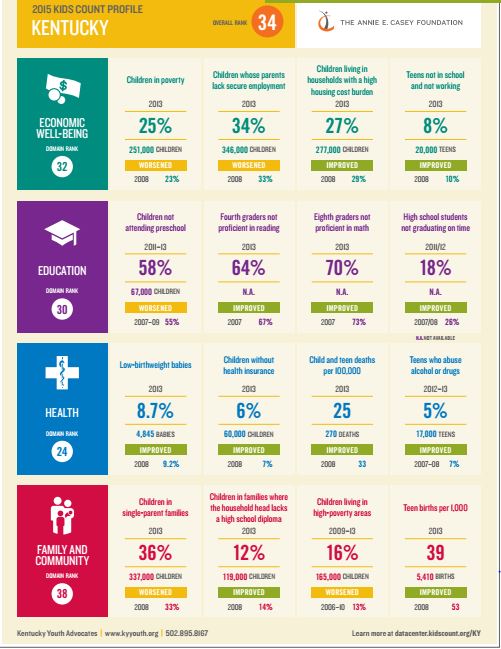
Kentucky ranks 34th in the nation for overall child well-being, showing the most improvement in health and a significant decrease in teen births in recent years, according to the Kids Count report, released by the Annie E. Casey Foundation and Kentucky Youth Advocates.

The annual report offers a state-by-state assessment that measures 16 indicators to determine the overall well-being of children. The latest data is for 2013, and is compared with data from five or so years earlier.

The report focuses on four major domains: economic security, education, health, and family and community strength. (Click on image for larger version)

Kentucky ranked the highest in health, climbing to 24th from 31st in 2013 and 28th in 2014. Its economic security (32nd), education (30th) and family and community strength (38th) rankings remained similar to the past three years.

“Health may be a political hot potato for many reasons," Dr. Terry Brooks, executive director of Kentucky Youth Advocates, said in a press release. "However, when it comes to kids, the results are clear. Our health ranking stands as a beacon for tangible results for Kentucky kids.”

Kentucky's improved health ranking reflects a 24 percent decrease in child and teen mortality rate, as well as improvements in the percentage of low-birthweight babies (8.7 percent), teens using alcohol or drugs (5 percent), and children without health insurance (6 percent).

"With recent increases in health insurance access through Kynect and Medicaid expansion, we expect to see even more children with coverage and able to receive health care," Susan Zepeda, president and CEO of Foundation for a Healthy Kentucky, said in the release.

A significant area of improvement was found in the family and community domains, where Kentucky showed a 26 percent decrease in teen births between 2008 and 2013.

Though still one of the highest in the nation, Kentucky's teen birth rate decreased to 39 births per 1,000 teen girls ages 15 to 19 in 2013, compared to 53 births per 1,000 teens in 2008. The national average is 26 births per 1000 teens, which is at a historic low level.

"Teenage childbearing can have long-term negative effects for both the mother and newborn," says the report. "Teens are at higher risk of bearing low-birthweight and pre-term babies. And, their babies are far more likely to be born into families with limited educational and economic resources, which function as barriers to future success."

However, overall in this domain Kentucky got its lowest ranking, showing little change from previous years: 36 percent of Kentucky's children live in single-parent families; 12 percent of Kentucky's children live in families where the household head lacks a high-school diploma; and 16 percent of Kentucky's children live in a high-poverty area, defined as neighborhoods where more than 30 percent of people live in poverty.

The report also looks at education. It shows that Kentucky had a 31 percent decrease in the number of high school students not graduating on time, from 26 percent to 18 percent, but most of its fourth graders (64 percent) can't read at a national proficiency level, and most of its eighth graders (70 percent) are not proficient in math. Those numbers haven't moved much since 2007, when they were at 67 percent and 73 percent respectively.

"Children who reach fourth grade without being able to read proficiently are more likely to drop out of high school, reducing their earning potential and chances for success," says the report, noting that "Students who take advanced math and science courses are more likely to graduate from high school, attend and complete college and earn higher incomes."

Added to this, the percentage of children not attending preschool has increased to 58 percent from 55 percent. "We have to ensure strong early learning is a reality for every youngster," Tom Shelton, executive director of the Kentucky Association of School Superintendents, said in the release. "That means creating an environment in which children learn in every child care center and in every pre-school across Kentucky."

Kentucky improved to 32nd from 35th last year in the economic well-being domain, but that is little to brag about with one in four of Kentucky's children found to be living in poverty. Measures in this domain also found that 34 percent of Kentucky's children live with parents that don't have secure employment; 27 percent live in households with a high housing cost burden; and 8 percent of Kentucky's teens are not in school and are not working.

"Here’s the bottom line from this year’s report: If we as a commonwealth want to get serious about improving the lives of our children, there is one overriding and persistent challenge: poverty," Brooks said. "You can’t talk education or health without talking family economics. And we can begin to tackle persistent poverty only when economic well-being policy stops being political and starts being about the common good."

The release suggested broad solutions to improve poverty, including advancing micro-enterprise opportunities, ensuring access to responsible lending and financial services, a more integrated approach to benefits access, expanded child care assistance, and family-focused tax reforms.

Sunday, July 19, 2015

Health-care jobs fewer than projected, but health secretary says Medicaid expansion is still on track to pay for itself through 2020

By Al Cross
Kentucky Health News

FRANKFORT, Ky. – The basic financial premise of Kentucky's expansion of Medicaid under federal health reform is that the addition of so many people and money to the health-care system will create enough jobs to generate state tax revenue sufficient to cover the state's share of the expansion.

However, the jobs numbers have been falling short of projections that support the premise, raising questions for the governor's race and the state budget, which will need money for the expansion in 2017. State officials point to a recent uptick and say the expansion is still on track to pay for itself through 2020.

The federal government is paying the entire cost of the expansion for the first three years, but the state will have to pay 5 percent in 2017, 6 percent in 2018, 7 percent in 2019 and 10 percent (the limit set by the law) in 2020.

The Urban Studies Institute at the University of Louisville estimated in a February 2015 report for the state by Deloitte Consulting that in 2014, the first year of the expanded Medicaid program, that the expansion had created more than 12,000 jobs, including 5,400 in health care.

But the latest adjusted data from the federal Bureau of Labor Statistics show that from December 2013 to December 2014, Kentucky employment in health care and social assistance rose by only 3,100 – from 230,100 to 233,200. The number of health-care jobs is the main driver of other types of jobs related to the expansion.
Charts by Dr. Paul Coomes, University of Louisville
This year, monthly BLS figures show that the growth in health-care jobs has accelerated, to 234,900 in April and 235,700 in May (a preliminary estimate). Those data and other factors help state Health Secretary Audrey Tayse Haynes argue that the expansion is still on track to pay for itself through 2020, the next-to-last year of Deloitte's projections.

"You can't deny that overall employment is up," Haynes said in an interview. She also cited state figures for June, which said Kentucky jobs in health care and education rose by 3,100 in June, for a total gain of 11,900 this year in those combined sectors, broader than the sector defined by BLS.

The one-month gain for health care and social assistance was 2,700, and the gain for the first half of the year was 9,500, or 4.1 percent, said Manoj Shanker, an economist for the state Office of Employment and Training.

"The job growth has been fueled partly by the introduction of over $2 billion in expanded Medicaid Services beginning in 2014," Shanker said, calling it "manna from heaven."

However, retired U of L economist Paul Coomes isn't convinced there is a solid trend. He argues, "It is dangerous to look just a month to month changes. The annual data tell a more comprehensive story."

Coomes points to BLS data showing that Kentucky averaged 230,300 health-care and social-assistance jobs in 2014, down from an average of 231,000 in 2013. "You can see there has been no job growth the last two years," he said.

Haynes argues otherwise. "It doesn't say any of that at all," because of the latest state jobs numbers, she said. "You cannot drop over $2 billion in any economy, but in particular Kentucky's economy, and not see job growth."

Haynes acknowledged that monthly jobs numbers are subject to revision, but said she is confident because the state has now measured jobs for a year and a half of Medicaid expansion. Through 2020, the expansion is estimated to create 40,000 jobs, less than half in health care. Haynes said the estimates should be refreshed each year, perhaps by different researchers.

BLS figures provided by Coomes show that a loss of jobs at Kentucky hospitals is largely responsible for the shortfall in expected health-care jobs.

Haynes said that is a national phenomenon, as hospitals adjust to other features of the Patient Protection and Affordable Care Act. She said services that were once being done only in hospitals are now being done elsewhere, and hospitals now have their Medicare payments reduced if patients are readmitted within 30 days. Kentucky has one of the nation's highest readmission rates.

"Just because there is a specific industry or institution within the overall sector that has had an overall net loss of jobs does not mean that the overall sector has not improved," Haynes said. She said the state could have also applied a readmission penalty to Medicaid patients, but did not.

Kentucky hospitals have said they have been forced to lay off employees because of problems with the managed-care organizations, mostly insurance-company subsidiaries, that oversee care of Medicaid patients.

Hospitals complain that they lose money on each Medicare or Medicaid patient because the government programs reimburse them at less than cost. Haynes and her staff counter that the hospitals no longer have to write off millions of dollars in bad debts because relatively few people now lack health insurance.

"In addition to getting paid lots more by Medicaid, they've also seen their uncompensated care plummet," said Robin Rhea, an economist in the Cabinet for Health and Family Services, which Haynes runs.

Louisville businessman Matt Bevin, the Republican nominee for governor, has said that he would eliminate the Medicaid expansion because the state can't afford it. Attorney General Jack Conway, the Democratic nominee, said last month that the state will have to find a way to pay for the expansion, and for Bevin to “say you’re going to kick a half a million people off of health insurance based on what we may or may not be able to afford in 2021 is irresponsible.”

Friday, July 17, 2015

Beshear, Rogers to announce loan-repayment program for new dentists who agree to set up practices in Eastern Kentucky

Rogers and Beshear at SOAR Strategy Summit in May
Gov. Steve Beshear and 5th District U.S. Rep. Hal Rogers plan to announce an "initiative promoting sustained oral health and well-being in Eastern Kentucky," a media advisory from their offices announced Friday. The oral health of the region is among the worst in the nation.

The initiative will be a program to help dental students who agree to practice in Eastern Kentucky to repay their student loans at the University of Kentucky and the University of Louisville. UK President Eli Capilouto, U of L School of Dentistry Dean John Sauk, and Dr. Raynor Mullins, project leader of the Appalachian Rural Dental Education Project of the UK Center for Oral Health., will join Rogers, Beshear and state Health and Family Services Secretary Audrey Tayse Haynes at the announcement.

The announcement is scheduled for 1 p.m. Monday, July 20 at the offices of Jackson Energy Cooperative, 103 Mildred Rd. in McKee. The announcement will be followed by a meeting of the executive committee of Shaping Our Appalachian Region, the Rogers-Beshear initiative to help the economy of Eastern Kentucky.

Huge infographic offers facts about Kentucky's oral health

The Kentucky Oral Health Coalition, a project of Kentucky Youth Advocates, recently released an infographic "Word of Mouth: The Importance of Oral Health in Kentucky" to offer some general awareness about dental health. It displays fun facts about oral health as well as details about the consequences of poor oral hygiene and barriers Kentuckians face related to oral health, such as cost and lack of access. View it here (sorry, this is as large as we can reproduce it), or download the full-size PDF version to share.