Tuesday, August 23, 2016

Several Kentucky schools start school year with new programs to get their students moving, to improve both learning and health

As the new school year begins, several Kentucky schools are working to increase student movement, with one elementary school in Louisville investing in a programs to increase student movement in the classroom to improve learning and four in Western Kentucky increasing movement outside the classroom to improve health.

Photo by Pete Ruiz, WDRB
Students in seven Wilder Elementary classrooms in Louisville came back to classrooms fitted with equipment to promote movement while learning, like standing desks and devices that allow children to move their feet while working, Antoinette Konz and Rachel Collier report for WDRB.

The "Let's Move Wilder!" project, led by the school's Parent Teacher Association, is part of a privately funded effort paid for by parents, local businesses, organizations and grants, WDRB reports.

"Research shows with movement, kids are less likely to become distracted. Plus, it is easier to retain information and switch between tasks," Konz and Collier write.

Sarah Rosenbalm, who has seen the equipment work for her own child, told WDRB, "It just helps him pay attention a little more, instead of playing with pencils, when he could kind of wiggle his feet, he stopped playing with pencils and actually started writing."

Students take turns with the limited equipment and are being asked what they like and what they don't, toward a long-term goal of equipping the school with as much equipment as it needs.

“Engaged students are successful students, and we are always seeking new and innovative ways to connect our kids with learning,” Wilder Elementary Principal Bill Perkins told WDRB.

He said a Kaiser Family Foundation study that found students spend more than four hours a day sitting at school and an additional seven hours sitting outside class time prompted the program.

Movement to improve health

Baptist Health Madisonville
provided $66,000 in grants to four Kentucky schools last spring to launch "Project Fit America" this fall, a fitness program aimed at reducing childhood obesity.

The State of Obesity report found that almost 20 percent of Kentucky's 10- to 17-year olds are obese and 15.5 percent of its 2- to 4-year-olds from low-income families are obese, and that these rates have remained consistent for 10- to 17-year olds since 2004 and for 2- to 4-year-olds since 2003.

Recipients of the grants include Whitesville Elementary in Daviess County, Freedom Elementary and Pembroke Elementary in Christian County and Sebree Elementary in Webster County. Each will receive indoor and outdoor fitness equipment, teacher training and curriculum materials.

Janet Farrell, Whitesville Elementary
PE teacher and Kristy Quinn, Baptist
Health marketing director
(Baptist Health Madisonville photo)
Whitesville Elementary, which received $16,350 in grant money, unveiled its new equipment Aug. 19, Keith Lawrence reports for the Messenger-Inquirer in Owensboro. (This story is behind a paywall.)

Kristy Quinn, the hospital's marketing director, told Lawrence that the equipment "will provide a whole new approach to health and wellness for these students. The curriculum is exciting and interactive."

This brings to 10 the total number of schools to receive Project Fit America grants from Baptist Health Madisonville.

“We know childhood obesity can lead to health problems such as high blood pressure and Type 2 diabetes,” Robert Ramey, Baptist Health Madisonville president, said in the news release. “We also know children learn better when they are healthy. Baptist Health and Project Fit America are perfect partners for helping our schools improve our students’ health and thereby improve their academic achievement.”

Baptist Health has partnered with Project Fit America since 2007, helping to implement 33 total projects implemented across the state, according to the Project Fit America website.

Nursing-home rating tool has added 5 new quality measures; here are tips for choosing a facility, and Kentucky's worst-rated

By Melissa Patrick
Kentucky Health News

Choosing a nursing home is a daunting task and often done in the middle of a crisis, but it doesn't have to be if you do your research.

One tool to help you choose a facility is "Nursing Home Compare." This online tool provides information on how well Medicare- and Medicaid-certified nursing homes provide care through individual star ratings in three sub-categories: health inspections, staffing and quality measures, which are then combined to calculate and overall star rating.

The Centers for Medicare and Medicaid Services recently added five new quality measures to the tool, all of which will gradually be factored into its five-star quality rating calculations, says a CMS news release. A five-star rating is considered best.

Four of the new measures are tied to the outcomes of short-stay residents, which reflect care provided in a nursing home for less than 100 days. They include the percentages of short-term residents who are successfully discharged; experience an outpatient emergency department visit; are re-hospitalized; and make improvements in function. The fifth measure looks at how many long-stay residents experienced a decrease in their ability to move independently.

“With this update, star ratings will provide an even more accurate reflection of the services that nursing homes provide,” Dr. Patrick Conway, the CMS' deputy administrator and chief medical officer, told Elizabeth Whitman of Modern Healthcare.

The new measures are being phased in slowly, starting with half of their full value in July, and will be fully counted by January 2017.

Nursing Home Compare measures have historically been based on self-reported data from nursing homes, but now three of the five new measures are based on Medicare claims data submitted by hospitals. The ratings are also affected by annual state inspections and staffing levels.

Critics of Nursing Home Compare say the star ratings are not reliable because most of the information used to calculate them is based on self-reported data and is not verified by the government, and that the annual health inspections are the only findings in the report that comes from independent reviewers.

Another tool at your disposal is "Nursing Home Inspect." This user-friendly online tool, offered by ProPublica, a nonprofit investigative journalism enterprise, allows consumers to search and analyze the details of recent nursing home inspections using keywords and by sorting results based on the severity of the violation and by state. Data come from CMS.

The Nursing Home Inspect website says 88 of the 289 nursing homes in Kentucky have serious deficiencies, and that they collectively owe $12 million in penalties and 43 have payment suspensions.

It also reports that three Kentucky nursing homes were in the top 20 nationwide for having the most fines, including: Somerwoods Nursing and Rehabilitation Center in Somerset ( $564,000); Brownsboro Hills Health Care and Rehabilitation Center in Louisville ($522,000); and Golden Livingcenter-Camelot in Louisville ($508,000).

It also found that five of Kentucky's nursing homes were in the top 20 nationwide for homes with the most serious deficiencies, including: Signature Healthcare of Pikeville (18); Edmonson Center in Brownsville (14); Fountain Circle Care and Rehabilitation Center in Winchester (14); Barkley Center in Paducah (14); and Bluegrass Care and Rehabilitation Center in Lexington (12).

In addiion, US News & World Report offers 10 tips to finding the right nursing home and reminds its readers that the aforementioned rating tools are just a place to start. Here are the tips:
  • Take a "just in case" tour before your family member actually needs the facility;
  • Sit in on a meal service while you are there; 
  • Listen to how the staff talks to and about residents;
  • Observe how residents pass the time, make sure there are choices.
  • Ask about resident choices, including flexibility in personal schedules and room personalization options; 
  • Ask about who is in charge, ask about management turnover and if there is a medical director on staff and on site;
  • Check references and ratings, suggesting that you use the rating systems as a starting point only;
  • Consider specialty care options, depending on your loved ones needs;
  • Find out what happens if your loved one needs more care; and 
  • Talk about payment options.


Pharmacy benefit managers secretly decide which prescription drugs are covered or not, critics call for more transparency

lexisnexis.com
Every year, pharmacy benefit managers in the United States decide which prescription drugs are excluded from health insurance plans, and this list is determined by a secret board of doctors and pharmacists, Samantha Liss reports for the St. Louis Post-Dispatch.

Pharmacy benefit managers process prescriptions, manage billing, decide which drugs will be covered (or not) and negotiate pricing for health insurance companies and corporations.

Executives at Express Scripts, the nation's largest pharmacy benefit manager, told Liss that the secrecy is necessary to "shield experts from the 'tremendous' influences of lobbyists," she writes.

Express Scripts provides prescriptions to about 85 million Americans each year through its employer-based prescription drug coverage, Liss reports.

To be included on Express Scripts' national list of covered drugs, known as a formulary, "The drugs are reviewed by three different committees during a four-step process," Liss reports, with the national pharmacy and therapeutics committee making the final recommendations.

The 16-member P&T committee is "independent and objective," Express Scripts says. It is comprised almost entirely of physicians who represent a broad rage of specialties and each member serves a three-year term, Liss reports.

The committee is self-perpetuating. Members are elected by current members, who are required to disclose their financial relationship with drug and device makers annually as well as their stock ownership and research-grant awards.

Dr. Steve Miller, Express Scripts’ chief medical officer, told Liss it was impossible to find experts who hadn’t received money from the industry.

“If you’re going to have some of the best experts, they’re going to be asked to speak and they’re going to be asked to be in (clinical) trials,” he said. “If they have no conflict at all, are they truly the experts in the field that people are turning to?”

Liss explains that "The P&T committee does not review any pricing information or potential discounts Express Scripts would receive. . . . After reviewing relevant scientific information on particular drugs and a review of its competitors that treat the same issues, the committee either recommends to include or exclude the drug from the annual list." Drugs can also be recommended as an optional choice.

After the committee makes its recommendations, another committee, comprised of Express Scripts employees, analyzes the recommended drugs compared to the optional drugs, based on pricing. These recommendations then go back to the P&T committee for final approval, Liss reports.

Critics call for more transparency

Express Scripts, like its rivals, does not disclose the names of its committee members or any actual or potential conflicts of interest they may have, Liss notes.

Critics question why this secrecy is allowed when the rest of the industry is required to publicly disclose its financial relationships, Liss reports: "For example, drugmakers and device makers must report how much they pay doctors for perks such as food and beverage, travel and speaking engagements."

“All of us are subject to reporting on what money we receive. These folks should do the same,” Dr. Adrian Di Bisceglie, co-director of St. Louis University Liver Center, told Liss.

It's big money. "In 2015, about $2.6 billion in general payments were funneled to doctors and teaching hospitals across the United States, according to data from the Centers for Medicare and Medicaid Services. And another $4.8 billion in payments were made for research and ownership or investment interests," Liss reports.

Others told Liss that such secrecy is not common in other parts of the world.

Steve Morgan, professor of health policy at the University of British Columbia and an expert on international pharmaceutical policy, said other countries name the members their expert panels, and “I can’t think of an exception to the rule. . . . You know who they are, you know about their conflict of interest.”

However, Morgan also told Liss that some countries allow the committee to cast their final votes anonymously. “The professionals who are on these committees are put under enormous pressure – political pressure, lobbying pressure from patient groups and industry,” Morgan said.

Why does it matter?

Pharmacy benefit managers say that having a national preferred formulary "curbs the rising costs of prescription drugs" and that "the threat of being excluded pressures drugmakers to lower their prices," Liss writes.

Express Scripts recently released its 2017 list of preferred drugs, which excludes 85 medications.

That means if you are on one of these excluded drugs, you will have to switch medications. Express Scripts told Liss this would affect about 0.12 percent of its clients, or about 30,000 people.

Patients can also appeal.

“In the instances when a patient has a rare medical need that requires that she be treated with a drug that has been excluded, we have an exception process in place to ensure the patient can have that drug covered,” Express Scripts spokesman David Whitrap told Liss.

For drug manufacturers, being excluded from Express Scripts’ list of preferred drugs has financial consequences. “Usually the stock drops; usually investors react negatively toward that news,” Vishnu Lekraj, an analyst covering Express Scripts for Morningstar, told Liss.

For example, "shares of Gilead Sciences Inc. plummeted 14 percent on Dec. 22, 2014, when Express Scripts moved to exclude the drugmaker’s new, high-cost hepatitis C drug (Sovaldi) in favor of a different version from Gilead’s rival (Viekira Pak made by AbbVie)," Liss writes.

Executives told Liss that this decision "saved the health care system $4 billion in 2015."

Monday, August 22, 2016

Drug prices keep rising, with no end in sight

By Trudy Lieberman
Rural Health News Service

Recently a tweet from Lauren Sausser, a fine health reporter I know in South Carolina, caught my eye. “Crazy drug prices became personal. My dad will start Keytruda regimen on Friday, $15,000 per infusion, once every three weeks indefinitely.” The high cost of pharmaceuticals had hit home!

Her 61-year-old father, Jim McCallister, who lives in Spartanburg, S.C., had been diagnosed with a melanoma discovered during a routine skin exam a few weeks earlier. It had spread to his lungs. Doctors recommended the drug, which uses the body’s immune system to attack cancer cells and has showed promise in treating aggressive melanomas.

McCallister’s employer-provided insurance is paying for most of his treatment, and the family is looking into Merck’s co-pay program. In the meantime, McCallister faces several thousand dollars of out-of-pocket costs.

McCallister may be lucky cost-wise. But the fact remains: Somebody is paying for the high cost of Keytruda and other new drugs coming on the market. Sausser said her dad asked if insurance would cover the drug. “The doctor told him they would find some way.”

That’s the nub of the dilemma. For many like McCallister, there may be help, often from the drug companies themselves in the form of patient assistance plans. Remember drug company AstraZeneca’s ads for some of its costly drugs: “AstraZeneca may be able to help”? Sometimes state or local government programs, private charities, nonprofit agencies, or coupon programs help patients pay for their drugs. Patients who can’t get help from any of those sources often go without.

None of the assistance programs, however, attack the underlying prices for the drugs, which pharmaceutical makers can set according to what the market will bear. They can pretty much do whatever they want with little push back from those who end up paying the bills – governments, insurers and patients. The U.S. has no cost controls, and government doesn’t negotiate drug prices the way many other countries do.

So the price of commonly prescribed drugs like the EpiPen, a shot that stops life-threatening allergic reactions, has risen to more than $600 for two pens. In 2009 two pens cost $100. The price for Abilify, an antipsychotic, has risen 113 percent between 2007 and 2014, and the cholesterol-lowering drug Crestor has climbed 103 percent over the same time period, according to The Campaign for Sustainable Rx Pricing, a group of employers, insurers, and unions that are trying to raise public awareness of high drug prices.

That helps explain why Medicare recently reported its spending on prescription drugs increased more than 17 percent in 2014 even though the number of claims from the program’s 38 million beneficiaries rose only 3 percent.

Medicare’s prescription drug law was never meant to pay all a person’s drug expenses. This year once a beneficiary and her drug plan have paid $3,310 for medicines, she reaches the coverage gap where she must pay the cost of most of her drugs. If she spends, out of her own pocket, another $4,850 for drugs this calendar year, she qualifies for catastrophic coverage and pays only 5 percent of all her remaining drugs for the year.

The trouble is that with prices so high, it’s easy to end up in the coverage gap paying out-of-pocket. Even protection offered by catastrophic coverage may not be enough. That’s especially true for people taking high-priced specialty drugs.

In 2013, about 3 million people were in this predicament. “Not a lot of people pay above the threshold, but those who do can pay through the nose,” says Tricia Neuman, senior vice president of the Kaiser Family Foundation.

Escalating drug prices affect everyone – even those not taking expensive drugs or not on Medicare. High drug prices affect all insurance premiums sooner or later.

Not long ago I spotted a letter to the editor in USA Today from Heather Block, age 53, who has Stage 4 breast cancer. She was calling for patients to organize and build a network to help craft solutions for the problem of skyrocketing drug prices.

I talked to Block about this. Her zeal and interest in organizing patients reminded me of the early days of the consumer movement in the 1960s when citizens organized to pass legislation to make the marketplace safer and more fair. With drugs, Block says, it’s hard to organize people because of drug assistance programs that take the sting out of prices and make patients less willing to work against the companies, the presence of disease advocacy groups funded by the pharmaceutical industry, and a general reluctance to speak up for fear of jeopardizing their own health and survival.

She’s asking for consumers to share their stories at this email: h3ath3rblock@gmail.com.

What problems are you having paying for prescription drugs? Write to Trudy at trudy.lieberman@gmail.com.

Report finds foundation initiative to help seven Ky. communities grow healthy children is making progress, with goal of replication

The seven local coalitions that got Foundation for a Healthy Kentucky grants to keep children from developing chronic diseases as they grow into adults are making "marked progress" toward their goals, according to a report prepared for the foundation.

The five-year, $3 million initiative, "Investing in Kentucky's Future," is designed to reduce the risk that Kentucky children will develop diseases all too common to the state, such as diabetes, heart disease and cancer. The community coalitions were charged with looking at the health needs of local children and developing an intervention plan to address their most pressing health issues.

The grantees include: Partnership for a Healthy McLean County, Purchase Area Connections for Health, Fitness for Life Around Grant County, Breathitt County Health Planning Council for Children, Perry County Wellness Coalition, Clinton County Healthy Hometown Coalition, all of which focus on childhood obesity. The Bounce Coalition in Jefferson County focuses on adverse childhood experiences.

"The coalitions are reporting that the grants, research, relationship-building support and other assistance we've provided have helped them tackle the health needs of their communities' children in new and bigger ways," Susan Zepeda, CEO of the foundation, said in a news release.

A list of their accomplishments include: 17 policy changes in their schools and communities, including shared-use agreements that allow school programs and fitness facilities to be used by the community after hours, healthier foods at park concessions, and "complete streets" initiatives, which aim to make streets more accessible to walking and biking; several improvements to community and school fitness facilities; and school-based nutrition curricula and physical activities.

"For many of the coalitions, rural and urban, their work under the 'Investing in Kentucky's Future' initiative is their first community-wide effort to address the issue they've identified," Zepeda said. "Our aim is to support these coalitions in expanding their membership, formalizing their structure, gain momentum, and strengthening their partnerships with schools to create successful programs that can be replicated across the commonwealth."

Click here to see the full report, prepared by the Center for Community Health and Evaluation.

Sunday, August 21, 2016

Fewer than 1/3 of Ky. schools have comprehensive tobacco-free policies, covering fewer than 1/2 of students; 85% of adults favor

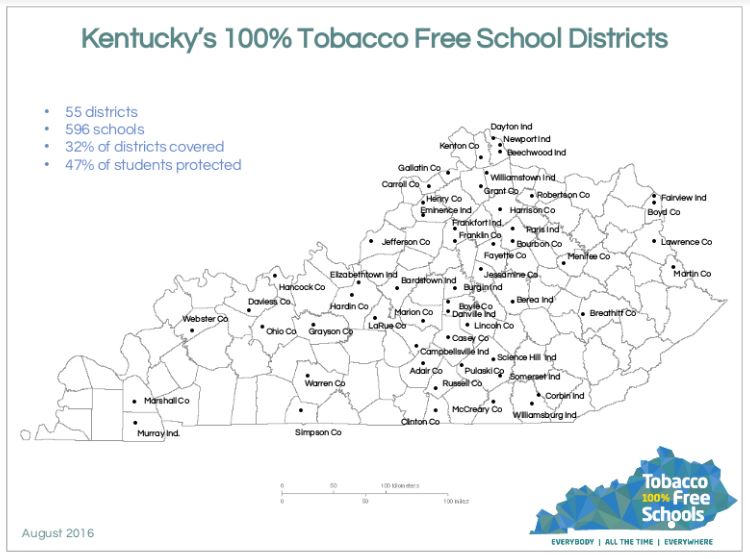
Though an overwhelming majority of Kentucky adults say they want schools to be tobacco-free, fewer than half of the state's students and less than one-third of its school districts are covered by such local policies.

Among Kentucky's 173 school districts, 55, or 32 percent, have 100 percent tobacco-free school policies, protecting 47 percent of the state's children.

This map has been updated to reflect Clinton and Menifee counties
The latest Kentucky Health Issues Poll for the Foundation for a Healthy Kentucky last year found that 85 percent of Kentucky adults want schools to be tobacco-free, with large majority support from smokers, former smokers, non-smokers and across party lines. At the same time, 26.5 percent of Kentuckians smoke, second only to West Virginia.

Campbellsville Independent Schools became the latest district to go tobacco-free, after a push from students.

Campbellsville's policy went into effect at the beginning of this school year and prohibits students, staff and visitors from using any tobacco products or electronic cigarette products on school property, including school-owned vehicles, school-sponsored trips and activities, and sporting events.

The policy was encouraged by several middle-school students who presented information in May about the school district becoming tobacco-free, the Central Kentucky News-Journal reports.

The national 2015 Youth Risk Behavior Survey found that 17 percent of Kentucky's high-school students smoked at least one cigarette during the 30 days before the survey and 24 percent of them use electronic cigarettes during that same time frame.

"Strictly enforced tobacco-free school policies can reduce youth smoking by 30 percent," says a presentation on the "100% Tobacco Free Schools" website.

The Kentucky Tobacco Prevention and Cessation Program, which works closely with the Department for Public Health and the Department of Education, is a resource for Kentucky schools that are considering becoming 100 percent tobacco-free. Click here for more information.

"Local health departments and other community partners can apply for grant funding to educate the community on the benefits of 100 percent tobacco free school policies, as well as funding for implementation and signage when policies go into effect," Elizabeth Anderson-Hoagland, the youth policy analyst with the Kentucky Tobacco Prevention and Cessation Program, said in an e-mail.

The Kentucky Tobacco Prevention and Cessation Program will also be releasing two promotional videos, with the assistance of the Warren County and Russell County school districts, to help communicate about the successful 100 percent tobacco free school policies in the state and about the process of passing such policies, Anderson-Hoagland said.

Ellen Hahn, director of the Bridging Research Efforts and Advocacy Toward Healthy Environments (BREATHE) initiative at the University of Kentucky College of Nursing, said in an interview that policy change is a more effective way to teach our children about the harms of tobacco than teaching about it in the classroom.

"We are in a hotbed of tobacco use and so it is really a great opportunity for schools to change the generations of tobacco users in our state and policy can do that," Hahn said. "I would highly and strongly encourage schools and parents and decision makers at the school level to take this step because it makes a huge difference."

Former director of UK medical foundation says it's 'gone beyond its scope' but UK officials say it's helped them do much good

A foundation that the University of Kentucky created to supplement pay for physicians has "gone beyond its scope," its former director told the Lexington Herald-Leader for a long story examining the workings of the Kentucky Medical Services Foundation.

Headlined "How the secretive arm of UK HealthCare spends $200 million a year," the story by Linda Blackford noted in the second paragraph, "Although its board is made up almost entirely of UK doctors, UK contends the foundation is a separate, private entity that does not have to make its records available for public inspection." That issue is in court.

The university did give the Herald-Leader some records, and those documents and tax and court filings showed that UK officials "used the foundation’s coffers to pay for a private airplane, construction of a daycare center, and millions of dollars in contracts with consultants and lawyers that aren’t subject to state procurement rules and don’t have to go through a bidding process," Blackford reports. "It even pays for the Keeneland membership of UK Executive Vice President for Health Affairs Michael Karpf, and supports aging foxhounds at the Iroquois Hunt Club."

The foundation's former director, Darrell Griffith, "cited several examples of the foundation's creeping mission in an affadavit filed in a lawsuit against UK by a former surgeon," Blackford writes. "For example, Griffith questioned the foundation’s decision to hire consultants to help a failing business at UK’s Coldstream Research Park, rent a private airplane for top-level UK HealthCare officials, become a landlord, and build a daycare on UK property and subsidize its day-to-day operations." He said it was designed to operate outside control of UK trustees and state procurement law.

UK officials say the foundation has allowed them to do such things as add Good Samaritan Hospital to UK HealthCare, move several UK HealthCare functions to a remodeled department store in the old Turfland Mall and subsidize day care for children of UK employees.

Nonprofit groups question Bevin's plan to require 'volunteer' work from able-bodied adults who aren't primary caregivers

Gov. Matt Bevin's plan to require volunteer work from unemployed, able-bodied Medicaid members isn't sitting well with the Kentucky Nonprofit Network, which represents nearly 600 of the state’s nonprofit groups, because it would mean tens of thousands of people would "need training, supervision and—in some instances—criminal-background checks," John Cheves reports for the Lexington Herald-Leader.

As part of the state's request for a federal waiver to tighten eligibility standards for the 440,000 Kentuckians covered by the 2014 expansion of Medicaid, Bevin wants to require "community engagement" for able-bodied adults who aren't primary caregivers, requiring them to work, search for a job, be enrolled in classes or volunteer in their communities, eventually for 20 hours a week. "The state estimates these requirements could affect roughly 215,000 people," many of whom live in rural areas, some with few volunteer opportunities, Cheves reports.

That's one thing Danielle Clore, executive director of the Kentucky Nonprofit Network,  told Bevin's office when it asked the group to support his proposal. In her letter, she included comments from her members:
"The bottom line is this will cost nonprofits money – money and resources we don’t have to spare."
"It takes professionals to effectively manage volunteers. For the experience to be valuable for both the agency and the individual, volunteer efforts have to be managed. Is it worth the limited and precious resources of a nonprofit to manage a volunteer that is there because 'they have to be,' not because they want to be? Nonprofit employees are spread so thin as it is and I feel like a volunteer requirement for anyone not truly committed to the mission of the agency isn't an effective use of anyone's time."
"I do not typically take people who are 'required' to volunteer, because they don't make good volunteers. Also, 20 hours is A LOT OF TIME. We don't allow people to volunteer that many hours because at that point they could be considered a part time employee, and you have potential legal issues to consider."
In an interview, Clore said "members of her organization have limited budgets," Cheves reports. "Many cannot afford to manage a much larger staff. Some do not have enough space or work for so many additional people, Clore said. In sparsely populated rural counties, only a handful of nonprofit groups operate, she said. And some groups that work with children or the elderly require volunteers to pass a criminal-background check, which costs money and raises questions for Medicaid recipients with legal problems in their past, Clore said."

The issue arose at the Aug. 17 meeting of the legislature's Medicaid Oversight Committee, Rep. Joni Jenkins, D-Louisville, asked administration officials if they had a plan for people in communities with few jobs or volunteer opportunities.

Meier said the waiver had been drafted to allow the administration to make a special request to exempt those counties, and that it would build partnerships with non-profits, churches and local governments to find ways for people to fulfill the requirement. He said people could pick up trash or work in places that did not require background checks, like soup kitchens or Habitat for Humanity.

"We are going to keep it pretty open," Meier said. "We don't want to really mandate where they go we just want them to be engaged in the community."

Emily Beauregard, executive director of Kentucky Voices for Health, told Kentucky Health News in an interview, "The majority of the people who are not working in the Medicaid expansion population are caregivers and students. . . . I think we better need to understand that population and what their needs are."

Beauregard added, "We need to provide them with the support services that they need, but forcing people to volunteer in order to get health care doesn't make anybody healthier. We know this. There are data to suggest that. In fact, sometimes these stringent requirements put people in a position where they are unable to get care and then they get sick, and they are unable to work."

Meier told Cheves that some Kentucky school districts require students to do volunteer work to graduate from high school, and in some counties this year work or volunteer requirements for people who get food stamps.

Information for this story was also gathered by Melissa Patrick of Kentucky Health News.

Saturday, August 20, 2016

Woodford County explores a syringe exchange; county attorney says local heroin problem is 'only going to get worse'

By Melissa Patrick
Kentucky Health News

VERSAILLES -- The Woodford County Board of Health is educating itself about syringe-exchange programs, with plans to begin the process of creating a plan for one in the county.

"We do have a horrible, insidious heroin problem," County Attorney Alan George said at the board's Aug. 18 meeting. "We are no different than any other county, but we are no worse. . . . It's only going to get worse."

George encouraged the board to take some time to learn more about how syringe exchanges work in other counties and then, if they wanted to proceed, to format a detailed plan to present to the Versailles City Council and and the Woodford County Fiscal Court, because they too must approve the program.

Syringe exchanges were authorized by the state's 2015 anti-heroin law, in an effort to thwart the spread of HIV and hepatitis C, which are commonly spread by the sharing of needles among intravenous drug users.

So far, 15 counties have approved syringe exchanges, according to a presentation by Greg Lee, who serves as the state Department of Public Health's point person for syringe exchanges.

Lee told the board that such programs have been around for 30 years, and are proven effective to discourage the spread of HIV and hepatitis C. Kentucky leads the nation in percentage of the population infected with acute hepatitis C.

"One of the things we know works is syringe exchange programs," Lee said. "Year after year studies show that these programs do not increase drug use, they actually decrease crime in the area, they increase community safety, they reduce spread of infection, increase first-responder safety and connect people who use drugs to drug treatment."

One Kentuckian is infected with HIV and two are infected with hepatitis C every day, mostly from intravenous drug use, Lee said.

Lee also noted several other benefits of syringe exchanges, including: Police departments in communities with the programs have seen a 66 percent drop in needle sticks; people in the programs are four times as likely to get into drug treatment; and for every dollar spent on these programs, seven dollars are saved in treatment costs.

Several Woodford County health board members asked about funding. Lee said syringe exchanges are "not an expensive program," because of the low cost of needles and because they are typically only open one day a week for a few hours.

Lee said some counties fund the programs through the state's Agency for Substance Abuse Policy program and that Operation UNITE had also helped some Appalachian counties fund their programs. He noted that while federal funds can now be used, so far no federal funding has been specifically allocated.

George wanted to know how other counties made sure participants in the program were from that county, noting that health departments are meant to only serve the people in that given county.

Lee said most programs don't ask people where they live. "One of the things that you want to be sure of is to not have any barriers to scare people from coming in to these programs," he said.

George also asked about whether programs were required to have a one-for-one exchange and if counseling was required.

Lee said that initially participants are typically given as many needles as they need to get through the week, but that as they become regular participants, the exchange rate becomes closer to one-for-one.

As for counseling and educational materials, Lee said that that is up to each individual needle exchange, but also said that the counseling aspect of the program works best after a level of trust has been developed between the staff and the participant.

Lee cautioned the board about the importance of involving local law enforcement.

"These programs will not work if you don't have local law enforcement behind it. Even though you don't need their official approval, you certainly need their understanding of what we are doing," he said.

Judge-Executive John Coyle, the board chair, said he supported a syringe exchange in Woodford County because the "health benefits outweigh any of the other concerns." And when asked if the local law enforcement would be on board, he said, "I don't think they will be opposed to it." Coyle is a former sheriff.

The next Woodford County Board of Health meeting will be Nov. 17, with plans to have another guest speaker on the topic.

Thursday, August 18, 2016

Philosophical divide evident at Medicaid oversight meeting; Bevin officials say revised plan will be sent to feds 'shortly'

By Melissa Patrick
Kentucky Health News

As Gov. Matt Bevin prepared to ask federal officials to let him change the state's Medicaid program, a discussion at a legislative committee meeting offered a glimpse of the philosophical differences between the political parties, through a window that showed the two mindsets at work.

Most of the Medicaid Oversight Committee meeting involved an overview of Bevin's draft proposal, which is designed to assure that "able bodied adults" have a higher level of involvement in their health care, through things like premiums and "community engagement" requirements.

Most who would be affected by the proposal have gained health insurance under then-Gov. Steve Beshear's expansion of Medicaid to those who earn up to 138 percent of the federal poverty level. The changes would not affect pregnant women, children or those who are deemed medically frail.

"We will be making some changes" in the draft request for a waiver of some Medicaid rules, Health Secretary Vickie Yates Brown Glisson told the committee. "We anticipate that shortly we will be getting a revised waiver to" the U.S. Department of Health and Human Services.

Comments after the presentation offered some insight into the deep philosophical divide between the political parties about how to provide health insurance to the state's poorest citizens.

Rep. Benvenuti
Rep. Robert Benvenuti, a Lexington Republican, shared a story that supports his belief that many able bodied Kentucky adults are taking advantage of the system. He said employers have called him and said they were having difficulty filling jobs because people didn't want to work full time because then they would lose the "free health care" they get from Medicaid.

"Have you all looked at that?" he asked. "The whole issue of people who voluntarily -- in other words, they are not vulnerable -- they voluntarily decided that it is simply not worth the effort to go work because the benefits of not working have outstripped the benefits of work?"

Adam Meier, the governor's deputy chief of staff, sympathized with Benvenuti and said the issue was of "serious concern." He said the fact that four of 10 Kentuckians are not working suggests "We have in some instances created a culture, or an environment where it is sometimes easier to not work and the benefits will be able to sustain you."

Meier said the work and community-engagement requirements in the draft Medicaid plan would help able-bodied Kentuckians have the tools and incentives they need "to go out and be engaged in their communities, be engaged with their employer."

Sen. McGarvey
Sen. Morgan McGarvey, a Louisville Democrat, asked the Republicans, "Do you guys have any evidence or numbers of people who have quit work to get Medicaid?

"I think that would be pretty anecdotal, it would be pretty hard to capture that," Meier said.

To which McGarvey said, "I think it would be too, especially with the roughly 5 percent unemployment rate right now."

Earlier in the meeting, Medicaid Commissioner Stephen Miller said Bevin's plan would save approximately $2.2 billion over five years, of which the state portion would be $331 million. The federal government is paying the full cost of Medicaid expansion through this year; next year the state will start paying 5 percent, rising in annual steps to the law's limit of 10 percent in 2020.

McGarvey asked the administration officials why they thought giving up nearly $2 billion in federal spending on Kentucky health care was a good idea, especially if their shared goal was to "get the best health care for the most number of Kentuckians in the cheapest way possible."

"We are going to save $331.3 million, but we are essentially giving up $1.9 billion coming into the state to get that savings," he said. "I am just wondering whether that is a good trade-off."

Meier said the administration didn't look at this as giving up money, but rather that it was a savings of taxpayer's money.

"Our administration's position is that a taxpayer dollar is a taxpayer dollar," he said.

McGarvey replied, "Under what you said, that is not necessarily true, because for every dollar we give the federal government, we get a dollar-fifty back. . . . It just looks like we are giving that up."

Meier responded, "I think from a philosophical standpoint, maybe we are going to have to disagree on that, that's the best way to use taxpayer dollars and if we can do it in a way that is more efficient and increase outcomes, then that is the approach that our administration is going to take."

McGarvey countered, "I don't disagree with that. I think we should do something in the most efficient (way), that gets the best outcomes in the state, I completely agree. I am just wondering when you look at these numbers which one actually gives us that best return. That's the question that I don't think I have enough data under the plans being proposed from the governor right now to differentiate, or to make that case."

Moving the needle

McGarvey said money spent on health care in Kentucky is money well spent, especially because this "is the first thing that has moved that needle effectively in 25 years."

Glisson disagreed: "The more we've spent, we have not moved the needle, we have not seen movement in those outcomes. . . . Our figures do not show that that needle has been improved as we have spent more on Medicaid. Those outcomes did not improve."

McGarvey asked for data supporting Glisson's claim, saying there is conflicting evidence. A study published last week found that Medicaid-eligible people in Kentucky and Arkansas, which also expanded Medicaid, are reporting that they are in "excellent" health in increasing numbers.

Emily Beauregard, executive director of Kentucky Voices for Health, noted the study in an interview. She said, "It's been really disappointing to hear the administration continue to say that we haven't moved the needle on health with Medicaid expansion, because we absolutely have. . . . We see that in the fact that preventive screenings have doubled, that chronic-disease management has increased by 15 percent, and that emergency department visits have decreased. And all of that points to expanded coverage having a real impact."

Sen. Alvarado
One area that McGarvey and Sen. Ralph Alvarado, a Republican and physician from Winchester, agreed on was the need for a statewide smoking ban, which both said would improve the state's dismal health outcomes.

"While we are debating dollars and taxpayer money up here, which is incredibly, incredibly important and certainly a large part of this debate, there are certain policies that we can do that cost nothing to improve the health of Kentuckians," McGarvey said. "We could all advocate for a smoking ban in the next legislative session." Bevin opposes such a ban, saying it is a local issue.

Agreeing with McGarvey, Alvarado said, "I think that would be a wise choice for our state going forward." He also urged the Cabinet to allow managed care organizations to pay for all smoking cessation medications, telling them that "the rates on that are tremendous."

Glisson noted that every health department in the state has a smoking cessation program, but said they would have to work with the actuaries to determine if MCOs could include all cessation medications. Meier noted that smoking cessation is one of the reward incentives in the new Medicaid plan.

Wednesday, August 17, 2016

Public health researchers and geologists combine research to create radon risk potential maps for state and 15 Ky. counties

University of Kentucky health researchers and geologists combined their research on radon and created a map that shows which parts of Kentucky have the highest risk of radon exposure, and most recently created maps that focus on 15 counties, according to a UK news release.

Radon is the second leading cause of lung cancer.

“It is a collaboration between two disciplines that might not traditionally be seen as related,” Ellen Hahn, a professor in the UK College of Nursing, said in the release. “There is a new and emerging emphasis on geology as we think about other disciplines, in this case, nursing and public health.”

Ellen Hahn
Hahn, who is also director of the Bridging Research Efforts and Advocacy Toward Healthy Environments (BREATHE) initiative, said she and her colleagues collected the results of more than 60,000 radon test kits from radon measurement laboratories, and UK geologists identified and mapped specific rock formations associated with a heightened risk of radon exposure.

Using these data, the researchers designed radon risk potential maps for 15 selected Kentucky counties, based on lung-cancer risk and existing local radon programs, says the release.

These counties include Boone, Boyle, Carroll, Edmonson, Estill, Fayette, Floyd, Knott, Knox, Leslie, Martin, McCreary, Perry, Warren and Wolfe. Click here for the radon maps and additional information.

The release notes that BREATHE researchers are partnering with local health organizations in these communities to share this information and promote radon testing.

The initial collaboration between these two groups produced a comprehensive radon risk map of Kentucky, which is unique because "it accounts for multiple risk factors and shows the gradient radon potential within counties and across geographic features," says the release. Findings from the initial research were published in a 2015 issue of Preventive Medicine Reports.

What is radon?

Radon is a naturally occurring radioactive gas that comes from rock formations below the ground. It is colorless, odorless and tasteless. It is created when the element uranium decays into hazardous particles which can be inhaled.

It can be found outside and indoors, though the highest concentrations of radon are usually found in homes, schools and office buildings, entering through cracks in the basement or foundation.

Why does it matter?

Radon is the second-leading cause of lung cancer, following cigarette smoking.

"The triple threats of smoking, radon exposure, and secondhand smoke compound the risk of developing lung cancer in Kentucky," says the release.

Secondhand smoke exposure is of particular concern because radon attaches to secondhand smoke particles and is then breathed directly into the lungs.

Partial example of one of the county-specific sheets with maps
Hahn said she hopes to use the maps to target specific geographic areas with interventions to reduce smoking rates, eliminate exposure to secondhand smoke, and mitigate radon potential.

“The reason I am interested in radon is because of its synergy with tobacco smoke exposure,” Hahn said. “Most of the cases of radon-induced lung cancer are in people who are current or former smokers or have been exposed to secondhand smoke. If you have ever smoked or have been exposed to secondhand smoke, it’s even more important to test for radon in the home and where you work.”

What can you do?

Homeowners and property owners should test for radon every two years because only a radon test can detect radon in a home or building, says the release.

If the levels are too high, then you will need to have a radon mitigation system installed, which reduces exposure by removing trapped or contained radon gas.

Levels of radon are measured by picoCuries, which measure as one-trillionth of one gram of radon, per liter of air. Property owners should call a certified radon professional if the test kit reads at or above 4.0 pCi/L, says the release.

"Living in a home with a radon level of 4 pCi/L is like getting 200 chest x-rays per year and living in a home with a radon level of 20 pCi/L is like smoking two packs of cigarettes per day," according to a BREATHE radon fact sheet.

Many local health departments have radon programs and provide free radon test kits, but if you are in a county that does not have a radon program the Kentucky Radon Program also offers free radon test kits. They can also be purchased.

For more information about radon, tobacco smoke or lung cancer risks, contact BREATHE at www.breathe.uky.edu or call 859-323-4587.

Tuesday, August 16, 2016

Aetna to quit selling Ky. Obamacare policies; affects 10 counties in 3 major metros; may relate to feds' suit to block Humana deal

Aetna Inc. will stop selling federally subsidized health-insurance policies in Kentucky and 10 other states, remaining only in Virginia, Delaware, Iowa and Nebraska, it said Aug. 15. The company is "joining other major insurers that have pulled out of the government-run markets in the face of mounting losses," notes Zachary Tracer of Bloomberg News.

"More than 40 payers of various sizes have similarly chosen to stop selling plans in one or more rating areas in the individual public exchanges over the 2015 and 2016 plan years, collectively exiting hundreds of rating areas in more than 30 states," Aetna said in a news release. "As a strong supporter of public exchanges as a means to meet the needs of the uninsured, we regret having to make this decision."

Aetna had filed and received state approval to sell plans for 2017 in Boone, Campbell, Kenton, Fayette, Madison, Jefferson, Oldham, Trimble, Henry and Owen counties.

Nationally, the company said it will sell policies on state and federal insurance exchanges in only 242 counties, down from 778 this year. It will continue to offer individual policies off the exchanges, and thus without federal subsidy, "in the vast majority of counties where it offered individual public exchange products in 2016," the release said.

"The decision is the latest blow to President Barack Obama’s signature domestic policy accomplishment," Tracer reports. "While the Affordable Care Act, known as Obamacare, has brought coverage to millions, the new markets have proven volatile for some of the largest for-profit insurers. Aetna said earlier this year that it expected to lose $300 million on the plans. UnitedHealth Group Inc. and Humana Inc., which Aetna has agreed to buy for $37 billion, are also pulling out after posting hundreds of millions of dollars of losses."

Kevin Counihan, who oversees Obamacare marketplaces for the Centers for Medicare and Medicaid Services, told Bloomberg News, “Aetna’s decision to alter its marketplace participation does not change the fundamental fact that the Health Insurance Marketplace will continue to bring quality coverage to millions of Americans next year.”

Aetna denied that its move had anything to do with the Justice Department's lawsuit to keep it from buying Louisville-based Humana Inc., but "Aetna's announcement . . . was seen by some as payback to the Obama administration," reports Carolyn Y. Johnson of The Washington Post. "After all, in April, Aetna chief executive Mark Bertolini had called selling insurance in the exchanges "a good investment."

"Now, a letter obtained by the Huffington Post through the Freedom of Information Act shows that the company's chief executive clearly explained to Justice Department officials in early July that if the merger were to be challenged or blocked, 'We would need to take immediate actions to mitigate public exchange and ACA small group losses.' Bertolini clearly spells out what that means," Johnson writes. "Aetna would withdraw from many insurance exchanges, limiting its participation to no more than 10 states in 2017, rather than the 20 it had been planning."