Wednesday, May 9, 2018

Hepatitis A cases continue to spread across state; proper hand-washing and a vaccine are best ways to prevent it

New cases of hepatitis A, a highly contagious liver disease, continue to be reported in Kentucky, with 43 new cases and one death being reported between April 22 and April 28, according to the Kentucky Department for Public Health.
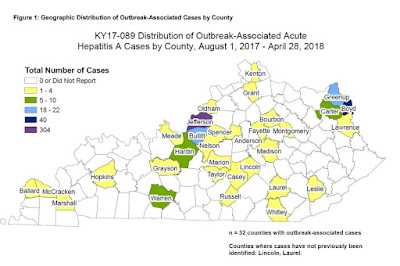
Since August, the health department has reported 448 cases and four deaths. The state averages about 20 cases a year.

Of the 448 cases, 11 have been in Hardin County, and four each in Nelson and Meade counties, department spokesman Donny Gill told Jeff D'Alessio of The News-Enterprise in Elizabethtown.

“It’s still steadily progressing upward and that’s not what we want,’’ Gill said. “Just a trace amount and you can come in contact with it. It’s a strong virus that lives outside of your body for a long time.’’

Hepatitis A is found in the feces of people with the disease and is most frequently transmitted by eating or drinking something that has been contaminated with fecal matter -- typically because the food or beverage has been handled by someone with the virus that hasn't properly washed their hands after going to the toilet. It is also spread by drinking contaminated water, sex, and illicit drug use. The Mayo Clinic notes that it does not spread through sneezing or coughing.

“It can get on surfaces and you never know if it’s there or not,” Gill told D'Alessio. “The contact doesn’t have to be person-to-person.”

For example, the Louisville Metro Health Department writes in a tweet:  "Hep. is spread when someone with the virus shares a cigarette, drink, joint, towel, sex with you."

The most common symptoms of hepatitis A are fatigue, low-grade fever, loss of appetite, joint pain, sudden nausea and vomiting, yellow eyes or skin, abdominal pain, pale stools and dark urine, according to the Centers for Disease Control and Prevention. A person with the virus is contagious for up to two weeks before showing symptoms.

D'Alessio reports that of the 11 people in Hardin County with the disease, none have been identified as restaurant workers. To date, a food transmitter has not been identified in any Kentucky outbreaks.

Most of the state's cases so far have been among the state's homeless and drug users, says the DPH website.

Louisville's health department also posted a tweet that says an employee of Texas Roadhouse at 13321 Shelbyville Road had been diagnosed with hepatitis A and that anyone who ate there between April 11 and April 25 should monitor for symptoms through June 14 as they may have been exposed to the virus.

On May 8, WSAZ-TV reported that an employee who handled food at the Dairy Queen on 13th Street in Ashland was diagnosed with hepatitis A.

"The investigation found that the risk of restaurant patrons becoming infected is very low," health officials stated in a press release. "Dairy Queen is working with the health department to prevent any new cases from arising in the community as a result of this case."

"This makes the fifth food worker in Boyd County diagnosed with the disease this year during this multistate outbreak," reports the station in Huntington, W.Va.

The CDC notes that hepatitis A is very hard to kill, and can live outside the body. It recommends hand washing with soap and water after using the bathroom or changing diapers, and before preparing or eating food, are the best ways to prevent an infection. A vaccine for the disease is also available.

The state health department has recommended hepatitis A vaccination for everyone in Jefferson, Bullitt, Hardin, Greenup, Carter and Boyd counties.

Owenton convenience store pulls synthetic urine used to pass drug tests after issue is raised by police chief and local paper

Following inquiries by the local newspaper and police chief, an Owenton convenience store has stopped selling "controversial items such as U-Pass, a brand of synthetic urine that can allegedly be used to pass a drug test," reports Molly Haines of the Owenton News-Herald.

The Owenton Marathon Station, also known as Cowboys, "began selling items like U-Pass and synthetic cannabinoids, an alternative to marijuana, earlier this year," Haines reports. "When local residents began noticing the items, they took to Facebook to express their concerns, with one post garnering nearly 170 comments and more than 100 shares on the social media website."

Police Chief Terry Gentry raised the issue with the City Council on April 17, and three days later the News-Herald interviewed store owner Dash Patel, who "said he was unaware of any discussion of the products on social media," Haines reports. "Additionally, Patel said concerned customers or Gentry had not approached him."

But the next day, "Gentry visited the store and Patel assured him the items would be removed from the business," Haines reports.

Gentry told Haines the items are “perfectly legal,” but she notes that "the health effects of using synthetic cannabinoids can be unpredictable and harmful — even life-threatening — according to the Centers for Disease Control and Prevention."

Meanwhile, the Owen County Drug Prevention Coalition wrote store manager Kishan Patel, asking her to no longer sell U-Pass because it encourages drug use.

Patel told the coalition in an email May 1, “At the time when we brought these products in our inventory (by customer demand), we were not aware of how these products would affect the community. One of our goals has always been helping our community grow.”

Tuesday, May 8, 2018

Law allowing petition for involuntary drug and alcohol treatment was passed in 2004, but is seldom used; big problem is cost

Information about Casey's Law can be found at
caseyslaw.org/KY_Files/About.htm
A law that allows families and others to file a petition to request involuntary, court-ordered drug treatment for their loved ones has been "slow to catch on around the state, even though the number of overdose deaths continues to rise," Miranda Combs reports for Lexington's WKYT-TV.

Combs reports that from December 2017 through April 2018, Rowan County attorneys filed 19 petitions under Casey's Law -- but before that, they had never used the law to involuntary order drug treatment. The law has been around since 2004.

"The law is for involuntary treatment," Combs writes. "This means a friend, co-worker or family member can file a petition requesting a judge order them to drug treatment. If the user doesn't follow appointments and court dates, a warrant can be issued for their arrest."

Assistant Rowan County Attorney Ashley Adkins, who coordinates the Casey's Law petitions, told Combs that after studying the law she quickly realized that the main barrier for family members to use the law is the expense, which she said costs about about $500 to execute.

"A lot of these families spent money in the past for their loved ones to go to rehab," Adkins says, "They've given them money to help support them so they don't have anything when they come to us. So we realized, if we want to make this work for everyone, there has to be funding available."

To help defray this cost, Adkins told Combs that the county had received a $20,000 grant through Pathways, an addiction resource center, that covers the full cost for families and friends to file a petition under Casey's law, and is also used to help fund the county's syringe-exchange program and efforts aimed at preventing drug abuse.

"The success of the county's way of operating has put Adkins on the road, teaching other counties how to successfully navigate Casey's Law," Combs writes.

"A lot of counties have had some confusion about how it works, or who pays for it," Adkins said. "You run into a lot of roadblocks that you learn along the way. So a lot of counties are just now starting to take advantage of Casey's Law."

Brad Stacy of The Morehead News wrote about a local effort organized by Adkins to educate their community about Casey's Law in January.

He reported that the Rowan County Agency for Substance Abuse Policy board and the county attorney's office held two free Casey's Law trainings in January, including how to manage the legal processes.

The class was led by Charlotte Wethington, who was instrumental in getting the law passed after losing her son Casey to a heroin overdose in 2001. She has since dedicated herself to advocating for Casey's law, which is officially called the "Mathew Casey Wethington Act for Substance Abuse Intervention."

In March, Beth Warren of the Louisville Courier Journal wrote a detailed article showing families and others how to invoke Casey's Law in Louisville. Warren notes a webpage with a step-by-step guide and video on to file a petition in Louisville, which links to another statewide resource: caseyslaw.org/Treatment.htm. She noted that 60 petitions were filed in Louisville in 2017, compared to 27 in 2016.

Warren also notes that parents and others who need added support with Casey's law can ask to join the closed Casey's Law group on Facebook, which has over 1,500 members.

In February, Sam Knef of the Tristate Homepage wrote about a Henderson woman who was forced into rehab through Casey's Law, but not before her family met some roadblocks from a local attorney.

Taylor Willoughby, who was addicted to drugs and ordered into treatment through Casey's law, told Knef, "If they hadn't forced it on me, I don't think I would be alive today."

But her mother, Teresia Johnston, told Knef that when she initially called a local attorney, he "kind of laughed me off, said it doesn't work unless they put themselves in rehab," and called the law "a joke."

However, the Henderson County attorney disagreed and told Knef that Casey's law is an effective way to get people into treatment before they get arrested.

“Court ordered treatment is just effective or more effective as that treatment that somebody decides to go in themselves,” Steve Gold said. “So I’m a believer.”

Knef also notes that the cost of court fees and treatment are huge deterrents to the law, but adds that there are many state-funded centers that offer court-ordered rehab for free.

Ky.'s oldest working dentist, 97, dies; may have been U.S.'s oldest

Dr. J.M. Stephenson
Julius Middleton Stephenson, who was Kentucky's oldest working dentist, and may have been the oldest in the nation, died May 5 in Bowling Green. He practiced in the Cumberland River town of Burkesville, population 1,500.

Stephenson worked in his office as recently as March. He was a fixture at the state high school basketball tournament well into his 90s, and was secretary-treasurer of the South Central Kentucky Dental Society for 40 years. His son and daughter, who survive, are both dentists.

His funeral service will be held at 2 p.m. Wednesday at Burkesville First United Methodist Church with burial in Burkesville Cemetery with military honors. Flowers are welcome, but donations are encouraged to Lindsey Wilson College in Columbia.

Full disclosure: In his youth, the writer of this post was a patient of Dr. Stephenson.

New telehealth law will require insurers in Ky. to pay for virtual visits in the home, starting in July 2019

Kentuckians will soon be able to see their health-care provider in the privacy of their own home, thanks to a new law passed during the 2018 legislative session, Lisa Gillespie reports for WFPL.

Currently, telehealth visits are limited to doctors and high-level practitioners, and patients must be in a clinical setting for the visit. But Gillespie reports that  the new law, which goes into effect July 2019, will allow Medicaid and commercial insurance to pay for telehealth visits in the home. It will also require insurers to pay mid-level providers, like psychologists, family therapists and physicians assistants, for telehealth visits.

"Telemedicine is similar to a face-to-face health-care visit but instead, patients interact with health providers remotely, usually via computer screen," Gillespie notes.

Mary Horsley of Eastern Kentucky told Gillespie about how her mother-in-law, also named Mary, had benefited from telehealth after being diagnosed with Alzheimer's disease.

Horsley said that instead of having to make the drive to Lexington to see an Alzheimer specialist every three months, they were able to go to their local rural health clinic -- which her mother-in-law was familiar with -- and participate in a telehealth visit. They did this for seven years until Mary died, Gillespie reports.

“I’m hoping this legislation will open up the opportunity to see these specialists from their homes,” Horsley said. “For people with Alzheimer’s, it is difficult for them to go places that are unfamiliar to them but a lot of times they’re familiar in their home.”

Rob Sprang, director of Kentucky TeleCare at the University of Kentucky, told Gillespie that he new law will increase access to mental-health care in the state. He pointed out that while psychiatrists and psychiatric nurse practitioners have been able to practice telehealth, psychologists and licensed social workers have not been.

That's important because Kentucky has a shortage of mental-health providers. Gillespie notes that in 2013, Kentucky needed 1,638 more providers to keep up with demand, according to a state report. The report also found that the greatest shortages were in rural counties and that there were more clinical social workers and psychologists than any other mental health professionals in the state.

“[Rural] medical clinics are more likely to bring on some mental-health specialists, and in most cases they can’t justify a psychiatrist. But it does make good sense for them to hire a family therapist and they can leverage that person using telehealth to reach anywhere in the state,” Sprang said. “We need every clinician we can find to meet the problems of underserved patients in our state.”

Gillespie notes that while this new law will increase access to telehealth, not everyone in the state has internet access at home. She writes, "Though 85 percent of Kentuckians have access to high-speed Internet, there are still 524,000 people who don’t, and 187,000 people don’t have any internet providers where they live."

Sprang told Gillespie that advocates will push next year for additional telemedicine techonologies, including a requirement for insurance companies to pay for remote patient monitoring, like for daily weigh-ins or blood-pressure readings.

“Many cardiologists will tell you, ‘If I knew every morning what that patient weighed, I could predict when they trend poorly,’” Sprang said. “Because if they eat too much salt, or forget to take their diuretic, they will begin to gather fluid around their heart and lungs and before you know it, they can’t breathe.”

Legislation passed a few years ago required the state Medicaid program create a remote-monitoring pilot project, but lack of funding stalled it, Gillespie reports. Sprang said advocates will also ask lawmakers for money for that project.

Monday, May 7, 2018

Meth resurges in Ky. and is cheaper and more lethal than ever

"While Louisville frantically tries to rescue residents from heroin, fentanyl and pain pills, another drug is creeping back to prominence: crystal meth," Beth Warren reports for the Louisville Courier Journal.

And while the drug can be made through a "simple but dangerous process of mixing easy-to-get ingredients," there are fewer local labs these days and most of it now is being made in Mexico by cartels and is "cheaper, easier to get -- and more lethal," Warren writes. "And sometimes it's secretly mixed with fentanyl, which is even deadlier than heroin."

"It's deadlier than the public perceives," Russell Coleman, U.S. attorney for Western Kentucky and a former FBI agent who has worked drug cases, told Warren. "Methamphetamines are the next phase of the drug epidemic in this commonwealth."

Steven Bell, a spokesman for the U.S. Drug Enforcement Administration, told Warren that today's meth, often dubbed "ice," has a purity often close to 100 percent, which is "much more lethal than the 50 percent purity of local one-pot labs."

Warren notes that meth never really went away, but instead has "resurged."

Dave Thompson of The Paducah Sun recently reported that in Western Kentucky and Southern Illinois, methamphetamine is the "drug of choice," according to law enforcement and rehabilitators in the region.

"Meth-related deaths in Kentucky more than tripled from 2013 to 2016, when 252 people died, according to the Kentucky Injury Prevention and Research Center. More than a third of those deaths were in Jefferson County," she writes. "Police across Kentucky intercepted more than triple the amount of meth last year than they did in 2013, according to a recent state police report. Nearly 11,000 drug seizures submitted to the state crime lab last year were meth — more than heroin, cocaine and fentanyl combined."

Coleman pointed out that because meth damages the body over time, causing things like convulsions, strokes and heart attacks that aren't always associated with the drug, it isn't always recognized for the "havoc it wreaks," Warren writes.

She notes that today's meth looks like chunks of clear glass with a slightly blue tint and can also come in white pills that can be crushed into a powder.

Charles Wilson, 32, a self-described "meth head" who is in recovery, told Warren, "It's safer and cheaper" to purchase meth from a cartel instead of a local lab, adding that he used to pay about $700 for an ounce of meth in Albany, Ky. Louisville Metro Police Sgt. Paul Neal, a veteran narcotics detective, told Warren that the drug is cheaper in Louisville, as low as $300 per ounce, because there is more available.

Coleman told her that police now are finding as much meth as marijuana on interstate and local roadway traffic stops. And because meth causes its users to become paranoid and agitated, it's often referred to as "the drug of violence," especially compared to heroin which causes user to become lethargic.

Unlike heroin, there's no antidote or medication-assisted-treatment for meth, though addiction specialists told Warren that they are optimistic that these intervention and treatment options will eventually be developed and approved.

Friday, May 4, 2018

Paducah cardiologist Pat Withrow receives a Healthy Kentucky Policy Champion award for his promotion of health

L-R: Chris Roty, president, Baptist Health Paducah; Dr. Pat Withrow;
 Ben Chandler, president/CEO, Foundation for a Healthy Kentucky;
Charlie Ross, immediate past foundation chair; and Dona Rains,
director of community outreach, Baptist Health Paducah. 
The Foundation for a Healthy Kentucky has named cardiologist Pat Withrow of Paducah a Healthy Kentucky Policy Champion.

Withrow is the director of outreach for Baptist Health Paducah and the governor-elect of the Kentucky Chapter of the American College of Cardiology.

"He is known locally and statewide for his advocacy of improved health. I know firsthand he is a health champion for our area," Dona Rains, director of community outreach at Baptist Health Paducah and a member of the foundation's board of directors, said in the news release.

Withrow's most recent advocacy to promote a $1 increase in the state's cigarette tax follows a long history of health-promotion efforts in the state, says the release.

When he served as the director of the heart center at Baptist Health Paducah, Withrow focused on reducing childhood obesity through an elementary school "Wizard of Health" presentation that focused on healthy eating, exercise and not smoking. He also advocated for CPR training in high schools and worked with area EMS teams to provide student instruction. He also tours middle schools with a police office and recovering addict to discuss the dangers of opioids.

"Pat is certainly an advocate for policies that will help make people healthier," said foundation president and CEO Ben Chandler. "But he goes beyond advocacy to education and implementation. He engages in the work from beginning to end . . . He keeps on advocating, keeps on teaching and keeps on working to ensure his Kentucky neighbors and colleagues have the best chance at a healthier life."

Withrow is now eligible for the Healthy Kentucky Policy Champion of the Year award, which comes with a $5,000 grant from the foundation to go to a Kentucky-based nonprofit of the winner's choice.That winner of that award will be announced Sept. 24 at the foundation's Howard L. Bost Memorial Health Policy Forum in Lexington.

Nominations for the Healthy Kentucky Policy Champion Award are accepted at any time; details are on the foundation's website.

Thursday, May 3, 2018

Polk says he resigned as health commissioner due to lack of funding for his program for anti-drug education in early childhood

Dr. Hiram Polk
5/9/18, Click on headline for updated story:  Polk maintains he quit for health reasons, denies knowing he had been placed on 'special leave' amid allegation of drinking on job

By Melissa Patrick
Kentucky Health News

During his 14 months as state health commissioner, Dr. Hiram Polk said he was on a mission to implement an early-childhood education program to teach young children how to live healthy, drug-free lives.

He says that when he learned in September that there would be no more money for the program, he resigned, leaving what he called "a toxic environment" that makes the work difficult.

“The purpose of my disagreement was how to spend some newly saved money in the Department for Public Health, a middle-management kind of disagreement," he said in a telephone interview.

Polk said in a later phone interview that the disagreement was with Vickie Yates Brown Glisson, who later resigned as secretary of the Cabinet for Health and Family Services to run for Congress in Louisville.

Polk said the argument was over whether some "new money" that became available was state money or health-department money, and that he had been "clear" with Glisson that he would leave if the money was not awarded to the department for his early-childhood drug-education program.

“It was strictly a fight over this thing," he said. "And by that time I was having trouble with what I thought was a stroke, but was indeed just a slow heartbeat."

Polk, 82, added that he was "feeling terrible" when he left, and a week after he resigned he got a pace-maker.

“I've felt a lot better over the last few months, but I think that's more because of the pacemaker," he said. "It's a little bit about being out of Frankfort, but mostly because of the pacemaker."

He said there has been "a lot of turnover" in personnel at the cabinet, and "I'd have to say it's a toxic environment."

Polk wouldn't expand on his description, other than to say that several key leadership positions, including Glisson's, are still open, adding, "I just think it's a difficult place to work. . . . It's just a very unpleasant environment."

Polk said he didn't know how much of that is because that's just the way it is in Frankfort or if it has to do with the current administration. He pointed out that he was just "a medical-school guy over here in Louisville" whose only prior experience with politics was to vote.

Polk is a world-renowned surgeon and retired professor of surgery at the University of Louisville, for whom the U of L surgery department is named. He remains a professor emeritus at the university.

Cabinet spokesman Doug Hogan said in an e-mail that the agency doesn't comment on personnel issues and there was "no new money," or "obligated funds" to use for Polk's education project.

"The early-childhood education projects were funded out of DPH cash balances," Hogan said. "There was never a funding stream or sustainability plan for these projects."

Polk said, "We saved a good bit of money to use for some childhood-education things, and there was no agreement on how to spend it."

As part of Polk's initiative, the DPH distributed nearly $943,000 to 28 school districts statewide for "Early Childhood Healthy Living" in August, reaching 96 schools. The one-time awards varied between $15,000 and $40,000 per school district to support "evidence-based" programs to teach children healthy life choices and to avoid drugs, alcohol and tobacco. The programs targeted preschool through fourth grade.

Asked what would happen to the program, Hogan said, "Due to difficult fiscal times, especially with the state’s pension crisis, we are not able to fund the program moving forward."

Ohio recently adopted an early childhood drug-abuse-prevention program that starts in kindergarten, but because of Ohio laws, the state can't mandate universal health-education standards. This has prompted state lawmakers to work on a bill to change the law, Sarah Vander Schaaff reports for The Washington Post. 

"Instead of relying on scare tactics about drug use or campaigns that recite facts about drugs' toll on the body, teachers are encouraged to discuss real-life situations and ways to deal with them and to build the social and emotional skills that experts say can reduce the risk of substance abuse," Schaaff writes about Ohio's Health and Opioid Prevention Education, or HOPE, program.

Polk told Kentucky Health News in September 2016, after being in the position a few months, "If there is a secret to drug, tobacco and alcohol addiction, it is through very early childhood education. I believe that."

He said recently that looking at it selfishly, leaving Frankfort was the best thing he could have done for himself, but he still hoped someone else would come along and champion this "wonderful" project.

But he also said, "Idealism doesn't go very far in Frankfort.”

Kentucky's gains in health care are overshadowed by greater increases in 'deaths of despair,' driven by drug overdoses

"Kentucky improved its standing in many health measures in recent years but still ranks near the bottom nationally, in part because of a troubling increase in deaths from suicide, alcohol abuse and drug overdoses," known as "deaths of despair," reports Bill Estep of the Lexington Herald-Leader, citing a new study.

In 2013, for every 100,000 people in Kentucky, there were 48.9 "deaths of despair." By 2016, driven mainly use by drug abuse, the rate had jumped 26 percent, to 61.7 per 100,000.

That rate was much higher than the national average of 43.2, according to the report from The Commonwealth Fund, a foundation that says it was created to "promote a high performing health care system that achieves better access, improved quality, and greater efficiency, particularly for society's most vulnerable and the elderly."

The study ranked Kentucky's health system 42nd in performance, up from 46th in 2013.

The jump in "deaths of despair" overshadowed Kentucky's improvement in 16 of the 37 indicators that the foundation uses to evaluate states' health systems, measuring access to care, quality and efficiency of care, health outcomes and income-based health care disparities. Only six states, led by New York, showed more improvements; Kentucky tied for seventh with Arizona and California.

All but one of the states with the most improvements expanded Medicaid under the Patient Protection and Affordable Care Act, most beginning in 2014. Kentucky led the nation in the percentage-point reduction of people without health insurance, going from 21 percent in 2013 to 7 percent in 2016.

"However, the state may reverse some of that improvement," Estep writes. "Gov. Matt Bevin and others have said Kentucky’s Medicaid expansion is financially unsustainable. Bevin’s administration received approval under President Donald Trump for a waiver requiring able-bodied adult Medicaid participants to complete 80 hours a month of work, education, job training or community service to keep benefits. Another provision of the waiver, which has not yet taken effect, is for Medicaid beneficiaries to pay premiums of $1 to $15 a month at first. Critics say the provisions would be difficult for many Medicaid participants to meet and that many would lose coverage as a result."

The Bevin administration has estimated that Kentucky's Medicaid rolls, now almost 1.5 million, will have 95,000 fewer people in five years than without the waiver.
Read moree: http://www.kentucky.com/news/state/article210360139.html#storylink=cpy

Wednesday, May 2, 2018

Most Ky. adults support court-mandated treatment for first or second drug offenses; all but five counties have drug courts

Most Kentucky adults favor court-mandated treatment programs for people convicted of a first or second drug offense, programs that can be ordered in place of or in addition to incarceration, according to the latest Kentucky Health Issues Poll.

The poll, taken Oct. 24 to Dec. 2, found that 82 percent of Kentucky adults favored court-mandated treatment for first or second drug offenses, while 15 percent opposed such a mandate.

Support for mandating treatment increased with education, with 90 percent of college graduates, 84 percent with "some college," 82 percent of high-school graduates and 72 percent of the rest in support of the mandate.

The poll also found that support for such a mandate was strong across party lines, with 85 percent of Democrats, 84 percent of independents and 80 percent of Republicans supporting mandatory treatment programs.

It was also high among Kentucky adults who believe that addiction is a disease, 86 percent, compared to those who do not believe addiction is a disease, 76 percent.

"We can't arrest our way out of Kentucky's substance-use epidemic," Ben Chandler, president and CEO of the Foundation for a Healthy Kentucky, which co-sponsors the poll, said in a news release.

Chandler added that because addiction is a brain disease that often leads to illegal behavior, it's important to treat the underlying condition. Otherwise, he said, "We never actually solve the problem."

Mandatory treatment for drug offenders can be ordered by a "drug court," which the release says are used in every Kentucky county except Logan, Todd, Carroll, Grant and Owen.

The poll report notes that successful completion of any type of treatment program is more effective than jail time alone in reducing the burdens of addiction.

"In fact, research shows that patients who successfully complete treatment have a lower risk of being arrested on drug-related charges again than those who were sentenced only to jail time," says the release.

This is the first time the Kentucky Health Issues Poll has asked this question. The survey was funded by the foundation and Interact for Health, a Cincinnati-area foundation. It surveyed a random sample of 1,692 Kentucky adults via landlines and cell phones. The poll's margin of error is plus or minus 2.4 percentage points.

Tuesday, May 1, 2018

Kentucky Public Health Association honors 10 public-health leaders, two health departments and a racetrack

Public health promotes and protects the health of people and their communities, largely through surveillance and prevention programs, and much of what people in public health do often goes unnoticed. But once a year the Kentucky Public Health Association honors outstanding contributors to public health. Here are the award winners for 2018, honored during the association's 70th annual conference on April 27 in Covington.

Sue Thomas-Cox, a nurse administrator with the Chronic Disease Branch of the state health department, won the Outstanding Public Health Nurse Award. Among other achievements, Thomas-Cox was instrumental in obtaining a multimillion-dollar Centers for Disease Control and Prevention grant to increase colorectal cancer screening in the state. Due in large part to her work, the state has moved from 49th to 19th in colorectal cancer screening, annual cases of such cancers have declined more than 25 percent, and mortality from them has fallen more than 30 percent.

Melinda Carey, an administrative specialist with the department's Division of Epidemiology and Health Planning, won an award for her contributions in the area of administrative support. Carey's nomination came with 26 letters of support, several of which described her as "the go-to person" who "goes the extra mile and makes the workplace enjoyable."

Robert Slaton of Georgetown, who has served in various health leadership capacities for more than five decades, was honored for his lifelong contribution to the improvement of public health. He was state health commissioner,  Gov. Brereton Jones' special assistant for health reform, external affairs director for the former Trover Clinic in Madisonville, and held several positions with the University of Louisville. He was a founding member of the group that developed Passport Health Plan. He is chair of the Community Advisory Council of the Foundation for a Healthy Kentucky and the national advisory board of the Institute for Rural Journalism and Community Issues, which publishes Kentucky Health News. “His contributions to improved health outcomes in the commonwealth will long outlive his numerous years of service to the people,” a nominator wrote.

Jennifer Hunter, director of clinical services at the Northern Kentucky District Health Department, received a career achievement award. Hunter has worked as a public-health nurse for 28 years. A few highlights: leading a team of six nurses in relief efforts in Mississippi after Hurricane Katrina in 2005; and her work around the heroin epidemic, including a hepatitis C testing pilot that has since gone statewide, advocating for syringe exchange programs, and her work with women with substance-use disorders.

Doraine F. Bailey, who works with the breastfeeding support services at the Lexington-Fayette County Health Department, was honored for her "exceptional contribution to the health and well-being of mothers and children in Kentucky."  Bailey was described as a "tireless champion for breastfeeding and maternal education," going beyond her job requirements to promote breastfeeding at community events and by serving as a guest lecturer in the University of Kentucky nutrition and dietetics program.

John Q. Moses, an HIV linkage navigator with the Lexington health department, was honored for his "significant contribution to benefit our most vulnerable population -- the indigent and uninsured." Moses has spent his career serving those at risk for and affected by HIV and STDs and was instrumental in launching Lexington's syringe exchange program.

The Christian and Todd County Health Departments were honored for their work on the August 2017 solar eclipse, which required several years of "hard work and planning to prepare for the influx of people and potential dangers." Visitors from over 47 states and 25 countries attended events in the area.

Nancy Merk, a board-certified lactation nutrition supervisor and regional breastfeeding coordinator with the Northern Kentucky Health Department, was honored for her 30 years in public health. Merk's leadership was instrumental in the health department receiving the Loving Support Award of Excellence Gold Level Award for Exemplary Breastfeeding Support and Practices from the U.S. Department of Agriculture.

Shana M. Peterson, a health educator at the Jessamine County Health Department, was awarded for her exceptional contribution in health education. Peterson has implemented many evidence based health education prevention programs in schools and has been a strong advocate for local smoke-free policies.

Lorrene Rawlins, nursing director at the Wedco District Health Department in Bourbon, Harrison and Scott counties, was honored for her exceptional home health services. Through her leadership, Rawlins was able to reduce costs in other areas of her department to create a budget to directly care for indigent patients.

Jody L. Schweitzer, a state epidemiologist, won the first-ever Outstanding Epidemiologist of the Year award. She was honored in large part for her work in implementing the state's immunization information system, the Kentucky Immunization Registry, which has been recognized on the state and national level.

Kentucky Speedway was honored "as an industry who has demonstrated exemplary leadership for the commonwealth's health. "

Baptist Health closing deal to buy E'town hospital from county

UPDATE: The closing has been delayed because of a lawsuit by a former physician alleging that the sale doesn't comply with state law. He lost in Hardin Circuit Court but has appealed to the state Court of Appeals, Mary Alford reports for The News-Enterprise.

Hardin Memorial Hospital on Dixie Boulevard in Elizabethtown
Baptist Health, Kentucky's largest hospital operator, is buying 300-bed Hardin Memorial Hospital in Elizabethtown from Hardin County, pending formal approval of the county Fiscal Court and state regulators.

The sale was announced in November, but without a price or other agreements. In a joint press release with the hospital, Baptist Health said it would "invest a minimum of $150 million in the first five years to build new facilities, recruit more physicians, upgrade HMH’s information technology and equipment and strengthen HMH’s position and reputation as the preferred regional healthcare center. After the first five-year period, Baptist Health will commit an additional $85 million in capital investments to HMH."

Baptist Health will pay the county $60 million up front, minus an estimated $30-35 million to fund the hospital's defined benefit pension plan; then pay the county $66.4 million over 25 years. it will also assume the hospital's debt of $37 million "and provide up to $150,000 per year (inflation adjusted) for 25 years for health-care services to inmates of the Hardin County Jail," the release says.

Hardin County Judge-Executive Harry Berry said, “This agreement will also ensure a steady source of non-taxpayer funding for the county for many years, as well as assuming HMH liabilities and continuing HMH-provided inmate health services.”

The Baptist board approved the deal Tuesday, May 1. Board Chair Allen Rudd said, “We are pleased to add the caring health-care providers of Hardin Memorial Health to the Baptist Health family." The hospital will be named Baptist Health Hardin and the changeover is expected to be final Dec. 1, Mary Alford reports for The News-Enterprise in Elizabethtown.

The deal also calls for Baptist to:
• Offer employment to all non-contracted employees at current pay.
• Provide employees with continuing health benefit coverage and employee benefits consistent with those offered similarly situated Baptist Health employees.
• Maintain retiree medical benefits for employees who began work before July 1, 2005.
• Accept contracts with physician employees, who will transition from hospital retirement and benefit plans to Baptist Health Medical Group plans."HMH and Baptist Health will work to ensure that each physician’s fair market value compensation remains consistent through this assignment process," the release says.
• Continue to provide medical staff membership and clinical privileges practitioners with in good standing.
• Retain Dennis Johnson as president of the hospital, and other members of the HMH senior leadership team "in their current positions of hospital leadership," the release says, without specifying a time frame. The hospital will have an administrative board with at least half its members from Hardin County.

The acquisition is the latest for Louisville-based Baptist Health, which added the former Floyd Memorial Hospital in New Albany, Ind. in 2016 and the former Pattie A. Clay Regional Medical Center in Richmond and the former Trover Health System in Madisonville in 2012. Its other hospitals are in Louisville, Paducah, La Grange, Lexington and Corbin. The company "has more than 300 points of care in 75 Kentucky counties, seven counties in Illinois, six counties in Southern Indiana and two counties in Tennessee," the release says. "Its physician network includes more than 3,000 employed and affiliated physicians."