Friday, June 1, 2018

Cabinet for Health and Family Services announces appointments to 5 key leadership positions; 2 top jobs were filled in mid-May

Several key leadership positions were filled at the Cabinet for Health and Family Services June 1, and take affect immediately, according to a state news release.

Dr. Jeffrey Howard, who has been acting state health commissioner since Dr. Hiram Polk left last fall, was appointed commissioner.

Howard attended Union College, University of Louisville School of Medicine and the Harvard T.H. Chan School of Public Health. He is a native of Eastern Kentucky and lives in Louisville.

Jill Hunter has been appointed acting commissioner for the Department for Medicaid Services. Hunter has worked for state government for more than 16 years, most recently as a deputy commissioner within the department where she focused on the redesign of the home and community-based service waiver program.

Hunter replaces Steve Miller who is retiring effective June 15. Miller has held this position for the past two and a half years.

Shannon Gadd was named commissioner for the Department for Aging and Independent Living. Gadd had been senior director of programs at ElderServe in Louisville.

Anne-Tyler Morgan has been named senior adviser to Cabinet Secretary Adam Meier for administrative hearings. Morgan, an attorney, served as a deputy commissioner in Medicaid.

LaToya Payne, who has held various leadership roles in the cabinet since 2007, was named the director of the administrative hearings branch.

“CHFS, and the commonwealth, are fortunate to have so many qualified individuals stepping into key leadership roles at this important time,” said Meier in the release. “I also want to thank Steve Miller for his dedicated service as Medicaid director. His steady leadership will certainly be missed but we wish him the best in his well-deserved retirement.”

Meier was appointed secretary of the cabinet May 17, when Kristi Putnam was named deputy secretary.

Thursday, May 31, 2018

Federal judge sets trial date for state's ban on most common type of second-trimester abortion; meanwhile, law remains suspended

A federal judge has ruled that a new law banning a common abortion procedure called dilation and evacuation, or D&E, after roughly 11 weeks will not be enforced in Kentucky until after a trial is held in November.

The order from Chief Judge Joseph H. McKinley set the trial for Nov. 13 after vacating the preliminary injunction hearing that had been scheduled June 5.

The new law banning the procedure, except in cases of medical emergencies, was House Bill 454, sponsored by Rep. Addia Wuchner, R-Florence. It passed the state Senate 31-5, and the House 75-13. The law went into effect immediately after Gov. Matt Bevin signed it on April 10.

McKinley delayed the enforcement of the law through a joint consent order April 12 after the American Civil Liberties Union filed a lawsuit arguing that the law is unconstitutional. A federal court struck down a ban on the procedure in Texas, and similar bans have been temporarily blocked in other states while they await litigation.

A D&E abortion, which is the most common kind of second-trimester abortion, involves dilating the cervix and removing the fetus using suction and surgical tools. If the law is upheld, abortion providers found in violation would be guilty of a felony that carries a prison sentence. Women undergoing the procedure would not be prosecuted.

Wednesday, May 30, 2018

Foundation for a Healthy Ky. will help state keep people covered as Medicaid changes; summit discusses new work requirements

Ben Chandler, president and CEO of the foundation,
with Gov. Matt Bevin (Associated Press photo by Adam Beam)
By Melissa Patrick
Kentucky Health News

LOUISVILLE, Ky. -- The Foundation for a Healthy Kentucky is partnering with the administration of Gov. Matt Bevin to help low-income Kentuckians keep their health coverage under the new Medicaid plan that starts taking effect July 1.

"We have a singular objective in the endeavor announced today, and that is to keep Kentuckians covered," Ben Chandler, president and CEO of the foundation, said at a May 30 press conference to announce the partnership.

Chandler told the nearly 200 people in attendance that "an independent, non-profit, non-partisan foundation" is "uniquely situated" to help Kentuckians on Medicaid meet the new requirements.

"The foundation's passion for this is our passion for this," Bevin said. "It is not a partisan issue." He is a Republican; Chandler is a Democrat who was in Congress in 2004-12, state attorney general in 1996-2003 and a 2003 nominee for governor.

Bevin's new Medicaid plan, called Kentucky HEALTH (for Helping to Engage and Achieve Long Term Health) includes, among other things, requirements for work, education or training; monthly reporting; lock-out periods for failure to comply; and premiums and co-payments based on income.

The changes will largely impact "able-bodied" Kentuckians who have gained Medicaid coverage through the expansion of the program to people with incomes up to 138 percent of the federal poverty level, which is less than $16,394 for an individual.

Medicaid covers almost one in three Kentuckians, almost half a million of them on the expansion. A county-by-county spreadsheet of enrollment in Medicaid, as of January 2018, can be downloaded from http://www.uky.edu/comminfostudies/irjci/MedicaidbycountyJan2018.xlsx.

Chandler said that through this partnership, the foundation will help Kentuckians keep their health coverage by helping them to better understand the new requirements; helping communities offer ample community engagement requirements; helping people find ways to pay their premiums, promoting preventive health initiatives, focusing on helping those with substance use disorders, and providing health and financial literacy education, as required by the program.

In addition, he said they will facilitate a "statewide feedback program," as the implementation rolls out " to identify best practices and lessons learned, and to resolve program inefficiencies."

Bonnie Hackbarth, spokeswoman for the foundation, said in a telephone interview that while they haven't specifically talked to other health advocacy groups in the state to enlist their help in this endeavor, like the Friedell Committee or Kentucky Voices for Health, she said they would likely reach out to them as they look to engage.

Veronica Judy Cecil, who had served as a deputy commissioner in the state Department for Medicaid Services under Bevin and Democratic predecessor Steve Beshear, has been hired to oversee this partnership. Cecil ran Chandler's congressional office.

Critics of Kentucky HEALTH say it is too complicated and creates barriers to health care.

The Center for Budget and Policy Priorities recently released a report saying that the plan's new rules, which were approved by the federal government through what is called a demonstration waiver, will likely cause many people to lose coverage.

"Current waiver proposals and recently approved waivers will cause large numbers of eligible people to lose coverage and will increase administrative costs," the report concludes. "Those who lose coverage will have less access to care, less financial security and worse health outcomes."

The Bevin administration estimates that 95,000 fewer Kentuckians will be on the Medicaid rolls with the changes than without them, partly because of non-compliance. The state has budgeted $186 million for fiscal year 2018 and $187 million for 2019 to implement the waiver, and has requested that the federal government pay for 90 percent of these costs, according to the budget center's report.

Chandler said the foundation was well aware that many stakeholders had "deep concerns" about beneficiaries losing their coverage, and added, "So do we."

Bevin has said that the state can't afford to have nearly one-third of its population on Medicaid, but when asked if his goal to decrease the Medicaid rolls was in conflict with the foundation's goal of keeping people on them, he said that kicking people off the program was never his goal.

“My goal is to get a healthier outcome for the people of Kentucky. I’ve never made any mention with respect to the size and scope of Medicaid," he said. "What I do believe is if you have a healthier population, you won’t need as many people.”

Chandler later added, "Not at any time have any of these folks here suggested to us that they are trying to throw people off Medicaid."

Attendees at the Partnership Summit (Photo by Melissa Patrick)
The second part of the morning was devoted to the Kentucky HEALTH Partnership Summit, which brought together state, business, health and education leaders to discuss the details of the community engagement requirements -- which require "able-bodied" Kentuckians on Medicaid to work, volunteer or attend school or job training at least 80 hours a month, and document their hours monthly, to keep their Medicaid coverage.

Bevin talked about the benefits of the engagement requirement, likening it to the pride in ownership a child has when they buy their own bicycle instead of having it given to them: "If you don't have engagement in your own health outcomes, you're not as likely to get the health outcomes you desire."

Most of the new requirements will kick in July 1, but the new work or community-engagement rules requirements will be phased in slowly, starting in Northern Kentucky. Campbell County's requirements begin on July 1, followed by Boone County on Aug. 1 and Kenton County on Sept. 1.

After that, large groups of counties will be rolled into the program each month until the last scheduled counties are added Dec. 1. Eight counties in Eastern Kentucky are exempt until December 2019 because they are already part of a pilot project that helps find jobs for people in the Supplemental Nutrition Assistance Program, formerly called food stamps.

Hugh Haydon, chair of the Kentucky Workforce Innovation Board, told the summit that from an economic perspective, his group fully supports the community engagement requirements. And he implicitly disputed some critics by saying that there are plenty of jobs to be found.

Calling it a huge "disconnect," Haydon said 200,000 more Kentuckians need to go to work for Kentucky to meet the national average for workforce participation and that there are "hundreds of thousands of jobs available. "

"We also know that for this program to succeed, employers have to be fully engaged," he said. Later adding, "We are ready to do this."

Tim Robinson, founder and CEO of Addiction Recovery Care, who said he was also in long-term recovery, spoke passionately about the importance of the new work requirements for recovering addicts.

He said that while his 14 treatment centers have always maintained a holistic approach to recovery, including clinical, medical and spiritual care, they added vocational rehabilitation and job training to their continuum of care two years ago and "the results have been amazing."

He said 46 of his patients have graduated from his company's Peer Support Specialist Academy, which was launched in 2016, and that 40 of them are sober and working full time. "Which tells me that job training is just as important as drug addiction treatment," he said to applause.

"Incredible things happen when you give someone whose trashed their life a path from crisis to career," Robinson said. "You give them hope for the future, the power of purpose, the dignity that comes from work, raising their self-esteem and an opportunity to pay their recovery forward."

At the end of the meeting attendees broke into groups, based on their local workforce development area, and discussed their concerns about implementation of the new plan.

Some of the concerns included the need for more communication about the changes; the importance of individuals learning how to self-report their monthly engagement requirements, and to manage their Kentucky HEALTH accounts, because there are no added resources to help them do this; concerns about transportation barriers, prompting a suggestion for a Kentucky HEALTH Uber service; and the need to create a "ramp" instead of a "cliff" for the many who will only work up to a certain number of hours for fear they will earn too much money and then lose their health coverage.

Smaller Kentucky HEALTH summits modeled after this bigger one are expected to be held across the state. Click here for Kentucky HEALTH resources page.

Tuesday, May 29, 2018

Grant for coolers from Southeast U.S. dairy group helps food banks in Lexington and Winchester provide milk to the needy

Agriculture Commissioner Ryan Quarles announced the gift.
Clients of the God's Pantry Food Bank in Lexington and Winchester have greater access to fresh milk thanks to a $30,000 grant from The Dairy Alliance, formerly the Southeast United Dairy Industry Association.

God’s Pantry used the grant to put a total of seven milk coolers in its four food pantries in Fayette and Clark counties. The grant was part of the group's Milk 2 My Plate initiative to get Kentucky milk into Kentucky homes, and was announced by state Agriculture Commissioner Ryan Quarles as part of his Hunger Initiative.

“As a bonus, our hard-working dairy farm families will get a new market for their products. This is one small step that hopefully will lead to more such initiatives to help Kentucky’s dairy farmers. We are extremely grateful to The Dairy Alliance for its support,” Quarles said in a news release.

Winchester Farms Dairy delivered milk to God’s Pantry as part of the May 29 announcement. The pilot project is providing 60 gallons of milk a week to the food bank; God’s Pantry CEO Michael Halligan is hoping to increase the volume.

“Hungry families, particularly those with young children, often lack calcium-rich milk in their diet. This pilot project will help us establish a consistent, sustainable flow of milk to those in need,” Halligan said. “In the first few weeks, we’ve witnessed so much joy and excitement through a cold glass of milk.”

Map the Meal Gap 2017, an annual study by Feeding America, found that one in six Kentuckians – including one in five children – were food insecure in 2015, meaning that consistent access to adequate food is limited by a lack of money and other resources at times during the year, the news release said.

New services tax includes memberships in fitness centers and Weight Watchers, though Kentucky ranks seventh in obesity

Will memberships in fitness programs at YMCAs, like this one in
Lexington, be taxed? The state isn't sure. (Lane Report photo)
"Kentucky, which has the seventh highest rate of obesity in the U.S., will begin to tax fitness center and Weight Watchers memberships on July 1," Chris Otts of WDRB notes in a report on the expansion of the state's 6 percent sales tax to several services.

"But is the YMCA – a nonprofit organization – required to collect the tax, or only for-profit gyms such as Planet Fitness?" Otts asked Richard Dobson, executive director of the Office of Sales and Excise Taxes at the state Department of Revenue. Dobson replied, “We are working on that [question] and we will be giving further clarification.”

The taxes were levied as part of a deal between House Republicans, who wanted to protect education funding and make fewer changes to teacher pensions, and Senate Republicans, whose apparent priority was tax cuts, such as lowering the state income tax to 5 percent from the current range of 5.8 to 6 percent for income above $8,000.

"Republican Gov. Matt Bevin vetoed the bill, saying he wanted a more 'comprehensive' overhaul of the state’s tax code, but lawmakers voted to override the veto on April 14, putting the changes into law," Otts notes. "Last week Kentucky officials launched a website to better explain the tax changes. They have also set up a phone line – 502-564-5700 – to take recorded questions." Questions can be emailed to taxanswers@ky.gov.

Monday, May 28, 2018

In close vote, Louisville sets content rules for children's menus, citing child obesity; critics say law invades parental responsibility

A food-service business in Louisville will be allowed to offer a children's menu only if it includes certain types of healthy items, under an ordinance passed by 13 Democrats on the Metro Council over "vocal bipartisan objections" from 11 other members, Phillip M. Bailey reports for the Courier Journal. "The proposal touched a nerve with many residents and council members who said such choices should be left up to parents."

Supporters said the ordinance is needed to fight an epidemic of child obesity and is the first in the United States to set food and drink standards for children's menus. The American Heart Association, which spearheaded the proposal, said about 12 cities, mostly in California, have adopted similar rules, Bailey reports. Mayor Greg Fischer said he plans to sign the measure into law.

The ordinance will require food service businesses "to provide a non-fried fruit or vegetables, a whole grain product or a lean protein or one 2-ounce serving of nuts, seeds, dry beans, peas or one egg," Bailey reports. "The restaurant must make available either a water, sparkling water, flavored water with no added natural or artificial sweeteners or milk product." Violation carries a fine of up to $100.

"Many of the council members who voted against the idea said they support the goals but that it shouldn't be the city's job to tell people how to eat," Bailey writes.

"Here we go again, this is a government overreach. We continue to tell parents what they need to do with their children," said Councilwoman Mary Woolridge, D-3rd District, one of three Democrats who joined eight Republicans in voting against it.

"Several Democrats who voted for the measure also expressed doubts that it would achieve its goals," Bailey reports. Councilwoman Vicki Aubrey Welch, Blackwell's co-sponsor, said it would address the local childhood obesity epidemic.

"Nearly 25 percent of Louisville sixth-graders and 18 percent of kindergartners are obese, according to the Louisville health department," Bailey writes. "Health advocates point out that one out of three children in the United States eat fast food and thus have a higher caloric intake that can result in a poor diet, obesity and diabetes."

Sunday, May 27, 2018

Summer's here, which means it's time to protect our skin from the sun and keep a regular watch for skin cancer

Chart from Great Plains Center for Agricultural Health; click on it
to view a larger version; to download a full-size version, click here.
Friday, June 1 is the start of meteorological summer, which is a great reminder to make sure you have enough sunscreen on hand and to remember to check your body for skin cancer.

The American Cancer Society says the top cause of skin cancer is exposure to ultraviolet, or UV, rays from the sun or other sources like tanning beds.

To protect yourself from the sun, the ACS recommends wearing clothing and a wide-brim hat to protect as much skin as possible; using a broad-spectrum sunscreen with a SPF of 30 or higher, and to reapply every two hours, as well as after swimming or sweating; staying in the shade if possible; and avoiding tanning beds and sunlamps.

But it's also important to be careful when using sunscreens on children.

Brenda Goodman of WebMD reports on a 14-month-old child who is recovering from a "painful, blistering rash that spread over her cheeks and nose, right where her mom had spread a palmful of Banana Boat Kids Free spray sunscreen."

The U.S. Food and Drug Administration is investigating the case, and told WebMD that it is aware of three other Canadian children who had reactions to the same product.

Dr. Alok Vij, a dermatologist at the Cleveland Clinic, told WebMD that he thought the reaction was something called a photoallergy, which happens when the sunlight combines with a chemical to cause a chemical reaction.

His advice to parents includes: Keep kids out of the sun during the brightest parts of the day, 11 a.m. to 4 p.m.; use sun-protective clothing; use mineral-based sunscreens, like those with zinc or titanium; and avoid spray sunscreens. 

The American Academy of Dermatology reports that one in five Americans will develop skin cancer in their lifetime.

 The doctors at University of Louisville Physicians – Surgical Oncology, in a U of L news release, recommends regular skin self-exams after a shower or bath.They note that it's important to learn where your birthmarks, moles and blemishes are located, and to take note of how they usually look and feel. Family members can examine areas that are hard for an individual to see.

"Using a full-length mirror and a hand-held mirror, check for anything new such as a mole that looks abnormal, a change in size, shape, color or texture of a mole or a sore that doesn’t heal," the doctors advice. "Check yourself from head to toe, including all areas and crevices of the skin."

They also offer these "ABCDE" tips to help you remember what to watch for:
  • Asymmetry – The shape of one half does not match the other.
  • Border – The edges are often jagged, uneven, distorted or atypical in outline; the pigment may spread into the surrounding skin.
  • Color – The color is uneven. Shades of black, brown and tan may be present. Areas of white, gray, red, pink or blue also may be seen.
  • Diameter – There is a change in size, usually an increase. Melanomas are usually larger than the eraser of a pencil (1/4 inch or 5 mm).
  • Evolution – Anything that changes over time. It is important to call a dermatologist if you find one of these suspicious characteristics.
And just because you have dark skin doesn't mean you shouldn't check yourself. A 2016 American Academy of Dermatology study, “Racial Disparities in Melanoma Survival,” found that while melanoma incidence is higher in whites, death rates are relatively higher among people of color.

 “Far too often, black, Hispanic, and Asian patients with melanoma cancer tell us they believed that melanoma was only a danger for sun-seeking whites,” says the study report. “But anyone – regardless of skin color – may develop melanoma, in both sun-exposed and sun-protected sites. Not noticing or ignoring a new or changing mole in a sun-protected site can be fatal.”

Children are at risk of death from being left in hot cars; health officials say don't do it in any circumstances, offer prevention tips

Image from Huffington Post
Every summer, children die from heat stroke because they are unintentionally left in a hot car, with the majority of these deaths occurring in children age 3 and under The latest reported victim was a 1-year-old girl in Nashville who was accidentally left inside a hot car May 23.

According to the safety organization Kids and Cars, 37 children a year die in hot cars. These include instances of children being forgotten, accidentally locking themselves in a car or trunk, or in a small number of cases, intentionally left in a car.

“Infants and small children are not able to regulate their body temperature in the same way that adults do,” Dr. Heather Felton, medical director of the University of Louisville Pediatrics - Sam Swope Kosair Charities Centre, said in a U of L news release. “Sweating won’t cool down an infant or young child in the same way that it does an adult, and children may not be able to extract themselves from a car seat or remove clothing to help their bodies adjust.”

A new study out of Arizona State University and the University of California San Diego School of Medicine, published in the science journal Temperature, found that it takes about an hour for a child left in a hot car to suffer heatstroke, an average of 80 minutes in a sunny car to kill a child, and a little under two hours for a 2-year-old's body to reach a core temperature of greater than 104 degrees Fahrenheit, a degree from which a body cannot cool down," Dr. Sima Patel reports for ABC News. Patel notes that in reality, different children reach hyperthermia at different times, based on the climate, child's size, clothing, ethnicity and age.

"I don’t think our study can address the overall ‘risk’ of heatstroke because that depends on human behavior and actions more than anything," Jennifer Vanos, lead study author told ABC.  "All cars heat up to lethal temperatures across every state, and although it’s the level of heat that in the end causes the death, it’s the act of forgetfulness that is the trigger. Deaths have occurred in not-so-hot states as well. And even though parking in the shade decrease the heart rate of the child’s core temperature, the risk of death is likely the same as if parking in the sun."

Felton offers these American Academy of Pediatrics-endorsed tips for parents when traveling in a car with infants or young children:
  • The inside of a car can reach dangerous temperatures quickly, even when the outside temperature is not hot. Never leave a child alone in a car, even if you expect to come back soon.
  • Always check the back seat to make sure all children are out of the car when you arrive at your destination. 
  • Avoid distractions while driving, especially cell phone use.
  • Be especially aware of kids in the car when there is a change from the routine such as someone else is driving them in the morning, or you take a different route to work or child care. 
  • Have your childcare provider call if your child has not arrived within 10 minutes of the expected arrival time.
  • Place your cell phone, bag or purse, or shoes in the back seat, so you are reminded to check the back seat when you arrive at your destination.
  •  Lock your car when it is parked so children cannot get in without supervision.
  • Drink plenty of water and have your children drink plenty of water when temperatures soar.
  • Plan for extra rest time – heat and a change from the normal routine leaves kids and parents feeling tired.

Saturday, May 26, 2018

Operation UNITE uses comprehensive approach to keep Appalachian kids off drugs; experts say it could be replicated

Preventing kids from falling into addiction is a major goal for Operation UNITE, a nonprofit serving 32 counties in Eastern Kentucky -- a region where the average age for first drug use is 11, Laura Ungar reports for the Louisville Courier Journal.

"Experts say UNITE’s approach — encompassing families, schools and communities — is supported by research and could work anywhere," Ungar writes.

“If it could be copied and replicated in other areas of the country, that would be fantastic,” Linda Richter, director of policy research and analysis at the New York-based Center on Addiction, told Ungar. Research shows “there’s no simple way to prevent substance abuse.You really need a comprehensive solution.”

This comprehensive approach includes summer camps, school-based service clubs and community events that feature real-life stories of addictions, all with the end goal of keeping children off drugs. writes that the message is always the same: "Drugs can destroy their future."

Ungar writes about the "real-life" story of Kayla McClure of Rockcastle County, who was addicted to heroin, but is now in recovery. At the community's annual celebration of Operation UNITE in Mount Vernon, McClure shared her "cautionary tale" of addiction and recovery.

Jamie Cromer, one of McClure's three daughters, told Ungar that she still checks her mom’s arms for fresh needle tracks, which she said is a "lingering habit" from the days when her mom used to shoot up heroin.

“I’m proud of her,” her daughter Kenya told Ungar, who, at age 13, is part of a UNITE anti-drug club at the same age her mom started popping pills. “I don’t want to end up like her.”

Jaime, Kenya and their 16-year-old sister, Gracelynn, who were raised by McClure’s parents, told Ungar that they had all three pledged  never to try drugs.

Ungar writes about several Rockcastle County Unite programs, one that teaches fourth- and fifth- graders at Mount Vernon Elementary School about wellness, healthy choices and how to plan for the future and another highly popular event called the UNITE Bowl Football game that collects toilet paper for drug treatment centers. She also writes about an outdoor activity program called Impact Outdoors in Manchester that is funded by UNITE.

The UNITE website says UNITE has 127 registered clubs in 23 counties, with 9,718 members. “We’re starting early enough to build the foundation,” said UNITE CEO Nancy Hale, whose son battled a painkiller addiction.“The earlier you start, the more you develop hope."

Since its inception in 2003, UNITE leaders told Ungar, they estimate the organization and its community coalitions have reached more than a million children through prevention and education activities. The state provides $2 million and another $1.3 million comes from other sources, such as private donations and the federal AmeriCorps program for public-service work.

A 2017 U.S. Centers for Disease Control and Prevention survey found that about one in eight Kentucky 12th graders reported abusing pain medicines at some point, nearly half said they’d smoked pot and about one in 60 said they’d injected illegal drugs at least once.

UNITE, which was launched by Fifth District U.S. Rep. Hal Rogers, R-Somerset, is an acronym for Unlawful Narcotics Investigations, Treatment and Education. Ungar notes that just over half of the organization’s budget goes to prevention and education.

Rogers told Ungar that keeping kids off drugs is crucial to the future of the region and “UNITE has been reasonably successful at that.”

CEO Hale told Ungar that while researchers at the University of Kentucky are studying the prevention outcomes, anecdotally, she said, “Young people in college and the workforce often tell us they’re there because of UNITE.” Recently Hale said she had fielded calls from Maryland, Tennessee, Ohio and other states asking about replicating UNITE.

How to get help: Operation UNITE is one of several partners of FindHelpNowKY.org, a real-time substance use disorder treatment locator and information center for Kentucky. To find the closest treatment facility near you or a loved one visit the site; call toll-free at 833-8KY-HELP (833-859-4357); or text HOPE to 96714.

Friday, May 25, 2018

State urges hepatitis shots for everyone in 10 counties with outbreaks; also: keep hands washed, but not with gels

Acting Health Commissioner Dr. Jeffrey Howard (left) and
Cabinet for Health and Family Services spokesman Doug Hogan
talked about the hepatitis A outbreak in a Facebook Live event.
By Melissa Patrick
Kentucky Health News

As the number of hepatitis A cases continues to rise in Kentucky -- up to 629 this week -- and the number of counties with an outbreak has increased by four, the state's top health official encouraged Kentuckians to be aware and take precautions against the highly contagious liver disease -- but to keep calm.

"I don't think there is a necessity to panic, but people do need to be aware that there is an outbreak going on in the state and take appropriate precautions," Dr. Jeffrey Howard, acting commissioner of the Department for Public Health, said during a May 24 Facebook Live event.

Howard offered these suggestions to protect yourself from the disease, which is typically caused by ingesting food or drink that is contaminated with fecal matter: avoid hand-to-mouth contact, get vaccinated and wash your hands with soap and water.

"The most important thing that someone can do in the state of Kentucky right now is wash your hands appropriately," Howard said, which he said means washing your hands with soap and water for at least 20 seconds and then drying them off.

He added, "Hand gels are not an alternative. They do not kill hepatitis A."

Howard also advised anyone living in Boyd, Bullitt, Carter, Greenup, Hardin, Jefferson, McCracken, Meade, Montgomery and Warren counties, where outbreaks have been identified, to get vaccinated. Immunization requires two vaccines, six months apart.

McCracken, Meade, Montgomery and Warren counties are new to the list this week. Each of these counties have had four or more cases reported, according to the health department.

Howard announced that the department will provide each of the local departments in the 10 counties with money to buy an additional 1,000 doses of the vaccine, a total of 10,000 doses.

He urged vaccination for anyone at high risk for getting the disease: people who use illegal drugs, are homeless or have unstable housing; men who have sex with men; people recently in jail or prison; and people with underlying liver disease.

Howard also advised anyone who works with any of these high-risk populations to get vaccinated, including health care workers, church or ministry workers and volunteers.

To the concerns of some about whether they should eat out or not, Howard said, "We've had zero cases related to a food worker," and the virus in this outbreak is spreading "via contaminated environments," at least for now. The department's website says the increase in cases have primarily been among the homeless and drug users.

Howard added that Kentucky hasn't singled out food workers to get vaccinated, as West Virginia has, because the state's recommendation is for everyone in an outbreak area get vaccinated, which includes food workers.

He encouraged people with insurance to go to their health-care provider or a local pharmacist to get vaccinated, and for those without insurance or in one of the high-risk categories to go to their local health department.

The most common symptoms of hepatitis A are fatigue, low-grade fever, loss of appetite, joint pain, sudden nausea and vomiting, yellow eyes or skin, abdominal pain, pale stools and dark urine. A person with the virus is contagious for up to two weeks before showing symptoms and one week after. Symptoms usually last less than two months, but 10 percent to 15 percent of victims remain sick for up to six months.

Howard noted that hepatitis A is "a very rare disease," and that the state normally only has about 20 cases a year. He added that the U.S. Centers for Disease Control and Prevention is working to figure out why this outbreak is occurring across the country.

Grant program for children's health enters final year; foundation hopes seven local projects can be replicated statewide

As a five-year, $3 million grant that focuses on children's health moves into its final year, the Foundation for a Healthy Kentucky is gearing up to share the seven grantees stories as a way to help other communities do the same.

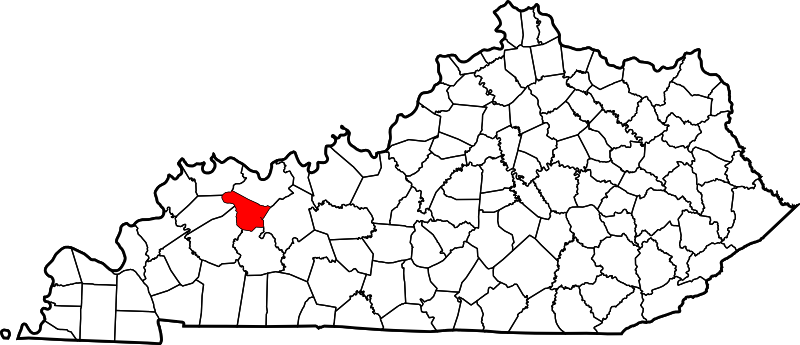
Most recently, foundation President and CEO Ben Chandler visited McLean County to review the progress of the "Partnership for a Healthy McLean County," part of the "Investing in Kentucky's Future" program. The initiative is intended to reduce the risk that today's school-aged children will develop debilitating chronic diseases as adults.

The McLean partnership used its five-year, $260,000 grant, and nearly $134,000 in local funds, to combat childhood obesity. It led to several new programs along the way.

The efforts included improving facilities to encourage more outdoor activity, adding programs in local schools to increase classroom movement, expanding nutrition programs, and supporting policy changes that ensure better nutrition and more physical activity in the daily lives of students, with the help of new physical-education equipment.

Wikipedia map
"I have seen first-hand the joy and excitement on the students' faces when they were given the new PE equipment," Brook Fogle, a program specialist with the Green River District Health Department, said in a foundation news release. "I have heard nothing but praise from the teachers that because of the new PE curriculum, they have been given the opportunity to teach kids that physical fitness can be fun."

Fogle said the local health coalition has added new partners since its inception, all while growing and strengthening the existing ones. "All in all, the grant has been beneficial in a multi-level way," she said.

One vision of the "Investing in Kentucky's Future" initiatives is that the programs could be replicated across the state. To that end, the foundation says it will create a video and other materials that can be shared in other communities.

"The next step is to take this . . . and other IKF case studies on the road, sharing and expanding what has been learned here to benefit even more residents of McLean County and other Kentucky communities," Chandler said in the release. "We'll also be making the connections between experienced coalition managers like Brooke Fogle with motivated leaders in other Kentucky communities who want to replicate the success of McLean County."

Six of the seven grantees, including McLean County, chose childhood obesity prevention as their focus. The other chose to address adverse childhood experiences. In addition to the funding, the foundation also provided training and technical assistance throughout the grant period.

"The foundation designed these grants to create lasting change," Chandler said."While we won't necessarily see changes of obesity rates in just a few years, we do expect to see an increase in the exercise and dietary behaviors that research shows will lead to healthier weight down the line."

The other grantees are: Purchase Area Connections for Health (McCracken County), Fitness for Life Around Grant County, the Breathitt County Health Planning Council for Children, the Perry County Wellness Coalition, the Clinton County Healthy Hometown Coalition, and the Bounce Coalition in Jefferson County.

Later this year, the foundation will start a final evaluation of the IKF initiative, which will be shared publicly.

As black lung surges in Appalachia, so do lung transplants

A new study published in the American Journal of Industrial Medicine shows that, as black-lung cases have surged in the Central Appalachian coalfield, so have lung transplants. The expensive surgery can be risky, and most transplant recipients die within five years. The study, conducted by researchers from the National Institute for Occupational Safety and Health, "found that 62 black lung patients had lung transplant surgery over the past two decades, and most of the miners lived in Kentucky, Virginia, and West Virginia," Benny Becker reports for Ohio Valley ReSource. "The study also found that more than two dozen patients were placed on a wait list for transplants. Of those, 11 died while waiting."

The study's lead author, David Blackley, said that the rate of lung transplants for black-lung patients increased nearly threefold in the last decade. "That suggested pretty strongly to us that this is a problem that's getting worse," he told Becker.

Insurance from coal companies and other private sources paid for about one third of the lung transplants. Nearly two-thirds were paid for with public insurance, including 26 percent paid for by Medicare and up to 24 percent paid for by the federal Black Lung Disability Trust Fund. "That fund has paid more than $45 billion to cover benefits for miners who can’t seek benefits from their employer, because the responsible company has either gone bankrupt or can’t be identified," Becker reports. A federal study is looking into how long the fund can stay solvent given the rise in cases.

The researchers who conducted the study had also recently discovered that the spike in late-stage black lung in Central Appalachia is the largest cluster of the disease ever recorded.