Thursday, November 12, 2020

Kentucky Supreme Court unanimously rules that Beshear's emergency orders to fight pandemic are legal and constitutional

By Melissa Patrick
Kentucky Health News

The Supreme Court of Kentucky has upheld, unanimously, Gov. Andy Beshear's authority to issue emergency regulations in the coronavirus pandemic. 

“The governor’s orders were, and continue to be, necessary to slow the spread of covid-19 and protect the health and safety of all Kentucky citizens,” said the 103-page opinion, written by Justice Lisabeth T. Hughes of Louisville, a native of Princeton.

"This type of highly contagious etiological hazard is precisely the type of emergency that requires a statewide response and properly serves as a basis for the governor's actions," Hughes wrote. ("Etiology" relates to the cause of a disease.)

Thursday's decision means that the governor's emergency pandemic orders, such as wearing a mask in public and capacity limits on businesses, will stand. 

Beshear called it a "decisive ruling" that is "about saving lives of Kentuckians."  

"Today's unanimous ruling sends a very clear, unambiguous message that the actions that my administration has taken are both legal and constitutional and fundamental to an effective response to a type of virus that requires a comprehensive statewide approach. Without, we lose more people," the governor said at a press conference. 

Beshear has argued that his orders are necessary to limit the spread of the virus, to safely open schools and the economy and to save lives. Attorney General Daniel Cameron has argued that the governor has exceeded his authority. He joined the case on the side of the businesses that sued to block the Democratic governor's orders. Another Republican, Agriculture Commissioner Ryan Quarles, supported their efforts.

But even with today's ruling,  Beshear will face an uphill battle during the upcoming legislative session as lawmakers in both chambers, which will have huge Republican majorities, have said they will limit the emergency powers given the governor by Chapter 39A of the Kentucky Revised Statutes. 

Beshear said an adverse ruling "would have eliminated every single safeguard we have here in Kentucky to keep you safe," such as the mask mandate, funding that allows public schools to hold classes virtually, capacity limits in businesses and event venues, and funding that allows first-line workers to get workers' compensation if they must quarantine because of exposure to the virus.

"We've seen over the past several weeks that covid is spreading at an alarming rate and the last thing that we ought to be doing is fighting with each other and trying to undo the steps that every public health official says are important to protect one another," he said. 

Kentucky reported a record high number of coronavirus cases Tuesday, 2,700, and the deaths of 1,604 Kentuckians have been attributed to covid-19. 

He added later, "Politics has no place in something like this because the virus doesn't care, doesn't care if you're a Democrat or Republican." 

Republican leaders quickly pushed back on the ruling on Twitter.

Senate Majority Floor Leader Damon Thayer said, "Rules unilaterally set by @GovAndyBeshear for restaurants & other businesses are arbitrary & capricious. They have destroyed jobs, harmed economic recovery & increased mental illness. Of course the liberal Supreme Court supports him. But the people’s voice will be heard."

Cameron's tweet said in part, "While the court disagreed with our position in this case, there are still lingering issues concerning KRS 39A and executive power that must be considered by the General Assembly in the upcoming legislative session. I look forward to working with the legislature on these matters." 

Quarles, who was part of the lawsuit regarding an agritourism business in Scott County, said, "I am disappointed in the court’s decision, which significantly reduces the voice of the General Assembly and citizens of the commonwealth. When the General Assembly returns in January, I hope they move quickly to restore the balance of our constitutional order back to the people."

Senate President Robert Stivers and House Speaker David Osborne issued statements that said they would review the ruling and make appropriate recommendations for the upcoming session. 

Stivers said they are reviewing the opinion “to see if we agree with the court on legislative grants of power to the governor, and power granted to him through the Kentucky Constitution. Upon reading and researching the opinion and these issues, I will propose an appropriate course of conduct for our chamber for the upcoming 2021 legislative session.”

Osborne said, “It appears that the court’s opinion provides further evidence of the great need to better define emergency powers granted by previous legislatures. Ultimately, the real issue is what can be done to ensure that the actions taken under a state of emergency follow the appropriate process, include necessary input, and provide consistent and logical guidance.”

Asked if he could do better in working with the General Assembly, Beshear said he could always do better, but added, "What I look for is a relationship that is mutual, where there can be give and take,  just not take and take. So I hope that there's an opportunity to build some of those bridges." 

Asked if he plans to issue more mandates in light of the ruling, Beshear said, "We've not been waiting on a decision to put anything in place or not to," but have been waiting to see the effectiveness of the recommendations for "red zones," where infection rates are the highest. He said what is really needed is more compliance with current orders.

And what about turning red-zone recommendations into mandates? "We're not there yet," Beshear said. "I don't have specific plans on it. We'll need to see first of all how well they work . . . If a community embraces these, then we believe that they will be really effective, but I'm not sure you get embracing from a mandate."

McConnell urges mask wearing, social distancing and hand washing; criticizes Democrats for remarks about vaccine rollout

McConnell masks up in public.
Senate Majority Leader Mitch McConnell pointed Thursday to fast-rising numbers of coronavirus cases and said “It’s urgent that all Americans continue the smart steps that have gotten us this far: wearing masks, social distancing, adapting our plans and routines.”

“This virus is not going to magically leave us alone if we decide we are fed up with taking precautions,” McConnell added after noting that it “is continuing to spread across our country at rates that are not sustainable, and which we must try to slow.”

He noted that Kentucky had its highest-ever daily total of new cases, 2,700, and that the percentage of Kentuckians testing positive for the virus is the highest since early May, 8.12%.

“But — thank God, and thanks to brilliant scientists — we may look back on this hopeful announcement as the beginning of the end of this terrible ordeal,” McConnell said, hailing the statement by Pfizer Inc. that it has developed a coronavirus vaccine that appears to be 90% effective.

“I said in March that our country was about to meet a whole lot of new heroes. Many were going to be doctors and nurses. Others were going to be the essential workers who kept society going. And some were going to be men and women who worked like crazy in labs and research centers until we had this virus beat,” McConnell said. “But every American has a role. As cases continue to climb, the simple advice — wear a mask, practice social distancing, wash your hands — are now as important as ever.”

In his speech on the Senate floor, McConnell criticized Democratic officeholders for questioning “this unambiguous good news. The Democratic governor of New York state opined a few days ago that it was, quote, ‘bad news’ that a vaccine breakthrough may have been reached because President Trump is in office.”

New York Gov. Andrew Cuomo's complete quote was “It's good news, bad news. The good news is that the Pfizer tests look good and we'll have a vaccine shortly. The bad news is that it's about two months before Joe Biden takes over and that means this administration is going to be implementing a vaccine plan . . . I believe it's flawed,” because it relies mainly on the private sector, including pharmacies and hospitals, “and that's going to leave out all sorts of communities that were left out the first time when covid ravaged them.”

McConnell noted that Sen. Lamar Alexander, R-Tenn., has pointed out “that the plans that are in place put states in the driver’s seat for arranging distribution and making sure the most vulnerable citizens receive access. The federal government is there to provide guidance and support.”

McConnell also called out Cuomo and California Gov. Gavin Newsom for "openly second-guessing the Food and Drug Administration and doubting its ability to assess the safety of a vaccine." He called the FDA "the trusted authority" and said the governors' statements reminded him of California Sen. Kamala Harris saying "in September, during her vice-presidential campaign, that she might hesitate to trust a vaccine."

“The whole country understands that our Democratic friends are not charter members of the President Donald Trump fan club,” McConnell said. “They do not need to dabble in the early stages of anti-vax conspiracy theories to prove it. In fact, for the sake of public health, and public confidence, and saving lives, they have a moral obligation to stop.”

On Twitter, Newsom called McConnell an invertebrate as he retweeted a news item saying McConnell had declined to say whether President-elect Joe Biden should get intelligence briefings now.

Wednesday, November 11, 2020

Kentucky has highest day of new coronavirus cases by far, 2,700, as positive-test rate jumps to 8.12% and all other metrics are bad

Ky. Health News graph; case numbers from unadjusted daily reports; click on it to enlarge.

By Melissa Patrick
Kentucky Health News

Gov. Andy Beshear reported a record 2,700 new cases of the novel coronavirus Wednesday, beating the old one set six days before by 16 percent.

That brought the state's seven-day rolling average of new cases to 2,075, 152 more than it was Tuesday, an increase of 8%.

On top that, all of the key metrics used by the state to determine how it's doing when it comes to the virus are bad, prompting the governor to warn in a news release that Kentuckians must take the pandemic more seriously. Beshear did not hold his daily briefing today because of Veterans Day. 

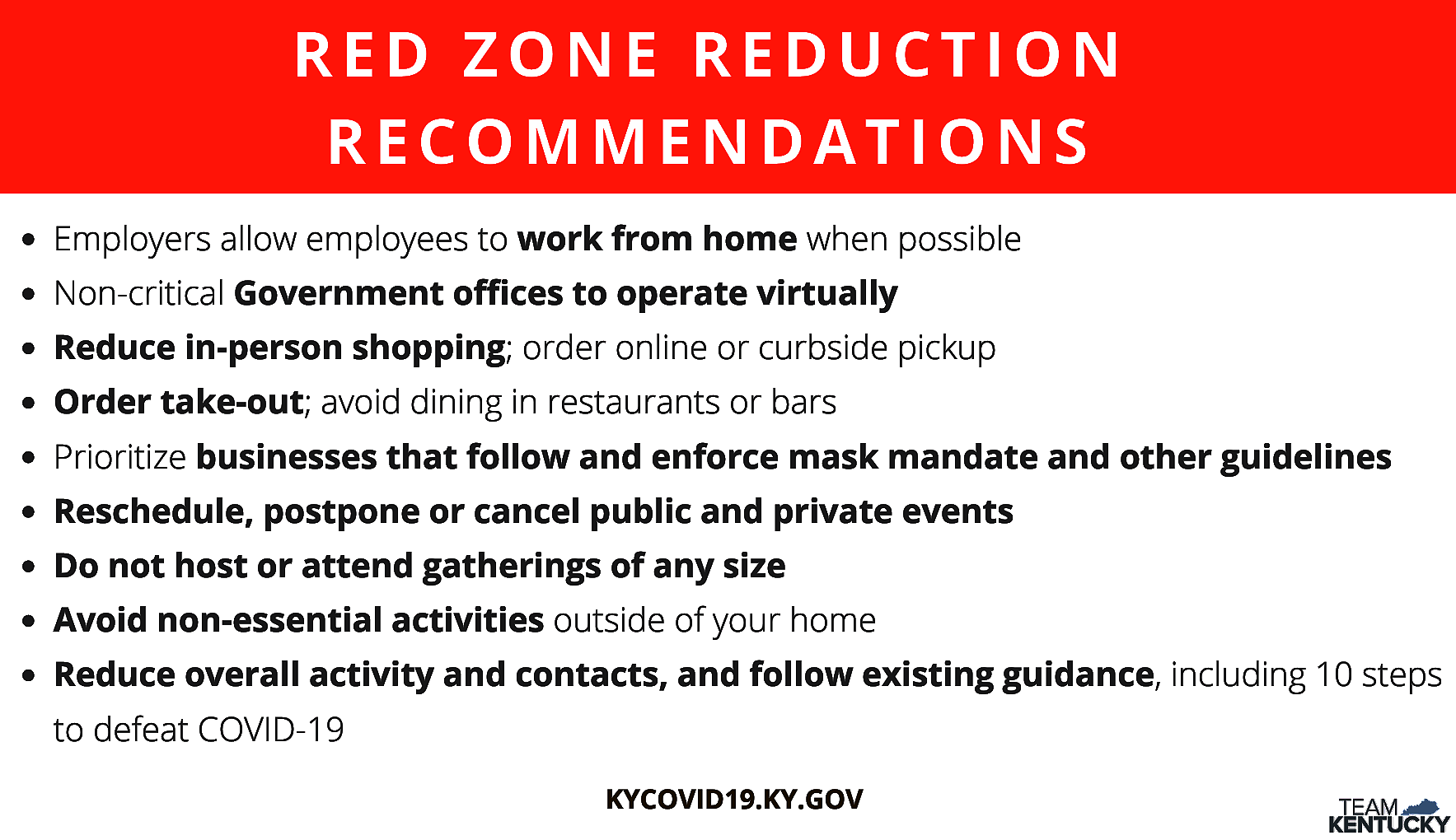
“This entire state is in danger. Covid-19 is absolutely everywhere,” Beshear said. “We need everybody to wear your masks and follow red-zone reduction recommendations and school recommendations. It is a must if you want to lessen the impact in your community.”

Other statistics are bad. The share of Kentuckians testing positive for the virus in the past seven days has increased to 8.12%, by far the highest since testing became widely available. That was a jump from Tuesday's 7.68%.

Hospitalizations for covid-19 are at an all-time high, 1,274; and numbers of patients in intensive care and on ventilators remain high, at 297 and 151, respectively. 

Kentucky is part of a national surge. States reported more than 144,000 new cases Wednesday, a record; seven governors have told people to stay home; Indiana Gov. Eric Holcomb said he would reimpose restrictions in 87 of the state's 92 counties, which have high infection rates; and Ohio Gov. Mike DeWine stepped up enforcement of restrictions and said he would consider shutting down bars, gyms and restaurants in a week if the trend continues. 

As the pandemic has accelerated in Kentucky, and Beshear has been asked if he is considering further restrictions, he has said the existing ones are adequate if Kentuckians would only follow them. 

After begging Kentuckians for months to wear a mask and socially distance -- proven measures to slow the spread of the virus -- Beshear has now largely placed the burden on local communities, with the hope that people will care enough about their neighbors to follow the recommended guidelines.

The guidelines call for community leaders, schools, businesses, nursing homes and individuals in counties that are hardest hit by the virus to follow the state's recommended precautions to slow its spread.

Among other things, the "red zone" reduction recommendations ask people in red zone counties to not eat in restaurants, to allow employees to work from home when possible, and to not host gatherings of any size. School recommendations call on schools in these hard-hit counties to move to virtual learning only and  nursing homes are required to increase testing and asked to further limit visitation. 

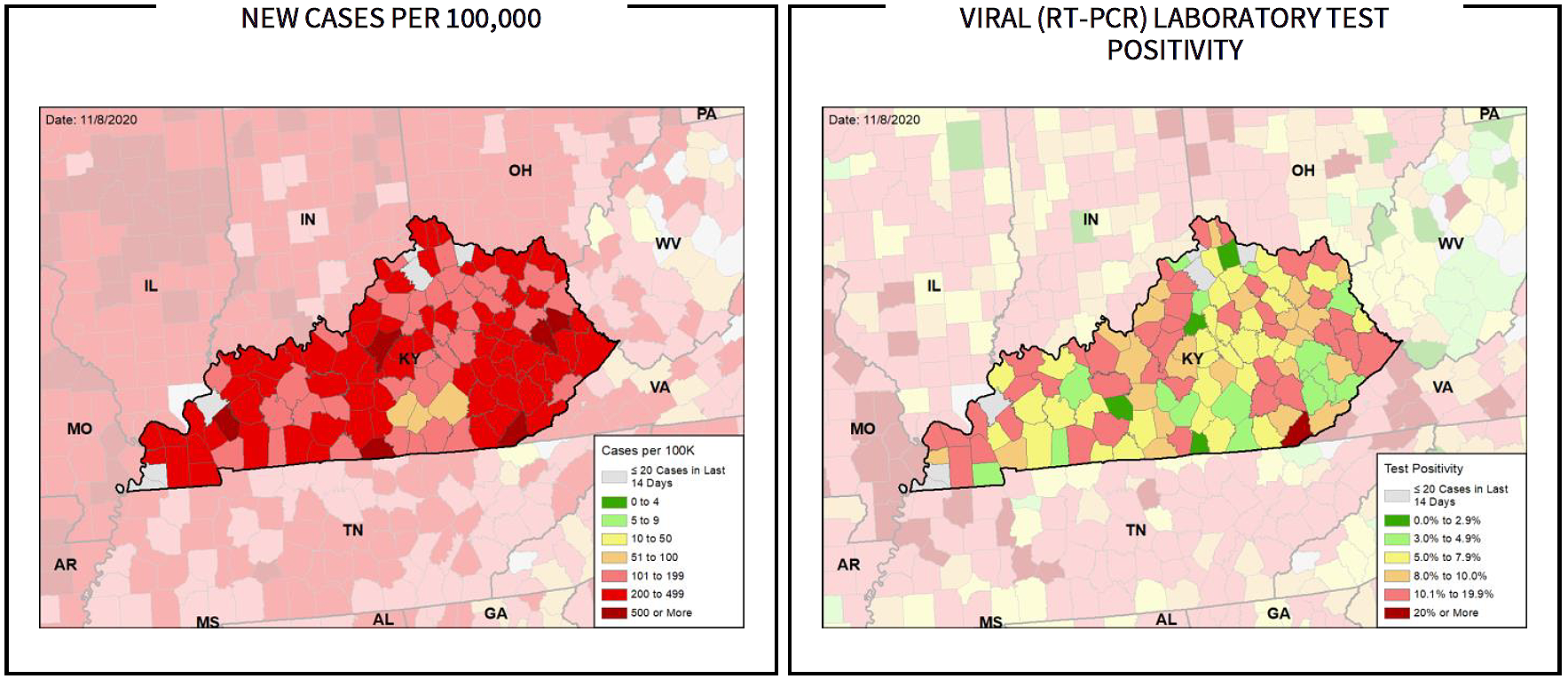
A county is in a "red zone" if it has at least 25 new cases per 100,000 residents in the last seven days. Last week, 80 counties were asked to follow these recommendations. Each Thursday's list of red-zone counties is supposed to guide individuals, businesses, governments and institutions with recommendations for the following week. Wednesday, 91 of the state's 120 counties are in the red zone. 

Beshear announced that 14 more Kentuckians had died from covid-19, bringing the state's death toll from the disease to 1,604. 

The fatalities were a 62-year-old man from Bell County; a 56-year-old woman from Christian County; a 100-year-old woman from Fayette County; two women, ages 74 and 77, and six men, ages 61, 67, 71, 78, 84 and 97, from Jefferson County; a 77-year-old woman from Lawrence County; a 75-year-old man from Magoffin County; and an 85-year-old woman from Montgomery County.

In other covid-19 news Wednesday:
  • Counties with 10 or more new cases were Jefferson, 479; Fayette, 182; Boone, 172; Kenton, 153; Hardin, 87; Nelson, 78; Campbell, 75; Daviess, 71; McCracken, 63; Bullitt, 54; Warren, 44; Laurel, 40; Graves and Pike, 39 each; Madison, 37; Greenup, 36; Hopkins, Ohio and Whitley, 34 each; Calloway and Oldham, 30 each; Christian, Henderson and Shelby, 29 each; Floyd and Muhlenberg, 26 each; Clay, 25; Grayson and Jessamine, 23 each; Monroe, 22; Grant, 21; Scott, 20; Barren, Carter, Harlan, Lawrence and Meade, 17 each; Bell, Marion and Perry, 16 each; Franklin, Hancock and Webster, 15 each; Boyd and Knox, 14 each; Boyle and Larue, 13 each; Anderson, Caldwell, Johnson and Logan, 12 each; Elliott, Pulaski, Trigg and Wayne, 11 each; Pendleton and Spencer, 10 each.
  • The K-12 dashboard shows  that as of Nov. 10, 440 more students and 236 more employees have tested positive for the virus this week, with 2,705 students and 549 employees in quarantine. 
  • Lexington has reported100 or more cases every day for more than a week, with its single-day record reported over the weekend, 236, Jeremy Chisenhall reports for the Lexington Herald-Leader. He notes that the Lexington health department is working to enforce the state's mask mandate, reporting that it has received more than 670 complaints of covid-19-related health violations and issued at least 85 notices to correct and eight citations issued. Citations range from $50-$100, depending on how many times the business has been cited. 
  • Perry County Schools have shut down both in-person and virtual learning for the rest of November because of the virus, Valarie Honeycutt Spears reports for the Herald-Leader. The superintendent said he hopes this will allow the district to add 11 days of in-person instruction at the end of the school year. The system is also planning to offer Saturday sessions in January for students who are struggling. 
  • Sarah Ladd of the Courier Journal tells the story of a 39-year-old veteran and father who died from covid-19, one of the state's youngest victims. Army Sgt. Michael Keene, who did four tours in Iraq and Afghanistan, died Oct. 28 after spending 18 days in intensive care. He leaves behind a wife, two young children, including a newborn son he never got to meet, Ladd reports. 
  • Kaiser Health News answers five important questions about Pfizer Inc.'s coronavirus vaccine, including: How long will the vaccine protect patients? Will it protect the most vulnerable? Can it be rolled out effectively? Could a premature announcement hurt future vaccines? Could the Pfizer study expedite future vaccines?

Tuesday, November 10, 2020

4th highest day for virus cases; state issues Thanksgiving caution; 94 Kentucky counties are in one of White House's danger zones

White House Coronavirus Task Force table; for a larger version, click on it.
By Lisa Gillespie and Melissa Patrick
Kentucky Health News

Gov. Andy Beshear reported 2,120 new cases of the novel coronavirus, the most ever on a Tuesday and fourth highest since Kentucky saw its first case in March. This brings the state's seven-day rolling average to 1,923, more than double what it was four weeks ago.

“Remember, the more cases we have, the more people that are affected, the more people who will need hospitalization, the more people who will be in the ICU, the more people we’ll lose," Gov. Andy Beshear said at his daily briefing. "And as we're finding out, the more people who will have long-term complications. The real damage and devastation of this virus, we don't fully know yet. So again, it’s really important that you do your part to start tamping down these cases.”

As cases continued to escalate, the state reported a new record for the number of covid-19 patients in Kentucky hospitals: 1,189, an increase of 56 from Monday. Of those, 286 are in intensive care and 139 of those are on a ventilator. 

The share of Kentuckians testing positive for the virus in the past seven days also continues to rise, reaching 7.68% today, another record for the months since testing became widely available.

"That shows that not only are we testing more per million than all but five states but even in that the number of people who test positive is going up, which shows that this virus is is growing and spreading," Beshear said. He said earlier in the briefing that Kaiser Family Foundation ranked Kentucky sixth among the states for daily tests per million people.

State graphic; for a larger version, click on it.
State Health Commissioner Steven Stack offered some guidance for the Thanksgiving holiday, which includes: avoiding gatherings with people who don't live in your household, wearing a mask when not eating or drinking, social distancing, avoiding large indoor gatherings, not attending or hosting crowded events, including parades, and avoiding shopping in crowded stores before, on or after the holiday.

Stack, a physician, described Thanksgiving and its risks: “We take a large number of people, often from different households and from different states and cities and regions, we put them indoors in a small, confined space . . . We take off our masks . . . We eat and we drink, which increases our salivation . . . and then we talk and we laugh and we joke and we shout and we sing, and we do all sorts of things that spray that saliva throughout the room. That’s a perfect recipe to spread this virus. So as you make your plans for the holidays, I urge you: 2020 has been a mess for all of us. We've got to hang in there just a little bit longer. . . . Don’t do the things that make us at highest risk.”

The governor also issued a warning for Kentuckians who are considering gathering for the Thanksgiving holiday.

“It is a special time for my family that is normally spent with a lot of extended family," he said. "But this year, those larger gatherings can be very dangerous. Those that you may think that you may only have five, 10 Thanksgivings left with, if we're not careful this year, you might not have more than one.”

Stack also noted that the latest recommendations from the White House Coronavirus Task Force, which were released Tuesday, continues to line up with the state's recommendations.

The report calls on Kentuckians to wear a mask, physical distance, practice hand hygiene, and to isolate and quarantine if infected or exposed. It says to limit restaurant indoor capacity to less than 50% and to restrict their hours, to not gather without a mask with people living outside your household, to stop gathering with anyone outside your immediate household until cases and test positivity are in the yellow zone, to get a flu shot, and for students and teachers in K-12 schools to wear a mask. It also calls for an aggressive messaging campaign that targets rural communities, and offers detailed recommendations for testing. 

Regarding the recommendations, Stack said, "I know there are some who aren't gonna listen; I hope you listen; I'm urging you to listen for your own well being and that of your family, your friends, your neighbors.”

White House Coronavirus Task Force maps; for a larger version of the image, click on it.

The report says 78% of Kentucky's counties had a moderate or high level of community transmission, with 32% of them having high levels.  

Again, it put the state in the red zone for cases, with the 21st highest rate in the country. The report, which covers Saturday, Oct. 31 through Friday, Nov. 6, shows Kentucky with 274 new cases per 100,000 people -- a number that continues to creep up. It was 257 per 100,000 in the prior week and 185 per 100,000 the week before. The national average is 209 per 100,000. 

The number of counties in the red zone decreased from 44 to 39; the orange zone increased from 17 to 23 and the yellow zone increased from 30 to 32. 

Today's report puts Kentucky in the federal orange zone for the percentage of residents testing positive for the virus, indicating a rate between 8% and 10%, with the 24th highest rate in the country. The state uses a different method to calculate the rate, which gives a lower number.

Beshear applauded the Louisville health department's decision to expand the list of businesses it inspects for violations of pandemic restrictions, including surprise visits, saying, “Stepping up enforcement can also help businesses out there by them not being able to look across the street and see somebody else cheating on the rules, while they may suffer from trying to enforce them. I believe that it is the right move at the right time.” 

Grace Schneider reports for the Courier Journal that the department will also publish a weekly list of businesses that are violating mask ordinances and other requirements. As of October, she writes, it had conducted about 3,200 investigations and issued about 100 "orders" for failing to adhere to the state's mask mandate and more than 111 "orders" for failing to maintain social distancing. 

Timothy England
Beshear announced 14 more covid-19 deaths Wednesday, raising the state's toll to 1,590.

He honored the life of Timothy England, a 10-year employee of the Department of Housing, Buildings and Construction, who died Nov. 8 from covid-19 complications at age 60. Beshear said England was a field inspector of heating and cooling systems, and a Glasgow native who enjoyed spending time with his family.

“He also enjoyed camping, riding motorcycles and just being outdoors with his five grandchildren. his family said he loved making people laugh, and he was a loved man,” Beshear said. “We promise to your family to work harder so that others don’t’ have to go through what they’re going through right now.”

In other covid-19 news Tuesday: 
  • Today's fatalities were an 80-year-old woman and a 69-year-old man from Bracken County; an 84-year-old man from Bullitt County; a 91-year-old woman from Daviess County; an 86-year-old man from Hopkins County; five men, 76, 84, 86, 87 and 89, from Jessamine County; an 87-year-old man from Marshall County; a 92-year-old woman from McLean County; a 68-year-old man from Muhlenberg County; and a 76-year-old man from Shelby County.
  • Beshear said in his daily news release that all five Jessamine County men were residents at Thomson-Hood Veterans Center at Wilmore, which has had a recent outbreak. The state's report on long-term-care shows that the facility has 24 active resident cases and 11 active staff cases, with 21 resident deaths.
  • The ranking of Tuesday's new cases as the fourth highest does not count a day that a backlog of more than 1,400 cases in Fayette County pushed the daily total above 2,300. Counties with more than 10 new cases were: Jefferson, 378; Fayette, 187; Warren, 86; Hardin, 68; Madison, 67; Laurel, 61; Bullitt, 54; Nelson, 48; Daviess, 42; Boone, 40; Christian, 39; Floyd and Henderson, 38; Hopkins, Kenton and Pike, 36; Jessamine, 33; McCracken, 32; Campbell, 29; Monroe, 27; Clay, 21; Simpson, 20; Boyle, 19; Boyd and Rowan, 18; Lee and Muhlenberg; 17; Graves and Martin, 16; Franklin, Grayson, Greenup, Knox, Logan, Montgomery Oldham, Rockcastle and Union, 15; Barren and Harlan, 14; Magoffin and Mercer, 13; Knott and Shelby, 12; Bell, Grant, Metcalfe, Scott, Taylor and Todd, 11; and Adair, Jackson, Larue, Lincoln and Perry, 10.
  • The state added a new behavioral health provider to a list of agencies that help field calls to the National Suicide Prevention Lifeline: Pathways, Inc., which services Bath, Boyd, Carter, Elliott, Greenup, Lawrence and Menifee and Rowan counties. Beshear said the expansion is crucial to help people struggling with mental-health issues, financial stress, job loss from the pandemic and isolation. The lifeline number is 1-800-273-8255. 
  • Beshear reported a case at the Kentucky State Police Academy, with six additional people displaying covid-19 symptoms.
  • He also announced an outbreak of 94 cases at Beattyville's Lee Adjustment Center, a private prison owned by CoreCivic, a large operator of prisons and detention centers that’s had outbreaks across the country. He said all inmates and staff at the prison will be tested. 
  • Ohio Valley ReSource has expanded its Covid Data Tracker to include the number of people hospitalized and in intensive care from covid-19 and the amount of coronavirus testing being done. It already provides daily updates on cases, the seven-day average trend line on cases, a snapshot of each county's cases along with key health measures of each county that speak to a person's vulnerability to the virus. 
  • "The Lexington Police Department said it received complaints about 60 large parties during Halloween weekend and another 30 over the just-completed weekend of the Breeders Cup," Jeremy Chisenhall reports for the Lexington Herald-Leader. The parties were primarily in areas near the University of Kentucky campus, police spokeswoman Brenna Angel said, adding that on average there have been 20-30 party complaints each weekend since classes started. 
  • Ayana Archie of the Courier Journal explores the pros and cons of getting a rapid covid-19 test.
  • University of Louisville Jewish Hospital has treated the first patient in a national covid-19 drug trial aimed at preventing the progression of pulmonary complications due to covid-19, WDRB reports. 
  • A new survey from Stat and The Harris Poll found that six in 10 Americans said they are somewhat or very likely to get a coronavirus vaccine if doing so would lower the risk of becoming infected by about half. It also found that more Americans say they are likely to get a vaccine and follow public-health guidelines if they know someone who has contracted the virus, Ed Silverman reports for Stat. “If we’re actually at 90%, it’s going to reinforce for two-thirds of Americans who are then much more likely to take the vaccine, although I think it’s fair to say that it doesn’t need to be 90% effective to get that pull through,” said Rob Jekielek, managing director of the poll. “It may not necessarily need to be the 90% that Pfizer is showing in its preliminary results. But the data indicates it will have to be over 50% for the general public and over 75% for that younger generation of Americans.”
  • The U.S. Food and Drug Administration has granted emergency-use authorization for Eli Lilly's covid-19 antibody drug, Becker's Hospital Review reports. "The drug, called bamlanivimab, is authorized for use in covid-19 patients with mild to moderate disease. Specifically, the drug is authorized for patients 12 years and older and for populations at high risk of progressing to severe covid-19 and/or hospitalization," Maia Anderson reports. 

Monday, November 9, 2020

Beshear says testing gives "accurate picture" of virus in Kentucky; economists backed by universities, Chamber, foundation disagree

This story has been updated.
By Melissa Patrick
Kentucky Health News

Gov. Andy Beshear disagreed Monday with two prominent Kentucky economists who want the state to do random testing for the novel coronavirus to get a more reliable estimate of its spread than they say is available from voluntary testing.

"My belief is that we have so much testing statewide right now that we are getting an accurate picture," Beshear said at his daily briefing. "I mean, we've got over 2 million, I believe now, total tests that we've done since the beginning of this virus." 

He added, "I know some economists, just from a value system, are more worried about, you know, economic impact than lives. But it's not an either-or here. It's not. I mean, all the national economists . . . say that protecting our economy is about lessening the virus, because if people think restrictions are a problem, if the virus continues at this level, anywhere we go in public, anywhere inside, the virus will be spreading and it'll impose capacity restrictions on its own."

Economists Paul Coomes and Kenneth Troske
The economists are Kenneth Troske, who holds an endowed chair at the University of Kentucky, and Paul Coomes, emeritus professor of economics at University of Louisville. They made their case for increased random testing, combined model-based estimates, in a paper commissioned by UK's Institute for the Study of Free Enterprise and first reported by Kentucky Health News.

They write that "convenience samples," as opposed to representative random samples, offer an inaccurate measure of the spread of the disease, and that national studies indicate that as of September, the state was still only identifying one of every two people infected.

A similar result has been found through random testing in Louisville, by the Co-Immunity Project at UofL. Its last round of testing found the number of people who had been infected by the virus was much higher than the number that had been reported. 

"We estimate that nearly 34,000 individuals (between 21,470 and 52,900) may have been exposed to the virus – a number much higher than the 17,516 cases reported in the city by the end of September,” Aruni Bhatnagar, director of the U of L Christina Lee Brown Envirome Institute, said in an October news release.

Asked about the economists' argument that many more people have been infected than the daily case count reveals, which means that the death rate would be much lower than is being reported, and the suspicion of some that the current method of testing and reporting is making people more afraid of the virus than they really need to be, Beshear did not answer directly.

"We're not forcing anybody to get tested, so there's no way to manipulate the numbers to make people more scared," he said. "We've always talked about the death rate probably being lower than what it is right now, but . . . 1,576 people have died, at least in part, due to covid. Again, we can rationalize or create arguments or try to poke holes in the numbers, but is 1,500 people not enough to say it's real. . . . If that economist wants to say, 'See, it's not a big deal,' he can go talk to every single one of those 1,500 families."

Coomes and Troske replied in an email, "The governor has a tough job this year, and he is no doubt doing what he thinks is best for the state. However, our analysis suggests that the state needs more reliable indicators of the spread and lethality of the virus. The state, using results from nonrandom testing, has been grossly underestimating the prevalence of the virus in the population, and thus overestimating the true fatality rate. We believe that more accurate measures would lead to more targeted public-health policies, with no more and perhaps fewer deaths than the state has suffered so far.

"The experiences of the folks running the Co-Immunity project in Jefferson County and the folks from Indiana State Department of Health and the School of Public Health at IUPUI have demonstrated it is possible to successfully conduct testing of randomized populations that produces more accurate data on how covid-19 is spreading throughout a region, which can then lead to a more effective allocation of resources to fight the disease. And while we can’t speak directly for the people involved in the Co-immunity project, we are confident that we all remain willing to devote our expertise in data collection and analysis to help the state implement testing procedures that will produce the data needed to develop these more effective policies."

Business, health and university leaders also seek random testing

The Kentucky Chamber of Commerce, the Foundation for a Healthy Kentucky and the presidents of the two universities endorsed the economists' approach in a letter to the governor's office June 17. They called for the expansion of the Co-Immunity Project across the state, using federal Coronavirus Aid, Relief and Economic Security Act funds.

"This research will provide, for the first time, the real percentage of the population that has been infected, have symptoms and were treated as well as the array of outcomes," the letter said. "The information will be presented by age, gender, race, and location in the community. This data would allow health and policy leaders to determine if the rate of infection is increasing or decreasing, and which parts of the state are most affected.

"Because the same number of tests will be performed each time, the increase in the number of positive tests would not be due to an increase in testing. Such information would help the state catch any resurgence in the rates of infection early before spreading widely and determine whether it would overwhelm the current health care capacity."

The letter notes that the Co-Immunity Project brings together economists from UK and U of L to consider the social and economic impacts of the medical data: "Combining health information with such data as the economic impact of businesses and the characteristics of people who work at or frequent different types of businesses would enable the development of data-driven measures on what types of businesses could safely remain open and what types of workers could continue to work. 

"This evidence will support more targeted public health and economic policies as alternatives to broader closing, such as reopening and closing in cycles that may occur until a vaccine or a highly effective treatment is developed. Of greatest importance is the fact that this information would allow Kentucky to effectively protect its most vulnerable citizens in a less costly manner." 

Ashli Watts, president of the Chamber, said it still supports this approach.  "We still believe that this type of testing could give a more accurate representation of cases across Kentucky," she said in an e-mail. "The experts feel that knowing this data would help as we work to reopen business, schools, etc." 

Bonnie Hackbarth, the foundation's vice-president for external affairs, said the foundation continues to support statewide random testing, especially sewage wastewater testing that is also being done by the Co-Immunity Project, because it provides early warning signs of coronavirus hotspots and can guide targeted interventions.

"Regular, random, voluntary testing would give Kentucky the most detailed information about the state of covid at any given time, because it's scientific," she said. 

Hackbarth added that the foundation, which focuses on health equity, has invested $50,000 in the project, to not only support its work in Louisville, but to help it expand to Northern Kentucky and Graves County. 

"If we can identify hotspots in communities where statistically we've seen that covid rates are higher, so communities of color, lower income," she said, "we can target interventions to reduce the spread in those communities, and start to address the disparities that we're seeing in covid."

All the major metrics used to measure the coronavirus in Ky. have reached new highs; health chief expects them to keep going up

State chart, relabeled by Ky. Health News; last week may be adjusted. Click it to enlarge.

By Melissa Patrick
Kentucky Health News

Gov. Andy Beshear announced 1,745 new cases of the novel coronavirus Monday, bringing the state's seven-day rolling average up to 1,876, 102 more than yesterday. And that's following the highest week of new cases reported yet: 12,196.

“It means it is everywhere, everywhere,” Beshear said at his daily briefing. “If you don’t believe that, open your ears, open your eyes, open your heart, and you will see the pain and suffering that is currently occurring in Kentucky.” 

In addition to today's case numbers being the highest for a Monday, usually a low-number day because of limited testing on weekends, Beshear and Health Commissioner Steven Stack noted that Monday also saw new records for hospitalizations, intensive-care usage, and use of ventilators to help patients breathe. 

State Department for Public Health chart, adapted; click on it to enlarge.
Kentucky hospitals reported 1,133 patients with covid-19, 300 of them in intensive care and 142 of those on ventilators.

Beshear said capacity of the state's hospitals is adequate now, but said he remained concerned about staffing. "They can move patients around," he said. "Staffing is a bigger question." 

Another concerning number is 7.49%, the share of Kentuckians testing positive for the virus in the past seven days. That's the highest it's been since May 5, when the state had a shortage of tests and was only testing people with symptoms. 

“What this ought to tell you is there’s no way to deny or rationalize it,” Beshear said. “We are at a significant surge. If you’re not wearing a mask, we can’t stop the surge and you're not protecting yourself.”

Stack said, "Every one of our metrics has reached new highs just in the last one day or so," said Stack. "Those numbers continue to show signs of increasing."

He added, “We are clearly at the worst place we have been for this disease,” adding later, “It took us almost 15 weeks from the start of this pandemic in Kentucky just to get to the number of cases we had last week alone.” 

With so many cases, the state's contact tracers, who trace the contacts of infected people and determine whether they need to quarantine for 14 days, can't keep up with the demand, Stack said.

"Contact tracing, unfortunately, is overwhelmed," he said. "When you have 12,000 plus cases in a week, there's no way the system can keep up." 

State health department chart; for a larger version, click on it.
Again, Beshear called on the 80 counties that were in the state's high-infection "red zone" Thursday, Nov. 5, to follow the state's recommendations to slow the spread of the virus, and reminded schools and long-term-care facilities to follow their guidance.

"It's everybody, at the same time, working together to do the things that we know that lessen the virus," he said. "It's not a puzzle to work out. We know the steps to take. But it is a team endeavor."  

Stack continued to encourage Kentuckians to wear a mask, social distance, wash your hands, to stay home if you are sick and get tested if you have been exposed to the virus or have symptoms. 

Monday's good news was an announcement by Pfizer Inc. that its two-dose coronavirus vaccine has proven to be "more than 90% effective in preventing covid-19," it said in a news release. Pfizer, along with the German drugmaker BioNTech, said it expects to ask for emergency-use authorization from the Food and Drug Administration around the third week of November. 

"It is too early to take that to the bank," Beshear said. "But folks, if it holds, it is a game-changer, and really good news. While our times are very dark right now, and we need a lot more out of everybody to get through, this is really seeing a potential light at the end of the tunnel and of a world beyond covid." 

President-elect Joe Biden cautioned in a statement that even with a vaccine, "it will be many more months before there is widespread vaccination in this country." He added, "This is why the head of the CDC warned this fall that for the foreseeable future, a mask remains a more potent weapon against the virus than the vaccine."

Beshear reported 11 more deaths from covid-19 Monday, bringing the state's death toll to 1,576. They were a 67-year-old man from Adair County; a 78-year-old woman and two men, 66 and 70, from Bullitt County; a 43-year-old woman from Fayette County; a 50-year-old woman from Graves County; a 73-year-old man from Green County; a 96-year-old woman from Hancock County; a 95-year-old woman and a 92-year-old man from Hardin County; and an 81-year-old woman from Jefferson County.

In other covid-19 news Monday: 
  • In long-term care, 1,280 residents and 751 staff have active cases of the virus, with 56 residents and 59 staff being reported today. There have been 955 residents and six staff deaths attributed to covid-19, with 34 added to the list today. 
  • The K-12 schools report of confirmed cases shows 876 students and 411 employees have tested positive in the last 14 days. 
  • The college and university report shows 532 students and 411 employees tested positive in the last 14 days. 
  • Beshear gave an update on the outbreak at the Thomson-Hood Veterans Center in Wilmore. He said 85 residents and 59 staff have tested positive for the virus. He said 23 veterans and 10 staff have active cases, and 22 veterans have died from it. 
  • Thirteen states are in Kentucky's travel advisory because they have a positive-test rate of 15% or higher. They are, from highest rate to lowest: South Dakota, Iowa, Idaho, Kansas, Wyoming, Montana, Missouri, Alabama, Utah, Wisconsin, Mississippi, North Dakota and Pennsylvania. Kentuckians who travel to these states are asked to isolate for two weeks upon return. The state also recommends a 14-day self-quarantine for anyone returning from any international travel.
  • Counties with 10 or more new cases were: Jefferson, 372; Fayette, 255; Lee, 94; Bell, 61; Boone, 59; Daviess, 52; Kenton, 52; Pike, 40; McCracken, 38; Campbell, 30; Nelson, 29; Hardin, 28; Boyle, 25; Graves, 25; Bullitt, 24; Madison, 23; Warren, 22; Perry, 18; Barren, 17; Greenup, 16; Pulaski, 15; Oldham, Scott and Shelby, 14 each; Boyd, Knott and Whitley, 13 each; Estill and Monroe, 12 each; Grayson and Hopkins, 11 each; and Henderson, Marshall and Montgomery, 10 each.
  • Fayette County reported 236 new cases on Saturday, its highest single day yet, Jeremy Chisenhall reports for the Lexington Herald-Leader.  “We are seeing it from everywhere,” said health department spokesman Kevin Hall. “I mean it is truly coming from everywhere in the community.” 
  • The University of Kentucky's cases have more than doubled over the last two weeks, but UK officials told Chisenhall that this is consistent with the city's increases. “At this point, we believe our continued interventions — ongoing randomized and wastewater testing, daily screening, robust contact tracing and wellness support for students and expanded flu vaccinations — will continue to help us manage the virus,” UK spokesman Jay Blanton said. Cases from the university make up for more than 20% of the city's total cases, Chisenhall reports. 
  • Scott Gottlieb, who was President Trump's first Food and Drug Administration commissioner, "said there has to be a new post-election focus on what more should be done at the national and state level," The Washington Post reports. He said on CBS’s "Face the Nation" Sunday, “We’ve been sort of arguing politically over what I think is a false dichotomy, a straw man, that it’s really a choice between lockdowns and no lockdowns. And that’s not the case.”
  • A study in Morbidity and Mortality Weekly Report, published by the Centers for Disease Control and Prevention, found that one in 11 patients (9%) who had been hospitalized for covid-19 were readmitted to the same hospital within two months. Multiple readmissions occurred in 1.6% of patients. Those who were readmitted were more likely to be 65 or older, have a chronic medical condition,  have been hospitalized within three months preceding the first covid-19 hospitalization or were discharged to a nursing home or home-health care after their covid-19 hospitalization. 
Centers for Disease Control and Prevention graphic; for a larger version, click on it.

Sunday, November 8, 2020

In the past week, Ky. has had the most new coronavirus cases yet; share of Kentuckians testing positive jumps again, to 7.24%

Map, relabeled by Kentucky Health News, shows rates over last seven days. Click it to enlarge.

By Al Cross
Kentucky Health News

Kentucky reported 1,177 new cases of the novel coronavirus Sunday, less than the last two Sundays but enough to make the state's Monday-to-Sunday reporting week the most infectious yet.

Meanwhile, the share of Kentuckians testing positive for the virus in the last seven days rose again, to 7.24 percent, the highest since early May, when numbers were high because testing wasn't widely available.

That means Kentuckians, especially those in high-infection "red zone" counties, must follow the state's recommendations to reduce the spread of the virus, Gov. Andy Beshear said in a press release. The 80 counties that were in the red zone on Thursday, Nov. 5 should follow the recommendations Monday through Sunday, Nov. 9-15, state officials said.

“This virus is spreading in communities in every corner of the commonwealth, and everyone, from our businesses and schools to individuals, must do their part to stop the spread and save lives,” Beshear said. “Without each of us doing our part, the rampant spread will continue to take more Kentuckians. Let’s come together as Team Kentucky to defeat this virus.”

New-case numbers are typically low on Sundays due to limited testing and reporting on weekends. The 1,177 cases reported Sunday made the seven-day rolling average of new cases 1,774. That is about double what it was four weeks ago and about triple what it was eight weeks ago.

The unadjusted daily reports in the reporting week totaled 12,421; the previous week's unadjusted figure figure was 11,774.

Health Commissioner Steven Stack said in the release, “With colder outdoor temperatures just around the corner, I encourage you to get outside and enjoy the great weather while it lasts. . . . The more we have contact with each other, the more transmission we’re going to see. So please avoid social gatherings, maintain a social distance of at least six feet, wear a mask and wash your hands thoroughly. Now is not the time to let your guard down. We must maintain our vigilance.”

Hospital numbers declined slightly. Kentucky hospitals had 1,102 covid-19 patients, 279 of them in intensive care and 148 of those on ventilators.

The state reported four more deaths from covid-19: two 92-year-old men and a 77-year-old man from Hardin County, and a 76-year-old man from Marion County. They brought the state's death toll from the disease to 1,565.

Counties with more than 10 new cases were: Jefferson, 223; Fayette, 99; Pike, 82; Kenton, 60; Bell, 46; Boone, 42; Warren, 41; McCracken, 35; Bullitt, 31; Elliott, 29; Nelson, 29; Campbell, 28; Graves, 24; Daviess, 20; Christian, 16; Oldham, 16; Boyd, Franklin, Greenup and Hardin, 14 each; Henderson, 13; Calloway, Madison and Rowan, 12 each; and Monroe, 11.

In other coronavirus news:
  • Kentucky's surge is part of a national surge. On Saturday, the nation reported a record number of cases in one day: 126,742.
  • President-elect Joe Biden "has ambitious plans to curb the coronavirus, but they could face big hurdles in a divided country and Congress," The Washington Post reports. "His first order of business will be to call Republican and Democratic governors to urge them to adopt mask mandates and communicate the importance of social distancing."
  • The Army general planning the distribution of 300 million doses of coronavirus vaccine, the equipment to administer them, and the dry ice needed to keep them at 94 degrees below zero, told David Martin of CBS that his biggest worry is that “We get vaccines to the American people and they don’t take ‘em . . . It does keep me up at night.” The New Jersey health commissioner said she surveyed 2,000 doctors and nurses and only 60% and 40%, respectively, said they would take a vaccine.
  • The Kentucky High School Athletic Association delayed its football playoffs one week "to provide schools and school systems time to review their situations and work with their health departments to determine the best course of action," it said. "The first round of the playoffs will now take place the weekend of Nov. 19-21 with no additional planned changes in the playoff structure at this point in time."
  • Maggie Menderski of the Courier Journal writes about the people in the state' health cabinet's Complaint Review Branch who answer emails sent to the KYcovid19@ky.gov address: "They're genuinely running a complaint department in a year where seemingly everyone is hurting and in theory, everyone has the right to complain. And the problems that come across their desks? They're heartbreaking because the pandemic has disrupted so many lives. The manager of the operation, Sherry Carnahan, told her, "People are more desperate. We get the calls and the tears that people are living in their cars. You have parents crying that they’ve lost their job, they're going to lose their home, they can’t feed their kids."
Emailing KYcovid19@ky.gov gets you these folks. (Photo by James Crisp via CJ)

Saturday, November 7, 2020

Coronavirus cases are third highest in a single day; positive-test rate is highest since testing became widely available; 17 deaths

Kentucky Health News chart from state Department for Public Health reports
By Al Cross
Kentucky Health News

Kentucky reported 2,162 new cases of the novel coronavirus, the most ever on a Saturday and third highest found on any day of the pandemic. The two higher days were Thursday and Friday, and the next four highest were last week.

The share of Kentuckians testing positive for the virus jumped 0.4 percentage points, to 7.17%. That is the highest since May 5, before testing became widespread in the state.

“Sadly, we are also reporting 17 more deaths” from covid-19, Gov. Andy Beshear said in a press release. “As Kentuckians we need to come together right now. We need everyone wearing a mask, following the red-zone recommendations and other guidance, like limiting travel and social distancing, so that we can stop this alarming escalation of cases.”

Hospitalization figures declined slightly. Kentucky hospitals reported 1,129 covid-19 patients, with 289 of them in intensive-care units and 149 of those on ventilators.

Health Commissioner Steven Stack said, “We have been witnessing an escalation in covid-19 cases, hospitalizations, patients in the ICU and on ventilators statewide over the past few weeks, and it is an alarming and deeply concerning situation.

“Now is a critical time for Kentuckians to work together to defeat this virus by following the recommendations meant to slow and limit new cases – socially distance, wear masks and practice good hand hygiene. We are all in this together, and we can only stop further spread of the virus by working together.” 

Saturday's 17 deaths from covid-19 raised the state's death toll to 1,561, The fatalities were a 66-year-old woman and a 71-year-old man from Barren County; a 76-year-old man from Breathitt County; a 68-year-old man from Daviess County; an 85-year-old man from Graves County; an 81-year-old woman and a 82-year-old man from Grayson County; a 93-year-old woman from Knott County; a 75-year-old man, a 63-year-old man, a 59-year-old man and an 86-year-old woman from Jefferson County; an 85-year-old man from Jessamine County; an 80-year-old man and an 81-year-old woman from Lee County; a 70-year-old man from Livingston County; and a 76-year-old man from Warren County.

Counties with more than 10 new cases confirmed Saturday were: Jefferson, 324; Fayette, 206; Warren, 77; Hardin, 68; Kenton, 65; Campbell, 62; Boone, 60; Hopkins, 59; Daviess, 46; Christian, 45; McCracken, 45; Madison, 41; Laurel, 38; Nelson, 34; Floyd, 33; Bullitt, 30; Henderson, 29; Oldham, 27; Scott, 27; Barren, Boyd, Calloway and Graves, 26 each; Jessamine and Pike, 25 each; Shelby, 24; Elliott, 23; Whitley, 22; Perry, 21; Clark, 20; Franklin and Monroe, 18 each; Grant and Greenup, 15 each; Boyle, 14; Anderson, Bell, Lewis, Magoffin, Metcalfe and Taylor, 13 each; Clay, Hart and
Washington, 12; and Knott, Montgomery and Powell, 11 each.

Trump lost in large part because he mishandled the pandemic, his aides and allies say; appears to have hurt his margin in Kentucky

Joe Biden usually wore a mask; President Trump didn't. (W. Post photos: Demetrius Freeman, Jabin Botsford)
President Trump lost Tuesday's election in large measure because he mismanaged the novel coronavirus, many of his aides and allies told The Washington Post, which recounts the election in a 9,200-word story. Politico has a similar account.

The Post reports: "He lost, they said, over the summer, when the virus didn’t go away as he promised; when racial unrest roiled the nation in the wake of George Floyd’s death and protesters ran rampant through the streets; and when federal and local authorities gassed largely peaceful demonstrators in Lafayette Square across from the White House so Trump could stage a photo op. And he lost, they said, during a roughly three-week stretch from late September to mid-October, when an angry and brooding Trump heckled and interrupted his way through the first debate and then, several days later, announced he had tested positive for the coronavirus. He also lost, aides added, after years of confrontational and incendiary conduct turned off independent voters, who finally said they had seen enough." And there were money and managerial problems, but the overarching reason was the pandemic.

Josh Holmes, a longtime adviser to Senate Majority Leader Mitch McConnell, told the Post, “The pandemic is the difference between him winning and losing. The better question is: Could he have still won during the pandemic? I think we’ve seen a number of times when America has had great challenges, when you have leadership that’s rewarded. That just didn’t happen here.”

“If he loses, it’s going to be because of covid,” Ronna McDaniel, chairwoman of the Republican National Committee, told the Post shortly before Election Day. She was one of 65 "Trump and Biden aides, advisers, confidants, lawmakers and political operatives, many of whom spoke on the condition of anonymity to share candid details of the 2020 campaign," the newspaper says. Aides played a role in Trump's failure, too. The story begins with Trump deciding not to wear a mask in the public part of his visit to a Ford Motor Co. plant in Ypsilanti, Mich., in May.

“Do you think I should wear a mask?” he aides and advisers as Air Force One came in for a landing, the Post reports: "The responses were nearly unanimous, with senior White House officials arguing that wearing a mask was unnecessary and would send a bad signal to the public about the magnitude of the crisis." At about the same time, Joe Biden made his first public appearance in 71 days and wore a mask. "The mask would become a symbol of his entire campaign — a durable cloth representation of Biden’s caution and deliberation, his steady leadership style, his adherence to science and facts, his reassuring vanilla decency."

In contrast, "Trump kept returning to a faulty strategy of trying to wish, tweet and riff away the deadly virus. He forced his team to create an alternate reality in which he held massive rallies — supporters packed together, few sporting masks — and said that the coronavirus was only a modest threat and was going to disappear any day. . . . In the end, 82 percent of voters who said the coronavirus was their most important issue in choosing a president supported Biden, according to preliminary national exit polls."

Trump carried Kentucky, but by about two-thirds the margin that he had in 2016. In the exit poll for The Associated Press, 91 percent of Kentucky voters said the federal government's response to the pandemic was a factor in their vote. Trump won that group of voters, 60% to 38%; his share of the vote was 58.2%, less than his 62.5% in 2016.

A plurality of voters, 39%, said the pandemic was the most important issue facing the country, and Biden won those voters 56% to 43%. Next came the economy and jobs, at 32%, and Trump son those voters 89% to 9%. Health care was a distant third, at 8%, and Biden won those voters 58-41.

Just over half of Kentucky voters, 55%, said the coronavirus in the U.S. is at least somewhat under control, and Trump carried those voters 88-10. Among the 45% who said it is "not at all under control," Biden won 68-31. The poll's margin of error was plus or minus 2.3 percentage points.

Kentucky voters were evenly divided when asked if the federal government should limit the spread of the virus, even if it damages the economy, or if the priority should be limiting additional damage to the economy, even if it increases the spread of the virus. By 66-34, Biden won the 50% who gave the virus top priority; Trump carried 89-9 the 48% who chose the economy.

Gov. Andy Beshear mentioned the virus in congratulating Biden and Vice President-elect Kamala Harris: “We will work with the incoming administration, as we have the current White House, to improve lives and opportunities for every Kentuckian. Now, the election is over, and it is time to come together as Americans and as Kentuckians. We are in the fight of our lifetime against covid-19 and we must unite to battle this virus that has killed 235,000 Americans, including more than 1,500 Kentuckians.”

2 economists say state must do random testing to see true impact of coronavirus; examples indicate lower covid-19 mortality rate

Horth Rasur, Shutterstock image from News Medical 
The governor's comments are reported in a follow-up story.
By Melissa Patrick
Kentucky Health News

The best way to determine the true impact of the novel coronavirus in Kentucky would be to do random testing of the population, instead of the current approach that only gathers test information from people who choose to get tested, according to a paper commissioned by the Institute for the Study of Free Enterprise at the University of Kentucky.

"To accurately track the spread of the infection requires random testing of the population, with samples that represent people by age, gender, ethnicity, and place," write the authors. They are Kenneth Troske, the Richard W. and Janis H. Furst Endowed Chair of Economics at UK, and Paul Coomes, emeritus professor of economics at University of Louisville.

They also call for a statewide program that samples wastewater in communities, as has been done in Jefferson County and several Kentucky universities. "This method can detect the presence of the virus in a population, even as small as a dormitory or nursing facility," they write. 

The Co-Immunity Project, a collaboration among U of L, the Louisville Healthcare CEO Council and three Louisville health systems, uses both random and wastewater testing to find the true extent of the pandemic in Louisville and see who may have had the virus previously. The project is entering its third round of community testing.

"True prevalence lets us know what resources and policies are needed to support keeping the community healthy," said Rachel Keith, an assistant professor of environmental health at U of L and a researcher on the study. "More informed decisions can be made on what is safe in the community, if the hospitals need to plan for a surge, if testing sites need more supplies, and other important factors that support keeping Kentucky healthy."

Keith said the partners have discussed the possibility of doing random testing "throughout the state" but "for now, there are no studies scheduled."

In June, Aruni Bhatnagar, director of U of L's Christina Lee Brown Envirome Institute, explained why random testing is important to show the true extent of the virus in a community. 

"Much like a well-designed political poll, we have to be careful to ensure that the test results from a group of people mirror that of the larger population," Bhatnagar said. "Only this can give us a real picture of who has the virus, and who has had the virus."

Troske and Coomes say using model-based estimates that adjust for "the number of people being tested, the demographic characteristics of who is being tested, hospitalization rates, death rates, data on mobility, as well as the known biases in the reported data" would be a better way to determine the extent of the pandemic.

They note that at the end of September, the state had confirmed about 66,000 cases, while model-based estimates and data from the Centers for Disease Control and Prevention indicate that the actual number was over 200,000.

They also point out that while the virus has been most dangerous for people over 65, the societal effects, including shutting down schools and businesses, have been hardest on those under 65. 

"Given the enormous costs the disease is imposing on Kentuckians," they write, "it seems worth making the relatively small investments in collecting better data that could help save additional lives."

They argue that the best way forward would be to obtain better data, while using reliable data already available, like death rates by age, "to better direct efforts and resources at fighting the virus so we can protect the elderly and other vulnerable populations, while keeping schools and businesses open."

Businesses are open, but at limited capacities. Schools are open in most districts, but many have stuck with or returned to remote instruction because of high case numbers in their counties.

Troske and Coomes are not alone in their thinking. In an opinion pieceWall Street Journal editorial-board member Holman W. Jenkins Jr. points to a list of studies that show infection rates far exceed official case counts, and calls on the news media to report it, to show that the mortality rate from the virus is not as great as the confirmed case numbers indicate.

“It would suggest the death risk for any individual is flu-like,” Jenkins writes. “The bigger numbers might suggest we are grappling with a natural phenomenon over which we exercise little control.”

That said, Jenkins acknowledges, "Hospitals face a covid challenge two or three times bigger than their annual flu challenge simply because so many more of us are susceptible.”

Keeping hospitals from filling up has been a primary goal of the emergency measures implemented by Gov. Andy Beshear and governors of other states.

Health Commissioner Steven Stack declined to comment on the Troske-Coomes analysis, but he has frequently disputed comparisons of covid-19 and the flu, noting that the novel virus has long-term effects that are not fully understood yet.

Stack, a physician, has been grilled multiple times by Republican legislators in committee meetings over how the state collects and uses coronavirus data, and has acknowledged that the data is "imperfect" but "incredibly valuable." He says that because the state is consistent in how it collects and reports the data, the seven-day rolling average of confirmed case numbers is a "very useful and accurate measure."

In August, a CDC report lauded the monitoring system Kentucky officials use to guide their decisions and said the user-friendly system could help guide other states in their efforts. 

The system monitors five primary indicators: new coronavirus cases, deaths from covid-19, health-care capacity, contact-tracing capacity and syndromic surveillance, which allows the state to track symptoms before a covid-19 diagnosis is confirmed. It was implemented on May 19.

At this point, all of those metrics are heading in the wrong direction, but Beshear has not imposed additional restrictions, saying they are only as effective as the willingness of people to obey them, and he pleads daily for people to wear masks and practice social distancing.

Obedience of those measures would be more effective than screening test, like those that have been used in the White House, says an analysis by a partnership between the Brookings Institution and the University of Southern California Schaeffer Center for Health Policy & Economics.

The center's paper explores the pitfalls of mass-testing asymptomatic people for the virus and concludes that it is not the best way to achieve public health goals, and could actually do harm. 

"To effectively reduce the spread of covid-19 we need wide-spread adoption of simple, cheap, collective public health policies: mask wearing, hand washing, and physical distancing (especially inside)," the authors write. "High-frequency testing of asymptomatic populations may result in laxness practicing such key behaviors by engendering a false sense of security and paradoxically burden clinical laboratories and contact-tracing efforts," because of false-positive and false-negative results.

Friday, November 6, 2020

Christian County health director goes behind the daily data to tell covid-19 "stories to pull at your heart strings"

The front-line fighters against the coronavirus are employees of local health departments, who find their jobs increasingly difficult. People exposed to the virus won't self-quarantine, or won't answer the phone if they think the call is from a contact tracer at the health department. And as the pandemic accelerates, health-department employees lose more of their friends and relatives to covid-19. Christian County Health Director Kayla Bebout wrote about the personal and professional aspects of the pandemic on behalf of the department's 43 employees this week in a letter to news media in Hopkinsville. For the complete letter, in Hoptown Chronicle, click here.

Kayla Bebout
Our staff continues to work overtime to manage the pandemic, track cases, keep up with direct contacts — which can sometimes be in the thousands, and still operate other programs that are essential in our community," she wrote. "We don’t say this to solicit sympathy or for a pat on the back, but we do see the back story of the pandemic, what’s going on behind the scenes, and personally talk with people who have the virus each day. We report the data, and the public sees the numbers and statistics, but we sometimes forget that each number represents a real person, living a real life, who, in just a moments’ time, has had their world temporarily, sometimes permanently changed because of covid-19.

On a personal level, some of our very own staff have lost aunts, grandmothers and friends to covid-19. We have talked with friends who are restless because they are isolated at home, alone, frustrated, and concerned about their finances because they are missing work. We have staff with parents who are recovering cancer patients who are at an especially high risk for contracting a detrimental case of covid-19. One of our staff even sympathized with a friend who just had a baby. When she delivered, she was positive [for the virus] so she was isolated away from her newborn for days. Could you imagine being a new mother unable to hold your baby?

Marketing Specialist Amanda Sweeney lost her aunt in April to covid-19. “She was in her 80s, and in the Owensboro hospital for days by herself because she couldn’t have visitors,” Sweeney said. “My uncle still tells the story of how lonely she sounded on the phone as she told him, ‘I don’t think I’ll ever be home,’ and she didn’t come home. She died on Easter Sunday.”

Are we telling you these stories to pull at your heart strings? Well, we hope these stories pull on your heart strings. Even if in the grand scheme of numbers, the death toll may seem to be a small percent, these “small percentages” are real people who have died and left very big holes in the hearts of families and communities. These “mild cases” are still people who, although they may feel well, are still isolated at home away from family and friends, while missing work and worrying about how their mortgage will be paid if they don’t return work soon.

So, when we sound like a broken record as we ask you to wear your mask, wash your hands, and social distance, please remember that these simple measures could mean one less case. One less case means someone didn’t lose a loved one. One less case means someone isn’t out of work for days on end and stressing about finances. One less case means that a parent isn’t isolated from her children. One less case, although a small number, is still a huge deal when that small case is you.

Coronavirus and covid-19 numbers set new records; Beshear urges 80 counties in red zone to follow extra preventive steps

Ky. Health News graph; case numbers are based on unadjusted daily reports; click image to enlarge
By Al Cross
Kentucky Health News

Kentucky reported its second largest number of new coronavirus cases Friday, and almost every other measurement of the pandemic also went the wrong way.

The 2,302 new cases were second only to the 2,318 reported the day before. The state recorded 2,398 cases on Oct. 7, but that included a Fayette County backlog of more than 1,400.

The seven-day rolling average of new cases, a better measure of the infection trend, was 1,784. That was 51 more than Thursday, and a new record.

The share of Kentuckians testing positive for the virus jumped again, to 6.77 percent, the highest rate since June 1, when testing wasn't as available as now.

Kentucky hospitals had 1,153 covid-19 patients and 299 of them in intensive case, both new records. Among the intensive-care patients, 158 were on ventilators, probably another record. Officials have voiced concern about hospitals and intensive-care units filling up and not having enough staff because of exposure to the virus.

“These numbers are truly frightening," Gov. Andy Beshear said in a press release. “I know we’ve been in this fight for so long that it’s easy to get numb to the scary headlines and high case numbers. That’s normal. It’s human nature, but you have to understand this is the most dangerous covid-19 has ever been in the commonwealth, and it is leading to more of our fellow Kentuckians becoming sick, being hospitalized and dying.

Map relabeled by Ky. Health News; for a larger version, click on it.
“We can only get back to normal if we address it head-on and that is why I am urging all of you, especially those in red counties, to follow recommendations for reducing the spread in your community.”

Beshear was referring to counties in the state's "red zone," where daily case numbers for the last seven days average 25 or more per 100,000 residents.

"Communities in red-zone counties must work together to defeat an alarming spike in covid-19," the news release said. "Gov. Beshear reminded community leaders, schools, businesses and residents in the state’s hardest hit areas to follow the Red Zone Reduction Recommendations. Thursday’s 80 red-zone counties should follow the recommendations Monday, Nov. 9, through Sunday, Nov. 15."

The state reported 10 additional deaths from covid-19, bringing its death toll to 1,544. The fatalities were a 38-year-old woman from Todd County; a 92-year-old woman from Muhlenberg County; an 82-year-old man from McLean County; two women, 89 and 99, from Hardin County; two men, 88 and 104, from Jessamine County; two men, 72 and 80, from Laurel County; and a 76-year-old man from Lyon County.

Counties with more than 10 new cases were: Jefferson, 418; Fayette, 155; Kenton, 110; Hardin, 89; Warren, 89; Campbell, 76; Bullitt, 75; Boone, 68; Nelson, 57; McCracken, 51; Laurel, 40; Oldham, 33; Pike, 33; Graves, 32; Madison, 32; Hopkins, 30; Daviess, 29; Christian, 28; Barren, 27; Monroe, 27; Henderson, 24; Clay, 23; Johnson, 23; Rowan, 22; Knox, 19; Floyd, 18; Hart, 18; Clark, Franklin and Grant, 17 each; Scott and Shelby, 16 each; Bell and Powell, 15 each; Greenup, Logan, Marshall and Meade, 13 each; Boyd, Larue and Webster, 12; and Breathitt, Elliott, Jessamine, Mason and Montgomery, 11 each.