Saturday, August 7, 2021

Community Health Days offering screenings and coronavirus vaccines in 32 Appalachian Ky. counties through November

The first Community Health Day was held in Hindman Friday, Aug. 6. (Photos by Melissa Slone, UK)
By Melissa Patrick
Kentucky Health News

HINDMAN, Ky. — The first of 96 University of Kentucky events to offer Covid-19 vaccines and other health screenings in 32 Kentucky counties resulted in seven more Kentuckians getting a vaccine. 

The three-hour Community Health Days event, which felt like a mini-health fair, was held at the June Buchanan Clinic in Hindman Friday, Aug. 6. The next one listed on the UK Center of Excellence in Rural Health website is Aug. 20 at Topmost Baptist Church, also in Knott County. The events will continue through November and will be added to an interactive website at www.kyruralhealth.org as they are scheduled.

Robin Hensley got a shot at the first Community Health
Day from the Kentucky River District Health Department.
Robin Hensley of Clay County, who was camping in the area, was one of the seven who got vaccinated. Hensley, a registered nurse, said she was initially against taking the vaccine because "it came out too soon," but after learning more about it, decided to get a shot. 

"I think it's important to to be respectful of others' opinions if they choose not to get it, but I also have studied it enough to know that now I'm comfortable with the decision to go ahead and take it," she said. 

The coronavirus vaccines were able to be developed, tested and given emergency-use authorization in less than a year because of previous research on related coronaviruses and new technology, and federal funding by Congress and the Trump administration.

Community Health Days are funded by a $3.3 million federal grant and sponsored by the UK rural-health center, Kentucky Homeplace, USA Drone Port and a network of community partners, according to a UK news release.

Screenshot, adapted, of interactive map; it's available here.
At the request of the Health Resources and Services Administration, which made the grant, the program will also include clinics in West Virginia's Mingo and Wayne counties.

The clinics are being offered as the much more contagious Delta variant of the coronavirus surges across the state, with no real end in sight. They offer more than vaccinations.

Melissa Slone, research, interdisciplinary director at the UK center, said blood-pressure checks and screenings for diabetes and stroke risk at the events remind people to start thinking about and managing their chronic health conditions again after allowing them to worsen while vaccines were yet to come.

"We want people to get vaccinated," Slone said, "but if we can also help them with managing some of the other chronic diseases, then that's a win as well."  

Kentucky Homeplace, through its community health workers, can help people with a range of resources, whether medical, social, or environmental, like heating and air-conditioning assistance or housing needs. 

Twenty-two people were evaluated at the Hindman event, but only seven got the vaccine. 

Fran Feltner, director of the rural-health center, which is based in Hazard, said it's important to offer a range of screenings along with the coronavirus vaccines because it allows them to provide factual information about the vaccines and to answer any questions the participants may have about them, whether they choose to get vaccinated or not. 

Fran Feltner's magnets
For example, she said many people continue to think there is a microchip or a magnet in the vaccine, which is not true. To dispel that myth, she had a pack of magnets available to prove that wasn't true. 

"Our intent is to meet people where they are to work through barriers, alleviate fears, dispel myths, educate and assess any needs people may have that could be holding them back from being vaccinated," Feltner said in the news release.

Feltner said in the interview that the events are "about community members taking care of community members. The ultimate goal is to make sure that everybody has access to vaccine, whether it be the kids or the adults that need access to the vaccine. And sometimes, you bring it to them instead of them coming to you. . . . It's up to us as community members to make sure that people have the right information so that they can make the right decisions." 

Feltner said the Homeplace health workers, who know the people in their communities, have been instrumental in planning the events. She said some sites have had trouble finding local providers to administer vaccinations, and in those cases Walgreens has agreed to partner with them to give the vaccines.

Feltner wrapped up the interview by encouraging people who are hesitant to get a vaccine to seek out credible information about the vaccines and to then weigh their risk before deciding to get one or not. She said, "The more people we can get vaccinated, the more we can get back to a new normal." 

Click here for answers to frequently asked questions about the coronavirus and the vaccines.

Friday, August 6, 2021

A six-week surge of the coronavirus has put Ky. about where it was six months ago, but then it was going down; now it's going up

Ky. Health News graph, based on initial, unadjusted daily reports; to enlarge, click on it.

By Al Cross
Kentucky Health News

Six weeks of the Delta variant have put the pandemic in Kentucky about where it was six months ago, but then it was coming off its biggest surge. Just how big the current surge will get is anybody's guess, because vaccinations are rising more slowly than new cases are increasing and the coronavirus is mutating.

Kentucky reported 2,612 new cases of the virus Friday, the largest in one day since Jan. 30. That raised the seven-day rolling average of daily new cases by more than 100, to 1,820 per day. That's the highest since Feb. 10.

The average has increased 175 percent over the last two weeks, giving Kentucky the nation's 14th highest rate of increase, according to The New York Times.

Covid-19 hospitalizations and intensive-care cases continued to rise, to the point that more than 1,000 Kentuckians are likely to be hospitalized with the disease this weekend. Hospitals in the state reported 976 cases, 286 of them in intensive care and 121 of those on mechanical ventilation. The next report will be Monday.

Covid-19 deaths, a lagging indicator of the pandemic, are starting to creep up. The state reported six more Friday, raising Kentucky's toll to 7,372 and the seven-day average to 5.4, the highest since mid-June.
 
Gov. Andy Beshear said in a Facebook post, "Folks, we've got too much to lose. Let us never forget what we are fighting for. Do the right thing – get vaccinated and mask up when indoors."

The  percentage of Kentuckians testing positive for the virus increased for the 43rd day in a row, to 10.46%.

The daily new-case rate for the last seven days is 38.98 per 100,000 residents. Counties with rates more than double that rate are Clay, 114.9; Hart, 87.8; Webster, 82.8; Floyd, 82.3; Laurel, 81; and Carter, 78.4.

Vaccinations continued to creep up. According to the Centers for Disease Control and Prevention, 11,850 doses were reported Friday, raising the daily average over the last seven days to 10,196. It had not been above 10,000 since July 1.

Thursday, August 5, 2021

11 Ky. hospital systems require vaccine amid surge (2,000 new cases, 2nd day in a row); Beshear asks other sectors to follow suit

Health Commissioner Steven Stack drew red trendlines on this state Department for Public Health graph to show that the pandemic is accelerating in Kentucky more quickly now than it did last fall.
By Melissa Patrick
Kentucky Health News

Seeing their intensive-care units filling up with Covid-19 patients, 11 Kentucky hospital systems are requiring their staff to get vaccinated for the coronavirus, and Gov. Andy Beshear says other private employers should follow suit. 

“I think that other companies should follow the lead that we’re seeing here today . . . of doing everything they can, including what was announced here today, requirements to get people vaccinated,” Beshear said at his weekly news conference. “We’re going to support each and every one of them that do.”

Health Commissioner Steven Stack said the 11 health-care systems have about 75% of the state's hospital beds. Beshear said they had not reached out to every hospital in the state.

The systems are Appalachian Regional Healthcare, Baptist Health, CHI Saint Joseph Health, Ashland-based King’s Daughters Health System, Bowling Green-based Med Center Health, Norton Healthcare, Pikeville Medical Center, Morehead-based St. Claire Healthcare, St. Elizabeth Healthcare of Northern Kentucky, UK Healthcare and UofL Health. All were represented at the news conference; some had imposed the requirement already but most joined publicly on Thursday.

The number of Covid-19 patients in intensive care in Kentucky hospitals is four and a half times what it was a month ago. "Just a month ago I had three Covid patients and only one in the ICU," Pikeville CEO Donovan Blackburn said. "As of this morning, I had 43 [Covid] patients in the hospital. Over a third of them are in the ICU fighting for their life."

The vaccine mandate for health-care workers is supported by the Kentucky Hospital Association, the Kentucky Medical Association and the Kentucky Nurses Association, which said in a joint statement that they "support hospitals and health systems amending their existing vaccine policies to require Covid-19 vaccines for their health care employees. . . . Vaccination against Covid-19 is the best tool to prevent spread of the disease, protect patients and ensure the health and well-being of the hospital workforce and all Kentuckians."

Some employees at Baptist Health Hardin in Elizabethtown, a hospital the chain recently took over, staged a protest of the mandate. Beshear the "courageous" move by the hospitals will make him think again about a similar requirement for state-run hospitals.

Few long-term-care and senior-living facilities have mandated coronavirus vaccinations, though the state ranks low in immunization of those staffs. But associations representing the facilities issued a statement saying they are "expecting health-care workers to initiate" vaccinations no later than Sept. 15. 

Beshear also called for local leaders to do all they can to encourage people to get vaccinated, citing as an example Matt South, chair of Metcalfe County's industrial board, who closed an economic-development announcement with Beshear this week by promoting vaccination.

Beshear quoted South as saying: "I have two grandkids, one seven year old and one two year old, and they can't take this vaccine that's been provided for us. And that scares me. So please get the vaccine for my grandkids and for yours."

Beshear said South is a registered Republican who was speaking to friends, with whom "it may be a hard conversation to have. These are folks that might change their opinion on him locally. But he stepped up and he made a statement on the biggest of stages in his community in a very personal way to push these vaccines. We need more leadership like this."

Daily numbers: The governor's pleas came as the state's rates of new coronavirus cases, Covid-19 hospitalizations and percentage of Kentuckians testing positive from the virus keep are surging. 

On Thursday, the state reported its second consecutive day of coronavirus cases above the 2,000 mark, 2,217, with 478, or 21.6 percent, of those in Kentuckians 18 and younger. Stack said early indications are that young people are more susceptible to the much stronger Delta variant. 

Nationwide, Covid-19 cases among children and teens are up 84% in one week, Stack said. Beshear said, "This ought to be setting up alarm bells, everybody. Kids are not proxies for political battle." 

Beshear said cases in Kentucky youth increased about fourfold between June and July, going from 1,197 to 4,165 in those 18 and younger and from 534 to 2,092 in those under 12, who aren't eligible for vaccines yet.

The rate for new cases over the last seven days is 36.06 per 100,000 residents. Counties with more than double that rate are Floyd, 83.5; Clay, 82.6; Hart, 81.1; Webster, 74; and Laurel, 73.3.

The share of Kentuckians testing positive for the virus in the last seven days is 10.27%. It has risen every day for six weeks.

Kentucky hospitals reported 939 Covid-19 patients Thursday, with 282 of them in intensive care and 108 of those on a ventilator. Between March 1 and Aug. 4, 92.3% of cases, 91.4% of hospitalizations, and 88.7% of deaths were in unvaccinated or partially vaccinated people, the state says. 

"Our beds and our ICU beds are full of unvaccinated individuals," said Hollie Harris Phillips, president and CEO of Appalachian Regional Healthcare.

On Thursday, two of the state's 10 hospital readiness regions were using at least 80% of their intensive-care beds: the easternmost region (from Lee to Pike counties) and Lake Cumberland, 84.6% and 93.3% respectively. 

Beshear said hospital capacity is a key metric he will use to determine any emergency mandates he might issue. He said the state must not let its hospitals be overrun with Covid-19 patients and keep others from getting care.

The state reported four new Covid-19 deaths on Thursday, bringing the toll to 7,366. 

Vaccinations: Kentuckians are getting vaccinated at a faster rate, though it pales in comparison to the number of new cases. Over the last seven days, the state has averaged 9,865 shots per day, 30% more than the previous seven days, according to Centers for Disease Control and Prevention data in The Washington Post. 

Still, only 46% of the state's population is fully vaccinated. Almost 53% of Kentuckians have received at least one dose of a vaccine; among those 18 and older, the rate is 64%. 

Stack again pointed out that public-health strategies to slow the spread of the virus continue to work, including masking, social distancing, hand hygiene, staying home when you are sick, and getting tested -- but the way to get back to our normal lives and not have to do these things is to get vaccinated. 

"Vaccines are the exit strategy," he said, adding, "We treat this virus casually and cavalierly at our own peril. We can't afford to do that. Getting vaccinated and getting all of us vaccinated is essential." 

He said the vaccines have been proven safe with immunization of nearly 1.6 billion people worldwide, but alluded to the possibility that continued spread could lead to a variant that could circumvent vaccines.

"We know for a fact, this virus is dangerous and becoming more dangerous the longer it has the opportunity to spread," he said. "When you look at the relative risks of the disease and the vaccines, there is no debate, there is no uncertainty. Being vaccinated is hands down the far better route for all of us." 

Beshear announced an incentive to encourage state Executive Branch employees to get vaccinated, giving them an extra vacation day for proof of getting at least one dose of a vaccine. The employees already get up to two hours off to get vaccinated, and time to recuperate from any side effects. 

Wednesday, August 4, 2021

'Things will get worse before they get better, but we can fight this,' Beshear says as pandemic accelerates again in Kentucky

State Dept. for Public Health map, adapted by Ky. Health News; for a larger version, click on it.

By Melissa Patrick

Kentucky Health News

As the pandemic continues to surge in Kentucky because of the Delta variant of the coronavirus, every metric used to measure it is on the rise. 

The state reported 2,583 new cases of the coronavirus on Wednesday, with 512 of them in people under 19, or 20 percent of the cases. The daily number was the highest since Feb. 11. 

It raised the seven-day rolling average by more than 100, to 1,597 cases per day. That figure is now more than doubling every 10 days, faster than before, and the two-week rate of increase, 175%, is 14th in the nation.

"We are not moving in the right direction," Gov. Andy Beshear said with some understatement on a Facebook post to announce the rising numbers. "And remember, with more cases comes more death."

The state reported 10 more Covid-19 deaths Wednesday, the highest daily total in eight weeks. Beshear said one of the deaths was a 21-year-old from Daviess County. The state's pandemic death toll is 7,362.  

Hospitalizations also continue to rise. Kentucky hospitals reported 889 Covid-19 patients, with 275 of them in intensive care and 100 of those on a ventilator. 

"This is serious," Beshear said. "The Delta variant is real and we have to be willing to do what it takes. Folks, you need to get vaccinated. Things will get worse before they get better, but we can fight this. We can reduce the loss and the damage if you're willing to get vaccinated." 

Also, the governor said Kentuckians need to be wearing masks indoors, regardless of their vaccination status.

The share of Kentuckians testing positive for the virus in the last seven days passed the 10% mark and is 10.08%. 

The rate of daily new cases in the last seven days is 34.39 per 100,000 residents. Counties with double that rate are Clay, 108.4; Hart, 76.6; Webster, 74.0; Laurel, 73.5; Floyd, 71.9; Carter, 68.2; and Metcalfe, 68.1.

The surge in cases appears to have sparked a lesser surge in vaccinations in Kentucky. Another 11,862 were reported Wednesday, making the average for the last seven days 9,803. It's been more than a month since the weekly average was that high; the last seven days saw 35% more shots than the previous seven, according to Centers for Disease Control and Prevention data processed by The Washington Post.

Statewide, 52.7% of the total population and 61.8% of the eligible population (12 and older) has received at least one dose of vaccine.

Tuesday, August 3, 2021

Drug overdose deaths in Kentucky rose 49% in 2020; fentanyl and methamphetamine remained the biggest drivers of death


By Melissa Patrick

Kentucky Health News

Drug-overdose deaths in Kentucky rose 49% in 2020, according to the state's latest annual report. 

“In addition to the stress caused by the pandemic, we believe the increase in overdose deaths for 2020 is due to a rise in illicit fentanyl and its analogues within the drug supply. The problem is also exacerbated by the widespread availability of potent, inexpensive methamphetamine,” Van Ingram, Executive Director of the Kentucky Office of Drug Control Policy, said in a news release. 

The state recorded 1,964 overdose deaths in 2020, the highest number recorded to date. That was 648 more than in 2019, when 1.316 were recorded. It is also 498 more overdose deaths than in 2017, when the state recorded its last record high for overdose deaths, 1,566. 

Knott County had the highest rate of fatal overdoses in 2020, 122 per 100,000 residents. It was followed by Clark, 104; Bourbon, 98.4; Henry, 88; and Garrard, 82.3. The report cautions that counties with fewer than 20 overdose deaths per year, as was the case in all but Clark County, are unstable and should be interpreted with caution. 

The report does not give rates for counties with fewer than 10 overdose deaths, so the report only includes 44 counties. That's up from 2019, when 29 counties had 10 or more overdose deaths, and up from 23 in 2018. 

Jefferson County, the state's most populous county, had the most resident overdose deaths of any county, 512, which was an increase from 319 in 2019. 

Ky. Health News table, from state data; yellow counties
had fewer than 20 OD deaths, so rates are less reliable;
rates were not released for those with fewer than 10.
Toxicology reports show that fentanyl was involved in 1,393 of the overdose autopsies, or approximately 71% of all overdose deaths for the year. Acetylfentanyl, another version of the drug, was found in 502 of the cases. 

Heroin was involved in 191 of the 2020 overdose deaths, an increase from 166 in 2019. Also seeing increases from the prior year were morphine, detected in 504 cases; alprazolam, 237 cases; gabapentin, 390 cases; methamphetamine, 801 cases; and oxycodone, 198 cases. 

The age group in which Kentucky overdose deaths are most common continues to be 35-44. Next is 25-34, which ranked third in the 2019 report and traded places with the 45-54s in this year's report.

“Deaths attributed to overdose in 2020 are a somber reminder that the opioid epidemic continues to deeply impact our commonwealth  . . . Opioid response is complex and our success will be dependent on our willingness to unite in a shared responsibility to end the stigma and discrimination against substance use disorders and build an equitable system of care that engages and empowers individuals and their families to lead healthy, fulfilling lives," Health Secretary Eric Friedlander said in the release.

Data for the report was compiled with data from the Kentucky Office of the Medical Examiner, the Kentucky Injury Prevention & Research Center, and the Kentucky Office of Vital Statistics.

People who are struggling with drug abuse or who are concerned about a family member's substance use can search for treatment providers at www.findhelpnowky.org. The KY Help Call Center (1-833-859-4357) also provides information on treatment options an open slots among treatment providers. The Kentucky State Police has also launched the Angel Initiative, which allows anyone with a substance-use disorder seeking treatment to visit a KSP post where they are directed to treatment. 

Pandemic keeps accelerating in Kentucky, more so than in the rest of the nation; hospitalizations have risen 58% in last week

New York Times new-case map shows Kentucky's increase in the last 14 days is higher than most.
By Al Cross
Kentucky Health News

The pandemic continued to accelerate in Kentucky Tuesday, as the state reported 1,803 new cases of the coronavirus, the most in one day since Feb. 11. That raised the seven-day rolling average to 1,470 cases per day; six weeks ago it was only 175. The average is doubling every 11 days.

The surge driven by the more contagious Delta variant is stronger in Kentucky than in the nation as a whole. The average is 8.4 times what it was six weeks ago; the national average has increased by a factor of 6.8. The New York Times says Kentucky's increase in the last two weeks is 13th in the nation.

The statewide new-case rate for the last week is 31.2 per 100,000 residents, well into the red "critical" zone of the state Department for Public Health. The top three counties adjoin each other: Clay, with a rate of 108; Jackson, 81.5; and Laurel, 73.8.

Other counties with rates above 50 per 100,000 for the last seven days are Floyd, 70.6; Hart, 69; Carter, 59.7; Webster, 59.6; Muhlenberg, 59.2; Letcher, 59; Knox, 56.4; Metcalfe, 55.3; Whitley, 55.2; Knott, 54; Henderson, 53.1; Hopkins, 53.1; and Leslie, 52.1.

The percentage of Kentuckians testing positive for the virus in the last seven days is 9.88%. The percentage has risen for 40 consecutive days from 1.79% on June 25, the low ebb of the pandemic in Kentucky.

The number of Covid-19 patients in Kentucky hospitals continued to rise, to 824, with 263 of them in intensive care and 96 of those on mechanical ventilation. Total Covid-19 hospitalizations in the state are the most since Feb. 24, and have increased 58% in the last week. The national increase was 42%.

Other pandemic news Tuesday: Gov. Andy Beshear reversed yesterday's announcement and said workers at state-run health facilities will not have to be vaccinated, but must be tested at least twice a week if they aren't; Kentucky health departments are again offering free testing and drive-thru clinics; Northern Kentucky University will require masks, and so will Fayette County schools.

What you should know about the Delta variant: Vaccinated people can get and transmit it, but their symptoms are likely to be mild

By Becky Dutch, Vince Venditto, Ashley Montgomery-Yates and Aaron Grubbs
University of Kentucky

As the SARS-CoV-2 Delta variant continues to spread across the United States and hospitals’ Covid-positive intake numbers climb again, many questions remain around both vaccine effectiveness and vaccination rates, and what these numbers could mean moving into the fall.

When viruses replicate, they make billions and billions of copies of themselves. Every time they make a copy, they can make mistakes. Over time, you will expect that normal viral evolution means you are going to start picking up variants. The Delta variant is the first notable variant we’ve seen from Covid-19. It is beginning to spread rapidly in the U.S. because of the large population of unvaccinated people here.

peterschreiber.media, iStock/Getty Images Plus
While this is a scary notion, there is good news that comes from this information. We now have on good authority that the Covid-19 vaccine is doing what it was made to do. Most people who have been hospitalized recently for Covid-19 are not vaccinated. This is evidence that the vaccines are working. They are inducing the appropriate immune response to keep us protected, keep us out of the hospital and prevent death.

Some are expecting to see a surge in hospitalization rates coming in the fall. The issue is not that the Delta variant is a more aggressive virus, it is just more transmissible, which makes it easier to catch. Last year, even the people who were not necessarily full believers in what the Centers for Disease Control and Prevention was saying had things in place that kept them safe in ways they did not even realize. Without the mandates we were previously under — masking, no mass gatherings and businesses shut down — health-care workers fear that the variant will cause surges.

The discussion is once again going back to precautions we can take to keep each other safe. Vaccinated people have had a taste of no mask life, but is that really what we should be doing?

There is evidence that suggests a vaccinated person can get the Delta variant. However, those who have gotten it have had a mild infection. Even if you are vaccinated, if you are attending mass gatherings, or have someone in your immediate circle who is immunocompromised, the best solution is to wear a mask. If we’ve learned anything from Covid-19, it is much better to air on the side of precaution when dealing with your health. And if you haven’t yet, get your Covid-19 vaccine!

Becky Dutch, Ph.D., is a virologist and the vice dean for research with the UK College of Medicine; Vince Venditto, Ph.D., is an assistant professor of pharmaceutical sciences in the UK College of Pharmacy; Dr. Ashley Montgomery-Yates is UK HealthCare chief medical officer for inpatient and emergency services; and Dr. Aaron Grubbs is an infectious-disease physician and UK HealthCare assistant medical director of infection prevention and control.

Monday, August 2, 2021

Beshear asks vaccinated Kentuckians to talk to their unvaccinated friends about getting immunized; virus is 'spreading like wildfire'

State Dept. for Public Health graph, relabeled by Ky. Health News; for a larger version, click on it.

By Melissa Patrick

Kentucky Health News

In a press conference focused on getting Kentuckians vaccinated for the coronavirus, Gov. Andy Beshear made a special plea for those who are vaccinated to talk to others about their experience, again acknowledging that anyone who might listen to him has already gotten their immunization.  

"I need every single Kentuckian who's gotten vaccinated . . .  to talk to somebody who hasn't because your friends, your loved ones are more at risk than they have ever been," Beshear said Monday. " So if you haven't had that tough conversation yet, and I get why you might not have, I really need you to now because you might be the only person that they trust, that they will listen to. And you might be the only person that can break through and get them that protection." 

A recent Kaiser Family Foundation poll found that friends, family and health-care providers have the most influence in getting vaccine-hesitant individuals to get vaccinated. 

Carter County (Wikipedia map)
Schools: Monday was the first day of school for many Kentucky students, and schools are the other big battleground of the pandemic. The Carter County School District, one of many that decided not to require masks, delayed classes due to a large number of infected school-age children.  

Asked about that, Beshear said he wasn't sure what parents were supposed to do with that information and "I really hope smarter heads prevail."

He said Kentucky's guidance follows Centers for Disease Control and Prevention guidance and calls on schools to require masking for all students, staff and visitors, regardless of their vaccination status. He said schools that do not follow this guidance "are doing it in contradiction of all public-health advice."

CDC map shows agency's county-level infection rates.

The latest research from the CDC says vaccinated people are about as capable of getting and transmitting the Delta variant of the virus as unvaccinated people are. That's what prompted the new guidance to wear masks indoors in areas where infection is substantial or high, which includes almost every county in Kentucky.

Mandates: Asked about restoring the mask mandate he lifted in June, Beshear said would not take that possibility off the table. He said things that would influence him would be virus-transmission rates and hospital capacity. 

"Again, if we just get vaccinated, we can tear off the masks and go back to our regular lives," he said. 

He also said the state is not considering any vaccination mandate. He asked, "Do you think one would work? When people have dug their heels in already in the face of all the information? We've got to think about effectiveness.. . . What makes something effective? It's the step that you're taking times the number of people who will follow it."  

Beshear and Health Secretary Eric Friedlander announced that universal masking will be required in all state-run health facilities, including veterans' nursing homes, and all unvaccinated staff in the facilities will be required to be tested at least twice a week. 

Daily numbers: The state reported 1,052 new cases of the coronavirus on Monday, with 231 of them in those 18 and under. That brings the seven-day rolling average up to 1,394, more than double what it was 11 days ago.  

Kentucky hospitals reported 796 Covid-19 patients; 250 of them in intensive care units; and 98 of those on a ventilator. Those figures are also doubling every 11 to 12 days. 

Beshear said he was not worried about the increase because hospital capacity remains stable, but is concerned with how sick the Covid-19 patients are. 

Dept. for Public Health graph
The positive-test rate for Kentuckians has risen for 38 straight days, reaching 9.77% today. 

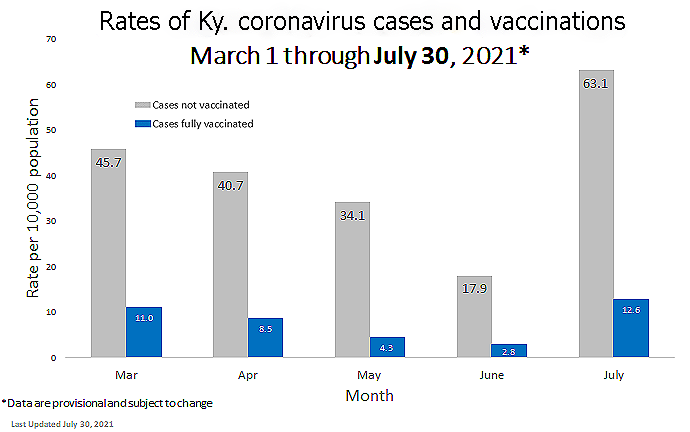
From March through July, 94% of new coronavirus cases, 91.5% of Covid-19 hospitalizations and 88.7% of Covid-related deaths were Kentuckians who were unvaccinated or only partially vaccinated.

Beshear stressed that fully vaccinated people are protected against severe illness and death, and he is asking vaccinated people to wear masks because of the latest research showing they can spread the virus. 

Two of the state's 10 hospital readiness regions were using at least 80% of their intensive-care beds. The easternmost region, from Lee to Pike counties, was at 85%, with 24% of ICU beds used by Covid-19 patients; Lake Cumberland, was at 87%, with 29% of ICU beds used by Covid-19 patients. 

The statewide rate of daily new cases over the last seven days is 29.64 per 100,000 residents. Counties with double that rate areClay, 104.8; Jackson, 89.0; Laurel, 70.5; Floyd, 69.4; Hart, 68.3; Letcher, 61.6; and Muhlenberg, 59.7. Of the state's 120 counties, 74 are considered to have what the state calls a "critical" level of virus transmission. The CDC's critical level is lower than the state's.

And while all of these numbers are concerning, Beshear stressed that the difference between now and the beginning of the pandemic, when the state took more extreme measures to slow the virus, is the vaccines.

The state reported five Covid-19 deaths Monday, bringing the toll to 7,348. 

Dept. for Public Health graph shows that unvaccinated Kentuckians
are five times as likely to get infected as their vaccinated neighbors.
Vaccinations:
Kentucky has not seen a spike in vaccinations like a few states, but Beshear said the trend is going in the right direction. He said more than 40,000 residents of the state got vaccinated last week, which was half the number vaccinated in the month prior to that. 

"The Delta variant is spreading like wildfire," he said. "If you are unvaccinated, you are at significant risk. Please, go get vaccinated." 

Kentuckians under 40 continue to have vaccination rates under 50%, with 18-to-29-year-olds at 37%. "That's far, far too low," said Beshear. "This Delta variant is coming for you."

Statewide, 52% of the state's total population has received at least one dose of a vaccine and 63% of adults have.

Beshear gave a shout-out to Kentucky Health News Editor-Publisher Al Cross for his request that local news media and medical professionals collaborate to persuade Kentuckians to get a shot.

"There is no more immediately pressing public interest in this country or this state than persuading people to get vaccinated," Cross wrote in his weekly Kentucky Health News update to news media.

Hospitals seeing many more Covid-19 cases, and more of them in younger people; four systems now require employee vaccination

This story has been updated.

Kentucky Health News graph, based on data from state Department for Public Health
When the pandemic resurged in Kentucky last month, Gov. Andy Beshear said he would base his decisions about how to deal with it partly on the number of hospitalizations, "what the outcomes are, and how sick individuals are."

"Outcomes" mean recovery, death or something in between, such as the lingering illness known as "long Covid." Death is a lagging indicator of the pandemic, and Covid-19 deaths in Kentucky remain low, averaging less than four per day. But there is a rising level of sickness, as measured by Covid-19 hospitalizations, intensive-care cases and mechanically ventilated patients.

On June 28, Kentucky hospitals reported 169 patients with Covid-19. On July 30, they reported 625. Monday, Aug. 2, it was 796. Hospitalizations began a steep increase on July 15, and are doubling about every 12 days.

Almost all the new admissions are people who have not been vaccinated for the coronavirus, hospitals told Deborah Yetter of the Louisville Courier Journal.

The number of Covid-19 patients in intensive care has likewise increased, from 51 on June 27 to 195 on June 30. On Monday, the number hit 250, doubling in 11 days. Those on ventilators increased from 21 on June 30 to 85 a month later, and to 98 on Monday.

Kristy Quinn, spokesperson for Baptist Health Madisonville, told Murray's WKMS that the hospital is seeing more patients who need serious care. “During the earlier surges of Covid, we saw larger numbers of inpatients at times than this, but the proportion of them in critical care was lower,” Quinn said. “To have half of them in [ICU] is significantly different from what we saw previously.”

Hospitals told Yetter and WKMS's Dustin Wilcox that they are seeing more young people who need hospitalization for Covid-19, "which they attribute to the much higher rate of vaccination in older Kentuckians who are at the greatest risk of serious illness or death from the virus," Yetter writes.

Hospitals say the surge makes vaccination imperative. Two major hospital operators, the University of Louisville and Med Center Health of Bowling Green, have told employees that they must be vaccinated by Sept. 1. Med Center Health, which has five Southern Kentucky hospitals, set an earlier deadline for staff in leadership positions, Aug. 9.

Baptist Health, which has seven major hospitals around the state, has a staff that is 75 percent vaccinated but is considering requiring vaccination, Chief Medical Officer Kenneth Anderson told Yetter. announced Monday that it would require employees to be vaccinated. Norton Healthcare in Louisville did likewise.

Pikeville Medical Center CEO Donovan Blackburn told Yetter that about 60% of employees have been vaccinated. "Of those who haven't, some express distrust of the vaccine or possible unknown effects" she reports. "Others who are young and healthy don't see the need." The hospital is trying to persuade them.

"I think there's some that are swayable," Blackburn said. "There's some that are dead-set against it."

UPDATE, Aug. 3: The Centers for Medicare and Medicaid Services finalized its requirements for hospitals and al long-term-care facilities to report their employees' vaccination rates starting Oct. 1. "The move would let patients see the vaccination rates of health care personnel in the medical centers they visit, and comes as pressure grows on facilities to mandate vaccines for health workers," Politico Pulse reports. "Last week, nearly 60 medical groups urged hospitals and nursing homes to mandate shots for their employees."


Sunday, August 1, 2021

Fauci: The vaccinated can be as infectious as the unvaccinated, so they need to wear masks indoors; pandemic will get worse

As Gov. Andy Beshear issued a vaccination-promotion video with one of the latest student winners of the state's vaccine lottery, President Biden's top medical adviser warned that the pandemic will worsen.

“Things are going to get worse” due to the Delta variant of the coronavirus, Dr. Anthony Fauci said on ABC's "This Week" Sunday. “We are looking, not I believe, to lockdown, but we are looking to some pain and suffering in the future because we are seeing the cases go up.”

Anthony Fauci (CBS image)
Fauci, director of the National Institute of Allergy and Infectious Diseases, said “The solution to this is, get vaccinated.”

Fauci and other experts stressed that vaccines are still doing the job even though the Delta variant is infecting some vaccinated people, who can spread the virus without knowing the have it.

“Almost invariably they get minimal symptoms or no symptoms at all,” but new research shows they average about the same level of virus in their nasal pharynx as they unvaccinated, so that's why vaccinated people need to wear masks indoors, Fauci said on CBS's "Face The Nation."

“If you do get infected, the likelihood of you getting a severe outcome of the infection is very low … so the vaccine is doing what you want it to do: it’s preventing people from getting sick,” Fauci said.

Looking at it another way, the Centers for Disease Control and Prevention says that fewer than 0.1% of the 164 million vaccinated Americans have been infected with the virus, and only 0.001% of the vaccinated have died.

Speaking to the 100 million Americans who haven't been vaccinated though they are eligible, Fauci said, “If you're going to be part of the transmission chain to someone else, then your decision is impacting someone else. It's not only impacting you. And you've got to think about it, that you are a member of society and you have a responsibility.”

Vaccinations are increasing. In Kentucky, the CDC reported Sunday that 15,482 doses were given Saturday, the highest daily number in almost five weeks but still below the levels seen in most of May. The seven-day rolling average is 8,738 doses per day, a third higher than the previous week.

Chart by The Washington Post based on Centers for Disease Control and Prevention data

Special enrollment period for health insurance on healthcare.gov ends Aug. 15; subsidies are bigger, and more people qualify

By Melissa Patrick
Kentucky Health News

Time is running out to sign up for low- or no-cost health insurance through the federal marketplace under the special enrollment created by Congress and President Biden. The deadline to sign up on healthcare.gov is Aug. 15. 

AARP illustration
The president reopened the marketplace in mid-February under the American Rescue Plan Act, for people who needed coverage during the pandemic, and later extended the deadline to Aug. 15. 

The special enrollment is open to both new and existing customers, including the thousands of Kentuckians who got temporary Medicaid coverage during the pandemic through the state's "presumptive eligibility" program. 

About 120,000 Kentuckians lost that temporary Medicaid coverage in July, according to Brice Mitchell, a spokesman for the state Cabinet for Health and Family Services.  

Mitchell said the state has told some of those people they would be losing their coverage and encouraged them to check kynect.ky.gov to see if they qualify for traditional Medicaid, or go healthcare.gov to apply for a federally subsidized plan. He said state Kynectors, who help people enroll, will continue the outreach through August. 

Dustin Pugel, senior policy analyst at the Kentucky Center for Economic Policy, encouraged Kentuckians who recently lost their temporary Medicaid coverage and are not covered by work or traditional Medicaid to "Run, not walk, to the marketplace to find an affordable option." 

Priscilla Easterling, the outreach coordinator for Kentucky Voices for Health and a Kynector, also encouraged Kentuckians without health coverage to explore their options on healthcare.gov, especially those who looked at plans in the past and found them unaffordable at that time.

"With the increased subsidies that the American Rescue Plan included . . . we have seen so many people save a surprising amount of money," Easterling said. "It is 100-percent worth just checking it out. . . . It's a totally different ballgame."

A federal report says 34% of those who got a subsidized plan since April 1 paid $10 or less a month for their coverage, thanks to the American Rescue Plan's premium reductions. In Kentucky, 32% of new customers and 19% of returning customers were able to find a plan for $10 or less per month. 

In the special enrollment period, plans are more affordable due to bigger premium subsidies through tax credits, and no repayments are required if a tax return shows they didn't qualify for the tax credit. Also, more people eligible for the subsidies, and costs are limited to no more than 8.5% of income, down from nearly 10%.

For the first time, the new rules allow those earning more than 400% of the federal poverty level -- about $51,000 for an individual and $104,800 for a family of four in 2021 -- to get a subsidized plan. 

This change is especially helpful to older adults with incomes above 400% of the poverty level, because unlike traditional health plans, which are allowed to charge more based on age, special-enrollment premiums are capped at 8.5% of income.

"Compared to current premium payments, a 60-year-old with a $55,000 income would pay 77% less for a bronze plan ($146 vs. $634 per month), 56% less for a benchmark silver plan ($390 vs. $887 per month), and 52% less for a gold plan ($453 vs. $951 per month), on average," says the Kaiser Family Foundation.

Also benefiting from this expansion to 400% of the poverty line are self-employed people who have not had access to affordable health insurance. "As wonderful as the Affordable Care Act was to open up affordable coverage for so many people," Pugel said. "It really did leave that group of folks out." 

Through the end of June, 13,773 Kentuckians had signed up for health insurance during the special enrollment period, according to a federal report. That's an increase from the special enrollment periods in 2020 and 2019, when 6,747 and 7,041 signed up, respectively. 

But fewer than 10% of eligible Kentuckians have taken advantage of the opportunity. Easterling said about 115,000 Kentuckians who qualify for a subsidy under the special enrollment period have not yet signed up.

Nationwide, more than 2 million have signed up.

Open enrollment is usually in effect only six weeks at the end of a year, except for those who experience a "qualifying life event," like getting married or losing a job. After the special enrollment period closes on Aug. 15, open enrollment will re-open Nov. 1.

Biden's American Families Plan would make some of these measures permanent, including the bigger tax credits, coverage to those who earn 400% and above the federal poverty level, and the premium cap of 8.5% of household income. Those measures will stop at the end of 2022 unless Congress makes them permanent.

Neurosurgeon in a county at high risk from the coronavirus gets local paper to share the facts about the virus and the vaccines

In a big Kentucky county with a low coronavirus vaccination rate, a critical infection rate and Covid-19 patients filling its intensive-care beds, a doctor reached out to his local newspaper to voice his concerns.

Dr. Amr El-Naggar
Neurosurgeon Amr El-Naggar, a native of Egypt, said "he understands the freedom of choice, but wanted every member of the public to truly consider what that freedom means," the Somerset Commonwealth Journal reports.

“I became a U.S. citizen 26 years ago, and one of the things that I learned is to appreciate freedom. This is the number one thing that I’m proud of. But I try to use my freedom in a correct way. I choose to live freely. I do not choose to die freely,” he said. “I have the freedom to take the vaccine or not. But I recommend you use your freedom to live and let your children live, and to enjoy the taste and smell of food and flowers. We do not have to give up those things that are gifts from God.”

In Pulaski County, only 40 percent of residents have received at least one dose of a coronavirus vaccine, the county's infection rate has put it in the state's "red zone" and is taxing Lake Cumberland Regional Hospital. 

“Two days ago, there were no open beds in the whole, and no ICU beds at all in the hospital,” El-Naggar said. “This condition waxes and wanes, but I’m aware there are big hospitals in the state that do not have any ICU beds at all. Beds are filling up very quickly. Much quicker than we did a year ago.”

In the interview, El-Naggar explained why unvaccinated people should get vaccinated even though the latest research shows that vaccinated people can still get and transmit the virus.

“The simple answer, my friend, is that ‘You get to live!’. . . If you are vaccinated, there is a chance you can get a breakthrough infection, but if you do you are going to probably get treated as an outpatient and still have your life. At worst you may be hospitalized for a few days, get treated then released!”

He said all the hospital's Covid-19 patients are unvaccinated, and “Many of them are young, and many are critical!” That's true all over the nation, he said.

“It is a statistical fact that the Moderna and Pfizer vaccines protect you from the virus in the order of 95%. It is also a statistical fact that about 95% of hospitalized Covid patients who require high levels of oxygenation and/or are on ventilators in critical care units are among the unvaccinated.”

El-Naggar also debunked myths about the vaccines' use of genetic material known as messenger RNA: “Our DNA, which is the main gene codes of our body, are in the nucleus of the cell. The cell has a nucleus in the middle, and is surrounded by this cytoplasm, sort of like if you have a house and have the big yard or farm around it. The DNA lives in the house, or the core. And it sends the messenger RNA out. The first thing it does is expel it out of the nucleus. It goes into the cytoplasm or the yard. But the messenger RNA does not have the ability to reenter the nucleus. In other words, it goes out into the yard of the farm, and it can never be allowed to enter into the house again.”

The doctor also said there is no evidence that the vaccines affect female fertility, and “People might be surprised to know that it is recommended that pregnant women be vaccinated. If a pregnant woman gets infected with the Covid Delta variant, it puts her at a high risk of developing a severe illness and increases the probability of hospitalization and critical-care needs.”