Friday, January 7, 2022

America's Health Rankings provide a snapshot of Kentucky's health challenges, but also of its recent progress

Kentucky page of report from United Health Foundation; to enlarge or download, click on it.
By Ben Chandler
Foundation for a Healthy Kentucky

As we move into another year, the discussion of New Year’s resolutions and the noble quest for doing some things differently and better comes to the forefront. More than half of all such resolutions are health-related – namely losing weight, better diet, and regular exercise.

Each of us will decide individually what, if anything, we would like to improve during 2022. And perhaps collectively, as a commonwealth, we should consider areas for “self-improvement.” A review of the recently released 2021 America’s Health Rankings might be a good thought-starter. The rankings, released by the United Health Foundation, provide a snapshot of Kentucky’s overall health relative to other states. It does not merely “rank” states against one another; it evaluates each state through a set of health, environmental and socioeconomic categories to help shed light on our health challenges and successes.

The rankings are created to help states determine health benchmarks and establish goals moving forward.

This year’s report reinforces the Foundation for a Healthy Kentucky’s priorities regarding how we can collectively create a healthier commonwealth in 2022 and beyond. The foundation’s priorities include combating obesity, reducing diabetes by improving nutrition, and physical exercise.

Indeed, the report validates these priorities. It indicates 36.6 percent of Kentucky adults are obese (compared to 31.9% nationally), a higher percentage than all but five states. Kentucky ranks 50th in two other categories of concern – the amount of vegetables and fruit consumed, and physical activity and exercise.

It is my hope that individual Kentuckians, their communities, their local and state government representatives, and health-care advocates – among others – can have open, candid dialogue about increasing opportunities for physical activity and ensuring more access to healthy food. For Kentucky school children, stronger nutritional standards, increased participation in school nutrition programs, and quality physical education are needed.

As an organization whose mission is to address unmet health needs of Kentuckians by developing and influencing policy, improving access to care, reducing health disparities, and promoting health equity, we view these rankings as a call to action for leaders in government, health care, education and social services … as well as for individual Kentuckians.

Though Kentucky has the second highest percentage of adults who smoke tobacco products, there is a ray of good news: Smoking among adults has declined 26 percent during recent years – from 29% in 2011 to 21.4% in 2021.

While that is a positive trend, there is much more work to be done. Every Kentuckian who smokes should strongly consider quitting as a 2022 resolution. Tobacco-use prevention and cessation programs are available, though more funding is critically needed.

It is encouraging to see we are ranked 14th for percentage of residents (93.6%) covered by private or public health insurance. But barriers to health-care access remain. Consider that Kentucky ranks 42nd for percentage of homes lacking reliable internet. Kentuckians need this access to tap into telehealth services. Though telehealth was less common pre-pandemic, it is here to stay and a necessity for residents with limited access to transportation or who live an hour or more from the nearest health-care provider.

Another noteworthy but negative item from the report: Kentucky ranks 45th for non-medical drug use among adults and 42nd for drug deaths. Kentucky’s substance-use epidemic is spiraling in a dangerous direction. There is a crisis-level need for funding and support for expanded prevention, treatment and mitigation services.

While some may view the rankings as daunting, it’s important we view them as points of reference for Kentuckians’ health. Now is the time to challenge one another – to push for new and better ways to make our entire commonwealth healthier.

Ben Chandler is president and CEO of the Foundation for a Healthy Kentucky.

Don't just cover your nose and mouth when you cough or sneeze; tilt your head down, study indicates

Pinstock/Getty Images
Coughing downward may be the best way to prevent germs from traveling far and infecting others.

A recent study published in AIP Advances used three mannequins to mimic people going up and down stairs. Researchers examined the fall of droplets from each mannequin to model how respiratory droplets fall from people.

When a mannequin went upstairs, particles concentrated below the shoulder and moved downward for a short distance. Going downstairs, particles dispersed over the mannequins' heads and flowed over a long distance.

"These results suggest that we should cough with the head down toward the ground to ensure that most of the droplets enter the wake region," said Hongping Wang, the lead author.

The study's authors stress the importance of not only coughing downward but also continuing social distancing, especially for people going downstairs or riding descending escalators and for covering one's coughs and sneezes.

Looking to be more active in 2022? Here are some tips

Photo by Julia Larson from Prexels

The American Chiropractic Association recently released five strategies to help people establish a more active lifestyle.

The release came in early January, when people normally try to become healthier and lose weight, but pandemic restrictions during the past two years have caused many people to be even less active than normal. If you have been less than active the past year or two, consider the following strategies to help you get moving again:
  • Just start moving. According to Matthew Dimond of the ACA, the type of exercise is less important than whether or not a person is moving. In his words: "Make it fun."
  • Be consistent. After getting started, the most important thing is consistency. “The human body—and the human mind for that matter—like normalcy,” DiMond explains. “Wherever you currently are is what your body likes to do. The initial effort can be monumental; being consistent with it will create a habit.”
  • Be accountable. Consider finding an exercise partner or activities that involve other people. Such connections can often inspire, drive, and motivate people to focus on their health goals and move forward.
  • Be safe. When starting to move again after being inactive, assume you will not be as physically fit as you once were. Be aware of your limits and focus on what works for you, rather than comparing yourself to others or to your previous fitness level. Also be mindful of any pain you experience. 
  • Identify your motivation. Motivation can be a challenge for people who start to move after a period of inactivity. “Willpower is not enough,” DiMond says. He encourages people to define their goals in terms of “what” instead of “why.” Ask yourself what you are trying to accomplish and create measurements based on that goal. Do you want to run a 5K? Do you want to walk your dog every day or be able to pick up your grandchild? Determine your “what” and set metrics to achieve it.
“Brief periods of inactivity usually aren’t that big of a deal,” DiMond says. “However, long-standing inactivity will lead to more fatigue, tiredness, and lethargy. Depending on where you are in the lifespan, muscle fiber types can start to change, and that can be detrimental. In the elderly, less movement and decreasing load demands can have a negative impact on their quality of compact bone.”

Thursday, January 6, 2022

Kentucky has over 9,000 new coronavirus cases for 2nd day in a row, setting another record; positive-test rate also at new high

New York Times map, adapted by Kentucky Health News; to enlarge, click on it.
By Melissa Patrick
Kentucky Health News

Coronavirus cases and the share of Kentuckians testing positive for the virus set records for the third day in a row, caused by the Omicron variant which Gov. Andy Beshear said "is now the predominant variant in Kentucky and across the country."  

Kentucky reported 9,836 new coronavirus cases Thursday, up 29 from Wednesday. That brings the seven-day rolling average to 6,220 per day. Of today's new cases, 21% are in people 18 and younger. 

Kentucky's seven-day infection rate is 133 daily cases per 100,000 people. The New York Times ranks Kentucky's rate 32nd among the states. 

The share of Kentuckians testing positive for the virus in the past seven days is 23.67%, up from 22.89% on Wednesday. "Nearly one in four people being tested are coming up positive," said Beshear

Because the Omicron variant is so contagious, Beshear has said one of the most important metrics to follow are hospitalizations, which continue to rise. 

“They’re starting to increase rapidly,” Beshear said. “Although we’re hopeful we will not see a similar increase in ICU admissions and patients needing a ventilator, there are still people getting very sick, and the trend does not look positive in either of those areas.”

Kentucky hospitals reported 1,783 Covid-19 patients Thursday, 79 more than Wednesday, with 402 of them in intensive care units (up 8) and 227 on mechanical ventilation (up 16). 

Nine of the state's 10 hospital-readiness regions are using at least 80% of their intensive-care-unit capacity, with seven over 90%. The Lake Cumberland region is using all its ICU beds. Overall, 91% of ICU beds are in use.

Beshear said the increase in hospitalizations is "real cause for concern that hospitals can and maybe will be overrun" and the state is looking at ways to augment them, including use of nursing programs and the National Guard.

He also called Kentuckians to help: “Folks, you can help us. You can help us by getting vaccinated and getting your booster, which makes it very unlikely that you'll end up in the hospital, and then wearing a mask when it's appropriate.” 

State Department for Public Health graph; click it to enlarge. 
In another effort to encourage vaccination, Beshear showed how deaths related to Covid-19 are much higher among those who are unvaccinated, across all age groups.  

Since July, there have been 453 Covid-19 deaths among unvaccinated Kentuckians younger than 50, and 15 among those who were vaccinated. Among those in their 50s, 643 deaths were among the unvaccinated and 51 were among the vaccinated. Of those in their 60s, 920 victims were unvaccinated and 179 were unvaccinated. Of those 70 and older, 1,495 were unvaccinated and 699 were vaccinated. 

Since June, when the Delta variant hit Kentucky, 10% of all deaths are among people in their 30s. In Kentucky, 61% of people aged 25 to 39 have received at least one dose of a vaccine. That's almost the rate for the total population, 62%. But only 27% of fully vaccinated people have received a booster shot. 

The Centers for Disease Control and Prevention has endorsed an advisory panel's recommendation that 12-to-15-year-olds should get the Pfizer-BioNTech booster at least five months after their second Pfizer shot. Boosters were already approved for 16- and 17-year-olds.

At his regular Thursday press conference, Beshear was asked if he was concerned about the large number of state legislators not wearing masks. He said that given how fast the virus is spreading, "People are just putting themselves at a risk that they shouldn't. . . . I just really hope that people will wear masks, and I don't want to see anybody harmed." 

Asked if we can get to the other side of this Omicron surge without masks, he said, "We're gonna get on the other side of the surge one way or another, the question is how many people are hurt in the process. The number of people that we lose will be based in part on the number of cases that we have." 

He acknowledged that people are tired of wearing masks, but said, "The need to wear a mask to lessen the spread has never been greater, even if the personal threat to you might be a little bit less." The Omicron variant appears to be causing milder cases, but the number of cases still threatens hospitals.

Beshear said "some significant outbreaks" are in state prisons, including the Eastern Kentucky Correctional Complex in West Liberty, the Kentucky Correctional Institution for Women at Pewee Valley, Roederer Correctional Complex at LaGrange and Lee Adjustment Center at Beattyville.

Beshear said prisoners and staff have good vaccination rates and that the prisons have protocols to protect the inmates, including limiting visitation, separating prisoners who test positive for the virus and providing mask. 

The state reported 35 more Covid-19 deaths, bringing the pandemic death toll to 12,319. Over the last two weeks, it has reported an average of 25 per day.

Wednesday, January 5, 2022

Kentucky pediatrician urges vaccines and masking to keep children in schools: 'This is a very worrisome time in pediatrics'

By Melissa Patrick
Kentucky Health News

As coronavirus cases surged across the state in the first days of January, several Kentucky doctors not only urged Kentucky adults to get vaccinated and to wear masks, but also to get their children vaccinated and make sure they are wearing a mask to school.  

Dr. Lindsay Ragsdale
"This is the way that we can keep school systems in-person: vaccinations and masking. Really, really strongly encourage that," Dr. Lindsay Ragsdale, interim chief medical officer at Kentucky Children’s Hospital, said at a news conference. 

"We don't want to get involved in all of the debates. We just know what science says, which is vaccinations work, masking works and hand washing -- it works," Ragsdale said. "So we'd like to encourage our pediatric patients to continue to do that, and parents can be part of this. So making sure that your child goes to school every day with a mask on, making sure you encourage them to wash their hands and get vaccinated." 

At the same news conference, Dr. Dan Goulson, chief medical officer at CHI Saint Joseph Health, encouraged Kentuckians to stay strong in their commitment to the public health measures that have been proven to work to slow the spread of disease. These include masking, social distancing, hand hygiene, staying home when you are sick, regular testing and avoiding large crowds if at all possible. 

"We're in a situation now where masking is as important as it's ever been, and vaccination and being boosted is as important as it's ever been," he said. 

In Kentucky, about one-fifth of coronavirus cases have been in people younger than 20. 

Ragsdale said the children's hospital is starting to get more Covid-19 hospitalizations, and most of their patients are unvaccinated, including their most severe cases. 

"So we really do strongly suggest vaccines for kids that are eligible and masks while in school," she said. "This is  a very worrisome time in pediatrics. We've seen other states really have a skyrocket in the number of pediatric patients that are getting infected with Covid and needing hospitalizations, so we're definitely worried about that. "

An NBC News analysis found that Kentucky is one of at least nine states reporting record numbers of Covid-related hospitalizations of children, and the American Academy of Pediatrics has reported a sharp rise in pediatric Covid-19 patients across the nation. 

"Covid-19 cases among U.S. children have reached the highest case count ever reported since the start of the pandemic," the report said. "For the week ending December 30th, over 325,000 child Covid-19 cases were reported. This number is a 64% increase over the 199,000 added cases reported the week ending December 23rd and an almost doubling of case counts from the two weeks prior."

Ragsdale encouraged parents who are on the fence about getting their children vaccinated to get off the fence.

"We have seen really sick kids in our children's hospital," she said. "Kids needing ventilation and ECMO or bypass." ECMO stands for extracorporeal membrane oxygenation and is used to oxygenate a patient's blood outside the body to allow the heart and lungs to rest.

"This can be very severe. So the idea that this doesn't affect children is not true any longer. We really want to take this seriously. . . . Masking, handwashing and vaccines for kids are the way that we can keep them out of the hospital."

This urgent plea to get kids vaccinated and to wear masks comes as schools across Kentucky re-open to in-person learning and many of them with "masks optional" policies, despite Kentucky's record high numbers of Covid-19 cases and positive test rates. 

"They've got to wear these masks," Health Commissioner Steven Stack said Jan. 3. "I'm telling you, if you open a school this week, and you're not requiring masks, you're gonna infect the whole building in the first two weeks. I mean, it's gonna happen that fast."

Fewer than half of 12-to-17-year-olds and only 17% of 5-to-11-year-olds have received a Covid-19 vaccine, so most of Kentucky's school-age children aren't protected from the highly contagious Omicron variant.

Ragsdale said she worries about low vaccination rates. "We really are concerned that we have kids that are coming back to school," she said. "Omicron is highly contagious and we want to protect the kids of Kentucky the best we can and the ways that we know how to do that is masking, hand washing and vaccinations."

Coronavirus numbers explode; positive-test rate also at new high; seven-day average of new cases has doubled in one week

Gov. Andy Beshear donned a mask Wednesday as he concluded his pandemic report on Facebook.
By Al Cross
Kentucky Health News

Kentucky reported 9,807 new cases of the coronavirus Wednesday, an explosion that far exceeded the record of 6,915 set the day before.

Likewise, the percentage of Kentuckians testing positive for the virus in the last seven days hit another new high, 22.89%.

The state's seven-day infection rate was 123 new cases per 100,000 residents, meaning that of every 10,000 Kentuckians, more than 12 have been identified as coronavirus cases in the last seven days. Tuesday, the rate was 109.

The seven-day rolling average of new cases is 5,735, more than 600 above Tuesday's figure and more than double last Wednesday's 2,832. 

As steep as those increases are, they are not as steep as those seen in the rest of the nation. The state's infection rate ranks 30th among the states and its rate of increase in the last 14 days, 129%, is 34th, according to The New York Times. The national increase in the same period has been 254%.

Health experts say hospital numbers are likely to be the critical statistics, since the now-dominant Omicron variant of the virus seems to cause milder cases though it is one of the most infectious viruses ever found.

Kentucky hospitals reported 1,704 Covid-19 patients at midnight Wednesday, 58 more than Tuesday, with 394 of them in intensive care (up by 1) and 211 on mechanical ventilation (down 35, or 14%).

Eight of Kentucky's hospital-readiness regions reported more than 80% of their intensive-care beds in use, with five of them above 90%. The Barren River region, which includes Bowling Green, was highest at 98.45%.
 
"Omicron is surging; more cases than we ever thought possible in any given day," Gov. Andy Beshear said on Facebook. "Everybody needs to not only be vaccinated, but get boosted. If you're eligible for your booster and you haven't gotten it yet, get it tonight or get it tomorrow. Do not wait."

Holding up an N95 mask, Beshear also urged his audience to mask up. "Folks, wearing these masks right now protect you. Otherwise, you'll be getting this, you'll be spreading it, and I know no one wants that to happen. So please be careful during this period of time. Thank you."

The state reported 29 more Covid-19 deaths, bringing Kentucky's pandemic death toll to 12,284.

Kentucky's flu season is in full swing, with cases still increasing; cases have been confirmed in 15 of the state's 16 health regions

State Department for Public Health map, adapted by Kentucky Health News; click on it to enlarge.
By Melissa Patrick
Kentucky Health News

Influenza cases in Kentucky continue on the rise, and health officials say it's not too late to get your flu vaccination. Flu season typically peaks in February, but runs through May.

"It is very important that people get their flu vaccine," said Brooke Hudspeth, chief practice officer at the University of Kentucky College of Pharmacy. "We know that flu vaccines work and they are very well tolerated. And they are a key way to help prevent complications that we see from the flu."

The latest weekly report from the state Department for Public Health shows that in the week ended Dec. 18, Kentucky counted 618 new flu cases, up from 402 the previous week, an increase of nearly 54%. That followed a week in which the state saw a jump of 106%. The state has recorded 1,313 cases this season. No flu-related deaths have been reported this year.

Fewer adults in Kentucky got a flu vaccine last season, but the state also saw a big drop in cases. During the same reporting week last year, Kentucky had only two confirmed cases of the flu, and a total of 127 for the season.

The drop was likely due to the strict public-health measures taken against Covid-19, such as masking and social distancing.
 
According to the Centers for Disease Control and Prevention, the number of adults getting a flu vaccine in Kentucky dropped to 44.9% in the 2020-21 flu season, compared to 48.4% in the 2019-20 flu season.

A county-by-county report shows that Jefferson County, which has more than 750,000 people, had the highest number of cases, reporting 262 in the week ending Dec. 18. Other counties with the highest number of cases that week were Allen, 70; Warren, 42; Pike, 42; Oldham, 28; Fayette, 27; Jessamine, 22; and Floyd, 17. 

State Health Commissioner Steven Stack has repeatedly encouraged Kentuckians to get both a Covid-19 vaccination or booster and a flu vaccine.

"With Covid-19 cases escalating and the added threat of circulating flu viruses, it is imperative that every Kentuckian take the essential steps to protect themselves, their loved ones and their communities," Stack said in a news release.

Hudspeth said it is safe to get both the Covid-19 vaccination and the flu shot at the same time, and it's important to get both, since having Covid-19 and the flu at the same time can increase a person's risk of severe complications.

“If you are vaccinated, you are less likely to get the flu and spread the flu to those at greatest risk for becoming dangerously ill, including young children, pregnant women, people 65 and older and those with underlying medical conditions," said Stack.

At a Dec. 18 news conference, Stack said this year's flu vaccine should be quite effective because it contains the H3N2 strain, which is the one that is circulating. "So this year's vaccine should be very helpful," he said.

Flu shots are recommended for everyone six months and older and are strongly encouraged for people who may be at higher risk for complications or negative consequences.

Kentucky has a long way to go to get all of its adults vaccinated against the flu.
 
A Foundation for a Healthy Kentucky poll, taken Aug. 4 through Sept. 4, found that almost two-thirds of Kentucky adults said they are very or somewhat likely to get the vaccine by the end of the year; 28.4% said they were very unlikely to get the flu vaccine and 5.9% said they were somewhat unlikely to get it.

Kentucky's influenza level is considered to be widespread, a classification that is applied when increases in flu cases have been confirmed in at least half of the state's 16 regions.

Tuesday, January 4, 2022

Ky. again sets records for new Covid-19 cases and positivity rate; governor begs Kentuckians to get vaccinated and wear a mask

Ky. Dept. for Public Health map, adapted by Ky. Health News; for a larger version, click on it.
By Melissa Patrick
Kentucky Health News

Kentucky again set records for new coronavirus cases and its positive-test rate Tuesday, driven by the highly contagious Omicron variant of the virus.

"Omicron is spreading like wildfire throughout Kentucky," Gov. Andy Beshear said on Facebook. "Everybody needs to get vaccinated and boosted. And folks, you have got to be wearing a mask when you are in public places and indoors right now. Not because anybody's telling you you have to, but to protect yourself and to try not to spread this to other people. We are seeing a surge the likes of which this country and this world have not seen in our lifetimes." 

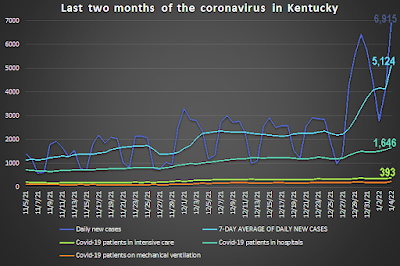
KHN graph; case numbers from initial, unadjusted reports; click to enlarge.
Of the 6,915 new cases reported on Tuesday, 20% are 18 and under. The seven-day rolling average for cases is 5,124, more than double what it was a week ago.  

The share of Kentuckians testing positive for the virus in the past seven days is 21.74%, more than a full percentage point above Monday's rate. 

Hospital numbers also jumped. Kentucky hospitals reported 1,646 Covid-19 patients, an increase of 67 from Monday, with 393 of them in intensive care (up 20) and 246 on mechanical ventilation (up 41). The number of Covid-19 patients in Kentucky hospitals is 24% higher than a week ago. 

Beshear said there is hope that Omicron "is less severe in its effects" than the Delta variant, but "If this many people continue to get Omicron it will fill up our hospitals and it will create challenges for others who need care."

Doctors from several Lexington hospitals held a joint press conference to discuss the increasing numbers of cases and to urge Kentuckians to get a Covid-19 vaccine or booster and to wear a mask in indoor spaces, along with other public health measures, to prevent the spread of the Omicron variant. 

"The more people we get vaccinated and boosted the more we can help to slow this down and decrease hospitalizations," said Dr. David Dougherty, an infectious-disease specialist at Baptist Health Lexington. "A lot of us are going to be exposed to Omicron, but if you're vaccinated and especially if you're boosted, your chances of getting hospitalized are much lower."

Baptist Health and St. Elizabeth Healthcare of Northern Kentucky are scaling back inpatient elective surgeries due to the influx of patients. 

Seven of the state's 10 hospital-readiness regions are using at least 90% of their intensive care unit capacity, with three of them at 98% or above. Northern Kentucky is again at 100%.

The state's daily infection rate is 109.36 cases per 100,000 residents; 24 counties have infection rates over 100 per 100,000 (1 per 1,000), and all but four of the 120 counties are red on the state infection map, for counties with more than 25 cases per 100,000, the state's highest category of infection. 

The New York Times ranks Kentucky's infection rate 25th among the states, reporting a 119% increase in cases in the last 14 days.

The state reported 21 more Covid-19 deaths, bringing the pandemic death toll to 12,255.

As the Omicron variant of the coronavirus rages through Kentucky, some hospitals are stopping inpatient elective surgeries

Baptist Health Lexington (Baptist Health Foundation photo)
By Melissa Patrick
Kentucky Health News

As the Omicron variant of the coronavirus skyrockets in Kentucky, hospitals and their intensive-care units continue to fill up, and a few Kentucky hospitals have begun to scale back on some elective surgeries. 

One is Baptist Health Lexington. Dr. David Dougherty, an infectious-disease specialist at the hospital, said Tuesday that the hospital will postpone or scale back inpatient elective surgeries starting Wednesday. He said it will continue to do outpatient elective surgeries. 

"The elective surgeries that we're postponing right now are mostly the ones that are requiring an overnight stay, and they're, you know, non-urgent or emergent cases," he said. "And this is a fluid thing, you know, we're assessing on a daily basis when this will end and we can do elective surgeries again." 

St. Elizabeth Healthcare in Northern Kentucky is also scaling back elective procedures by not scheduling any additional same-day and elective surgeries that require admissions through Jan. 8, and halting any non-emergency add-on cases until mid-January, the Northern Kentucky Tribune reports.

“Our community is in the midst of a surge from a mix of Delta-variant infections and Omicron-variant infections, the latter strain having a much shorter doubling time and infection rate,” said a statement from St. Elizabeth. “At the conclusion of the holiday season and people gathering, we are expecting to see incidence rates in our region over the next few weeks.”

Dougherty said the best way to slow down Covid-19 hospitalizations is for people to get vaccinated or boosted, noting that an influx of Covid-19 patients affects care for everyone. 

"The more people we get vaccinated and boosted the more we can help to slow this down and decrease hospitalizations," he said. "A lot of us are going to be exposed to Omicron, but if you're vaccinated and especially if you're boosted, your chances of getting hospitalized are much lower."

Dougherty said the decision to postpone some elective surgeries is the result of both staffing issues and bed space, which go "hand in hand." He said 85 of the 450 beds at his hospital are occupied by Covid-19 patients, and the number will increase; and Omicron puts hospital staff at increased risk of infection.  

Doctors from CHI Saint Joseph Health and UK HealthCare said at the same press conference that they have not had to curtail elective surgeries, but said both Lexington hospitals consider it daily. 

Dr. Ashley Montgomery-Yates, chief medical officer for inpatient and emergency services at UK, said "I would speculate that with our numbers continuing to rise, with the alarming rate, it's not out of the realm of possibility." 

Yates also pointed to the real-life challenges associated with canceling elective procedures, noting that often what is considered elective may not feel very elective to patients who are dealing with diseases like cancer. 

Dr. Dan Goulson, chief medical officer at CHI Saint Joseph Health, said hospitals are still caring for patients who had elective procedures cancelled earlier in the pandemic.

Monday, January 3, 2022

Coronavirus causes cases to escalate as schools begin to re-open; Beshear and top doctor urge universal masking in schools

State Dept. for Public Health graph, adapted by Kentucky Health News; to enlarge, click on it.
State graph, adapted by Ky. Health News; click to enlarge.

By Melissa Patrick

Kentucky Health News

With coronavirus cases and positive-test rate skyrocketing just as students head back to school, Gov. Andy Beshear and his health commissioner urged more parents to get their children vaccinated and said universal masking in schools will be key to keeping Kentucky's kids in classrooms. 

 "I'm telling you, if you open a school this week and you're not requiring masks, you're going to infect the whole building in the first two weeks. I mean, it's going to happen that fast. This virus is like measles," the most infectious disease known, Commissioner Steven Stack said at a news conference.

"So, folks, I urge you if you're running a school, require masks when they come back to school after this New Year's break [and] use the test-to-stay program. Employees, we're going to keep our regular guidance up that we had before, because if you use test-to-stay plus masks, no kid needs to miss school unless they actually have an infection, and then they shouldn't be in school because we can't afford to have Covid(-19) spreading around other folks."

Beshear said he would ask legislators, who start their annual session Tuesday, to give him back the power to require masks in schools.

"I have or I am asking the General Assembly to return authority to require masking in public schools," he said in response to a question. "I don't expect them to do it but I do believe it's necessary. And I think we've seen the pressures at the local levels are just too much for some leaders to do what I think each one knows is necessary and right. But it's also really unpopular or could be unpopular. I actually think the majority wants it in the community that they're in. I'm willing to take that hit. I'm willing to be the unpopular guy if it means that my kids and everybody else's are not only protected in schools, but that they also can stay in school."

Fewer than 50% of 12-to-17-year-olds and only 17% of 5-to-11-year-olds have received a Covid-19 vaccine, so most of Kentucky's school-age children aren't protected from the highly contagious Omicron variant. 

Of the 4,111 new cases reported Monday, 20% of them were in people 18 and younger. Since Dec. 30, Kentucky has reported 23,426 new cases, including 6,441 on Dec. 30, the most since the pandemic began. 

From last Monday to Sunday, Kentucky saw its second highest week of cases since the beginning of the pandemic, with 29,955 cases reported in the week ending Jan. 2, surpassed only by the week of Aug. 30.

The share of Kentuckians testing positive for the virus in the past seven days is 20.72%, the highest rate since the start of the pandemic.

Beshear cautioned that these numbers are likely lower than reality, because of delayed holiday reporting and home testing.

"Omicron has not only come to the commonwealth, it has hit us harder in terms of escalation of cases than anything we have seen to date," Beshear said. He added later, "We are likely to see a further escalation." 

The state's infection rate is 100.54 daily cases per 100,000 residents. Twenty of the state's counties have an infection rate above 100 daily cases per 100,000, and all but six of the 120 counties are red on the state infection map, for counties with more than 25 cases per 100,000, the state's highest category of infection. 

Beshear encouraged people who test positive for the virus to do three things: self-isolate, notify their close contacts, and inform their personal health-care provider that they have tested positive. 

"If you have Omicron and you don't isolate, you will infect a ton of people," said Beshear. Because it is so contagious, he said, it is more likely that you could infect an unvaccinated person or someone with pre-existing conditions -- groups that are at higher risk for getting a severe infection or being hospitalized.   

Hospital numbers are also going up. Kentucky hospitals reported 1,579 Covid-19 patients on Monday, with 373 of them in intensive care and 205 on mechanical ventilation. 

Eight of the state's 10 hospital-readiness regions are using at least 80% of their intensive-care capacity, with four above 90%. Northern Kentucky is at 100% capacity. 

While hospitalizations are not increasing as quickly as cases, Stack said, there is still cause for worry.

"If Omicron reaches a peak that's half again, or twice as high as the previous peak, there'll be plenty of people who are sick enough to need hospitalization," he said. "And unfortunately, it'll be predominantly unvaccinated folks who have no protection probably against the virus."

Beshear and Stack urged Kentuckians to get a Covid-19 vaccine, and if they have been vaccinated, to get a booster shot, which experts say is needed for reliable protection from the Omicron variant. 

Stack stressed that the vaccines remain the best line of defense against the virus, again pointing out that only one of the three available monoclonal antibodies will work against Omicron, which is making up 80% of cases in Kentucky, and that there is a very limited supply of the two antiviral pills. 

"I urge you to get vaccinated. Hands down it is the single most powerful medication tool we have to minimize the harm of this disease," said Stack. 

Beshear said that during December, about five unvaccinated individuals got Covid-19 for every one vaccinated person in Kentucky. 

So far, nearly 2.8 million Kentuckians have received at least one dose of a vaccine, or 62% of the total population; 2.4 million are fully vaccinated, or 54% of the total population; and 864,321 Kentuckians have gotten boosted, or 36% of those who have been fully vaccinated. 

The U.S. Food and Drug Administration has approved a Covid-19 booster shot for 12-to-15-year-olds and reduced the required wait time for a booster from six to five months after the second shot for anyone 12 and older, USA Today reports. The Centers for Disease Control and Prevention still must sign off on the authorization. 

The state health department has revised the guidance for the general public in light of the changes presented by the CDC last week allowing for shortened isolation and quarantine under certain circumstances. Click here to review the CDC guidance. Institutions of higher education may follow the guidance for the public. Health-care facilities (including long-term care) should follow the health care personnel guidance for isolation and quarantine. Guidance for K-12 Schools and Early Childhood Education remain unchanged

The state reported 120 more Covid-19 deaths since Dec. 30, bringing Kentucky's pandemic death toll to 12,234. One of the deaths was a 26-year-old man from Jefferson County.

Sunday, January 2, 2022

Kentucky Medical Assn. offers short videos for child vaccination

The Kentucky Medical Association has launched a new series of public service announcements encouraging parents to get their children immunized. The 30-second PSA appears below; the 60-second version can be downloaded at https://www.dropbox.com/s/urcqx6d22f0w0ru/KMA%20PSA%20-%20Purcell%20%3A60.mp4?dl=0.

Saturday, January 1, 2022

Baptist Health offers a free, one-hour, online class to help smokers quit; the next one is scheduled for Wednesday, Jan. 12

"Quitting tobacco is one the most common New Year’s resolutions made each year, but often proves to be one of the most difficult to keep," Baptist Health says in a news release about its free, online class in how to quit.

Quitting is tough for most people. The Centers for Disease Control and Prevention says more than half of adult smokers try to stop smoking but only one in 10 succeed. The pandemic is making it even tougher for many to quit, says Crystal Labbato, a certified tobacco-treatment specialist with Baptist Health.

“The pandemic has been so hard and isolating, and smoking is a common way to cope with stress,” Labbato says in the news release. “If you don't have alternative coping techniques, then you tend to fall back on the thing you know best. Unfortunately, smoking happens to be that for a lot of people.”

Labbato is the leader of "Plan to be Tobacco Free," the free one-hour class offered by Baptist Health and the Kentucky Cancer Program. The one-time online class, next scheduled Jan. 12, helps viewers learn about tobacco and nicotine addiction, over-the-counter replacement products and how to develop a personal plan to quit.

Labbato offers these tips for those in the class, and to anyone trying to quit:

If at first you don’t succeed, try, try again: In Labbato’s experience, it can take many attempts before someone is able to quit tobacco for good, because nicotine is so addictive and behavior is hard to change. She urges her patients not to get discouraged if their first try doesn’t work out.

“I always like to remind people that quitting smoking is probably the hardest thing they will ever do,” Labbato says. “It took you a while to learn how to smoke, it’s going to take you a while to learn how to live as a nonsmoker. The only thing that matters is that you keep showing up and you keep trying, because you will get there.”

Smokers who want to quit should review their past attempts, she says, to find a new strategy that will work. “I think you learn something new about yourself at each quit attempt, so with each try you bring along new skills that you've learned from the last try,” she says.

Don’t be afraid to ask for help: Quitting tobacco for good takes more than willpower, and health-care providers can be important partners to get you the resources you need.

“We've moved away from talking about smoking and continuing smoking as a moral failure,” Labbato says. “Nicotine addiction is a physiologic process is happening in your brain. our doctor can help you get real treatment, so always be honest about tobacco use.”

Labbato says medicine and counseling can double the chances of quitting. The Food and Drug Administration has approved seven medications to help smokers quit, which are reviewed in the "Plan to be Tobacco Free" class.

“The idea behind using medications is to calm down the mind and the withdrawal symptoms that cause anxiety . . . so you can work on the behavioral changes and new coping skills that you need to develop to walk away from cigarettes,” Labbato says.

A personalized plan can increase chances of success: In her one-on-one counseling sessions, Labbato works with patients to create a customized stop-smoking plan. To find new coping skills, for example, she asks them to think about where they find relaxation, which might be talking to a trusted friend.

Other recommendations can include increasing the amount of water you’re drinking, reducing alcohol and caffeine, or increasing physical activity.

“Personalizing it for the individual is important,” Labbato said. “What their sources of strength are, what are the sort of healthy coping patterns that they've used in the past, and we've also worked to explore new coping pattern, so that's an essential part of any quit plan.”

Register for "Plan to be Tobacco Free": The next free, one-hour, online class is scheduled for Wednesday, Jan. 12. More information and registration are at www.BaptistHealth.com/event/plan-to-be-tobacco-free-louisville.