Wednesday, January 12, 2022

Health portion of Beshear's budget would help nursing homes, fund training and retention of nurses; mental health, and more

By Melissa Patrick
Kentucky Health News

Gov. Andy Beshear previewed the health portion of his budget plan Wednesday, with new money for nursing homes, retention and recruitment of nurses, along with funding for senior hunger and mental health. 

Beshear will deliver his budget address at 7 p.m. ET Thursday, Jan. 13. In an unprecedented move that he called a stunt, Republicans who control the House filed their own version of the budget Friday. 

There are many differences in the plans for spending the state's money from July 1, 2022 to June 30, 2024, but Beshear said, "Any of our values that they fund more than we do, we're in favor of it."

The legislature makes the final decisions on the budget. The Democratic governor can remove line items with vetoes, but Republicans can override him with simple majorities in the House and Senate.

Nursing home relief: Both plans would keep paying nursing homes the additional $29 a day they have been getting for each of their Medicaid patients during the pandemic. 

The money comes mainly from the federal Centers for Medicare and Medicaid Services. The normal federal match rate for Medicaid is 72%, but that has been increased 6.2% during the pandemic.

The state is asking CMS to re-approve this additional funding retroactive to Jan. 1 and until the end of the federal health emergency, which is expected to be extended at least one more time, said Betsy Johnson, president of the Kentucky Association of Health Care Facilities, the nursing-home lobby.

"We are very grateful that it appears that both the Kentucky General Assembly and Governor Beshear are both on the same page with regard to the needs of skilled nursing facilities in Kentucky."

Johnson said she also was pleased to hear the governor say that the rate increase will be re-evaluated at the end of 2024. (Voters will decide in November 2023 if Beshear gets a second term.) 

"I believe the Kentucky General Assembly realizes that we're not going to ever be able to go back to pre-Covid days," Johnson said. "Our costs have gone way up, so this $29 add-on really should continue because that's just the reality of operating a skilled nursing facility today."

Money to retain and recruit nurses: Beshear said his budget will include scholarship money to recruit nursing students and loan-forgiveness money to keep nurses in the profession and in Kentucky. 

He said it will have $6 million a year to "significantly increase" scholarships, doubling the maximum award to $3,000 per semester. "That is a huge difference to students who want to pursue this path, but worry about the cost of doing so," Beshear said. Currently, about 150 students get scholarships funded by nursing-license fees.

To keep nurses on the job, Beshear's budget would create a five-year student-loan forgiveness program with up to $3,000 annually for each year a nurse or faculty member is employed in and stays in their job in Kentucky.

"We love our Kentucky nurses," Beshear said. "We want to support them and we want more people to join the ranks."
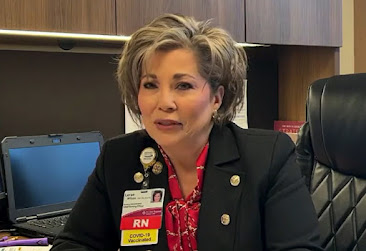
Lerae Wilson of St. Claire Regional Medical Center (Image from video)
Lerae Wilson, chief nursing officer and vice-president of patient services for St. Claire Regional Medical Center in Morehead, thanked the governor in a video. 

"Nurses are warriors," she said. "We are fighting for the lives of those we serve. . . . but these warriors are tired. They're exhausted. The pandemic has shown us that while we're good at what we do, mandatory overtime can only continue for so long. And with the shortage like it is we have got to have people who are willing to step into those shoes and continue that fight. . . . We have to have replacements." 

The Kentucky Nurses Association projects that the state will need more than 16,000 more nurses by 2024 to replace those who will retire or leave the profession, as many have during the pandemic.

A KNA survey of 850 nurses in October found that one-fourth said it was likely or extremely likely that they would leave their job in the next three months, and 16% said they were likely to leave nursing.

Beshear also wants to use $2 million of federal pandemic relief money for a marketing and outreach program for the profession, and includes nurses in his proposed $400 million "hero bonuses" for pandemic through-work.

In December, Beshear signed an executive order allowing the state to take special steps to educate and license more nurses. Among other things, it requires the state Board of Nursing to approve requests for enrollment increases in schools that show sufficient resources to handle more students; requires schools to report vacant student seats to the board each month; and requires the board to post them online, allowing schools without vacancies to refer applicants to the open slots. 

Senior hunger: Using pandemic money, Beshear said, Kentucky eliminate a waitlist of about 7,000 seniors to receive free meals. 

"I'm bit ashamed that I did not know before this pandemic that we had a waiting list for seniors that were going hungry in Kentucky," he said. "That's right. We had a list of how many seniors couldn't afford regular meals and needed our help and we weren't reaching all of them."

So that never happens again, Beshear said, he wants $36.2 million over the next two and a half years for an additional 49,000 meals for seniors per week, which fully meets the current needs of Kentucky’s citizens.

"We should never have a waiting list for seniors who are going hungry to get help ever again," he said. 

Mental health: Beshear's plan includes several boosts for mental health: 
  • $3.4 million in fiscal year 2023 and $9.9 million in fiscal year 2024 to phase in 170 additional staff to Kentucky's Community Mental Health Centers, which offer support 24-huors a day, seven-days a week. 
  • Implementation of the new 988 crisis support line, a three-digit number set to replace the National Suicide Prevention Lifeline in July 2024.
  • Funding to expand Tim's Law to two other psychiatric hospitals in the state: Eastern State Hospital and the Appalachian Regional Hospital system. Tim's Law allows judges to order assisted outpatient treatment for people who have been involuntarily hospitalized, aimed at stopping the revolving door of these individuals in and out of jails and state psychiatric hospitals. 
Also proposed in Beshear's health portion of the budget:
  • Full funding of Medicaid, which covers one in three Kentuckians, including more than 650,000 children. 
  • Money for 500 more slots in the "Michelle P." waiver program and 100 more slots in the Supports for Community Living waiver program, both for people with intellectual or developmental disabilities. Thousands of Kentuckians are on the programs' waiting lists. 
  • More than $36 million for health departments, which are shifting to a new funding model. The money can be used to help with staffing and operations. 
  • A 34% increase in funding for domestic violence centers, rape crisis centers and child advocacy centers; an additional $19.6 million a year to sustain and expand prevention services; and a 17% rate increase for residential and therapeutic foster-care providers. 
  • A $2 per-child, per-day increase in the child-care assistant program reimbursement rate, using federal relief funds.
  • Various funds to help veterans' causes, including $1 million in fiscal year 2024 to phase in operations at the newest state veterans center in Bowling Green.
  • Funding of the Pediatric Research Trust Fund, which organizes all Kentucky research on pediatric cancer, would rise to $3.75 million a year from $2.5 million.

Daily new cases of the coronavirus in Ky. set a record, at 11,232; hospitals, schools and communities are strained, Beshear says

Ky. Health News graph; cases are from initial, unadjusted daily reports. (Click on it to enlarge.)
By Al Cross
Kentucky Health News

The pandemic kept surging in Kentucky Wednesday, as the state reported a record 11,232 new cases of the coronavirus, another record-high rate of positive tests, and Covid-19 hospitalizations above 2,000 for the first time since September.

"Our hospitals are becoming strained and we're seeing concerning impacts in our schools and communities," Gov. Andy Beshear said on Facebook. "Please mask up and get your vaccine and booster."

Research shows that boosters of the Moderna or Pfizer-BioNTech vaccines are needed to provide immunity from the highly contagious Omicron variant of the virus, which accounts for almost all new cases. "If you're vaccinated and you're boosted, the chances of you getting sick are very, very low," said Dr. Anthony Fauci, director of the National Institute of Allergy and Infectious Diseases.

Kentucky's record count of new cases drove the state's seven-day average to 8,378, another record and 52 percent higher than the average reported a week ago. The national average went up 47% in the last week.

Kentucky's seven-day infection rate is 174 daily cases per 100,000 residents, also a record. But even though the new-case numbers have risen 240% in the last two weeks, the state's rate is only 29th among the states, according to federal data analyzed by The New York Times.

Kentucky's hot spots are mainly in metropolitan areas; the 22 counties with rates higher than the statewide rate are Jefferson, 260; Fayette, 251; Campbell, 236; Boone, 228; Warren, 226; Shelby, 222; Boyd, 216; Simpson, 216; Kenton, 212; Oldham, 207; Jessamine, 200; Hardin, 200; Greenup, 198; Carroll, 197.5; Muhlenberg, 194.1; Franklin, 192.8; Bullitt, 192.6; Daviess, 192.2; Spencer, 186; Nelson, 185.1; Pendleton, 179.2; and Henderson, 174.7.

The other record set Wednesday was the percentage of Kentuckians testing positive for the virus in the last seven days: 27.39%. It has been rising by more than half a percentage point per day for nine days.

Kentucky hospitals reported 2,011 patients with Covid-19, the first time since Sept. 28 that the figure exceeded 2,000. That was 58 more than Tuesday, a gain of 3%. Intensive-care units had 454 of the patients, up 5; and 243 were on mechanical ventilation, up 6.

Seven of the state's hospital-readiness regions reported more than 90% of their intensive-care beds in use, and two others were above 80%. Northern Kentucky was highest at 98.65%, with 43% of its ICU beds occupied by Covid-19 patients. The latter metric was highest in far Western Kentucky, at 47%.

The state attributed 21 more deaths to Covid-19, bringing its total to 12,455.

Tuesday, January 11, 2022

Pandemic still setting records in Kentucky; more than 1 in 4 who get tested are positive; hospitals and schools are disrupted

Chart by The Washington Post, adapted by Kentucky Health News; to enlarge, click on it.
By Melissa Patrick
Kentucky Health News

Kentucky's coronavirus cases continued to skyrocket Tuesday, and the state's positive-test rate hit yet another record and hospital numbers kept going up.

Kentucky reported 9,450 new cases Tuesday, the fourth most of the pandemic. The top three days were all last week, as were Nos. 5 and 6. Of today's cases, 24.8%, more than 2,000, were in people 18 and younger. 

The seven-day rolling average of new cases is 8,175, a new record that is 4.6% higher than Monday and 60% higher than it was a week ago.

The share of Kentuckians testing positive in the last seven days is 26.79%, another record, and that does not include any at-home test results. 

"Folks, we’re seeing an impact in our hospitals, our schools and our communities. Get your vaccine and booster and mask up," Gov. Andy Beshear said in a Facebook post.

Kentucky hospitals are asking the public to stop using emergency rooms for Covid-19 testing, Deborah Yetter reports for the Louisville Courier Journal.

"We are running into a lot of problems with patients coming into the emergency department simply for testing," Dr. Mark Spanier, medical director of the emergency department of Baptist Health Lexington, said Tuesday: "If you show up for routine testing, you'll be delaying care of other patients."

Kentucky hospitals reported 1,953 Covid-19 patients Tuesday, 80 more than Monday and one of the largest daily gains of the pandemic. Hospitalizations have gone up 47% in the last 14 days. 

The number of Covid-19 patients in intensive care and on mechanical ventilation both went down. The state reported 449 in intensive care, three fewer than Monday and 237 on mechanical ventilation, down one.

Nine of the state's 10 hospital-readiness regions are using at least 80% of their intensive-care beds, with five over 90%. Northern Kentucky is highest at 100%. 

The state's seven-day infection rate is 169.27 daily cases per 100,000 residents. Eight counties have rates above 200 per 100,000 people, including Fayette, 264.6; Jefferson, 261.5; Campbell, 238; Oldham, 217.3; Shelby, 211.6; Boone, 208.6; Jessamine, 203.8; and Boyd, 201.2. That's two more counties than Monday, and like then, all are in metropolitan areas. 

The New York Times ranks Kentucky's infection rate 30th among the states, a drop of 10 slots from Monday.

The state reported nine more Covid-19 deaths. The pandemic death toll in Kentucky is now 12,434. 

In other pandemic news:
  • Covid-19 vaccinations in Kentucky are trending upward after a four-week decline. The seven-day average of doses given is 16,392, almost 50 percent higher than the 10,991 average recorded Jan. 5. That's still well below the 21,726 average recorded Dec. 11, after which the decline began. Just over 58% of the eligible population, 5 and older, are vaccinated, and just under 38% of those have received a booster shot, which experts say is needed for immunity from the Omicron variant. Most shots being given now are boosters.
  • "Health departments are now asking people who have tested positive to notify others they may have exposed," WKYT-TV reports, quoting Woodford County Health Director Cassie Prather: “You want to make sure that those who live in your household are notified, and also anyone that you were with 24 to 48 hours prior to you becoming symptomatic or testing positive.”
  • The state Department for Public Health says people who have been in close contact with someone who has Covid-19 and is not fully vaccinated should quarantine for 10 days. That may be shortened to five days if you have no symptoms and test negative on the fifth day.
  • In his Monday press conference on the state's education budget, Beshear proposed adding $6.2 million a year for eight regional centers with staff to address the social, emotional and mental-health needs of students, which have been worsened by the pandemic. “We must do more to help our youngest Kentuckians heal, and deal with the adversity in their lives,” he said.
  • Lt. Gov. Jacqueline Coleman played video clips from students, including Julia Eady of Rowan County Senior High School, who said, “My peers are struggling with mental-health needs and obstacles . . . being safe and healthy is a basic need.”
  • Jefferson County Public Schools went on remote instruction Tuesday after being closed Monday. The county has state's second-highest coronavirus infection rate. It became impossible to safely staff schools, Supt. Marty Pollio told reporters Monday. Hundreds of staff members are out because of positive tests or quarantine, and about 600 requests for substitute teachers Thursday went unfilled, Olivia Krauth reports for the Louisville Courier Journal. JCPS is tentatively scheduled to reopen to in-person learning Tuesday.
  • Private insurance will pay for up to eight at-home Covid-19 tests per person per month starting Saturday, Jan. 15, says the U.S. Department of Health and Human Services: "Over-the-counter test purchases will be covered in the commercial market without the need for a health-care provider’s order or individualized clinical assessment, and without any cost-sharing requirements such as deductibles, co-payments or coinsurance, prior authorization, or other medical management requirements." Tests are reimbursable up to $12 per individual test. Click here for more information on how to get your at-home test for free.
  • Pope Francis suggested Monday that getting vaccinated against the coronavirus is "a moral obligation." He spoke at an annual event in which he takes stock of the world and sets out the Vatican's foreign policy goals for the year, NPR reports. Francis previously called vaccination an "act of love," but on Monday, he said people have a responsibility to care for themselves "and this translates into respect for the health of those around us. Health care is a moral obligation."

Sen. Rand Paul attacks Dr. Anthony Fauci again; Fauci tells him: 'You are making a catastrophic epidemic for your political gain'

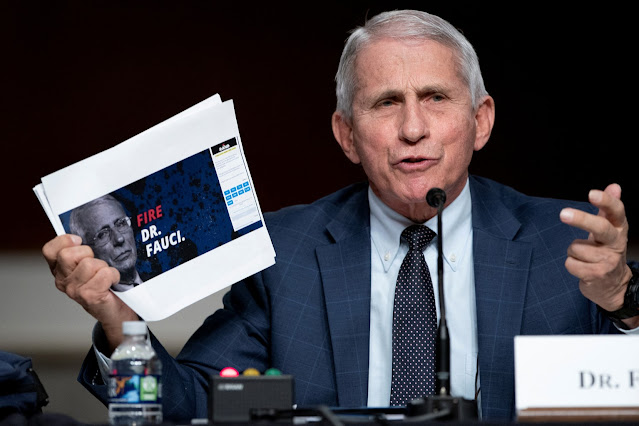
Anthony Fauci counterattacked against Rand Paul by showing pictures of a website on which Paul says to "Fire Dr. Fauci" and has nine buttons for contributions of increasing amounts. (Reuters photo)
By Al Cross
Kentucky Health News

U.S. Sen. Rand Paul accused Dr. Anthony Fauci on Tuesday of misusing his position to attack fellow scientists who disagreed with him, and Fauci counterattacked by accusing Paul of inspiring threats on Fauci's life and making money off the pandemic. Each accused the other of acting politically.

Fauci, head of the National Institute of Allergy and Infectious Diseases, was among four Biden administration witnesses at a hearing that was dominated by senators' concern about the advice and messaging of the Centers for Disease Control and Prevention.

Paul used his time to continue his year-long attack on Fauci, who became a political punching bag in the presidency of Donald Trump. 

Paul cited email traffic between Paul and Dr. Francis Collins, recently retired director of the National Institutes of Health, in which Collins called for a "quick and devastating public takedown" of claims by "fringe epidemiologists" at Harvard, Stanford and Oxford universities who had questioned the effectiveness of lockdowns early in the pandemic. Fauci replied with published examples.

Paul said that by agreeing to help Collins, Fauci was "using government resources to smear the reputations of other scientists. . . . Instead of engaging them on the merits, you and Dr. Collins sought to smear them as fringe and take them down." He called that "cheap politics" and asked, "Do you really think it's appropriate to use your $420,000 federal salary to attack scientists who disagree with you?"

Fauci replied, "In usual fashion, you are distorting everything about me. . . . "You've accused me of in a monolithic way, telling people what they need to do. Everything I said has been in support of the CDC guidelines. Wear a mask. Get boosted. Get vaccinated. Take a look at everything I've said."

Paul shot back, "Do you think anybody has had more influence over our response than you have? Do you think it is a great success what has happened so far? Do you think the lockdowns were good for our kids? Do you think we slowed down the death rate? more people have died now under President Biden than did under Trump. You are the one responsible. You are the architect. You are the lead architect for the response from the government and now 800,000 people have died. Do you think it is a winning success, what you've advocated for government?"

Repeatedly, as Fauci answered and disputed Paul, the senator interrupted him and Fauci resumed.

"You keep coming back to personal attacks on me that have no relevance to reality . . . with not a shred of evidence of anything you say," Fauci told Paul. "You're doing this for political reasons."

Fauci said that the last time the two clashed, "He was accusing me of being responsible for the deaths of 4 to 5 million people . . . That kindles the crazies out there and I have threats upon my life, harassment of my family and my children with obscene phone calls because people are lying about me."

He said that on Dec., 21 in Iowa, "someone from Sacramento" who was stopped by police "said he was going to Washington, D.C., to kill Dr. Fauci" and had an AR-15 and ammunition magazines in his vehicle.

Fauci said he asked himself why Paul would want to keep attacking him, and held up screenshots of Paul's website with the headline "Fire Dr. Fauci" and a portal for contributing to Paul: "So you are making a catastrophic epidemic for your political gain." Paul is running for re-election this year.

UPDATE, Jan. 14: "Dozens of doctors, academics and health experts denounced 'personal attacks' against Anthony Fauci in a joint letter yesterday," The Washington Post reports. "Signatories include Nobel laureates and the leaders of many public-health schools."

Kynect health-insurance open enrollment extended to Jan. 31

Map shows choice of health insurance companies offering federally subsidized plans in each county. 
The deadline to sign up for federally subsidized health insurance through kynect.ky.gov , the state's online portal, has been extended to Jan. 31. The previous deadline was Jan. 15.

The system that many call "Obamacare" has two more insurers than this year, and its first coverage for vision care. Also, some people will find coverage less expensive, thanks to greater federal subsidies.

On the site, Kentuckians can compare options, apply for coverage and complete their enrollment all on one platform, even if they qualify for Medicaid, which covers about a third of Kentuckians.

"Kynectors," who help Kentuckians sign up for coverage on Kynect, are available for free in every county to answer questions and help people sign up for coverage.

The major insurers offering subsidized plan are Anthem, in every county, and CareSource, in 100 of the 120 counties. A few counties have new insurers; Ambetter from WellCare, in six western counties, and Passport Health Plan by Molina in Jefferson, Oldham and Bullitt counties.

Fourteen counties have only Anthem plans to choose from, down from 26 last year. Most are small and rural, but they include Warren County, the core of metropolitan Bowling Green, the state's third-largest city. Warren and eight neighboring counties also had Anthem as their only choice this year.

For the first time, Kynect has a vision plan. VSP Individual Vision Plans offers a comprehensive eye exam from an in-network doctor, an eyeglass-frame allowance and lens enhancements, such as progressive lenses.

Monday, January 10, 2022

Over 1 in 4 Kentuckians tested for coronavirus are positive; hospitals filling up with Covid-19 patients, get National Guard help

State Department for Public Health graph, adapted by Ky. Health News; to enlarge, click on it.
By Melissa Patrick
Kentucky Health News

As the Omicron variant surges across Kentucky, Gov. Andy Beshear said the most important thing is to protect the state's hospital capacity, which is filling up, with only 134 intensive-care beds available.

Beshear said 33 of the state's 96 acute-care hospitals are reporting critical staffing shortages, and 445 members of the National Guard are helping with the workload at 27 hospitals and 10 other health-care facilites.

"Our main goal right now has to be to not allow our hospitals to get overrun," Beshear said at his regular Monday afternoon news conference about the pandemic.

"The way we prevent this happening . . . are vaccinations and boosters," he said, adding later, "If you are unvaccinated, for many people this is hitting them like a freight train. And the vast majority of those ending up in the hospital are unvaccinated."

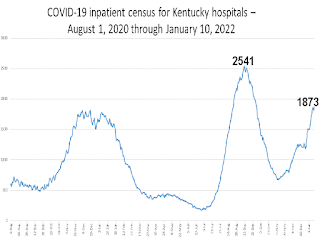
State chart, adapted by KHN; to enlarge, click on it.
Kentucky hospitals reported 1,873 Covid-19 patients Monday, with 452 of them in intensive care and 238 of them on mechanical ventilation.

Since last Monday, Covid-19 hospitalizations in Kentucky are up 18.6%. Nine of the state's 10 hospital readiness regions are using at least 80% of their intensive-care capacity, with four them above 90%. 

Kentucky has reported 17,034 new cases of the coronavirus since Saturday, bringing the seven-day rolling average to 7,813. That's 89 percent higher than last Monday. Each day since set a new record. 

That made for the state's highest weekly case number since the beginning of the pandemic. In the week ended Jan. 9, Kentucky reported 52,603 cases, beating the previous weekly record of 30,680 in early September. 

Beshear warned that this number could be even higher in coming weeks. "We have never seen an escalation like this," he said. "Omicron continues to burn through the commonwealth growing at levels we have never seen before."

Of the 5,049 cases reported Monday, 19.5% are in people under 18. Beshear said 23 Kentucky children are hospitalized with Covid-19, with four in intensive care and three on mechanical ventilation. 

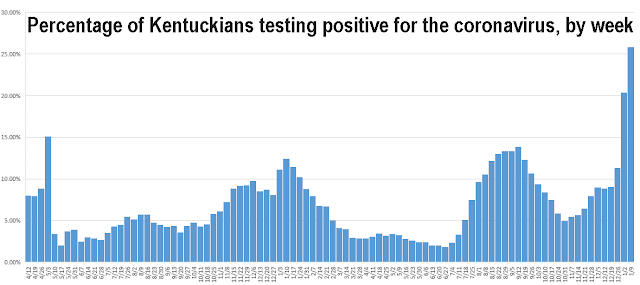
The share of Kentuckians testing positive for the virus in the past seven days is 26.33%, which has set new records each of the last 12 days. "We have never seen that before," said Beshear.

State Department for Public Health graph, adapted by Ky. Health News; top enlarge, click on it.
The rate is calculated from 120,000 to 150,000 tests per day across the state and does not include any at-home test results.

Health Commissioner Steven Stack said because Omicron is not hitting people as hard as the Delta variant, the length of stay in hospitals may be shorter. However, he said the recovery time for patients who have been in intensive care often requires an extended stay.

He said hospitals work to help each other care for patients when their facilities become overrun, but with the stat and nation seeing escalation of cases, the entire system is overrun. 

Stack said some rural hospitals are reporting they are having trouble finding larger hospitals to take their patients that need to be cared for in an intensive care unit, which means that "very sick people can remain stuck in small rural hospitals for extended periods of time without access to sub-specialty medical and surgical care." 

"This is why I continue to urge all the people in the public need to help contribute to the solution," he said, including getting a vaccine or booster, wearing a well-fitted mask in indoor spaces and not going to the emergency department for a Covid-19 test.

He added that because the demand for testing is "unlike anything we've ever seen before" it's important to stay home if you are sick: "If you can't get a test, but have mild to moderate illness, stay at home and do not go to school or work until you feel better." 

Amidst a "frightening surge" of Covid-19 cases in Louisville, a new mass testing site opened at Churchill Downs on Monday, WDRB reports.

Stack also went over a new list of school isolation and quarantine guidance that line up with the latest Centers for Disease Control and Prevention suggestions. The rules are less stringent for schools that require masking.

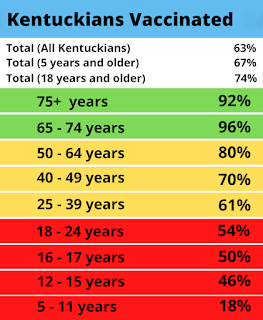
Ky. Department for Public Health table
And while the share of Kentuckians getting vaccinated and boosted continues to creep up, Beshear said it's still not high enough.

"If you've been waiting, if there is some excuse, please go out and get boosted immediately. . . Get that booster and get it as fast as you can," he said. 

Kentucky's daily Covid-19 infection rate over the last seven days is 160.74 cases per 100,000 residents. Six Kentucky counties, all in metropolitan areas, have rates above 200 per 100,000: Jefferson, 259.2; Fayette, 251.1; Campbell, 242.3; Boyd, 208.5; Boone, 206.4; and Oldham, 202.7. 

The New York Times ranks Kentucky's infection rate 20th among states, reporting a 578% increase in cases in the last 14 days. Jefferson County's 727% increase is 63rd among the approximately 3,200 U.S. counties.

The state reported 67 more Covid-19 deaths since Saturday, bringing the pandemic death toll to 12,425. One of the deaths was a 21-year-old from Johnson County. The 14-day death average is holding steady, at 25 per day.

Sunday, January 9, 2022

Booster shot needed to protect against Omicron, lab study finds

A booster shot of the Moderna or Pfizer-BioNTech vaccine is needed to provide immunity against the Omicron variant of the coronavirus, according to a study just reported in the peer-reviewed journal Cell.

The study "indicates that traditional dosing regimens of Covid-19 vaccines available in the United States do not produce antibodies capable of recognizing and neutralizing the Omicron variant," report the researchers, from the Ragon Institute of Massachusetts General Hospital, Harvard University and the Massachusetts Institute of Technology.

The researchers created a harmless "pseudovirus" version of Omicron to evaluate the laboratory effectiveness of the three Covid-19 vaccines available in the U.S., which include the two-dose Pfizer and Moderna messenger RNA vaccines and the one-dose Johnson & Johnson injection. 

Chelsea, Mass. (Photo from Robert Wood Johnson Foundation)
They obtained blood samples from 239 people in Chelsea, Mass., just north of Boston, who had been fully vaccinated with one of the three vaccines. The group included 70 who had received a third dose of the Pfizer or Moderna mRNA vaccine.

“The results were striking,” the researchers report. “We detected very little neutralization of the Omicron variant pseudovirus when we used samples taken from people who were recently vaccinated with two doses of mRNA vaccine or one dose of Johnson & Johnson,” says Balazs. “But individuals who received three doses of mRNA vaccine had very significant neutralization against the Omicron variant.”

"It’s not yet clear why an mRNA booster dramatically improves immune protection against Omicron," they report, but "one possibility is that an additional dose creates antibodies that bind more tightly to the spike protein" that attaches to human cells, causing the infection. Also, a booster dose may generate antibodies that target regions of the spike protein that are common to all forms" of the virus.

Three doses of mRNA provide "somewhat lower levels of neutralizing antibodies against Omicron than it does against the Covid-19 wild type strain or Delta variant," the researchers report. "But the study’s results strongly support the CDC’s advice that Covid-19 booster shots are appropriate for anyone 16 and older, and that mRNA vaccines are preferred."

With the Omicron variant, N95 or equivalent masks are needed to stop infection, say physicians and epidemiologists

Wall Street Journal illustration, adapted by Kentucky Health News
The Omicron variant of the coronavirus "spreads much more quickly than its predecessors" and research "suggests the virus has acquired the ability to gain a foothold regardless of a person’s vaccination status," so epidemiologists recommend you start using an N95 mask or an equivalent, Sandra Guiterrez writes for Popular Science. Physicians "recommend pairing cloth masks with surgical models or moving on to stronger respirator masks," The Wall Street Journal reports.

"The fibers in a cloth mask are just not dense enough to filter out a large number of particles in the air that may contain Covid-19," Guiterrez reports. "Then there are surgical masks, which are good at protecting people against infection but not in the way you might think. They protect others if you’re infected because they block your exhaled aerosols from traveling as far as they would without a mask in the way—they don’t protect the wearer as much. . . . The gaps between a surgical mask and your skin make them unsuitable for the level of infectiousness researchers have seen with the Omicron variant."

N95s have three layers of polypropylene, and the middle layer has an electrostatic charge that allows it to filter out 95 percent of particles, giving the mask its name. "While N95s are widely considered the golden standard for particle filtration, there are other masks that do an equally good job, such as the KF94, FPP1, FPP2, and FPP3," Guiterrez reports. "The only difference among them is their country of origin. N95s are manufactured under a strict U.S. protocol that is regulated and certified by the National Institute of Occupational Safety and Health."

The KF94 mask is South Korea's version of the N95, while FPP masks are the standard in the European Union. "These types are also subject to careful government oversight and perform with similar efficacy to N95s," Guiterrez notes. They will provide equal protection against Covid-19."

The most widely available foreign-made mask in the U.S. is the KN95, made under a Chinese protocol. Guiterrez reports that it doesn't fit as snugly as the other masks, because it has a vertical fold or hinge, which "tend to slide up and down, preventing a proper seal and forcing wearers to touch it constantly to readjust."

Also, "In September 2020, the Emergency Care Research Institute found that 70 percent of KN95 masks didn’t meet minimum U.S. standards," Guiterrez notes. "The Centers for Disease Control and Prevention’s website warns that 60 percent of KN95s in the US are actually counterfeit. . . . There’s no way to be sure if they are actually protecting you or anyone around you."

The CDC website offers guidance for identifying fakes, and has an online search platform where you can see if a brand/model has been certified by NIOSH. Appendix A of a Food and Drug Administration list also shows brands and products approved for emergency use.

Guiterrez also cites advice to look for a mask with head straps instead of ear loops: "This feature helps provide that much-needed seal while making it comfortable to wear your mask for prolonged periods of time."

For many people, the biggest downside of N95 masks is that they are designed for only two to three hours of use. "If you have to regularly interact with someone who’s infected with Covid-19, experts recommend you change your mask every time you come into contact with them," Guiterrez reports.

However, the masks can be rotated. Peter Tsai, the inventor of the material used to make N95s, suggested in a study back in May 2020 that people use four masks — wearing one while the others undergo decontamination in separate paper bags at room temperature for three days, "enough time for any traces of the virus on the mask to die out," Guiterrez writes.

 "If you want to be extra careful, you can increase the number of masks in rotation and, say, have one for each day of the week. For this method to work, it’s crucial to identify each mask—you can use a number or color system—to avoid errors, and use a clean paper bag every time you start the decontamination phase."

Getting rid of the virus "doesn’t mean the mask is clean," Guiterrez cautions. "There are countless pathogens living in our mouths and airways—not to mention bits of decomposing food—and these also get stuck in our masks every time we breathe out, eat, or talk. . . . If you’re not bothered by weeks-old bacteria living in your mask, or think this is a small price to pay to keep plastic out of the landfill, rotating your N95s is a reasonably safe way to protect yourself and others against Covid-19."

Also, "you cannot rotate masks forever," Guiterrez reports. "Wearing your mask day in and day out will eventually affect its ability to do its job. Learning how to spot signs of degradation will help you know when it’s time to get rid of it. . . . As soon as the noseband starts bouncing back and is no longer able to stay in place, or the elastics don’t provide as much tension as they used to, throw your N95 away." One signal: If you wear glasses and they fog up, you need a tighter mask.

As Covid-19 cases spike, guidelines for people with cancer receive significant upgrades

Photo illustration from Beth Israel Deaconess Medical Center
The National Comprehensive Cancer Network has published significant updates to the expert consensus recommendations on vaccination and pre-exposure measures of Covid-19 in people with cancer. The updated guidance includes information on the preventive use of human monoclonal antibodies in addition to the following principles:
  • Patients with cancer should get fully immunized, including third doses and/or any approved boosters.
  • There is a strong preference for mRNA vaccines, such as the Pfizer or Moderna vaccines.
  • Vaccination should be delayed for at least three months following certain cancer treatments. Vaccine delays in patients with cancer should also include those recommended for the general public.
  • Full vaccination is also recommended for caregivers, household/close contacts, and the general public.
  • The committee strongly supports full vaccination mandates for healthcare workers.
“All of us are called to do everything we can to save as many lives as possible during the ongoing pandemic,” said Robert W. Carlson, CEO of the National Comprehensive Cancer Network. “Vaccination is our most effective approach for avoiding serious Covid-19 complications, including hospitalization and death. However, research shows many immuno-compromised people develop inadequate immune responses from vaccines." 

Carlson mentioned additional tools to help people with cancer and others who are immuno-compromised. For example, the Food and Drug Administration has issued an emergency-use authorization for a drug combination for pre-exposure protection from Covid-19 in adults and children, starting at age 12, who have moderate to severe immune compromise and may not be responsive to vaccination.

“The medical and scientific community’s response to the Covid-19 crisis continues to be extremely encouraging, even in the face of setbacks like new variants and surging infection rates,” Carlson said. “Rapid research, thoughtful analyses, and tireless care delivery is allowing us to save so many more people than we could have a year ago. We hope by sharing this simplified guidance highlighting the latest research and approvals, we can help make sure the very latest in evidence-based care reaches as many patients and providers as possible.”

Saturday, January 8, 2022

Cap on insulin costs takes effect, but for fewer than 1/3 of Kentuckians; Biden bill would cover them all but its fate is in doubt

Jan. 1 was the effective date of a new Kentucky law that caps at $30 the cost of a 30-day supply of insulin. But it affects fewer than a third of Kentucky diabetics, so "advocates and others in the commonwealth's diabetic community are pushing for lawmakers to do more to open access to a medication that thousands in the Bluegrass State need to survive," reports Lucas Aulbach of the Louisville Courier Journal.

The law, passed last year, applies to people covered by group health-insurance plans, those regulated only by the state, plans on the Kynect exchange, and state employees. It does not apply to those who have health insurance through their employers; or through sources like Medicare or Tricare, which covers U.S. military-service members and veterans.

"The problem is that a state can't pass a law that would affect anything that's federally regulated, and most people have health insurance that's federally regulated," advocate Sarah Ferguson told Aulbach. Her daughter was diagnosed with Type 1 diabetes at age 14 more than 10 years ago.

Reps. Patti Minter and Danny Bentley saw Gov. Andy Beshear
sign their insulin price limit bill into law last March. (Screenshot)
President Biden's "Build Back Better" funding bill would cap all insulin co-payments at $35 a month, but it is stalled in the Senate and even if it passes, negotiations to accomplish that might remove the provision. "People need to let their Congress members know that this isn't OK, that people need $35 for a 30-day supply," said Rep. Patti Minter, D-Bowling Green, a sponsor of the new law.

Minter and co-sponsor Danny Bentley, R-Russell, have filed a bill to let people without health insurance those and people whose insurance has recently dropped insulin from coverage to get an emergency 30-day or 12-month supply at a reduced cost. "Similar bills have been passed in Minnesota and several other states under the name 'Alec's Law,' in honor of Alec Smith, a 26-year-old Minnesota man who died in 2017 while rationing insulin he could no longer afford," Aulbach reports.

Meanwhile, many people affected by the law are getting a significant break. "A single dose of insulin which cost between $2 and $7 to manufacture could sell for an average wholesale price of around $300 per vial," Gov. Andy Beshear said when he signed the Bentley-Minter bill into law last March.

More than half a million Kentuckians have diabetes, and Kentucky ranks seventh-highest in the U.S. for diabetes prevalence. more than one in four insulin-dependent people ration insulin due to cost, according to Angela Lautner, legislative lead for the Kentucky #insulin4all advocacy group.

The Bentley-Minter law requires health plans to provide the equipment, supplies and outpatient training and education needed to help diabetics stay healthy.

Friday, January 7, 2022

There's still time to get a flu shot; season runs through May

By Melissa Patrick
Kentucky Health News

After three weeks of increases in influenza cases across the state, reported cases took a steep dive during Christmas week. 

The latest weekly report from the state Department for Public Health shows that in the week ended Dec. 25, Kentucky counted 290 new flu cases. That was much fewer than the prior week, when the state reported 618 cases.

These numbers could be influenced by delayed reporting during the holiday week. It's also important to remember that flu cases are likely more numerous than the official state numbers because they do not include any rapid testing, which many health-care providers use in their offices.

The state has recorded 1,603 cases this season. No flu-related deaths have been reported this year. 

The majority of  laboratory-confirmed flu cases have been in people between 1 and 30, with the highest rate among those 11 to 20. 

There is still time to get a flu vaccine. Click here to find a location that offers them near you. 

Health officials encourage everyone six months and older to get a flu shot every year, because it's your best defense in fighting influenza. Flu season typically peaks in February, but runs through May. 

The Centers for Disease Control and Prevention offers a summary of the benefits of flu vaccination, with selected scientific studies that establish those benefits. For example, getting a flu shot not only can keep you from getting influenza, but can mean that any case you do get will be less severe.

The shot can also reduce the risk of flu-associated hospitalizations; is a preventive tool for certain chronic health conditions; significantly reduces a child's risk of dying from the flu; protects pregnant women from getting the flu; and helps protect their babies from flu for several months after birth.

Jefferson County, the state's most populous, again had the most cases, reporting 66 in the week ending Dec. 18. Other counties with the highest number of cases that week were Allen, 44; Pike, 43; Fayette, 29; Warren, 20; Kenton, 14; and Graves, 10.

Kentucky's influenza level is considered to be widespread, a classification that is applied when increases in flu cases have been confirmed in at least half of the state's 16 regions.

Ky. doesn't just break the 10,000 new-case mark, it goes over 11,000; Covid-19 hospitalizations up by nearly half in last 2 weeks

Ky. Health News graph; case numbers are from initial, unadjusted daily reports; click on it to enlarge.
By Al Cross
Kentucky Health News

Kentucky shattered its recently set records for new coronavirus cases Friday, reporting more than 11,000, the first time the number has had five digits.

The state's daily report, the last one until Monday, showed 11,096 new cases, raising the seven-day rolling average to 6,984. That's 86 percent higher than it was one week earlier, and 200 percent higher than two weeks ago.

The top five highest days for new cases have occurred in the last seven days, as the highly contagious Omicron variant keeps spreading with the unwitting help of unmasked, unvaccinated, and vaccinated but unboosted Kentuckians.

"Omicron is burning through Kentucky, and for the third straight day, we have an all-time high in cases," Gov. Andy Beshear said in a Facebook video. "Get your booster. Wear your mask, This thing is spreading like crazy. Protect yourself."

The Omicron fire is burning hottest in the state's urban areas. The counties with the top seven infection rates are all metropolitan. Jefferson County leads with 236 daily cases per 100,000 residents in the last seven days. Other top counties are Fayette, 226 per 100,000; Oldham, 191; Campbell, 190; Jessamine, 184; Boyd, 181; and Shelby, 173.

The state's overall seven-day infection rate is 142 per 100,000, double what it was a week ago. Its rate is 21st in the nation, and its 14-day increase is now higher than the nation's, after many days below it, according to The New York Times' breakdown of Centers for Disease Control and Prevention data.

The percentage of Kentuckians testing positive for the virus in the last seven days also set a new record: 24.45%, less than a percentage point above the previous seven-day rate.

Health experts say the more important numbers to watch are from hospitals. Omicron cases seem to be milder than those from the previously dominant Delta variant, but there are so many cases that hospitals could be overrun, and some have scaled back surgeries to make sure they have beds available.  

Kentucky hospitals reported 1,856 Covid-19 patients Friday, 73 more than Thursday. That's 24% more than a week earlier and 48% more than two weeks earlier.

Intensive-care units reported 423 Covid-19 patients, 21 more than the day before, with 223 on mechanical ventilation, down by four.

Seven of the state's hospital regions reported more than 90% of their ICU beds occupied; Northern Kentucky was again at 100%. The region with its ICUs most heavily occupied by Covid-19 patients is the far west, around Paducah, at 46%; overall, 97% of the region's ICU beds were occupied.

Perhaps reflecting the high new-case rate in Jefferson County, the Louisville hospital region had the highest share of its inpatient capacity used by Covid-19 patients, 18%. Overall, it was at 73% capacity and its ICUs were 93% full.

St. Claire Regional Medical Center in Morehead said it ran out of monoclonal antibodies used to treat people with Omicron.

The state reported 39 more Covid-19 deaths Friday, raising Kentucky's pandemic toll to 12,358.