Events, trends, issues, ideas and independent journalism about health care and health in Kentucky, from the Institute for Rural Journalism at the University of Kentucky
University of Kentucky Professor Sharon Walsh and Lexington Fire Battalion Chief Marc Bramlage have been named the Dr. Rice C. Leach Public Health Heroes for 2022 by the Lexington-Fayette County Health Department.
The award, announced Monday at the start of National Public Heath Week, is given annually to those who have demonstrated their dedication to improving the health of Lexington residents. It is named for the late Rice C. Leach, who was commissioner of health for Lexington and the state and spent more than 50 years as a public-health physician.
Walsh is the principal investigator on UK's largest grant ever, an $87 million study to determine how to reduce opioid overdose deaths in Kentucky and create a national model. It involves Jefferson, Fayette, Franklin, Kenton, Campbell, Mason, Greenup, Boyd, Carter, Bourbon, Clark, Madison, Jessamine, Boyle, Knox and Floyd counties.
Walsh and her team have established partnerships with behavioral-health and criminal-justice agencies to implement an integrated set of evidence-based practices to combat the opioid epidemic, including communication campaigns, expanding capacity to medication-assisted treatment for opioid-use disorder, providing overdose education and distributing 4,600 units of naloxone, a drug that reverses overdoses.
“I’m honored to receive the award created in memory of Rice C. Leach, a true public health hero committed to improving the health and well-being of Lexingtonians and all Kentuckians,” Walsh said in a news release. “Kentucky was one of the first and is among the states hardest hit by the nation’s opioid crisis. Combating this epidemic must happen in the communities where affected people live.”
Chief Marc Bramlage (Photo by Frank Handshoe)
Bramlage received the award for supporting the health department's Covid-19 vaccination clinics. "it is an honor to be awarded for doing a job you love," he said. He and Walsh will be recognized at the April 11 Board of Health meeting and at the April 14 Urban County Council meeting.
UK's College of Public Health has organized daily events this week to celebrate Public Health Week, including a panel discussion at 6 p.m. Thursday, April 7, to discuss health equity and social determinants of health. Click here to register.
University of Kentucky video; for captions, click on play, then click the CC icon on the bottom line. If using a mobile device, click on the "thought bubble" in the same area.
April Ballentine uses new equipment to walk. (University of Kentucky photo by Mark Cornelison)
By Allison Perry and Steve Shaffer University of Kentucky
“Deep breaths, April. Deep breaths.” April Ballentine nods, steeling herself. As she sits inside the lab of the University of Kentucky’s Sports Medicine Research Institute, her anticipation stirs up an incredible amount of pure nervousness. This is the day the Lexington native has been waiting for, working for – for weeks, months, even years. A crowd has gathered to witness this moment, including April’s friends and family, UK faculty, and physical therapy students from the UK College of Health Sciences. With great trepidation, she shifts her body into position, channeling her mindfulness to conquer this new task. Then, she is asked the million-dollar question. “You ready?” April looks up at the physical therapist in front of her, unflinching. “Yes.” Today, the 51-year-old will stand and walk for the first time in more than eight years.
•
In August 2013, April was out with friends at a happy hour when an ex-boyfriend showed up, gun in hand. As he raised it toward her face, she blocked his first shot. But in the chaos, she blacked out and fell to the ground. He then unloaded the chamber on her in front of more than 50 witnesses. At some point, April woke up, covered in a white sheet. Her ears were ringing, and all she could utter was one phrase, over and over. “I’ve got to get up.” She then heard a voice gently reply, telling her to lie still, followed by sirens. She couldn’t breathe. Then, everything went black again. When April woke up for the second time, she was at UK's Albert B. Chandler Hospital. She had survived five gunshots at close range. A trauma team led Dr. Andrew Bernard, the trauma medical director, had stopped the bleeding, saving her life. Because she was hooked up to a respirator, April’s medical team gave her a dry-erase board to communicate. “I wrote my daughter’s name with a question mark, and they said she was fine,” April said. “Then they asked me if there was anything they could get for me. And I said I was hungry as hell.” That fighting spirit kept April going during her stint in the ICU – a time she calls “one of the greatest challenges I’ve had to go through in my life.” After several weeks of intensive care, she was discharged to Cardinal Hill Rehabilitation Hospital. “That’s when I learned I was paralyzed,” April said. “I had never heard that word before – or if I did, it just never registered because I was so highly medicated.” At Cardinal Hill, April began working with a team of therapists led by physical medicine and rehabilitation physician Sara Salles. She had to learn how to live with her new normal: paralyzed from the chest down due to a T4 spinal-cord injury. “Dr. Salles explained everything to me,” April said. “And I said, ‘OK.’ I never asked why. I never cried about it. The pain was more overbearing than anything else I could have imagined because it was constant. [It’s] something I never want anyone to experience.” April spent 90 days at the facility. She’d heard of companies that made robotic exoskeletons, which allowed users to stand up and walk again with bracing and support from the upper body. Occasionally during her therapy, April would try to stand, holding herself with her arms. It was far harder than she had expected. “It was so difficult,” she said. “I recall trying to push myself up, and it almost seemed impossible. That dream was shot really easily. I had to learn that I had to live for today and not tomorrow. Because I lived for walking, I couldn’t live in the moment.”
•
In October 2015, April was speaking about her experience at a church to raise awareness for Domestic Violence Awareness Month. Fayette County Sheriff Kathy Witt heard her story and approached April with a proposition. “She said, ‘I want you on my team’,” April said. “She’s been a great advocate for domestic violence awareness for a very long time.” April began working with the sheriff’s office, first as a volunteer, then as an employee. She now serves as a victim advocate intake specialist in Amanda’s Center, a 24-hour point of contact for victims of domestic violence located in the Fayette District Courthouse. In this role, she helps ensure victims have access to the resources and help they need. April describes the work as “a calling” that has helped her heal, process and understand her own trauma. “I understand what it’s like to be a victim, and I understand what it’s like to be afraid and to not be afraid,” she said. “And I believe that I’m a good resource to help someone escape, or to help them understand the extreme behavioral issues they’re experiencing.” April also began volunteering at Cardinal Hill, playing a mock “patient” for physical-therapy students to learn how to work with people who have spinal-cord injuries. “[I want to show] that for anyone with a spinal-cord injury, life is possible and life can be good,” she said. “And I make it fun, too. I think my personality fits because I break the ice, make them laugh, and say the unexpected.” Several years ago, she was contacted by ReWalk Robotics, a company that makes bionic devices to help people with spinal cord injuries. ReWalk’s exoskeleton has been available since 2014 and was the first such device to be cleared for market in the U.S. by the Food and Drug Administration. The company was looking for an opportunity to start a program in Lexington. April passed their information on to her contacts at Cardinal Hill, not really expecting to hear anything further. But that contact lit a spark in her. She decided to start focusing on her physical fitness. “I started thinking, ‘OK, I’ve got to take better care of myself,’” April said. “And then Covid hits. I said, ‘I’m not going to sit here and do nothing.’” April sought out a trainer and got to work, noting playfully that one of her goals was to develop “Angela Bassett arms.” Over the past two years, she’s lost 180 pounds and developed incredible upper-body and core strength. Although April’s spinal-cord injury is at her T4 vertebra – around chest height – she still has some sensation and strength in her core, which helps her do things that many others with her same injury classification can’t do. Last August, April began to build strength in another way. She bought her own house, regaining the independence she lost that traumatic day in August 2013. “Taking on my health and being able to live independently with such a high injury level made me dream,” she said, “and recognize, and remember that I can do anything.”
•
Denise O’Dell is relatively new to UK, having joined the College of Health Sciences as an associate professor last summer. As a physical therapist, she specializes in working with patients who have neurological impairments, including brain and spinal cord injuries. O’Dell teaches students in UK’s Doctor of Physical Therapy program and works with patients in the Kentucky Neuroscience Institute’s ALS Multidisciplinary Clinic.
O’Dell took a group of UK students to Cardinal Hill last fall, where April was volunteering again as a mock patient. In addition to the physical therapy techniques students will perform, O’Dell says she often reminds them how important it is to listen to their patients during therapy. And listening to April’s story, O’Dell and her students were impressed.
“I could see the drive that she has to give back to society, to better herself, to stay engaged,” O’Dell said. “Given my background and having worked with a lot of individuals with spinal cord injury, I saw sparks there that I hadn’t seen in others for quite some time.”
Encouraged by April’s overall strength, O’Dell asked if she’d ever stood up. April had been medically cleared via bone-density screenings for standing – with support – in her power chair, but she had never tried to stand another way. O’Dell brought her to a set of parallel bars. “Denise was like, ‘We’re going to do something different’,” April said. “She said, ‘I’m going to have you stand using these parallel bars.’ And I just kind of looked at her and said OK. I’m open to it.” With O’Dell supporting her legs, April grabbed the bars and pushed up into a standing position. “She literally just popped up into standing,” O’Dell said. “The first time she was up for two or three minutes. That’s pretty unheard of for someone who hasn’t done it for so long.” Shortly after, April asked to stand again. “Even though we were out of time, we did it again,” O’Dell said. “The students were like, ‘We’ll stay.’ They could see that this was a better learning moment than I think they had expected.” In a previous job, O’Dell had been part of a team that helped evaluate and train patients following spinal cord injury, including evaluations for standing and use of exoskeletons. Based on her experience – and what she had just witnessed – she thought April could be an ideal candidate. She made some calls to her colleagues at UK HealthCare and the College of Health Sciences and contacted ReWalk to come up with a plan for April to trial an exoskeleton device. “Next thing I knew, I had a phone call with a date,” April said. “So here we are.”
•
Back in the Sports Medicine Research Institute lab, April’s big moment is here. She’s officially “trialing” the exoskeleton, which will help the ReWalk team determine if she’s an eligible candidate to begin training with the device. From the crowd, a voice calls out: “Use those Angela Bassett arms!” April smiles and offers a correction: “These are April Ballentine arms.” She swings a set of forearm crutches back, tilts forward, and prepares to use her considerable upper body strength. The exoskeleton beeps and whirs. Guided by therapists from ReWalk, April pushes into the crutches and powers up to a full standing position. Now, she’s standing taller than the therapist in front of her. Her audience cheers. From there, the team takes April through some of the basic movements she will need to master: holding a neutral standing position, shifting her weight laterally, pivoting, and finally, walking. The machine will move her legs for her, but she will use the forearm crutches to support, balance and guide her body as she moves. When it’s time to walk, the therapists clear a path in the room and tell April she’ll be walking toward a man in a blue suit – Bernard, the UK trauma surgeon, who stopped by to show his support. Seeing him, her eyes fill with tears. April’s first few steps are big, lurching. The team stops to recalibrate the machine to her gait. Her trainer, David Asbury, comes to stand by her side and coach her through the walk. She grins. “Hey, I’m taller than you!” she exclaims to Asbury, and everyone laughs. With the machine recalibrated, she tries again. This time, she takes off, walking across the room, only stopping when she reaches a curve that requires a pivot. Sitting down to rest, she’s overcome with emotion as her friends and family hug and congratulate her. “I’m just overwhelmed right now,” she says, voice shaking. “It’s been eight and a half years.”
•
For patients with a spinal cord injury, a ReWalk exoskeleton isn’t just about the chance to walk again. The mobility it offers comes with a number of health benefits that can improve the patient’s overall quality of life – better circulation, muscle spasticity, bowel and bladder function, and even nerve pain. “The opportunity to stand and walk is multifaceted,” O’Dell said. “Physiologically, being upright, your gastrointestinal system works better. Your heart, your lungs work better. An individual such as April will rate their quality of life higher from a participation and health standpoint.” But April still has more work ahead of her. Although insurance will cover the cost of training with the device, it does not cover the cost of the device itself for non-veterans. ReWalk continues to pursue insurance coverage opportunities, but for now, April will need to cover the cost of her own exoskeleton. To help fundraise for the device, April is working through a nonprofit organization called I GOT LEGS, which set up a donation page for her. Once she has her down payment, she can begin working with ReWalk-trained physical therapists to become proficient with the exoskeleton, a process that usually takes 20-30 sessions. She isn’t deterred by the cost. Where there’s a will, there’s a way, and April Ballentine always finds a way. “Throughout the last nine years, there have been people saying, ‘You can’t do this, you can’t do that’ – whatever,” April said. “I’m going to prove you wrong every time.” Besides, she has another ambitious goal to meet. In November, April’s daughter is getting married. And she’s determined to walk her daughter down the aisle. It’s that determination that makes her such a light and role model for the community, said Bernard. Despite her tragedy, she has persevered. “She was a victim, but she’s not a victim anymore,” Bernard said, adding that her situation “was minutes of crisis, and then it’s a lifetime of potential impact.” When she woke up under that sheet in 2013, April had only one thought in her mind: I’ve got to get up. Eight and a half years later, she’s done it. And she’s hungry to do it again. She just needed that little extra push – one that came in the form of a chance meeting with someone who saw her potential and had the right experience to make it happen. Denise “is pretty phenomenal,” April said. “Recently, I told her, thank you for seeing my ability instead of my disability. If it wasn’t for her, I would not be here today.”
FRANKFORT – The latest bill to help independent pharmacies compete with pharmacy benefit managers sailed out of the House with overwhelming support but came to a resounding halt in the Senate. No one is saying why, but the PBMs mounted one of the session's heaviest lobbying campaigns.
PBMs determine what drugs are offered in insurance plans, where and how a patient gets their drugs, how much is paid for the drug, and how much the pharmacist gets. The leading PBM in Kentucky is CVS Caremark, a sister company to one of the nation's largest pharmacy chains.
House Bill 457 passed the House 88-3 on March 21, with 56 sponsors. The next day it went to the Senate Appropriations and Revenue Committee, not a usual location for such a bill, and never got a hearing. It has had none of its regularly required three daily readings, and only two legislative days remain.
Key parts of the bill would ensure that patients could pick their pharmacy, instead of being required to use one affiliated with the PBM; increase transparency between insurers and PBMs; and ban PBMs from retroactively denying a pharmacy claim after adjudication, commonly referred to as "clawing back." Opponents say the bill would raise costs for consumers.
Rep. Steve Sheldon, R-Bowling Green
Republican Rep. Steve Sheldon of Bowling Green, the bill's prime sponsor, said he was surprised that it didn't move in the Senate after getting such overwhelming support in the House. He said he couldn't say why leaders of the Senate's Republican majority had not supported it, but did say that many big companies opposed it.
Those companies' heavy lobbying efforts appear to have worked.
The Pharmaceutical Care Management Association, PBMs' trade group, was one of the state's top 10 lobbying spenders in the first two months of the legislative session, spending $38,369 to get their messages to lawmakers, according to reports they filed with the Kentucky Legislative Ethics Commission.
That ranked the PCMA ninth in spending, and it seems likely to end the session at a higher rank, because it spent thousands of dollars from March 21 to April 1 on television commercials asking viewers to contact their legislators and ask them to vote against HB 457, saying it would raise drug prices.
Sheldon fought back on his Facebook page March 28, pleading with senators to consider the bill.
"I would appreciate the Senate looking at HB 457," he said. "We are down to 2-3 days … I realize bills that inject millions back into Kentucky and allow our seniors patient choice are not as glamorous as the status quo, but please take a real close look at this. Don’t let your Kentucky dollars get mandated by PBMs out of state while our seniors wait by the mailbox for their medicine !! Don’t believe the lies, propaganda and rhetoric. It’s not TOO late."
The only group that appeared to spend money lobbying in favor of the bill through February was EPIC Pharmacies, a nonprofit buying group for independent pharmacies, which reported spending $7,416. Lobbying groups' spending reports for March are due April 15.
CVS Health reported spending $21,528 through February. In a statement dated March 21, it said, "House Bill 457 will only increase the costs of prescription drugs in Kentucky, making it more difficult for Kentuckians to access affordable medications. Dozens of Kentucky employers are opposed to this bill because it does not help control the cost of prescription drugs and hurts their employees. We urge the Senate to reject HB 457. We should protect consumers from increased health care costs, and lawmakers should focus on the high prices set by big drug companies."
The Kentucky Association of Health Plans, comprising companies selling health insurance in the state, reported spending $11,316 on legislative lobbying through February, and the Kentucky Association of Health Underwriters reported spending $5,000. Both spoke against the bill in a House committee.
Individual insurance companies, which have a wide range of interests, also opposed the bill. Anthem Inc. and its affiliates reported spending $35,597 on lobbying in the first two months, ranking 11th; United Healthcare reported spending $14,000.
Senate Appropriations and Revenue Committee Chair Sen. Chris McDaniel, R-Ryland Heights, did not respond to several e-mails from Kentucky Health News asking why he did not give the bill a hearting.
Angela Billings, spokeswoman for the Senate majority, said in an e-mail that she had reached out to McDaniel with the question and that it would have to be "tabled" until the General Assembly returns April 13 to reconsider bills and budget lines vetoed by Gov. Andy Beshear.
"I daresay that he was extraordinarily busy with the budget and could not get to many bills worthy of hearing," Billings said.
Sen. Max Wise, R-Campbellsville, who has been instrumental in getting PBM-control bills passed in prior legislative sessions, said he didn't know why this one hadn't moved in the Senate, but said in a text message, "I do support the concept and the language of HB 457." Asked if it was discussed in Republican senators' private caucus, he said, "Policy discussions stay within the caucus."
Kentucky lawmakers have been working on PBM issues for years, most recently passing 2020 Senate Bill 50 to make the state hire a single PBM to manage Kentucky Medicaid's prescription-drug business of more than $1 billion a year. A 2019 state analysis found PBMs made $123 million through spread pricing.
During the bill's House hearing, Sheldon, a pharmacist and businessman who is not seeking re-election, said it had taken three years of collaboration to produce, with upwards of 20 organizations supporting it. Not all of them lobby.
Lobbying groups must list the bills on which they are lobbying, but not whether they are for or against them. Other than those above, those that listed HB 457, and their total expenses between Jan. 1 and Feb. 28, were: American Pharmacy Services Corp., $550; Appalachian Regional Healthcare, $10,209; Chewy Inc., $10,000; Ford Motor Co., $17,500; GE Appliances, $5,000; St. Elizabeth Healthcare of Northern Kentucky, 16,358; and University of Louisville Health, $6,000.
Legislation aimed at getting able-bodied adults off Medicaid and other public-assistance programs and back into the workforce, and decreasing fraud in the programs, has passed the General Assembly in a watered-down form.
Rep. David Meade, R-Stanford
"The goal is to make sure that the folks who truly need these benefits are receiving them and that we're cutting down on fraud and cutting down on those who are ineligible," House Speaker Pro Tem David Meade, R-Stanford, said in presenting his House Bill 7 to the Senate Health and Welfare Committee March 28.
The Senate made several changes that made the bill less restrictive and passed it 24-12. The House concurred with the changes and sent the measure to Gov. Andy Beshear on a 70-22 vote.
The Senate adopted an amendment by President Pro Tem David Givens, R-Greensburg, with three changes that further eased some of the restrictions.
The changes would allow fluctuating income data to be used when determining eligibility, instead of the most recent data available; let Medicaid applicants self-attest their personal information as a last resort to determine their eligibility; and allow the Cabinet for Health and Family Services to apply for a waiver of work requirements in the Supplemental Nutrition Assistance Program under certain circumstances when the legislature is not in session.
The bill would still require more documentation since self-attestation is to be used as a last resort and that could create a hardship for many Kentuckians, said Emily Beauregard, executive director of Kentucky Voices for Health: "It creates roadblocks; it creates major delays."
Beauregard said in a letter to the many advocates who opposed the bill that the changes go "a long way in mitigating some of the more harmful provisions of the bill." However, she told Kentucky Health News, "We still continue to oppose the bill."
Asked his biggest concern when it comes to the new Medicaid requirements, Cabinet for Health and Family Services Secretary Eric Friedlander said, "The increased red tape for individuals."
Senate Minority Leader Morgan McGarvey said in the floor debate that he appreciated Givens' changes, but still opposed the bill because it could keep tens of thousands of Kentuckians from receiving benefits.
"I think this does make this a better bill," said McGarvey, D-Louisville. "I think the overall bill is still lacking. I thinks it is still punishing people, potentially punishing people just for being poor."
Sen. Ralph Alvarado, R-Winchester, who carried the bill in the Senate, said, "The only way you can lose benefits is if you’re doing something illegal or [are] able-bodied with no dependents at home."
The latter part of that became less certain with one Senate change. It would give the cabinet one year to implement a "community engagement" program for able-bodied adults without dependents who have been enrolled in Medicaid for more than a year, but one without the specific requirements of the original bill.
The original would have required the cabinet to seek a federal waiver to let Kentucky Medicaid require able-bodied adults not primarily responsible for a dependent to participate in at least 80 hours a month of "community engagement," including work. Federal courts say federal law doesn't allow that, but the House bill would have required the cabinet to apply annually, subtly hoping for a political change in the federal government that would allow it.
The final version would make the cabinet implement the program "to the extent permitted under federal law" but does not specify a number of hours or a work requirement, leaving the details to the cabinet.
Beauregard told Kentucky Health News that they could support voluntary community-engagement programs because they are great ways to help people get back to work or find better jobs, especially if combined with child-care and transportation support.
The bill would also make the Education and Workforce Development Cabinet establish a job-placement assistance program for adults on Medicaid who are able-bodied and not primarily responsible for a dependent.
It would also create a task force to study the "benefits cliff," the great adjustment faced by many people who go off public assistance but still lack the resources to access health care and other needs.
Even though she voted against the bill, Rep. Angie Hatton, D-Whitesburg, told her House colleagues that the Senate changes allayed many concerns of health advocates.
"I just think it's a matter of what keeps you up at night," she said on the House floor. "For me, it doesn't keep me up at night worrying that there's a tiny percentage of people who might get benefits who didn't deserve them. What keeps me up at night is worrying that there might be people hungry, who couldn't jump through hoops and get their benefits."
Meade disputed Hatton's assertion, saying a study by the Gatton College of Business and Economics at the University of Kentucky shows that it costs the federal government $1.86 billion and Kentucky taxpayers $186 million per year to pay for all Kentuckians who are enrolled in Medicaid improperly.
He said Kentucky ranks third in the nation for the biggest increase in improper Medicaid enrollment under the Patient Protection and Affordable Care Act. "You can see that we actually do have a major problem in this state," he said, "and that is what we are going to try to start taking care of."
Here are some other provisions related in HB 7 related to Medicaid:
After the federal government lifts the pandemic-era limit on the state's ability to disenroll people, the health cabinet would have 12 months to do a full audit of the Medicaid rolls.
Medicaid coverage for treatment of substance-use disorder for prisoners, included in the 2020 budget, would be put into law.
The cabinet could not make approve someone for Medicaid under presumptive eligibility before their qualifying paperwork is completed.
The bill would ban the cabinet from developing a state basic health program for low-income people not eligible for Medicaid without first obtaining specific legislative authorization.
The cabinet must must seek a federal waiver to authorize anything it needs to implement the legislation, tell the legislature if it is denied, and reapply "with or without modifications based on instructions from the General Assembly."
The task force would investigate and report on the cost of using a single electronic benefits card for Medicaid and the Supplemental Nutrition Assistance Program, formerly food stamps.
The attorney general, currently Republican Daniel Cameron, could bring action against the cabinet if he thinks provisions of the bill are not appropriately implemented.
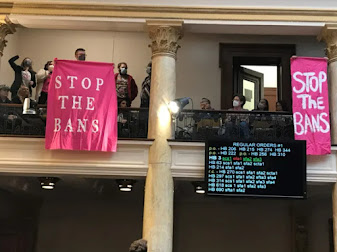
Protest in the Senate (Courier Journal photo by Deborah Yetter)
By Melissa Patrick and Al Cross Kentucky Health News
FRANKFORT – The legislature has passed a wide-ranging abortion bill that would ban the procedure after 15 weeks of pregnancy and that Planned Parenthood says would "eliminate abortion access in Kentucky."
The Senate passed the bill 29-0. Every Democrat but Sen. Dennis Parrett of Elizabethtown, who voted yes, left the chamber in solidarity with protesters in the gallery overlooking the chamber. Hours later, the House concurred with the Senate's changes and sent the bill to Gov. Andy Beshear on a vote of 74-19.
As senators voted, protesters chanted "Abortion is health care." After security officers escorted them out, they gathered on the landing below the Senate steps and chanted "Hands off our bodies," which was audible as the roll call continued.
House Bill 3 would set higher standards for judges to approve abortion without parental consent, strengthen rules for parental consent and disposal of fetal remains, increase reporting requirements, and ban mailing of medications that have become the means for most abortions in Kentucky.
The bill has an emergency clause, which makes it effective upon becoming law, rather than the usual 90-day hiatus. Senate Democratic Leader Morgan McGarvey said providers can’t necessarily implement it quickly. “We don’t treat other laws like this in this regard,” he said, and shouldn’t “when this is a decision best left to the woman and her physician.”
Planned Parenthood Alliance Advocates issued a statement saying that HB 3 “would completely eliminate abortion access in Kentucky immediately upon becoming law by piling on a laundry list of abortion restrictions so extreme that they would make it impossible for providers to operate in the state.”
“HB 3 is solely and deliberately designed to eliminate all abortion in the state of Kentucky,” said Tamarra Wieder, the group's state director. “This bill ignores our constitutional rights, dismisses science, and contradicts public opinion. We strongly urge Gov. Beshear to veto this cruel, dangerous bill and support what the majority of Kentuckians want – access to safe and legal abortion.”
Even if Beshear vetoes the bill, all it takes to override him is a majority vote in both chambers.
The abortion medication targeted by the bill consist of two drugs: one to block progesterone, a hormone necessary for a pregnancy to develop; and the other to cause contractions to empty the uterus early in a pregnancy. In mid-December, the U.S. Food and Drug Administration allowed the drugs to be sent by mail.
Republican Sen. Ralph Alvarado, a Winchester physician, spoke at length about the need for women to be properly screened and counseled by a "qualified and competent" provider before a "chemical abortion." He said the bill "Will prevent at-home, pill-by-mail, do-it-yourself abortions that leave women to fend for themselves if medical complications arise."
He said a peer-reviewed study of Medicaid claims data shows that emergency-room visits following chemical abortions are on the rise, occurring as frequently as 35 ER visits per 100 abortions. As evidence, the bill's sponsor, Rep. Nancy Tate, R-Brandenburg, gave Kentucky Health News a study from the Charlotte Lozier Institute, the research arm of the anti-abortion group Susan B. Anthony List.
The Kaiser Family Foundation reports: "Medication abortion is a safe and highly effective method of pregnancy termination if the pills are administered at nine weeks’ gestation or less, the pregnancy is terminated successfully 99.6% of the time, with a 0.4% risk of major complications, and an associated mortality rate of less than 0.001 percent (0.00064%)."
Language from Senate Bill 321 to ban abortions in Kentucky after the 15th week of pregnancy was added to HB 3 in a floor amendment. SB 321's sponsor, Sen. Max Wise, R-Campbellsville, said the bill is "closely modeled" after a Mississippi law that is awaiting a decision from the U.S. Supreme Court.
"In the event that the Supreme Court upholds Mississippi legislation as constitutional," he said, "we will then have a pro-life law in place that would not be subject to a good-faith legal challenge."
An amendment filed by Sen. Denise Harper Angel, D-Louisville, to add exceptions for rape or incest to HB 3 failed to pass. Without it, she said, "This body turns its back on these victims of heinous crimes."
Alvarado and Tate said current law allows abortion for any reason up to 20 weeks, so such exceptions are not necessary. Alvarado added that the judicial process to bypass lack of parental consent would help a minor with that decision.
Legislators in both chambers spoke to the difficulties minors already have with the judicial-bypass process, and said the tighter parental-consent rules will make getting abortions more difficult, especially for immigrants, the poor and those living in rural areas.
The bill would require the minor and the consenting parent or legal guardian to have a government-issued identification and show the judge that a reasonable attempt has been made to notify a parent or legal guardian with joint or physical custody within 48 hours prior to the consent being signed.
Rep. Nima Kulkarni, D-Louisville, said most young people talk to their parents before an abortion, but those who don't typically don't because of fear of harm, including being kicked out of the home. Others, she said, may not live with their parents or be able to locate them.
"Parental consent laws force young people to delay care, travel out of state, incur additional cost to obtain care or forego care altogether," she said.
The bill would establish an online complaint portal with the names of all physicians in Kentucky who provide abortion services. McGarvey said that will put them at risk, because there have been 11 murders, 26 attempted murders, 42 bombings, 189 arsons and thousands of criminal activities directed at people providing legal abortion services since 1977.
McGarvey said the portal would allow anonymous publication of complaints, and such a portal in Texas has led to "thousands upon thousands" of false complaints from both sides that the law requires state government to investigate, wasting time and money.
The debate was as passionate as it was familiar.
Sen. Karen Berg, D-Louisville and a physician, said medication abortion is safer than pulling a wisdom tooth and 14 times safer than childbirth, but "There are certain legislators who feel that they have a right to regulate their personal religious and their personal moral beliefs over the rest of us under the guise, under the guise of safety for women. . . . Leave your religion and morality out of my health-care decisions."
But Rep. David Hale, R-Wellington, won applause in the House by saying he voted because of the 4,104 "children" who were "murdered" by the 4,104 abortions in Kentucky in 2020: "My purpose in being in this chamber is to see this atrocity stopped."
On March 21, Republicans in Kentucky's legislature overrode Democratic Gov. Andy Beshear's veto of their resolution ending the Covid-19 state of emergency about a month early, and with it an extra $100 a month in food benefits for 544,000 Kentuckians, who will revert to the standard $243 monthly benefit.
Senate President Pro Tem David Givens of Greensburg said any state could apply for an extra month of the benefits after the end of its emergency, but Beshear said there had to be a state-declared state of emergency.
Technically, they were both right. Now Beshear has requested the extra month of additional Supplemental Nutrition Assistance Program benefits, formerly called food stamps, from the U.S. Department of Agriculture.
State spokesman Brice Mitchell told Kentucky Health News that the state asked for the one-month "phase-out" extension of the benefits on Monday, March 28, a week after the legislature overrode his veto.
"Since the General Assembly voted to end food assistance for nearly 500,000 Kentuckians, the Cabinet for Health and Family Services is notifying the USDA today that a transition period is now needed for April to notify recipients that their benefits are ending May 1," Mitchell said in an e-mail. "If the General Assembly would have not taken this action, the cabinet would have been able to have requested that the benefits continue beyond May 1." The emergency had been scheduled to end April 14.
After the legislature overrode the veto of Senate Joint Resolution 150, Beshear said it would take benefits from Kentuckians, because it had barred him from declaring another emergency.
He said March 24, "We could have continued to provide, at no cost to the Commonwealth, extra dollars to help kids and seniors afford food that costs more than before the pandemic. So what this legislature said is no more help. We're going to go back to giving you the same amount pre-pandemic, even though things cost more."
Beshear didn't respond directly to a question asking him if he had investigated the federal guidance that Givens alluded to, instead saying the state needed an emergency declaration to continue the benefits. He said the resolution was passed for political reasons, and "It's not worth any political point that someone's trying to make to take food off the table of those that need it."
The sponsor of SJR 150 is Sen. Donald Douglas of Nicholasville, who was elected in a special election in December and is opposed in the May 17 Republican primary by Andrew Cooperrider of Lexington, who was a fervent opponent of anti-pandemic measures and has said the bill is designed to boost the candidacy of Douglas, a more mainstream candidate.
Senate President Robert Stivers issued a statement on March 22 criticizing the governor's desire to continue the emergency benefits.
“Twenty-eight states have already declared the end of the emergency, as well as the U.S. Senate,” Stivers said. “Continuing to operate under a false emergency for the sake of pulling down federal dollars is simply fraudulent and unethical.”
Attorney General Daniel Cameron has joined 20 of his counterparts in a lawsuit to overturn the Centers for Disease Control and Prevention's rule requiring masks to be worn in public transportation hubs.
The suit "argues that the mandate exceeds the authority of the CDC, noting that the Biden administration continues to use a failed interpretation of a quarantine statute that has been ruled against in court several times," Cameron's office said in a press release.
Cameron said, “With most states now relaxing their Covid-19 requirements, the CDC should follow suit and eliminate the mask mandate for airports, train stations, and other transportation hubs. We believe the current mask mandate exceeds the authority of the agency, and the Biden administration should end it immediately.”
The attorneys general, most of them Republicans like Cameron, argue that the law used to justify the mandate does not authorize such broad measures. only authorizes rules directly related to preventing interstate spread of disease, and does not permit mask requirements for individuals who show no sign of infection, the release says. The suit also argues that the rule is arbitrary and capricious and does not consider preventive actions by states.
The other plaintiff states are Alabama, Alaska, Arizona, Arkansas, Florida, Georgia, Idaho, Indiana, Kansas, Louisiana, Mississippi, Missouri, Montana, Nebraska, Ohio, Oklahoma, South Carolina, Utah, Virginia and West Virginia. To read the lawsuit, click here.
Most Americans say they have contracted the coronavirus, and the infected are more likely to be Republicans, says a new poll by Monmouth University in New Jersey. "This appears to be the first poll to show a majority of Americans saying they’ve been infected at some point," reports Aaron Blake of The Washington Post. "Other polls from recent months have shown a sharp uptick in those who report testing positive — particularly during the rise of the omicron variant — but Monmouth’s poll brings in those who believe they’ve contracted the virus but lack a diagnosis."
In the March 10-14 telephone survey, 52 percent of respondents said they had contracted the virus, up from 40% in late January, and 57% percent of Republicans said they had been infected, but only 38% of Democrats said they had. In January, the numbers were 50% and 28%. "This tracks with polls that more narrowly surveyed self-reported positive tests. It also suggests the gap has grown since the pandemic began," Blake notes.
Blake casts a skeptical eye: "Is the gap really this big? Polls asking people to self-report things like an infection are prone to response bias. Democrats might be less willing to acknowledge falling ill: Given the emphasis on mitigation on their side of the political aisle, they might view infection as some kind of moral failing. Republicans, by contrast, have long been more likely to argue that mitigation efforts have gone overboard and the virus is overblown. What better way to prove that than to say you personally contracted the virus and lived to tell the tale?
"But if that were a major factor, you might expect the gap between Republicans and Democrats to be greater when it comes to one specific self-reported measure: non-diagnosed cases. This would seem a prime opportunity for Republicans to say they believe they’ve had the virus even if they might not have, and for Democrats to downplay their infection status. On both sides, though, about 1 in 5 who say they’ve had the virus lacked a diagnosis.
"Notably, this gap in self-reporting didn’t always exist. Early in the pandemic, the percentage of Republicans and Democrats reporting positive tests was roughly equal — and for much of 2021, the gaps weren’t nearly as wide as they are now. Of course, this difference may be inflated by self-reporting. But the fact that even that self-reporting gap has grown is important. And it provides even more evidence that, as the pandemic has progressed, the virus has hit Republicans harder."
Despite the greater prevalence of infection, "The number of people who are very concerned about a family member becoming seriously ill from the virus (23%) has dropped to its lowest point since last June (also 23%)," Monmouth reports. "This marks a 15-point decrease over the past two months." The biggest drop was among Democrats: 30% in March, compared with 61% in January,
A House-passed bill to keep state and local governments from asking employees and applicants if they have received a Covid-19 vaccination, and to ban colleges and universities from requiring disclosure of immunization status, has failed in a Senate committee with three days left in the legislative session.
Rep. Savannah Maddox
House Bill 28, sponsored by libertarian Republican Rep. Savannah Maddox of Dry Ridge, passed the House 71-22 on March 10, but Monday the Senate Health and Welfare Committee voted 5-4 against it.
Sen. Danny Carroll, R-Benton, who has been critical of the restrictions Democratic Gov. Andy Beshear imposed to thwart the Covid-19 pandemic, said he voted no out of concern for what the future may hold.
"It's easy to make policy in retrospect, looking at what has happened," Carroll said. "What is difficult is to make policy and foreseeing the future. There is no way we can know what Covid will bring, what the next variant might be. How important it is that people know someone's vaccination status, that could mean the difference between life and death, depending on the variant and how deadly it is."
Voting yes were Republicans Stephen Meredith of Leitchfield, Michael J. Nemes of Shepherdsville, Max Wise of Campbellsville and Chairman Ralph Alvarado of Winchester, who said he cast his "aye" vote at the end of the roll call for the "sake of the sponsor." Earlier, he questioned her handling of the bill.
Alvarado asked Maddox if she had the votes to pass the bill and if she had reached out to all committee members. Maddox said that when she approached Alvarado last week, it did not have the votes to pass, "but since that time, it has gained a bit of momentum" and that she had spoken to "a great number of them about this bill."
Alvarado said, "I know that you haven't spoken to all of them, at least. And so the question there becomes, why not? I know you had reached out, asked for this bill to be heard and you're right, a brief text message was, you don't have the votes. So I'm curious if you have them. Customarily, if a sponsor asks for a bill to be heard, the presumption is that you have the votes for it to pass. And so typically, it's an important bill, that would be the thing that I would hope to have coming forward."
HB 28 would also ban public entities from mandating or issuing vaccine passports and would allow parents or guardians of children in schools to opt them out of any Covid-19 vaccination requirements on the basis of a conscientiously held belief. Kentucky's public schools do not require Covid-19 vaccinations. The bill defines a public entity as the state, a local government, or any of their agencies or departments.
"This bill is not intended to debate the merit or non-merits of receiving a vaccine," Maddox said, adding later, "It comes down to the fact that Kentuckians are capable of making good decisions for themselves and their families when it comes to their health care without any undue influence force or coercion from the government."
The Kentucky League of Cities opposed the bill, saying it violates the home-rule powers of local governments.
Brittney Welch of the Kentucky Nurses Association said that if nursing schools could not ask students their vaccination status it would "severely alter the ability of nursing schools" to put them in clinical settings. Maddox said HB 28 would not keep hospitals from following federal vaccine mandates, and nursing students there would have to obey them.
Senate Republican Caucus Chair Julie Raque Adams of Louisville said she voted "no" because the bill would put the University of Louisville Medical Center in direct conflict with federal law.
Also voting no were Republican Jason Howell of Murray and Democrats Karen Berg and Denise Harper Angel of Louisville.
Kentucky Health News graph from weekly state reports
By Al Cross Kentucky Health News
The pandemic in Kentucky has declined to levels not seen since early last summer, when numbers bottomed out just before the surge of the Omicron variant of the coronavirus drove them to record levels.
From last Monday through Sunday, the share of Kentuckians testing positive for the virus was 2.29 percent, less than half the 5% level at which public-health officials say poses the risk of widespread outbreaks.
Since March 7, when the state started issuing weekly instead of daily reports, the rate has declined from 6.04%. The rate was below 2% for 12 days in late June last year, just before Omicron hit.
Omicron's BA.2 subvariant is becoming widespread and is at least twice as transmissible as the original, but hasn't been shown to cause worse disease.
The state reported 5,530 new cases during the reporting week, an average of 790 per day, still well above last summer's low average of 163 in the last week of June 2021.
But the state's seven-day infection rate fell to 4.82 daily cases per 100,000 residents, not too far above last summer's low of 3.13 per 100,000.
Hotspots remain. Counties with rates more than double the statewide rate, putting them into double figures, were Cumberland, 21.6 per 100,000; Perry, 16.1; Taylor, 15.5; Trimble, 15.2; Wayne, 14.1; Magoffin, 12.9; Anderson, 12.6; Adair, 11.9; Pike, 11.8; Floyd, 10.8; and Wolfe, 10.
The state's weekly report said 26 percent of the new cases were in Kentuckians 18 and younger. Generally in Kentucky, the younger someone is, then less likely they are to be vaccinated for Covid-19.
The report said 263 hospital patients had Covid-19, with 50 in intensive care and 25 on mechanical ventilation. The total number of Covid-19 patients is less than the number on intensive care five weeks ago.
One of the more encouraging indicators was a decline in the number of deaths. The state attributed 236 more deaths to Covid-19 last week, just over 33 per day, down from the approximately 40 per day recorded the previous three weeks. The state's pandemic death toll stands at 14,895.
Megan Simpson works after group class at Living Clean transitional
housing in Manchester. She recently completed peer support training
and passed her certification test. She started as a peer support specialist
in
Corbin and is scheduled to go to court in April to regain custody of
her three children. (Photo by Silas Walker, Lexington Herald-Leader)
Kentucky Health News
The continuing struggle of Megan Simpson of Manchester helps show the difficulty that rural and small-town Kentuckians have getting treatment for substance-use disorder.
Simpson's story of addiction, treatment, relapse and recovery has been told in two long installments by Liz Moomey of the Lexington Herald-Leader. The latest appeared Sunday, along with a story by Moomey about the limited access that rural Kentuckians have to treatment.
She reports, "In many rural areas, resources are often few and far between to get treatment and return to life after recovery. Sober living housing is scarce. Transportation is limited. Childcare is sparse. Broadband internet for telehealth appointments or for virtual recovery meetings is unreliable."
“Many people don’t have all those stars aligned and they have a very difficult path ahead of them,” said Matt Brown, Addiction Recovery Care’s senior vice president of administration, who "struggled with substance use disorder for 18 years," Moomey writes. "He considers himself fortunate to have a wife who stayed with him through his addiction, an education and a job."
Rural areas not only lack a choice of providers for counseling and treatment, there is a lack of anonymity in small towns, Moomey notes, quoting Brown: “Everybody knows everything.”
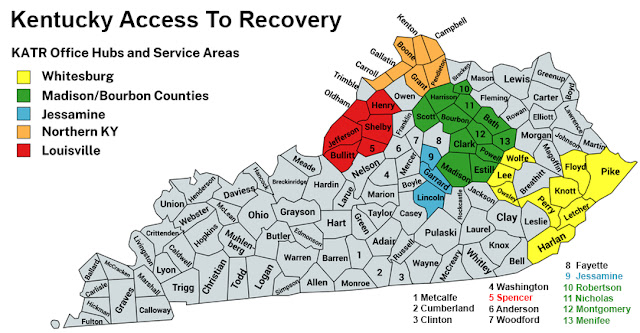
The Kentucky Access to Recovery program of the nonprofit Federation of Appalachian Housing Enterprises, a 37-county program that "connects participants recovering from opioid-use disorder or stimulant use disorder to housing, childcare, dental care, transportation and other services," Moomey writes.
KATR map via Herald-Leader, adapted by Kentucky Health News; to enlarge, click on it.
Aaron Brown, a Western Carolina University professor who researches the issue, "said KATR wants to address the practical needs of rural Kentuckians that prevent people from accessing recovery," Moomey reports. Brown said the types of jobs available and the benefits provided are more limited in rural areas. From his research on rural areas, good-paying jobs were often more taxing and didn’t always provide the option to take off work to participate in recovery opportunities."
Brown told Moomey that the ideal recovery model has these steps: medical detoxification, inpatient rehabilitation and a sober living facility with intensive outpatient services, such as group and individual treatment. But that's not always realistic in rural areas "because of lack of services and health professional shortages," Moomey writes.
State version of CDC map, with additional label by Kentucky Health News
Kentucky Health News
Kentucky as a whole is at lower risk from the coronavirus than it was a week ago, according to the Centers for Disease Control and Prevention. But about the same number of counties are rated at low risk, and the risk ratings increased in a few counties.
On Thursday the CDC listed 10 counties as high-risk. In those places, it still advises masks to be worn in indoor public spaces. The number is fewer than half the 24 listed last week, but two counties, Casey and Powell, moved from medium risk to high risk.
The 52 counties rated at medium risk included Ballard, McCracken, Carlisle and Hickman, in far Western Kentucky, which moved up from low risk.
The CDC says residents in medium-risk counties who are immuno-compromised or at high risk for severe illness should talk to a health-care provider about "additional precautions, such as wearing masks or respirators indoors in public. If you live with or have social contact with someone at high risk for severe illness, consider testing yourself for infection before you get together and wearing a mask when indoors with them."
CDC map, adapted by Kentucky Health News
The number of counties rated at low risk declined from 59 to 58. The ratings are based on new coronavirus cases, Covid-19 hospitalizations and the percentage of staffed inpatient beds occupied by Covid patients.
Kentucky remains one of the higher-risk states, according to the CDC's national map.