Sunday, April 24, 2022

Tick season nears. 10% of ticks carry debilitating diseases; quick action can prevent them. And UK wants you to send in your ticks!

Lucie Conchou works in UK entomologist
Zainulabeuddin Syed’s lab. (Photo by Matt Barton)
Kentucky Health News

Ticks are a threat in Kentucky year-round, but especially in the summer months. The next time one bites you, stop and think before flushing it down the toilet. You could help other people by mailing it to the University of Kentucky entomology department to see if it carries disease or not. 

Here's how: If you find a tick on yourself or your pet, remove it with tweezers, place it in alcohol in a sealed container or bag, and mail it to the university's entomology department. Those are the instructions Professor Reddy Palli, who chairs the department and serves as state entomologist, told Aaron Mudd of the Lexington Herald-Leader.

A university spokesperson told Mudd to check with your local UK Extension office to see exactly where to mail a specimen for study. 

“We will contact the person who submits the specimen if we detect pathogens in the tick and encourage them to contact their physician,” Palli told the Herald-Leader in an email.

Mudd reports, "As a leader in his field, Palli is overseeing several researchers who are studying tick populations in Kentucky, monitoring the diseases they spread and potentially engineering ways to repel them or even stop them from searching for blood in the first place."

Katie Pratt of the UK College of Agriculture, Food and Environment also wrote about the work of Palli and his colleagues. 

She reports that one of the Palli's graduate students is Anna Pasternak, who leads the Kentucky Tick Surveillance Program. She collects ticks analyze their genetic material and any disease-causing pathogens hiding within them. The program has been collecting information on ticks in the state since January 2019. 

“Preliminary results show that the greatest number of ticks exist in wooded areas of the state and at Land Between the Lakes, and 10 percent of them carry a pathogen that cause diseases like Lyme disease, Rocky Mountain spotted fever, alpha-gal and others,” Palli said. The last disease he mentioned can cause an allergy to red meat.

“We really did not expect pathogen presences in these ticks to be that high,” Palli said.

“Our goal is to take Anna’s data and educate farmers, loggers, physicians and health care workers about the ticks in the state and ways to minimize their effects. For example, if someone gets bitten by a tick carrying the Lyme disease pathogen and they get an antibiotic within 72 hours, it is likely the antibiotic will kill the bacteria that causes Lyme disease. Not many people know that, and by the time symptoms appear, it’s often too late.”

University of Kentucky graphic; for a larger version, click on it.
Blacklegged ticks, tiny bugs otherwise known as deer ticks, are the main transmitter of Lyme disease, the top insect vector-borne disease in America. And as these ticks expand their region from New England to the eastern half of the United States, cases of Lyme disease are growing too, Pratt reports. 

Signs and symptoms of Lyme disease include fever, chills, headache, fatigue, muscle and joint aches and swollen lymph glands. Upwards of 80% of infected persons have a distinctive "bull's eye" rash that appears at the site of the bite three to 30 days after infection.

The American dog tick and the brown dog tick can carry and transmit the bacteria that causes Rocky Mountain spotted fever.

Signs and symptoms of RMSF are fever, headache, nausea, vomiting, stomach pain, muscle pain, lack of appetite and a spotted rash. The rash usually develops several days after the onset of a fever and can vary between splotches and smaller pinpoint dots.

The Lone Star tick caries the bacteria that causes ehrilichiosis. Signs and symptoms of ehrilichiosis are fever, headache, chills, cough, malaise, muscle pain, nausea, vomiting, diarrhea, confusion and red eyes. A rash is common in children, but less so in adults.

The Lone Star tick is also a vector for alpha-gal syndrome, known as the red-meat allergy, which is becoming increasingly more common.

Ways to protect yourself from ticks are:
  • Avoid grassy, wooded and leaf-covered areas
  • Keep grass and shrubs trimmed and cleared away
  • Walk in the center of walking trails
  • Wear light-colored clothes, which make it easier to spot ticks
  • Wear long pants tucked into boots and tuck in your shirts
  • Use tick repellent that has the repellent DEET or picaridin
  • Treat your clothes with permethrin, which repels and kills ticks
  • Do a body check along the way and at the end of each day
  • Check your pets and equipment for ticks
  • Shower within two hours of potential exposure, if possible
To kill ticks on clothing, tumble dry for 10 minutes or wash them in hot water. If clothes can't be washed in hot water, tumble dry for 90 minutes on regular heat or 60 minutes on high.

Albert B. Chandler Hospital at UK opened 60 years ago today

The latest Chandler Hospital is on Limestone Street.
By Kristi Willett
University of Kentucky

Sixty years ago today, the Albert B. Chandler Hospital at the University of Kentucky opened its doors and welcomed its first patients. The hospital has evolved into the UK HealthCare system, operating three hospitals – UK Chandler, UK Good Samaritan and UK Kentucky Children’s Hospital – serving more than 40,000 patients a year.

UK HealthCare also includes more than 60 outpatient clinics, conducting more than 2.2 million outpatient visits every year, and employs more than 10,000 physicians, nurses, pharmacists and other health-care providers.

“This team is dedicated to providing the most advanced, high-quality patient care to Kentucky and beyond,” said Dr. Mark F. Newman, UK's executive vice president for health affairs.

Chandler Hospital has been rated the No. 1 hospital in Kentucky by U.S. News & World Report for six years.

Access to quality health care in the Bluegrass region is something that is often taken for granted, but that hasn’t always been the case. In the early 20th century, one of every three Kentuckians examined for military service during World War II was deemed medically unfit for duty. In 1949, there were more than 5,000 unattended births in Kentucky and the state ranked near the bottom in physician-to-patient ratio, with an estimated 1,400 additional doctors needed.

In the early 1950s, a group of UK professors and the Legislative Research Commission recommended that an academic medical center be built at UK to improve health-care access for Kentuckians. The state's only medical school was at the University of Louisville.

In 1954, UK trustees committed to fulfilling the university's original charter to create a medical college and associated medical center once funds became available. During his 1955 campaign for a second, nonconsecutive term as governor, Albert B. "Happy" Chandler promised that he would get it done, and the university named it for him.

The hospital immediately became a cornerstone for educating top physicians, providing outstanding health care, and conducting breakthrough medical research. It and the rest of UK HealthCare have become a statewide hub for advanced care. Chandler Hospital is a Level 1 trauma center and has one of the largest intensive-care units in Kentucky. During the Covid-19 pandemic, the hospital and UK HealthCare played a critical role, caring for more than 4,400 patients.

“During our anniversary celebration of the opening of UK Chandler Hospital, it is vital that we honor those who came before us and worked diligently on what was merely a vision of health-care access in the 1950s and '60s,” Newman said. “We are forever grateful for those who provided the support needed to build the foundation that has led to our world-class medical facilities. It is our hope that through our work, we honor the legacy of these visionaries and leaders each and every day.”

Saturday, April 23, 2022

Latest CDC map shows all of Kentucky has low level of Covid-19

CDC map shows all of Kentucky in green, for low levels of Covid-19 transmission. 

By Melissa Patrick
Kentucky Health News

Every county in Kentucky has a low level of coronavirus transmission, according to the latest weekly analysis of risk based on cases and hospital capacity by the Centers for Disease Control and Prevention. 

The CDC ratings are based on new coronavirus cases, Covid-19 hospitalizations and the percentage of staffed inpatient beds occupied by Covid-19 patients. Its color-coded map uses green for counties with low risk of transmission, yellow for counties with medium risk and red for counties with high risk. 

The latest map shows that the whole state is in the green, a level that comes with recommendations to stay up to date with your Covid-19 vaccines and to get tested if you have symptoms. 

The CDC reports that 91.7% of counties and county equivalents in the U.S. have a low level of Covid-19. 

The latest ratings came as Kentucky's Covid-19 cases and the share of Kentuckians testing positive for the virus in the previous week  ticked up a bit, while hospital numbers continued to decline.

"So we're gonna keep taking a look at at where the numbers of cases and positivity are, but [we're] not concerned because of where these [hospital] graphs are, which is in such a good place," Gov. Andy Beshear said at his weekly news conference on Thursday, before the new CDC map was released. 

The slight uptick also comes as Kentucky gears up for what Beshear said would be record crowds at this year's Kentucky Derby on Saturday, May 7, which he said he plans on attending. 

"We are in the best shape that we have been since the start of the pandemic, with all factors considered to host the Kentucky Derby," he said. "And how exciting is that?"

Friday, April 22, 2022

Appalachian Food for Health Diabetes Prevention virtual event is Tuesday, April 26; it's free, but registration is required


The fourth Appalachian Food for Health Diabetes Prevention event will take place Tuesday, April 26 from 10 a.m. to 12 p.m. ET.

The virtual event will focus on food and nutrition policy that impact diabetes. It will also include a discussion about diabetes prevention and how better access to fresh, healthy foods can play a role in deterring this disease. The event is free, but registration is required. Click here to register. 

The agenda for the event includes presentations from Tyler Offerman, food justice organizer for the Kentucky Equal Justice Center, who will give an overview of 2022 Kentucky legislation related to food and nutrition; Martin Richards and Kimberly Ishmael of the Community Farm Alliance, who will discuss the healthy farm and food fund; and Pamela Spradling, director of planning and grant management at Big Sandy Health Care, who will discuss community health workers and diabetes prevention. 

The Appalachian Food for Health Diabetes Prevention Convening series is a collaboration between the Community Farm Alliance, the Foundation for a Healthy Kentucky and Shaping Our Appalachian Region, the regional economic-development group for Kentucky's 54 Appalachian counties. 

Thursday, April 21, 2022

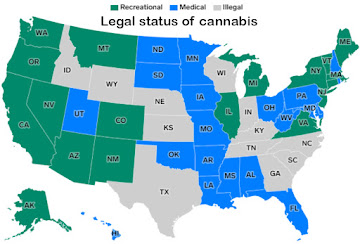
Beshear says he is looking at ways to bring medical marijuana to Ky. by executive action, while seeking public's opinion on topic

Business Insider map provided by Beshear's office, adapted by Ky. Health News
By Melissa Patrick
Kentucky Health News

After a bill to legalize medical marijuana in Kentucky failed again in the legislature, Gov. Andy Beshear announced a plan to ask Kentuckians how he might address the issue through executive action. 

"This session, like the last one and many before, the General Assembly did not get the job done, despite broad support from the public," Beshear said at his regular weekly news conference. A medical cannabis bill again passed the House this year but couldn't even get a committee hearing in the Senate.

The Democratic governor, who is seeking re-election next year, said his move isn't political.

"This issue's time has come," he said. "I think it's pretty clear where everybody falls on it. I believe if it had been given a committee vote, depending on the committee, it would have passed. If it would have been brought to the floor, it would have passed. You know, it's time that a couple of individuals that are out of touch with the vast majority of Kentuckians on this issue. Stop obstructing it, and we're able to move forward."

Senate President Robert Stivers has long said that he believes more research is needed before such a bill should pass. The Republican-controlled legislature passed a bill to create a cannabis research center, but the medical cannabis bill went nowhere in the Senate after passing the House 59-34.

Stivers issued a statement saying, “The public should be concerned with a governor who thinks he can change statute by executive order. He simply can’t legalize medical marijuana by executive order; you can’t supersede a statue by executive order because it’s a constitutional separation-of-powers violation.”

Beshear said, "We're looking through our legal options right now. If someone has just told you carte blanche, it's, it's against the law, then they haven't done the full analysis as we are looking at what different options there are out there."

He said he did not have an example of another state that had done this by executive action, and offered no details on what legalizing medical cannabis that way would look like, but outlined a plan to explore how it could be accomplished that would seek input from Kentuckians.

First, his lawyers will analyze options under the law regarding executive action on medical cannabis; then a Governor's Medical Cannabis Advisory Team will travel the state to hear from Kentuckians; and they will have an e-mail address to communicate with him about it: GovMedicalCannabisAdvisoryTeam@ky.gov

Beshear noted a long list of medical conditions that can be treated by cannabis, and stressed that 37 states, plus Puerto Rico, the U.S. Virgin Islands, Guam and Washington, D.C., already allow it for medical use and said it's time for Kentucky to do the same. 

"We are actually behind Mississippi," he said. "This time, we can't make that joke. Mississippi was actually the latest state to permit the use, and their legislature had the courage that ours did not." 

The bill that would create the research center and do several other things, HB 604, passed on the last day of the session. It would create the Kentucky Center for Cannabis Research at the University of Kentucky, which would get $2 million in the fiscal year that begins July 1. Stivers noted that Beshear has had the bill for a week and still hasn't signed it.

One stable at Keeneland focuses on addiction recovery while offering instruction on the basics of horsemanship

Will Walden and Tyler Maxwell of Ready Made Racing at Keeneland
on April 2. (Photo by Silas Walker, Lexington Herald-Leader)
Jacalyn Carfagno, a contributing writer for the Lexington Herald-Leader, tells a story about a group of men training horses at Ready Made Racing, a stable where all of the staff are in addiction recovery. 

The idea came to fruition last summer when Will Walden, a fourth-generation horseman and the son of Elliott Walden, president and CEO of WinStar Farm, went to Frank Taylor, vice president of sales at his family's Taylor Made Farm and pitched the idea, Carfagno reports. 

Taylor, also in recovery,  proceeded to buy 10 yearlings, found a group of investors and convinced his brothers to try a pilot project they called the Taylor Made School of Horsemanship to train people in recovery from substance use addiction the basics of horsemanship, she writes. 

Taylor told Carfagno that the horse industry is rife with addiction and "It's a lot safer to hire the ones that are in treatment."  

A year later, she writes that 20 have graduated from the 90-day program, 11 still work for Taylor Made, and others have gone on to other farms or industries. 

At the core of Ready Made Stables are Walden, Michael Lowry and Tyler Maxwell, who had gotten to know each other in the Shepherd's House recovery program. Carfagno reports that these three men took the 10 yearlings to Florida to train over the winter, even after a friend told Taylor that he was "a complete idiot" for trusting "three addicted guys that are in recovery" with that responsibility. 

Walden agreed it was a leap of faith, telling her, “You wouldn’t trust any one of us with five dollars to go to the store just a year ago, let alone hundreds of thousands of dollars worth of horses.” 

"But the three supported and encouraged each other, stayed sober and came back with race-ready two-year-olds," she writes. And by the time the Ready Made team arrived at Keeneland the third week of March,  she writes that Walden, 31, had been sober for 16 months, the longest period since he finished high school. 

On Wednesday, April 20, Sergeant Countzler, a two-year-old Bolt D'Oro colt and one of the 10 yearlings purchased for the program, came in third in his first race.

Walden told Carfagno that it was fitting that the horse is named for Christian Countzler, who helped him, Lowry and Maxwell climb out of addiction through his work at Shepherd's House. "I don't think we'd be here without that guy," he said. 

Lowry told Carfagno that caring for the horses entrusted to them is more than just a job.

"They do something to you, they bring peace, they really do, they bring peace," he said. 

Taylor shares even more about the mission and benefits of this program in a video with Blood Horse Magazine. 

Judge blocks state's new anti-abortion law, pending study of it

Kentucky Health News

A federal judge has blocked Kentucky's broad, new anti-abortion law, saying it has so many restrictions that she needs time to evaluate the ability of the state's two abortion clinics to follow them.

District Judge Rebecca Grady Jennings issued a temporary restraining order, saying “The Court restrains enforcement of the entirety of HB 3 at this time, as it lacks information to specifically determine which individual provisions and subsections are capable of compliance.”

The law was passed as House Bill 3 of the recently completed session of the Republican-controlled General Assembly, over the veto of Democratic Gov. Andy Beshear, who said it was unconstitutional and lacked an exception for cases of rape or incest. The bill had an emergency clause that made it take effect immediately, which the clinics said made compliance even more difficult.

U.S. District Judge Rebecca Grady Jennings
Jennings ruled in a lawsuit filed by a unit of Planned Parenthood, which has an abortion clinic in Louisville and called the law "tantamount to a ban on abortion." A similar suit was filed by the American Civil Liberties Union of Kentucky on behalf of EMW Women's Surgical Center of Louisville, the state's only other abortion clinic.

Both clinics stopped providing abortions when the law took effect April 13, saying it was impossible for them to comply with it immediately. "The law has put Kentucky in the national spotlight for becoming the first state to eliminate access to all abortion services," notes Deborah Yetter of the Courier Journal, adding that they are resuming services.

Jennings ruled that the law makes any abortion unlawful until the state Cabinet for Health and Family Services creates a system and forms for compliance. “Because [Planned Parenthood] cannot comply with HB 3 and thus cannot legally perform abortion services, its patients face a substantial obstacle to exercising their rights to a pre-viability abortion,” and that us an “undue burden,” making it constitutionally questionable, she wrote.

Jennings made her restraining order effective for two weeks, during which she will hold a hearing on the plaintiffs' motions for a preliminary injunction to keep the law from taking effect.

The law strengthens parental-consent rules, increases reporting rules, requires aborted fetuses to be cremated or buried through pre-arrangement with funeral homes, which the clinics said will be reluctant to make for fear of retribution.

It also prohibits abortion after the 15th week of pregnancy, mimicking a Mississippi law that is awaiting a decision from the U.S. Supreme Court, and bans mailing medications that have become the most common way to end a pregnancy in Kentucky, a means recently approved by the U.S. Food and Drug Administration. "It requires the state Cabinet for Health and Family Services to create a new, extensive system to certify, register and monitor anyone who produces, ships or dispenses the medication," Yetter notes. Beshear noted that the legislature provided no money for the system.

Planned Parenthood Great Northwest CEO Rebecca Gibron said in a press release that her group was “grateful” for Jennings' order: “This is a win, but it is only the first step. We’re prepared to fight for our patients’ right to basic health in court and continue doing everything in our power to ensure abortion access is permanently secured in Kentucky.”

Attorney General Daniel Cameron, a Republican who may run for governor against Beshear in 2023, said he was disappointed in the ruling. He had argued against a restraining order, notes Alex Acquisto of the Lexington Herald-Leader.

Free academy at Pikeville June 12-25 will introduce rising high-school seniors and juniors in Appalachian Kentucky to nursing

The regional development group Shaping our Appalachian Region and the state Department for Public Health’s Office of Health Equity are hosting the first Appalachian Nursing Academy June 12-25 at the University of Pikeville for rising juniors and seniors at high schools in Kentucky's 54 Appalachian counties. The free two-week academy offers:
· Interactive programming with workshops, presentation, shadowing, mentorship, tours, etc.
· Housing at the university
· Three meals a day
· $1,500 scholarship to further your education
· Trips to see and experience regional attractions and activities

You do not have to have any prior experience related to nursing to apply. Your interest is all that matters. If you are interested, click here to apply or here to download a flyer.

Wednesday, April 20, 2022

Kentucky highway fatalities rose again in 2021, by 3%; once more, most of those killed were not wearing their seat belt

Ky. Health News graph from state data shows fatalities not using a seat belt, and in which alcohol, speeding or aggressive driving, and distracted driving were involved, and the total number of fatalities.

Deaths from highway accidents in Kentucky rose 3.3 percent last year, according to the State Police and the Transportation Cabinet. But so far this year, fatality numbers are running below last year. 

Again last year, most of those killed were not wearing a seat belt.

"Of the 806 highway fatalities last year in Kentucky, 54.7 percent were not wearing a seat belt and 15 percent involved alcohol," the agencies said in a press release. "Approximately 26 percent involved speeding or aggressive drivers and 15 percent involved driver distraction."

Those percentages were about the same as in 2020, and those two years showed declines in fatal speeding or aggressive driving and driver distraction from 2019. About 32 percent of deaths in 2019 involved speeding or aggressive driving, and 21 percent involved driver distraction.

Unlike the last two years, 2021 saw deaths of motorcyclists outnumber those of pedestrians and  bicyclists. In 2021, pedestrians and bicyclists accounted for 85 deaths and motorcyclists accounted for 88 deaths. In 2020, pedestrians and bicyclists accounted for 97 deaths and motorcyclists accounted for 74 deaths. In 2019, pedestrians and bicyclists accounted for 79 deaths and motorcyclists accounted for 77 deaths.

“While we pledge to increase our awareness efforts, we need the public’s help,” Transportation Secretary Jim Gray said in the press release. “We’re asking motorists to commit to save driving behaviors when behind the wheel, and everyone – both drivers and passengers – pledge to always buckle up.”

According to the National Highway Traffic Safety Administration, wearing a seat belt gives motorists the best chance of preventing injury or death if involved in a crash. Properly fastened seat belts contact the strongest parts of the body, such as the chest, hips and shoulders. A seat belt spreads the force of a crash over a wide area of the body, putting less stress on any one part, and allows the body to slow down with the crash, extending the time when the crash forces are felt by the occupant.

Tuesday, April 19, 2022

Kentucky gets $4.19 million to expand AmeriCorps work in public health, with the hope it will funnel more people into such work


Kentucky has received nearly $4.2 million to expand the public-health role of the AmeriCorps program in the state. The grant comes from the American Rescue Plan Act, last year's pandemic relief bill.

"This funding will support the recruitment, training and development of a new generation of public health leaders,” Gov. Andy Beshear said in a news release. “The funding will support the addition of community health workers with coordination from Serve Kentucky, the agency committed to engaging Kentuckians in volunteerism and service to positively impact our communities.”

This new public health initiative is the result of a partnership between AmeriCorps and the Centers for Disease Control and Prevention. Nationwide, the initiative will fund up to 5,000 public-health positions over the next five years. 

Public Health AmeriCorps will help meet public-health needs of local communities by providing surge capacity and support while also creating pathways to public health-related careers, says the release. 

Health Commissioner Steven Stack pointed to the many public-health challenges caused by the pandemic, noting that it has been "neither easy nor without loss" to get to our current low rates of transmission. 

"This grant allows us to plan for future public health emergency responses," he said. "Creating a standing corps of public health personnel to manage surge capacity and respond to crises will enable Team Kentucky to stand ready to support Kentuckians when emergencies arise." 

Funding from the grant will  to the Kentucky Health Departments Association and Family Scholar House. 

The KHDA will get $1,367,986 to add 75 AmeriCorps members as community health workers in local health departments. They will work in programs such as the Health Access Nurturing Development Services, (HANDS), the Women, Infant and Children (WIC) program, and harm-reduction programs.

AmeriCorps members will not replace any existing health-department staffers, Susan Dunlap, spokeswoman for the Cabinet for Health and Family Services, told Kentucky Health News in an e-mail. 

"AmeriCorps members will be used to bolster the local public health workforce in Kentucky to expand the number of services delivered at local health departments currently available," Dunlap said. "Additionally, AmeriCorps members will receive training to become certified as community health workers, which are in short supply at local health departments throughout Kentucky."

Family Scholar House, which oversees the annual grant competition that awards funding to AmeriCorps State and other community service programs, says it works to provide a comprehensive, holistic continuum of care for low-income families and youth to help them reach their educational, career and family goals. It will get $2,825,124 to offer additional services.

Dunlap said, "FSH applied for the grant due to their familiarity with AmeriCorps, and because the grant will enable participants to receive training and support to enter the public-health field (in addition to the living allowance and education award) – which aligns with FSH’s priorities of health, educational support, and career pathways."

FSH's grant will allow it to leverage 200 AmeriCorps members who will provide health-care support to seniors and disabled individuals in health care facilities across Kentucky, says the news release. 

"FSH AmeriCorps member activities will include support with basic clinical assistance, activities for socialization, infection control, and dietary and patient services," said Dunlap. "FSH AmeriCorps members will develop their healthcare knowledge and complete credentialing coursework—enabling them to work in memory care, skilled nursing, assisted living, and other healthcare related environments." 

Eric Friedlander, secretary of the cabinet, which administers and oversees Serve Kentucky, said this initiative will serve as a steppingstone to get more people into the public-health field.

“After their year of service, we expect more than 200 AmeriCorps members will pursue future engagement in the public-health sector,” Friedlander said in the release. "AmeriCorps and the CDC believe that Public Health AmeriCorps provides a unique way to expose those interested in learning more about public health and its various careers.”

Joe Bringardner, executive director of Serve Kentucky, said, "Adults of all ages and education backgrounds are eligible to serve in Public Health AmeriCorps."

Monday, April 18, 2022

Coronavirus cases and positive-test rate in Kentucky are rising, but deaths and hospital numbers are declining more

Kentucky Health News chart from state data
By Melissa Patrick
Kentucky Health News

Daily cases and the share of Kentuckians testing positive for the coronavirus are rising again, apparently reflecting a national trend.

The state's report for the last Monday-Sunday period showed 3,257 new cases of the virus, an average of 465 per day, up 4.5% from 445 a day the week before.  

The New York Times reports that cases are rising again in the U.S., going up 39% in the last two weeks. It notes that case numbers are likely higher than reported, because of the prevalence of home Covid-19 tests.

Kentucky Health News graph, from state data
The percentage of Kentuckians testing positive for the virus in the past seven days is 3.12%, up from 2.27%. 

The Times ranks Kentucky's infection rate 20th among the states and Washington, D.C. Of the week's new cases in Kentucky, 25% were in people 18 and younger. 

Kentucky's seven-day infection rate also showed an uptick, to to 5.63 cases per 100,000 residents from 4.09 the week before. Counties with rates more than double the latest statewide rate are Franklin, 23.5; Campbell, 11.9; and Jefferson, 11.6. Twenty of the 120 counties reported no cases last week.

While leading indicators showed more risk of infection, deaths related to Covid-19 dropped 43 percent and hospital numbers continued to decline. 

The state attributed 97 more deaths to Covid-19, an average of just under 13.9 per day. That's down from 24.6 per day the week before and 19.3 per day the week before that. All told, the state has attributed 15,297 deaths to the pandemic. 

Kentucky hospitals reported 176 patients with Covid-19, with 20 of them in intensive care and only nine on mechanical ventilation. All of these numbers are lower than last week's Monday report; hospitalizations were down 11%; intensive-care cases were down 31%.

Very few intensive-care beds in Kentucky are being used for Covid-19 patients, but six of the state's 10 hospital regions are using at least 80% of their intensive care beds. Statewide, 78.7% of the beds are in use. 

Kentuckians who are not vaccinated or boosted are still encouraged to do so. The Washington Post reports that an average of 4,753 Covid-19 vaccine doses per day were given in Kentucky last week, a 6% increase over the week before.

The numbers include second doses and booster shots. They have been increasing since late March, when a second booster shot was authorized for people 65 and older and other more vulnerable populations. But the rate of increase in Kentucky since then has not been as fast as nationwide. 

So far, 65% of the state's total population has received at least one dose of a vaccine; 57% of the total population is fully vaccinated; and 44% of those eligible have been boosted. The Post adds that nearly 61% of the state's eligible population, those 5 and older, have been fully vaccinated. 

"Let's keep going," Gov. Andy Beshear said at last week's press conference. "It's not enough." 

Travel masks out: On Monday, a federal judge in Florida struck down the federal mask mandate on airplanes and other modes of public transportation, saying it exceeds the statutory authority of the Centers for Disease Control and Prevention and violates administrative law. 

Last week, the CDC extended the public transportation mask mandate through May 3. The Biden administration has not decided on an appeal.

"White House spokesperson Jen Psaki said Monday afternoon that it was a 'disappointing' decision, and that the Department of Homeland Security and the CDC were reviewing the ruling" and that "the Justice Department will make any determinations about a legal response," CNN reports.

Sunday, April 17, 2022

Cancer plagues Appalachia, so a UK program brings high-school and college students from the region into the study of it

The nation's highest cancer rates are in Appalachia, especially in Appalachian Kentucky. But the state is also home to an effort to get young people from the region involved in research to prevent and cure cancer.

It's at the University of Kentucky’s Markey Cancer Center, where college and high-school students from Appalachian Kentucky can explore research, clinical care and education "to help them learn more about pursuing careers in fighting cancer," Tom Martin of Richmond's WEKU-FM reports for The Daily Yonder.

The program is called ACTION, for Appalachian Career Training in Oncology, the study and treatment of cancer. It's directed by Nathan Vanderford, an associate professor of toxicology and cancer biology. He is editor of a book of student essays, Cancer Crisis in Appalachia: Kentucky Students Take ACTION , published by the University Press of Kentucky in 2020. A second edition, being edited by Vanderford and Chris Pritchard, is forthcoming.

Professor Nathan Vanderford with the students' book
and photographs (UK photo by Pete Comparoni)
Vanderford told Martin, "We truly do have a cancer crisis in Appalachian Kentucky. The state continues to rate number one in overall cancer incidence and mortality rates. And so it’s critically important that we bring awareness to this fact across the state, and particularly in Eastern Kentucky," which lacks oncology professionals and is distant from health-care centers.

"We are on a mission, and we think it’s really important to train the next generation of oncology professionals who are going to tackle the cancer problem in Appalachian Kentucky, and to have those be individuals who were born and raised and have a personal understanding of the issues that the area faces," Vanderford said. "And who best to do that than the youth of the region?"

Vanderford is from Appalachia, and lost his father to lung cancer in 2010. He told Martin that's when he "became really passionate about cancer and cancer disparities. . . . Just shortly thereafter, my mom was diagnosed with breast cancer, and luckily she was diagnosed early and went through some successful treatment and she’s OK today. So from a personal perspective . . . I’m deeply passionate about this work because of that. But in general, I just absolutely love working with students. It’s just so exciting to work with students, particularly students from Eastern Kentucky. We have amazing students in this state and they just need opportunities. In many of these rural areas, there’s fewer opportunities, outstanding students, and they can just excel when given opportunities like this to take the ball and run with it, so to speak."

Appalachian Kentucky students who are interested in applying to participate in ACTION may find information on the Markey Cancer Center website. The deadline for high-school students apply is May 13. The deadline for college-student applications has passed for this year. For more on the students' work, including photography that they used to illustrate their writings, click here.