Friday, May 13, 2022

DEA declared National Fentanyl Awareness Day; now is 'the most dangerous time in history to use drugs,' ARC executive says

dea.gov photo
By Melissa Patrick
Kentucky Health News

In response to increase in overdose deaths caused by fentanyl, a highly addictive synthetic opioid, the U.S. Drug Enforcement Administration declared Tuesday, May 10 National Fentanyl Awareness Day. The goal is saving lives by increasing awareness of, and decreasing the demand for, the powerful drug.

"The advent of fentanyl's integration into street-level use has dramatically changed the landscape of addiction, making this the most dangerous time in history to use drugs," Pat Fogarty, Addiction Recovery Care senior vice president of operations, said in a news release. "Nearly all illicit drugs are potentially contaminated with fentanyl, making any kind of drug use potentially deadly."

Fentanyl is about 50 times more potent than heroin and 100 times more potent than morphine. Drug traffickers often mix it with other illicit drugs to drive addiction and create repeat customers.

"Many people who are overdosing and dying don’t even know that they are taking fentanyl," says a DEA news release. 

Nationally, the news release says nearly 107,000 people died from a drug-overdose death in the 12-month period ending November 2021. Synthetic opioids, including fentanyls, are involved in 66% of all overdose deaths. 

Kentucky recorded 1,964 overdose deaths in 2020, the highest number recorded to date and a 49% increase from the year before, according to the state's latest annual report. 

Fentanyl-related overdose deaths are also on the rise among teens. A recent study published in the Journal of the American Medical Association shows that between 2019 and 2020, overdose deaths increased by 94.03% among teens aged 14-18, increasing from 492 overdose deaths in 2019 to 954 in 2020. From 2020 to 2021, they increased by 20.05%, increasing to 1,146 overdose deaths. In 2021, fentanyls were identified in 77.14% of adolescent overdose deaths. 

The researchers conclude that "increasing adolescent overdose deaths, in the context of increasing availability of illicit fentanyls, highlight the need for accurate harm-reduction education for adolescents and greater access to naloxone and services for mental health and substance use behaviors." 

The ARC news release says overdose deaths among teens "are projected to more than double in two years." 

In 2020, the state recorded 127 overdose deaths among Kentuckians between the ages of 15 and 24.

"Fentanyl overdose deaths are not only the result of individuals using a contaminated supply, but many have also adopted fentanyl as their drug of choice," added Fogarty. “For those who are struggling, treatment is available at Addiction Recovery Care, and recovery is possible.”

People who are struggling with drug abuse or who are concerned about a family member's substance use can also search for treatment providers at www.findhelpnowky.org. The KY Help Call Center (1-833-859-4357) also provides information on treatment options an open slots among treatment providers. The Kentucky State Police has also launched the Angel Initiative, which allows anyone with a substance-use disorder seeking treatment to visit a KSP post where they are directed to treatment.

Thursday, May 12, 2022

CDC says 12 Kentucky counties have medium levels of coronavirus as cases and positivity-rates creep up across state

Centers for Disease Control and Prevention map
By Melissa Patrick
Kentucky Health News

Twelve Kentucky counties, most of them in Eastern Kentucky, are in yellow, indicating a medium level of coronavirus transmission on the latest national Covid-19 risk map from the federal Centers for Disease Control and Prevention. 

Union and Henderson counties in Western Kentucky are yellow for the third week in a row. Also yellow are Jefferson County, the state's most populous, and nine Eastern Kentucky counties: Greenup, Carter, Boyd, Lawrence, Johnson, Magoffin, Floyd, Martin and Pike. They are part of a cluster that includes part of West Virginia and one county in southeastern Ohio.

Twelve is the highest number of Kentucky counties with only low and medium levels of virus on the CDC risk map since the March 31 report, when the state had six yellow counties, and it comes as the state's positive-test rate and new cases are ticking up. 

The state's weekly report showed a 16.5 percent increase in new cases from the prior week, to an average of 565 new cases per day. It showed a seven-day positive-test rate, not including results of home tests, of 7.19%. That was up from 5.67% the week before. 

The U.S. Food and Drug Administration has warned to avoid using the Skippack Medical Lab SARS-CoV-2 Antigen Rapid Test (Colloidal Gold) at-home Covid-19 test because it could give a wrong result, the Lexington Herald-Leader reports. SML Distribution LLC has recalled more than 209,000 of the tests. The company has not given “adequate data to show the test works correctly,” according to the federal Food and Drug Administration.

Gov. Andy Beshear noted that Kentucky's positive-test rate, while increasing, "is not the same indicator that it used to be" because it no longer means that our hospitals could get overrun, as was true earlier in the pandemic. 

Beshear explained that even as Covid-19 cases are slowly increasing, low hospitalization rates show that the coronavirus is not causing severe illness. 

"So am I a little concerned right now? Sure. I'm wary, I'm watching," Beshear said at his weekly news conference Thursday. "But I don't think there is cause for alarm yet. We are right to notice it, to watch it and to be ready for whatever is to come." 

Beshear again encouraged Kentuckians to get vaccinated or boosted, noting that in addition to lost productivity, the disease is still a major risk for some people. Kentucky lost an average of about 24 people per day to the virus last week.

"There's no question that each shot that you get helps you, helps prevent serious illness and only about 25% of our population is boosted at the moment," Beshear said. "That is one easy thing you can do right now to protect yourself as we're starting to see some of those numbers tick up." 

The CDC says people in yellow counties who are immunocompromised, or at high risk for severe illness from the virus, should talk to a health-care provider about whether they need to wear a mask or take other precautions.

The weekly ratings are based on new virus cases, Covid-19 hospitalizations and the percentage of staffed inpatient beds occupied by Covid-19 patients.

Nationwide, the number of counties with medium and high levels of the virus have gone up in this weeks report . The CDC says 81.6% of counties or county equivalents have a low level of the virus, down from 87.7% last week; 14.15% have a medium level, up from 9.9% ; and 4.25% have a high level of the virus, up from 2.4%.

University of Pikeville says it will build Kentucky's third dental school with a $25 million gift from an anonymous donor

University of Pikeville website logo
The University of Pikeville plans to create Kentucky's third dental school with a $25 million gift from an anonymous donor's family foundation, the largest in the school's 133-year history.

UPike President Burton Webb announced the gift last Saturday during the private university's health-professions commencement.

“The foresight of a generous family giving to a university to establish a dental school is special,” Webb said. “This is another example of challenges being met and solved right here by those who call this area home. It’s also incredible that the university, this family and now a dental school will each have their roots right here in these mountains. It’s a great day to be a Bear!” The university's mascot is a bear.

Webb told the Appalachian News-Express of Pikeville that the proposed school would go through an accreditation process, similar to that for its Kentucky College of Osteopathic Medicine and Kentucky College of Optometry, which will determine the project's timeline and size.

“Sometime before we started the optometry college, the university had done a feasibility study on the need for more dentists in Appalachia,” Webb told the newspaper. “At the behest of the family foundation we refreshed that study and it showed continued need. The gift is generous and we are deeply grateful.”

Kentucky's dental colleges are at the University of Kentucky and the University of Louisville. Pikeville is the seat of Pike County, Kentucky's easternmost, and is nearer to Charleston, W.Va. That state has one dental school, at West Virginia University in Morgantown, and Virginia has one, at Virginia Commonwealth University in Richmond. Lincoln Memorial University in Harrogate, Tenn., just south of Cumberland Gap and Kentucky's southeast corner, is scheduled to open a dental school this fall.

Terry Dotson, chair of UPike's Board of Trustees, said in a news release, “The founding of a dental program in these mountains will lead to better healthcare outcomes for a historically medically underserved population. This institution, its students, faculty and staff are a driving force for health education in the commonwealth. The dental school will complete the circle of medical services for the region and the immediate area. The economic impact with the addition of more professional students will grow businesses throughout the entire community and the region. This will be a project that will take the time and talents of many partners locally and statewide.”

Vice President for Advancement and Alumni Relations David Hutchens said the anonymous donor “has a deep love for Appalachia and a passion for improving healthcare in our region. Their generosity will reverberate for generations, impacting not only the graduates of the program but also profoundly benefitting the lives of the countless patients they will serve for generations to come. This is a transformative gift, an act of deep love and devotion for this region. We are humbled by this generosity, thrilled to have this opportunity and ecstatic about this vision.”

Do you use or prescribe medications for opioid-use disorder? Researchers at UK would like to know what you think about it

Illustration from University of Kentucky
Primary-care providers who prescribe buprenorphine to treat opioid-use disorder, and people receiving treatment for the disorder, are invited to participate in studies led by researchers at the University of Kentucky and the University of Arkansas for Medical Sciences.

Opioid treatment study for patients: The study of people with opioid-use disorder would involve participants completing a 30- to 45-minute survey that asks questions about their experiences with treatment, including problems accessing treatment, satisfaction with treatment and use of telehealth. 

This  survey would be completed on the person's personal internet-connected device or by phone with a member of the study team. Participants will be compensated for their time. 

To learn more or to participate for this study, call 859-562-2643, text at 859-800-5764 and enter access code 2072864546, or email bupstudy@uky.edu

Opioid treatment study for clinicians: A second study is for primary-care providers who prescribe buprenorphine to treat opioid-use disorder. 

A 45 minute phone interview, scheduled at the provider's convenience, will ask them about their experience with telehealth for this type of treatment. Participants who complete the study will be compensated for their time. 

To learn more or enroll, call 859-562-2643 or email bupstudy@uky.edu.

Wednesday, May 11, 2022

Most Kentucky hospitals in national safety ratings got Cs again; state's percentage of A grades is 35th in nation, down from 30th

By Melissa Patrick
Kentucky Health News

A nonprofit group that gives letter grades twice a year to hospitals for patient safety has again given grades of C to most Kentucky hospitals on its list. 

The Leapfrog Group, based in Washington, D.C., rated nearly 3,000 general acute-care hospitals. Most of Kentucky's 126 hospitals were not rated. 

The group does not grade small hospitals with "critical access" status because they don't have to report quality measures to the federal government; nor does it grade specialty hospitals, government hospitals, or hospitals that don't have enough publicly reported data.

Lepfrog gave A ratings to 11 Kentucky hospitals, 20% of the 55 it graded; Kentucky ranked 35th among states in A grades, down from 30th in the last report. It gave Bs to 14 Kentucky hospitals, Cs to 25 and Ds to five. 

The grades are based on more than 30 measures that indicate how well hospitals protect patients from preventable errors, injuries, accidents and infections. A Leapfrog news release says the latest grades reflect the impact of the pandemic on patient safety, with several measures showing a significant decline. The latest Hospital Safety Grades are published alongside a new report titled, "Patient Experience During the Pandemic: Adult Inpatient Care." 

The report uses data from the Centers for Medicare and Medicaid Services, Leapfrog's own survey and other supplemental data sources. Hospitals are only graded if they have submitted adequate data for evaluation, Leapfrog says.

The Leapfrog site offers details on a number of  measures, under headings titled Infections, Problems with Surgery, Practices to Prevent Errors, Safety Problems, and Doctors, Nurses and Hospital Staff. It also includes an easy-to-read, color-coded scale that indicates how the hospital is performing.
Screenshot of Leapfrog page for St. Claire Regional Medical Center in Morehead, which fell to a
D rating in the latest six-month report after getting seven Cs in a row. To enlarge an image, click on it. 
High Scores

Hospitals getting As were: Baptist Health in Corbin, Lexington and Richmond; Deaconess Henderson Hospital; Tompkinsville's Monroe County Medical Center; Louisville's Norton Audubon Hospital, Norton Brownsboro Hospital, Norton Hospital, and Norton Women's & Children's Hospital; Mercy Health Lourdes in Paducah; and St. Elizabeth Healthcare-Ft. Thomas

Of these, Baptist Health Corbin, Mercy Health Lourdes and St. Elizabeth moved up from a B rating in the last report. The rest maintained their A grade. 

This is the sixth straight grading period that all four Norton Healthcare adult-service hospitals in Louisville have received an A. 

Shifts up and down

After receiving Cs and one D since spring 2016, Ephraim McDowell Regional Medical Center in Danville rose to a B on the latest report. 

The Albert B. Chandler Hospital at the University of Kentucky also moved up to a B after receiving Cs and one D since fall 2018. 

Three others also moved up to a B, after getting a C last time: Baptist Health Deaconess Madisonville; Glasgow's T.J. Samson Community Hospital; and Leitchfield's Twin Lakes Regional Medical Center, which has joined the Owensboro Health system. 

Owensboro Health's main hospital fell moved from A to B, as did three others: Baptist Health Paducah; Bowling Green's TriStar Greenview Regional Hospital and Middlesboro ARH Hospital.  

Other hospitals with B grades are Baptist Health Louisville; Winchester's Clark Regional Medical Center; Frankfort Regional Medical Center; Lexington's Saint Joseph East; and St. Elizabeth Heatlhcare-Edgewood. 

Almost half the 55 Kentucky hospitals graded by Leapfrog got Cs on the latest report. Of those, most of them also got a C on the last report; nine moved down from a higher grade. 

After getting seven and three As in a row, respectively, St. Elizabeth Healthcare-Florence and Flaget Memorial Hospital in Bardstown fell to the C level. 

Seven hospitals dropped to a C after having Bs last time: Advent Health Manchester; Baptist Health La Grange; Lake Cumberland Regional Hospital in Somerset; St. Joseph Mount Sterling; St. Joseph-London; Tug Valley ARH Regional Medical Center in South Williamson; and U of L Health-Sts. Mary and Elizabeth Hospital in Louisville.

After receiving seven Cs in a row, St. Claire Regional Medical Center in Morehead fell to a D. The other four hospitals with Ds got the same grade on the last report: Murray-Calloway County Hospital; Hopkinsville's Jennie Stuart HealthPikeville Medical Center and Taylor Regional Hospital in Campbellsville.

Nation's top opioid manufacturer, which sent 716 million pills to Kentucky in 2006-14, drove epidemic by influencing prescribers

Average number of pain pills distributed per person, per year, by
county, 2006-14. (Detail of map by The Washington Post; click
the image to enlarge it or click here for the interactive version.)
Even as the opioid epidemic raged across the U.S. in 2013, the nation's biggest opioid manufacturer, Mallinckrodt Pharmaceuticals, continued to aggressively court and lavishly reward doctors (including one in Cincinnati) who prescribed more pain pills, even after sales reps cautioned the company that some doctors were running illegal pill mills. So says a treasure trove of newly released documents mined by Maryl Kornfield, Scott Higham and Steven Rich of The Washington Post. Mallinckrodt produced 36 billion pills in 2006-14 through its subsidiary SpecGx. More than 716 million of the pills went to Kentucky, part of the more than 2.4 billion pain pills that flooded the state during that period.

Mallinckrodt also "played a key role in an industry-wide effort to convince the health-care industry that addiction was rare among opioid users and marketed its drugs to specific segments of society" such as seniors, the Post reports. "The Mallinckrodt documents are part of a cache of 1.4 million records, emails, audio recordings, videotaped depositions and other materials the company turned over as part of its $1.7 billion bankruptcy settlement in 2020. Several state officials with claims against the company, led by Massachusetts Attorney General Maura Healey, urged that the documents be made public."

The Post was granted exclusive access to the files, which are part of the Opioid Industry Documents Archive, a digital vault of records created or obtained by state and federal opioid lawsuits and managed by Johns Hopkins University and the University of California at San Francisco; it's the largest repository of such evidence from an opioid company to date.

"For the first time in a long time, industry secrets are going to be turned over to the public and millions of documents will live online in an archive forever,” Healey told the Post. "Making this evidence available to the public will hopefully pave the way for important reforms that will stop dangerous conduct and save lives."

Though OxyContin maker Purdue Pharma has been the prime bogeyman of the opioid epidemic, Mallinckrodt produced more narcotics because its pills were often more potent. "Between 2006 and 2014, Mallinckrodt accounted for 27 percent of the opioid market compared with 18% for Purdue Pharma, measured by the potency of the pills they produced," the Post reports.

Mallinckrodt's 30-milligram Exalgo pill quickly became the opioid of choice on the street. "The baby-blue-colored pills, the equivalent to a hit of heroin, became so ubiquitous that the smuggling route from Florida to Appalachia became known as the 'Blue Highway,'" the Post reports.

Retired Drug Enforcement Administration supervisor Jim Geldhof, who investigated Mallinckrodt before his 2016 retirement and now consults with cities in opioid lawsuits, told the Post: "Everybody thinks of Purdue when they think about the opioid epidemic, but Mallinckrodt was far worse."

In videotaped depositions from 2018 to 2020, top Mallinckrodt executives "took little or no responsibility for the opioid epidemic. Several skirted questions about whether an opioid epidemic even existed," the Post reports. "For years, drug companies have argued they were simply filling orders written by medical professionals for legitimate patients. But the Mallinckrodt files show that the company had detailed knowledge of the prescribing patterns of doctors and bemoaned their loss when they fell into trouble with regulators." Sales representatives whose clients prescribed more Exalgo were showered with perks like free trips to Hawaii and Europe.

In six months in 2013, company sales representatives contacted the top 239 Exalgo prescribers more than 7,000 times. "More than a quarter of those prescribers — 65 — were later convicted of crimes related to their medical practices, had their medical licenses suspended or revoked, or paid state or federal fines after being accused of wrongdoing," The Post reports.

One of those top prescribers was Cincinnati orthopedic surgeon George Griffin, whom the company knew was in legal trouble for overprescribing pain pills. "For one patient, he prescribed 640 mg a day of OxyContin — despite warnings from a pharmacist that the patient was a drug dealer with a history of drug-related felonies, according to the board," the Post reports. In 2019 Griffin was convicted of unlawful distribution of controlled substances and sentenced to 40 months in prison.

A former Massachusetts doctor, Fathalla Mashali, who was convicted of health-care fraud and more, complained that the companies have not faced the same consequences as the doctors they influenced. "We got prosecuted criminally and we lost all our money, lost everything," Mashali said. "The Sacklers get to keep their money, Mallinckrodt to keep their money. All the companies get to keep their money."

As part of its 2020 bankruptcy settlement, Mallinckrodt turned over $1.725 billion to a trust serving communities affected by the opioid epidemic, the Post notes.

Tuesday, May 10, 2022

FDA proposes ban on menthol cigarettes and cigars, popular among Blacks, whose leaders are divided on the matter

Photo from ash.org
Last week the U.S. Food and Drug Administration announced its long-anticipated plan to ban menthol cigarettes and all flavors in cigars. 

“The proposed rules would help prevent children from becoming the next generation of smokers and help adult smokers quit,” Health and Human Services Secretary Xavier Becerra said in a news release. “Additionally, the proposed rules represent an important step to advance health equity by significantly reducing tobacco-related health disparities.”

When added to cigarettes and cigars, menthol's minty taste and cooling effect limits throat irritation, thereby making the products more appealing to smokers -- especially new and young smokers. The  release adds that menthol also interacts with nicotine in the brain to enhance nicotine's addictive effects and makes it more difficult to quit smoking. 

One study estimates that banning menthol in cigarettes and cigars in the U.S. would lead to a 15% reduction in smoking as early as 2026 and prevent upwards of 650,000 deaths by 2060.

The Washington Post reports on another study published in the peer-reviewed journal Tobacco Control that "found that if a menthol-cigarette ban in the United States were to have the same effect as a Canadian menthol ban, more than 1.3 million additional smokers would quit, including more than 381,000 African Americans." Nearly 85% of Black smokers smoke menthol cigarettes, compared to 30% of white smokers who smoke menthols, says the FDA. 

The proposed menthol ban has divided Black leaders. Ben Crump, a Black civil-rights attorney, told Politico, “There’s a difference between theory and reality. The reality is, we know once you make laws and such then you have local and state actors who use those as weapons to marginalize Black people.”

FDA says it "cannot and will not enforce against individual consumers for possession or use of menthol cigarettes or flavored cigars" and enforcement will only address the industry, but some Black leaders, including Rev. Al Sharpton and others, disagree that this will be the reality. 

The African American Tobacco Control Leadership Council supports the proposed rule. "This is a major step forward in saving Black lives." Dr. Phillip Gardiner, co-chair of the council, said in a statement.   

Gardiner went on to encourage tobacco control activist to continue to fight to ban the sale of menthol tobacco products at the local, state and federal level, noting that the rule-making process and court challenges by the tobacco industry could mean it will be years before this ban could becomes effective.

Stanton Glantz, who continues to conduct tobacco research even after retiring from the University of California San Francisco in 2020, writes on his blog that "FDA has built a strong foundation to justify prohibiting menthol as a characterizing flavor in cigarettes," but its justification for granting exceptions for heated tobacco products and low nicotine-cigarettes "is very weak" and "should be dropped."  

The New York Times published an essay written by Keith Wailoo, a professor of history and public affairs at Princeton University, that provides a detailed walk through the history of how the tobacco industry hooked black smokers on menthols. He is the author of "Pushing Cool: Big Tobacco, Racial Marketing, and the Untold Story of the Menthol Cigarette." 

"After decades of outcries from communities and public health experts about the health inequities and dangers posed by menthol marketing (with the NAACP now urging a ban), the FDA’s proposed rule that would impose the ban, announced April 28, is a long-awaited step that will save hundreds of thousands of lives in the decades to come," Wailoo writes. "We should not be distracted by those who work on behalf of the tobacco industry while claiming to speak for Black health and well-being. They are part of the web that has maintained the stranglehold, enticing consumers with deceptive promises."

The FDA says that in 2019 there were more than 18.5 million menthol cigarette smokers aged 12 and older in the U.S. which included high rates of youth, young adults, African Americans and other racial and ethnic minorities. In 2020 menthol made up 37% of the cigarette market in in the U.S., up from 26% in 2000, according to The Truth Initiative menthol fact sheet. 

The FDA is accepting public comments on its proposed rules for menthol cigarettes and flavored cigars through July 5. 

OPINION: Kentucky's governor could legalize medical marijuana with 'a game of constitutional chicken,' advocate writes

By Jim Higdon

Gov. Andy Beshear is the first governor in the history of Kentucky to call for legalizing cannabis. Following the failure of the Kentucky legislature to pass a medical marijuana bill last month, the governor has asked the public for input on what he can do by executive order. It’s about time that political leaders in Kentucky prioritize this issue to legalize cannabis.

The vast majority of Kentuckians agree with Gov. Beshear that medical marijuana should be legal in Kentucky, including a majority of Republicans. However, among the minority that disagrees with him is Senate President Robert Stivers, who single-handedly denied the opportunity to vote on this issue before the end of the legislative session, after the bill had passed the House for a second time.

Sen. Stivers responded quickly to Gov. Beshear’s call for ideas on executive action, saying in a statement that the governor "simply can’t legalize medical marijuana by executive order … because it’s a constitutional separation of powers violation."

Sen. Stivers was wrong to deny a floor vote on medical marijuana when so many Kentuckians are desperate for it, but he’s correct that the governor lacks authority to create a functioning medical marijuana program on his own under the Kentucky Constitution. That’s the legislature’s job, even when they refuse to do it.

Jim Higdon
Kentucky is one of 13 states without legal access to medical marijuana. That number will continue to drop this year as more states join the modern world, despite the lingering federal prohibition still in place.

By the end of this year, Kentucky will most likely be on a list of fewer than 10 states without legal medical marijuana – which will only add to the stigma that Kentucky is 20 years behind every other state. For reference, California legalized medicinal cannabis in 1996, more than 25 years ago.

What can the governor do to change this narrative? According to the Kentucky Constitution, there’s quite a bit he can do to lead Kentucky in the right direction, even when the legislature refuses to do its job.

Under Section 75 of the Kentucky Constitution, written in 1891, the governor is commander-in-chief of the army, navy and militia. In present-day terms, that means the governor is in charge of the Kentucky National Guard and the Kentucky State Police. These two agencies spend untold hours flying above Kentucky in helicopters for the sole purpose of eradicating illegal cannabis crops.

The governor has the power under the constitution to ground these helicopter missions until further notice. Anti-cannabis helicopters are an extraordinary waste of taxpayer resources and a use of military hardware against our own citizens. They should end immediately.

Under Section 77 of the Kentucky Constitution, the governor has the power to grant pardons. Gov. Beshear should use this constitutional power to pardon every person convicted of marijuana crimes under Kentucky law. Whether for possession, trafficking, or cultivation, Gov. Beshear should pardon all Kentuckians with marijuana felonies on their records. With the stroke of a pen, the governor would signal a new era.

And under Section 80 of the constitution, the governor has the power to call a special session of the legislature. Under normal circumstances, there’s an agreement between the governor and legislative leaders about the need for a special session before the governor calls for it. Otherwise, legislators can come to Frankfort, gavel in, and then immediately gavel out and go home.

In other words, the governor can lead a legislature to session, but he can’t make them work. In ordinary times, this would make a governor look weak and wasteful of government resources if legislators came to Frankfort only to turn around and immediately return home. But these are not ordinary times. If legislative leaders come to Frankfort for a special session called by the governor to consider medical marijuana but then gavel out without considering a bill, who is the loser? Which side looks weak?

To maximize the impact, the governor should call this special session as close to the general election as possible. Call the legislature into session in mid-October and dare Republican leadership to deny a vote on medical marijuana just weeks before Election Day.

It’s a game of constitutional chicken that the governor can win.

Jim Higdon of Louisville is co-founder of Cornbread Hemp and author of The Cornbread Mafia, the first book about Central Kentucky's marijuana-growing industry. He is a native of Lebanon, Ky.

Monday, May 9, 2022

Coronavirus positive-test rate and new cases, and Covid-19 hospitalizations and deaths, are all rising again in Kentucky

Kentucky Health News graph, from weekly state reports
By Melissa Patrick
Kentucky Health News

As in most other states, the metrics used to measure Covid-19 in Kentucky have ticked up again. 

The state's weekly report, for the last Monday-to-Sunday reporting period, showed 3,957 new cases of the virus, an average of 565 cases per day. That's 16.5 percent more than the 485 daily cases the week before, and 32% more than the 428-per-day average of two weeks ago.

Of last week's new cases, nearly 20% were in people 18 and younger. 

The share of Kentuckians testing positive for the virus last week was 7.19%, up from 5.67% the week before and well above a low of 1.97% five weeks ago. The figures do not include results of home tests. 

The state attributed 167 more deaths to Covid-19 last week, an average of 23.9 per day. The week before, it was 22.3 per day. The state's pandemic death toll is now 15,568. 

Kentucky hospitals reported 239 Covid-19 patients on Monday, 27.8% more than the previous Monday.

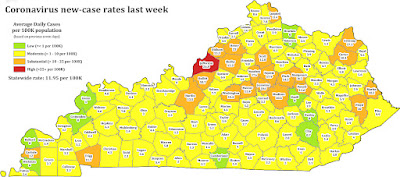
Dept. for Public Health map, adapted by Ky. Health News; click to enlarge
The statewide seven-day infection rate also went up again. That rate is now 11.95 cases per 100,000 residents, up from 9.65 daily cases per 100,000 the week before. Louisville and Jefferson County led the way, with a rate of 29.5 per 100,000. The only other county with a rate more than double the state rate was Henry, at 25.7. 

Covid-19 cases in the state's second largest county are also on the rise again, Christopher Leach reports for the Lexington Herald-Leader.

The Lexington-Fayette County Health Department "reported 101 new cases Friday, which is the first time since March 3 that there were over 100 cases in a day. That brought the seven-day rolling average up to 73, which is 16 more cases than the average one week ago and more than double the average from three weeks ago," Leach reports. 

"It's important to complete the Covid-19 vaccination series, including all recommended booster doses," the department said on its Facebook page. 

Vaccinations have slowed again in Kentucky. The Washington Post reports that in the last week, an average of 2,993 doses were administered per day, a 13% decrease over the week before. The Post reports that 61% of the state's eligible population, 5 and older, are fully vaccinated and 44.4% of the fully vaccinated people have received a booster shot. 

The New York Times ranks Kentucky's infection rate 33rd among the states and Washington, D.C., with a 1% increase in cases in the last 14 days. 

"Cases are increasing in all but seven states and territories, and in more than a dozen, the daily case average is twice as high today as it was two weeks ago," the Times reports, adding that "Coronavirus cases have doubled in the past month as Omicron subvariants have spread across the country."

A study published last week said some subvariants are defeating immunity gained from previous infection.

Last week, Gov. Andy Beshear said at his weekly press conference that it is not yet time to be concerned about another surge of cases because the severity of disease among people who are getting infected is not causing an increase in hospitalizations at this time.  

This week's Centers for Disease Control and Prevention risk map, which considers both cases and hospitalizations, says that only three Western Kentucky counties are yellow, for counties with a medium level of the virus. They are Union, Henderson and McCracken counties.

Ky. journalist tells the story of her first pregnancy, focusing on choice -- whether that be parenthood, adoption or abortion

A Kentucky women writes about the importance of choice when it comes to decisions about  abortion and tells her story titled, "I'm the mom I am today because I chose an abortion at 19." 

Bonnie Jean Feldkamp in her
high school band uniform

The essay by Bonnie Jean Feldkamp, opinion editor of the Louisville Courier Journal, was published there and in USA Today just days after the leak of a draft Supreme Court opinion that would overturn the 1973 Roe v. Wade decision.

"Make no mistake, this ruling, when it happens, will not end abortion," Feldkamp writes. "Some states will still provide the service. If it proceeds the way Justice Samuel Alito’s draft suggests, people of wealth and privilege will travel to terminate unwanted pregnancies. Only the poor will feel the harsh cold shoulder of this inequitable law. For a pregnant person without financial means, abortion costs are already a hardship." 

Feldkamp writes in detail about the decisions that led to her pregnancy, her abortion and why it was right for her to wait to become a mother. She writes about being a rebellious Northern Kentucky teen whose father kicked her out of the house shortly after her high school graduation in 1993 and how that resulted in her bouncing "from friend to friend and job to job," and when she ran out of friends, from "bed to bed." 

"At the time, I didn’t think there were any other options for me," she writes. After becoming pregnant, she approached the man who had fathered the child, whose message to her was clear: This was her problem. "How could I possibly be a mom? I was not yet finished being a child." 

Using $830 she received from a car-insurance settlement, Feldkamp had an abortion at 13 weeks of pregnancy. In pain and told to stay off of her feet after the procedure, she called her dad, who came to get her and took her home, after two years of being "unhoused." 

"It is the decision that changed my life," she writes. She now has two biological children.  

"Nurturing a pregnancy to birth isn't easy, and the parenting that follows is hard. But so is an abortion," she writes. "I think that’s the most misguided criticism I’ve heard of abortion rights – that abortion is supposedly the easy way out. Or that it’s somehow selfish. . . . Under other conditions and with more support, perhaps I would have made a different choice. That’s why it’s called a woman’s choice. Not a woman’s desire to terminate a pregnancy." 

Feldkamp writes that she had always wanted to be a mother, but her situation when she was 19 bore no resemblance to what motherhood would look like: "I didn’t have a home or a job or a support system. I was still couch-surfing or worse, sleeping in cars. I couldn’t take care of myself at the time, much less a child. The $830 arrived at exactly the right time, and it felt like my lifeline to the only choice that made any sense."

Fast forward: Feldkamp is now the mother of a daughter born in 2000 and a son born in 2015, and she has a 26-year-old stepdaughter. 

"My three children got the best version of me possible because I waited to become a mom," she writes. "I am not arrogant enough to think this means that my way was the only way. Women who decided to have their children and face parenthood head on will also tell you they made the best decision. Others will tell you, placing their child for adoption was the right choice. They are also right. We are all right. There’s room for gratitude in every path. The key is having the choice." 

Sunday, May 8, 2022

Months after a breast-cancer diagnosis and a double mastectomy, a Monticello mother completes a 102-mile, 33-hour road race

Lindsey Sexton runs the No Business 100. (Photo by Ryan C. Hermens, Lexington Herald-Leader)
When Lindsey Sexton of Monticello started to train for a 102-mile road race in the rugged Cumberland Plateau last year, she had no idea that the race "would come only months after a breast cancer diagnosis led to her having a double mastectomy," Mark Story writes for the Lexington Herald-Leader.

When Sexton was about to turn 35, her doctor encouraged her to get a mammogram "strictly for precautionary purposes," Story reports. Abnormalities led to a biopsy and a diagnosis of two types of breast cancer, one of which can spread aggressively.

She called her husband but couldn't reach him. Calling her brother, "Sexton’s mouth would not form the words, 'I have breast cancer'," Story writes.

She recalled, “Nothing came out except this horrible noise: A cry. A scream. A sob. . . . Your world stops.” The doctor “tried to assure me that we had caught it early and that there were multiple things that could be done. I told her, ‘I’m 35. I have three kids. We’ve go to do whatever it is that is going to get me back to a normal lifestyle as soon as possible.’”

After conferring with surgeons and her husband, Sexton got a bilateral mastectomy. “My boobs aren’t what make me who I am,” she told Story. “And, if they are causing a problem, let’s just get rid of them.”

Sexton trained until just before the surgery, but after it, "Jeff Sexton broached with his wife the idea of not running in a 102-mile trail race so soon after major medical procedures," Story writes. "She wasn't going to hear of that," Jeff said.

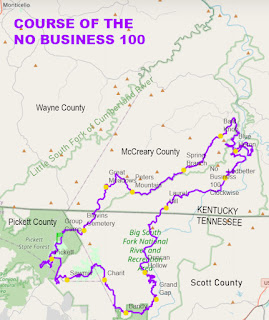
Map adapted from website; click on it to enlarge
Perhaps fittingly, the name of the race is the No Business 100, named for a creek in the nearby Big South Fork National River and Recreation Area in Kentucky and Tennessee, scene of the race. 

Sexton had never run more than 40 miles, so it could be argued that she had no business running 102, but Story reports, "The more Sexton trained, the better she felt."

The race began Oct. 1, with a 33-hour time limit for completion. At 50 miles, Sexton "began to stiffen up," blisters developed on her feet and it got dark. Her spotter, cousin Brian Jones of Louisville, ran ahead and found a group of runners stopped by a mother bear and two cubs.

After noises failed to dislodge the mother, the cubs scampered up a hill, and the mother climbed a tree, Story reports: "That meant to get past, the runners had to run directly beneath the treed momma bear." Sexton recalled, “Talk about getting your adrenaline running. But she let us go by.”

With 13 miles left, “My emotions creeped back in,” Sexton said. “I just started crying, kind of in a reflective mode of what all I had endured with surgeries, cancer diagnoses, that sort of thing.” For the last three miles, Kevin Jones, the Wayne County High School athletics director and longtime cross-country coach, "paced his younger sister," Story reports.

"Some 15 minutes beneath the race cutoff time — just under three months since undergoing a double mastectomy — Lindsey Sexton crossed the finish line of the No Business 100. . . . A friend had decorated the finish line with pink balloons in recognition of her battle with breast cancer. Members of Sexton’s church, Monticello’s First Christian, and other friends had come to cheer her to the finish."

Story concludes, "Eight months later, Sexton says her health is good. She is already registered to race in the 2022 No Business 100 this coming October. On Mother’s Day, Sexton says she hopes her children — daughter Jenna, now 11; and sons Jase, 9 and Jett, 7 — have drawn lessons from their mom’s determination in the face of unexpected adversity."

“I would hope my children learned from me that you should never give up,” Sexton told Story. “They need to know they can always do hard things. Never give up in life, and never give up on a dream.”

Former state public-health commissioner Jeff Howard is interim director of Metro Louisville Department of Health and Wellness

Dr. Jeffrey Howard
Dr. Jeffrey Howard, the longest-serving of three public-health commissioners in the previous state administration, has been named acting director of the Louisville Metro Department of Health and Wellness.

Howard succeeds Dr. Sarah Moyer, who will become chief medical officer for Humana Healthy Horizons, the new name for the health-insurance company's Medicaid plan in Kentucky. She will remain an adviser until June 30, the end of the the fiscal year, and start her new job on July 5.

Howard's "commitment to equitable health outcomes, paired with his experience at the state and federal levels makes him the right person to lead our health department at this critical time," Mayor Greg Fischer said.

Howard has been the department's contracted medical director since October. He told Kentucky Health News he still plans to leave to become a general surgeon at Louisville's Norton Healthcare in August.

Howard, a native of Harlan County, was health commissioner in 2017-19, during the term of Republican Gov. Matt Bevin. He left to become a White House fellow for a year, then returned to complete his residency at the University of Louisville.