Wednesday, March 16, 2016

Visiting chef at Harlan County High helps incorporate fresh, local foods and flavors into menus; 1 of 8 Ky. districts in program

image: foodtank.com
The "Chefs in Schools Collaborative" project, which helps school cooks learn how to incorporate fresh, local foods in their menus, is up and running at Harlan County High School, reports WYMT-TV.

"Fresh ingredients are always important to a cook," Judy Gurnee, visiting chef through March, told the Hazard station. "We like to work with the closest available products that we can get ... the finest quality."

Harlan County is one of eight Kentucky school districts in the program. Its cooks asked the visiting chef to help them better use spices on the local vegetables, so that students, whom they described as their "customers," would eat them.

"I'm for anything that's going to get the children to eat," Kitchen Manager Jan Hicks told WYMT. "That's what we are here for."

Making sure the kids eat their school lunch is especially important because for some, it is the only meal they get a day, WYMT reports.

"Our kids, one in four are homeless," Director of Food Service Jack Miniard said. "That means that they are living with a grandparent or they are living with some other family member ... so, this may be the only meal that they get a day."

The program is led by the Kentucky Department of Agriculture's Farm to School Program in partnership with the Community Farm Alliance and the National Farm to School Network. Participating school districts are in Boyle, Clark, Grayson, Oldham, Harlan, Martin, Morgan, and Pike counties.

Public is invited to join discussion about food sustainability systems at UK April 7; will help shape UK's food-systems studies

The public is invited to a discussion about sustainable food systems at the 2016 Food Studies Symposium at the University of Kentucky April 7 to "share current learning, build collaborations, identify opportunities, stimulate research and envision an interdisciplinary foods program," a UK news release says.

The panel discussion, "Building a Campus-wide, Multi-stakeholder Initiative/Program on Sustainability and Food Systems Studies: Learning from Our Leaders in the Field," will be held from 3:30 to 6:30 p.m. Thursday, April 7 in the E. S. Good Barn, followed by a reception.

"Participants will help shape the future of food systems studies at the university," says the release.

Invited speakers include Peggy Barlett, faculty liaison to Emory University's Office of Sustainability Initiatives; Tom Kelly, founding executive director of the Sustainability Institute at the University of New Hampshire; and Jane Kolodinsky, former chair of the University Food System Initiative Steering Committee and chair of the Department of Community Development and Applied Economics at the University of Vermont.

The symposium is co-sponsored by the Sustainability Challenge Grant, The Food Connection at UK and the Tracy Farmer Institute for Sustainability and the Environment. Click here for more information.

Customers of exchanges such as Kynect are more likely to get prescriptions than other private health-insurance customers

"People enrolled in health plans through the Affordable Care Act exchanges are ramping up their use of prescription medications more rapidly than those in employer or government-sponsored plans, according to a new report from Express Scripts, the largest prescription drug benefits company," Carolyn Y. Johnson reports for The Washington Post, which headlined the story "A new sign Obamacare is helping the people who really need it."

"In 2015, people in the exchanges increased their number of prescriptions filled by 8.6 percent, four times the rate of people who receive insurance through commercial plans outside of the exchanges," Johnson writes. However, "The overall amount spent was much lower per person -- $777.27 compared to $1060.75" for commercial plans.

"The rapid uptake of the prescription drug benefit suggests there was a significant unmet medical need for many people gaining insurance through the exchanges, some of whom could have preexisting conditions and may not have previously had access to medicines," Johnson reports. "Before 2014, insurance companies could refuse coverage or charge much higher premiums for people with pre-existing conditions."

Express Scripts handles about a third of the prescriptions paid for by plans sold through the exchanges, including Kynect in Kentucky.


Tuesday, March 15, 2016

85 percent of Kentucky adults want schools to be tobacco-free, but only 28 percent of the state's school districts are

An overwhelming majority of Kentucky adults, 85 percent, want schools to be tobacco-free, according to the latest Kentucky Health Issues Poll.

But only 28 percent of the state's school districts have "protected students, staff members, teachers and guests from secondhand smoke by enacting 100 percent tobacco-free school policies," says a press release from Interact for Health, which co-sponsored the poll with the Foundation for a Healthy Kentucky. A list of the districts is at www.tobaccofreeschoolsky.org.

"Kentucky ranks 50th, the worst state in the nation, in the percentage of secondary school campuses that prohibit tobacco use in all locations at all times," the release says. "Nationally, 65 percent of schools have such a policy." In Kentucky, such policies are set by local boards of education.

The state's tobacco heritage remains strong. In 2015, 23 percent of Kentucky middle-school students reported trying cigarettes, and 28 percent of high school students said they used cigarettes, cigars, or smokeless tobacco.

The poll found large majorities of smokers, former smokers and non-smokers in favor of tobacco-free campus policies, and support was strong across party lines. The greatest opposition was found among the poor, African Americans, people who haven't gone to college and those who said their general health was fair or poor.

Susan Zepeda, president and CEO of the foundation, said in its news release, "A 100 percent tobacco-free campus policy reduces a young person's exposure to second-hand smoke and allows adults to model tobacco-free lifestyles. Notably, Kentucky smokers understand this important issue. Eighty percent of current smokers favor tobacco-free school policies in their communities."

The Kentucky Health Issues Poll was conducted Sept. 17 through Oct. 7 by the Institute for Policy Research at the University of Cincinnati. The sample of 1,608 adults has an error margin of plus or minus 2.4 percentage points.

Kentucky ranks fourth nationally in painkiller prescriptions; CDC proposal would limit prescription strength and amount

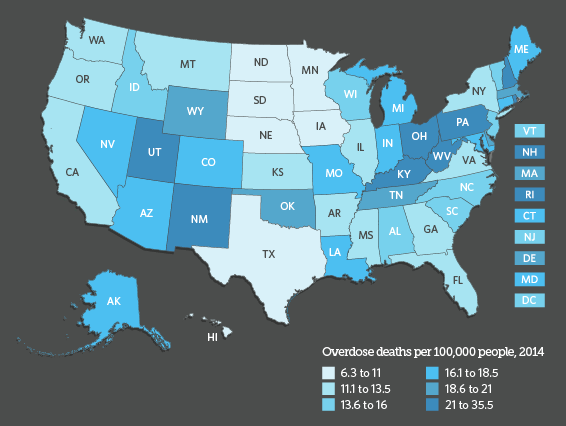
Kentucky has the nation's fourth highest rate of painkiller prescriptions, at about 130 prescriptions for every 100 people, Christine Vestal reports for Stateline. The high rate of painkiller prescriptions is being blamed on a rising rate of overdose deaths, leading health and government officials in many states to call for a limit on the number and strength of painkiller pills prescribed by doctors. (Stateline graphic)
"The U.S. Centers for Disease Control and Prevention is close to taking the unprecedented step of issuing national guidelines to curb liberal opioid prescribing practices widely blamed as the cause of the epidemic," Vestal writes. "CDC’s draft proposal urges primary care doctors to try drug-free methods to relieve chronic pain, such as exercise, weight loss and physical therapy, as well as non-opioid pain relievers such as acetaminophen and ibuprofen, before resorting to powerful opioid pills. If opioids are needed, the guidelines recommend starting with the smallest effective dose of immediate-release opioids, avoiding more dangerous time-release formulations except when needed." (Stateline graphic)
"Democratic and Republican governors unanimously support the CDC initiative and have pledged to promote the voluntary physician guidelines in their states," Vestal writes. "But the American Medical Association and pain organizations backed by drugmakers are complaining the initiative could make it difficult for chronic pain sufferers to get the pills they need."

Last week the U.S. Department of Health and Human Services announced that five Kentucky clinics—in Richmond, Louisville, Burkesville, Mount Sterling and Whitesburg—would receive $1.8 million to fight addiction to heroin and painkillers, Curtis Tate reports for McClatchy Newspapers. "According to the Kentucky Office of Drug Control Policy, 1,087 Kentucky residents died of overdoses in 2014, including 204 in Jefferson County and 112 in Fayette County. HHS estimates that overdose deaths from prescription pain medications quadrupled from 1999 to 2013 and that deaths related to heroin increased 39 percent from 2012 to 2013."

Rice Leach, battling cancer and headed for hospice, gets Public Health Hero Award that Fayette health board will name for him

Rice Leach
Dr. Rice Leach, a state and national leader in public health for decades, was honored March 14 with the Public Health Hero Award from the Lexington-Fayette County Board of Health, for which he is commissioner -- but is unable to work because he is battling cancer at home.

“When your peers recognize you, there’s nothing like it,” Leach told a crowd at the health department via Skype. “And when your peers you love recognize you, it’s got to be the best.” The board plans to rename the award for Leach, whose outspoken nature has endeared him to public-health officials not as disposed to strong public statements.

The award is usually given in April, during part of National Public Health Awareness Week. "It was presented Monday because of Leach’s medical condition," Karla Ward reports for the Lexington Herald-Leader. "Leach, 75, sent an email to the health department’s staff two weeks ago, updating them about his lymphoma and telling them he would not be back to work. He said palliative care and hospice would be 'not too far in the future'."
Read more here: http://www.kentucky.com/news/local/counties/fayette-county/article66083207.html#storylink=cpy

Read more here: http://www.kentucky.com/news/local/counties/fayette-county/article66083207.html#storylink=cpy

Ward writes, "Leach’s five-year tenure as Lexington’s health commissioner was preceded by decades of work in the public health field that included a stint as chief of staff to the U.S. surgeon general, and international work in Guatemala, Bolivia and Panama. He was Kentucky commissioner of public health from 1992 to 2004; from 2004 to 2010 he was medical director and executive director of the health department’s primary care center."

Monday, March 14, 2016

Did you know that smoking can lead to Type 2 diabetes?

Smoking can lead to diabetes, and then cause more complications from the disease. So writes Dr. Laura B. Hieronymus, associate director of education and quality services at the Barnstable Brown Kentucky Diabetes Center at the University of Kentucky, in a column in the Lexington Herald-Leader.

Laura Hieronymus
Smoking can cause resistance to insulin, which helps control levels of sugar in the blood. "Insulin resistance can occur if you have a family history of it, are overweight and/or have a sedentary lifestyle," Hieronymus writes. "Experts report smokers are insulin resistant and the more you smoke, the greater your chances of Type 2 diabetes. Data suggest if you smoke 16 to 25 cigarettes a day, your risk for Type 2 diabetes is three times higher than if you don’t smoke. In contrast, if you quit smoking and stay quit, your risk for Type 2 diabetes actually decreases."

If you have diabetes, smoking can make complications from it more likely, Hieronymus writes: "Damage to the blood vessels and nerves in your body is more common and often to a greater degree than if you have diabetes and don’t smoke. The heavier and the longer you smoke the greater your risk for complications. The bottom line is that smoking and diabetes are a dangerous combination. The good news is that by quitting smoking and keeping your blood glucose optimally controlled, you can greatly lower your chances for diabetes complications."

Sunday, March 13, 2016

Stivers calls for House bills on Kynect and Medicaid expansion, says Senate would vote on them to show where legislators stand

By Melissa Patrick
Kentucky Health News

Republican Senate President Robert Stivers challenged Democratic House Speaker Greg Stumbo Friday to send the Senate two House bills that would preserve the state's embrace of "Obamacare," in order to "have a full, fair debate on the issue" and see where legislators stand on it.

Robert Stivers
Stivers was referring to House Bill 5, which would require Kentucky to keep operating the Kynect health-insurance exchange, and House Bill 6, which would keep the state's current expansion of the federal-state Medicaid program.

Both would block Republican Gov. Matt Bevin's plans to change the programs, and with the Senate firmly in Republican control, their main sponsor, Rep. Darryl Owens, D-Louisville, has said he doesn't expect them to become law. Stivers noted that the bills aren't moving, despite being sponsored by several leaders of the House's Democratic majority.

“I would surmise that what they’re doing is just pandering and playing to a political base even though they don’t believe it’s good,” he said. “If they truly believe it's good, then vote them on the House floor.” Referring to House Speaker Greg Stumbo, he added, “If he votes it on the House floor, we'll vote 'em on the Senate floor.”

Stumbo said it was interesting that Stivers is attacking Obamacare when Bevin's plan for Kynect will use the federal health-insurance exchange, Don Weber reports for cn|2's "Pure Politics."

“He’s dismantling our Beshearcare here in Kentucky that Kentuckians were so happy to have. So, I'd be happy to have that discussion."

Former Gov. Steve Beshear, founder of non-profit Save Kentucky Healthcare, said in a press release that Stivers and Republican leaders are “once again touting misinformation about Kynect and the state of health care in Kentucky.”

Stivers claimed that the federal Bureau of Labor Statistics showed that the state had lost 3,500 health-care jobs while Beshear had promised that the expansion of Medicaid would add 5,400 such jobs in the state by bringing more people into the health care system, creating jobs and tax revenue.

Actually, BLS data show that while hospitals lost employment, overall employment in the health-care and social-assistance sector has gone up 4.6 percent since Obamacare was fully implemented in January 2014, compared to 3.1 percent job growth in all other Kentucky sectors, says Jason Bailey of the Kentucky Center for Economic Policy. (KCEP chart)
Beshear cited that data, adding, “Just last week Governor Bevin’s own administration released data showing that the educational and health services sector in Kentucky gained 4,200 jobs in 2015 alone.”

Saturday, March 12, 2016

Co-workers with CPR and AED training save Lexington man from 'widow maker' heart attack; now he's fine and cheering Wildcats

Tim Hayden (UK photo)
This time last year, co-workers' quick actions saved a Kentucky man who suffered from a usually fatal type of heart attack because they knew how to do cardiopulmonary resuscitation and how to use an automatic external defibrillator (AED). They were able to keep him alive until he could get medical help, according to a University of Kentucky news release.

Tim Hayden, a big UK basketball fan who works at Lexington's Southern Wine and Spirits, was at a work meeting last March, hoping it would end before the Southeastern Conference Tournament games started that day, when he had the heart attack.

His doctor, Adrian Messerli, director of the heart catheterization laboratory at the UK Gill Heart Institute, said it was the type of heart attack that is often called the "widow-maker" because fewer than half of its victims survive.

"Dr. Messerli told us if Tim had been at home, or if the meeting had been scheduled later, or if he'd been in his car, this type of heart attack isn't something that people typically survive," said Harold Nikirk, Southern Wine and Spirits' field sales manager and Tim's boss.

Upon realizing that Hayden wasn't just goofing off and pretending to be snoring so they would wrap up the meeting, two of the co-workers trained in CPR immediately began it. One who was trained on the AED, a portable device that checks heart rhythm and can send an electric shock to the heart to try to restore a normal rhythm, used it.

Everyone in the office pitched in, Nikirk said, calling 911, waving down the ambulance and moving cars and furniture out of the way to make room for the paramedics.

"I think Tim was fortunate for many reasons," Messerli said. "He was surrounded by co-workers who knew how to perform CPR and knew how to use an AED. Those critical first steps sustained Tim until we could get him the treatment he needed."

Paramedics took him to UK, where his wife Catherine works and where Dr. Messerli was waiting for him in the catheterization lab.

"With a heart attack, especially one like Tim's, every minute literally counts," Messerli said. "We were the first hospital in Lexington to allow paramedics to bypass the emergency room and go directly to the cath lab, which buys us precious time and hugely increases the patient's chances for survival."

Hayden's co-workers created
a Heart Walk team. (UK photo)
Messerli restored blood flow by inserting two stents with a catheter and placing him in a type of medically induced coma to cool his body temperature, which is "thought to protect the vital organs from damage and improves healing," Messerli said. Tim spent three weeks in the hospital.

"What's so gratifying about Tim's case is that the healing has really been complete and absolute," he said. "When I see him in the office, he's in wonderful spirits, minimal complaints, and he's doing really well."

Since then, about a dozen of SWS's 40 staffers have received CPR certification and AED training, says the release.

They have also been honored by the Lexington Fire Department for their bravery, quick thinking and knowledge of CPR and have participated in the American Heart Association's 2015 Heart Walk on #TimsTeam and raised $3,500 on his behalf.

Friday, March 11, 2016

This year's smoking-ban bill is dead; Senate advocates have bill to make insurers provide all smoking cessation treatments

By Melissa Patrick
Kentucky Health News

Despite early hope, the bill to ban smoking in Kentucky workplaces was likely dead on arrival this year.

"I haven't heard anything about the smoking ban bill in . . . well, really since the start of the session," House Speaker Greg Stumbo, D-Prestonsburg, said in an interview. "So, I would say yes, it's dead."

Rep. Susan Westrom
"The timing has just not been right," said Susan Westrom, D-Lexington, sponsor of the bill. "We don't have the votes. It seems like in every election year, people are afraid to vote on something like this that they perceive to be controversial."

In addition to it being an election year, Westrom elaborated on a long list of other reasons for why the smoking-ban bill hasn't had any support this year, including: it being a budget year, a new Republican governor and Senate leadership that don't support it, less organization from advocates, a quiet public and the loss of several funding streams.

"There's always next year," Westrom said. "This isn't an issue that will go away because we can't ignore that Kentucky is one of the least healthy states in the country. It always has to be at the top of our priority list."

The latest Kentucky Health Issues Poll found that two-thirds of Kentucky adults support a comprehensive statewide smoking ban, and have since 2013. The ban has support from solid majorities in each political party and has majority support in every region of the state. But more than one-fourth of Kentucky adults are smokers.

Last year was the first year Westrom's smoking ban bill passed out of the House with a vote of 51-46. The bill was then placed in an unfavorable Senate committee and never brought up for discussion. This is the sixth year she has sponsored this bill.

"I have enjoyed carrying this bill more than anything I've done over the years because it is the right thing to do and because I really, really care about the health of Kentucky," she said wistfully.

Republican Sen. Ralph Alvarado, a Winchester physician, said in an interview that he had worked very hard this session to get a smoke-free bill together in the Senate, but he just couldn't get the votes.

Instead, Republican senators Julie Raque Adams from Louisville and Alvarado have filed Senate Bill 291 that would require insurers in Kentucky to cover all approved smoking cessation treatments, counseling and medication. Currently, many plans only cover some physician-prescribed treatments and/or medications.

A flyer to drum up support for SB291 says the state has nine-thousand smoking related deaths per year; $1.92 billion in smoking related health expenditures; and $590 million in smoking related Medicaid costs. The statewide smoking rate in Kentucky is 26 percent.

"Tobacco is still one of the most expensive cost for our healthcare system in the state," Alvarado said. "Anything that we can do to help get people off of cigarettes voluntarily...I think is going to benefit us financially and is going to save lives."

Adams was pessimistic about the bills chance of passing this year, but said she was hoping for a hearing on it to continue the education process and keep the issue alive.

"The fact that insurance does cover cessation, I think that is a really important thing to get out to the consumer," she said in an interview.

According to Run Switch PR, this bill has the support of the following: American Cancer Society, American Heart Association, American Lung Association, Campaign for Tobacco Free Kids, Kentucky Medical Association, Kentucky Hospital Association, Kentucky Rural Health Association, Kentucky Voices for Health, Kentucky One and Baptist Health. It is currently in the Senate Baking and Insurance committee.

Hard-fought bill to protect independent pharmacies passes Senate committee; would regulate pharmacy benefit managers

By Melissa Patrick
Kentucky Health News

Update March 28: SB 117 passed the Senate March 14 with a 38-0 vote and passed the House March 25 with a 97-0 vote. It now awaits the signature of the governor.

Approval of Senate Bill 117 by the Senate Appropriations and Revenue Committee March 11 brought Kentucky's independent pharmacies one step closer to getting better price transparency from the companies that negotiate with pharmaceutical manufacturers, insurance companies and their beneficiaries. The bill would subject pharmacy benefit managers to regulation by the state Department of Insurance.

Republican Sen. Max Wise
"We are talking about independent pharmacies that have had family histories for years," Sen. Max Wise, sponsor of the bill, said in an interview. "They are trying to compete just to stay alive and . . . are suffering right now. This is a fight for the little guy and I am happy to stand up with the independent pharmacies."

Wise, a freshman Republican from Campbellsville, told the committee that while pharmacy benefit managers still don't support his bill, they did come to the table over the last week with independent-pharmacy representatives and the state Cabinet for Health and Family Services to reach a compromise that the committee approved unanimously.

The legislation would allow the Insurance Department to regulate PBMs much like insurance companies are regulated. It would also provide an appeal mechanism to resolve pricing disputes between pharmacies and PBMs.

The bill would not require PBMs to change how they work with fee-for-service Medicaid, nor does it require them to release their pricing methodology unless absolutely necessary, and any releases would not be subject to the state open-records law.

The bill was intensely debated for weeks, first in the Senate Health and Welfare Committee and then heard twice in the A&R Committee. Last week's A&R meeting involved "several hours of testimony from a local pharmacist, PBM representatives, and members of the Cabinet for Health and Family Services," the Kentucky Independent Pharmacist Alliance said in a news release.

Wise, a former FBI agent who was elected in 2014, told the committee, "This has been a very tough and complicated bill to work on."

The legislature passed a "maximum allowable cost" law in 2013 to require increased transparency in reimbursement practices. "Kentucky is one of only a handful of states to regulate the actions of PBMs," said the independent pharmacists' release. It said the state has more than 500 independent pharmacists.

First case of Zika confirmed in Ky., from traveler to Central America; no threat to Kentuckians unless they visit affected areas

By Melissa Patrick
Kentucky Health News

After the first case of Zika was confirmed in Kentucky March 9, health officials held a news conference at the Capitol to raise awareness of the virus, noting that the state was coming up on the spring travel season.

Mosquitoes carry Zika. (CNN image)
Gov. Matt Bevin, Health Secretary Vickie Yates Brown Glisson and Dr. Kraig Humbaugh, senior deputy commissioner of the Department for Public Health, emphasized that only those who have traveled to affected areas, like Central and South America, need to worry about contracting the virus, which is commonly transmitted through mosquitoes.

"Many areas, including most of our surrounding states, are reporting Zika cases," Humbaugh said in the news release. "For now, these positive results have only occurred in individuals who have traveled outside the country to places where the virus is currently spreading."

The infected male patient in Kentucky had recently returned to Louisville from Central America. Humbaugh said he presented with signs of fever and rash, which a "very astute" health-care provider suspected as symptoms of Zika.

Common symptoms of the virus are fever, rash, joint pain and red eyes,with symptoms lasting for about a week, according to the U.S. Centers for Disease Control and Prevention. Although many with the virus will not show symptoms, Humbaugh said.

Health officials stressed that Kentucky is not at risk, but said the state has a plan in case the Zika virus spreads. Glisson encouraged health-care providers to be alert to the symptoms of the virus.

She also noted that the Cabinet for Health and Family Services was partnering with Kentucky Emergency Management and the Kentucky Department of Agriculture to increase the monitoring and control of the state's mosquito population this year.

The CDC recommends that pregnant women or those trying to become pregnant postpone travel to affected areas. However, if they must travel to one of these areas, the CDC asks them to talk to their healthcare provider before they leave and strictly follow steps to avoid mosquito bites during the trip.

Humbaugh noted that increasing evidence has found a link between infection in pregnant women and infants born with microcephaly, a condition where the infants head is smaller than normal, which can lead to a variety of other health challenges.

The Washington Post reports that the Zika virus has "growing links to a broad array of birth defects and neurological disorders ... worse than they originally suspected, increasing the risk for devastating harm during pregnancy."

Until Zika, "there has never been a mosquito-borne virus that could cause serious birth deffects on such a large scale," CDC Director Thomas Frieden told reporters.

There is no vaccine or treatment for Zika.  The virus can also be spread through sexual intercourse, and it is still unknown how long the virus stays in semen, Humbaugh said.

Kentucky has at least one mosquito known to transmit Zika.

“We do have Aedes aegypti, but  they are a very small populations, from what I understand from our mosquito experts,” Humbaugh said. “Our entomologists at the University of Kentucky have been advising us on this particular area. However, we have other types of mosquitoes that may be what they call competent vectors. In other words they may be able to spread the disease, but at this point that hasn’t been shown that these other mosquito types are competent vectors.”

Humbaugh encouraged Kentuckians to take normal precautions to limit exposure to mosquitoes like using approved insect repellents, wearing long sleeves and pants when outdoors, to stay inside during dawn and dusk when mosquitoes are most active, minimize standing water and screening windows.

More information about Zika can be obtained from the department's Health Alerts website at http://healthalerts.ky.gov/Pages/Zika.aspx. For a full list of affected countries and regions visit http://www.cdc.gov/zika/geo/index.html.