Friday, February 10, 2017

Bill to ban tobacco products from school property and activities heads to full Senate after change to satisfy school officials

By Melissa Patrick
Kentucky Health News

FRANKFORT, Ky. – The idea of a statewide ban on smoking in workplaces has hit roadblocks in the General Assembly, but a bill to ban tobacco use on school properties and at school events might be a mandate legislators can accept.

Sen. Ralph Alvarado
"I think even those who might want to oppose it – I don't think they dare. I think they are holding back and I think they are realizing that this is something good for kids, good for the state," Republican Sen. Ralph Alvarado, a physician from Winchester and the sponsor of Senate Bill 78, said in an interview.

The bill unanimously cleared the Senate Education Committee Feb. 9 and went to the full Senate. It would prohibit use of tobacco products by students, school personnel, and visitors in schools, school vehicles, properties, and activities, allowing schools one year to adopt, implement and enforce the policy.

Asked if he thought SB 78 will become law, Alvarado said: "At this point, what I'm looking for is momentum. I tell people that we try to swing and try to get the home run. I'll settle for the single and get on base and (then) start driving to score the runs we need to score."

Alvarado has advocated a statewide smoke-free law, but has not been able to garner enough support for one in the Senate. The House voted for a smoking ban in 2014, but in 2015 voters elected Gov. Matt Bevin, who has said the issue should be decided locally, and in 2016 they replaced the House's narrow Democratic majority with a Republican super-majority.

Alvarado told the committee that his bill "is a beginning attempt to help reduce our youth smoking rates in Kentucky," which ranks third in the nation for youth smoking.
The 2015 Youth Risk Behavior Survey reports that 17 percent of Kentucky's high-school students smoke. That is higher than the national adult smoking average of 15 percent, Alvarado pointed out. Even more, 24 percent, use electronic cigarettes. The survey also found that 22.5 percent of Kentucky's middle school students have tried smoking.

Alvarado said 3,200 Kentucky youth become daily smokers every year, and Kentucky's youth buy 11.4 million packs of cigarettes each year.

He also noted the health and academic consequences of youth tobacco use, including: increased lung infections, decreased physical fitness, poorer school performance and increased school absences than their non-smoking peers, to name a few.

Alvarado opened the meeting with some stark facts on how smoking affects the state, noting that 8,900 Kentuckians died from a smoking-related illness in 2015 and an estimated 950 die each year from exposure to second-hand smoke.

"Tobacco is the leading cause of preventable death in the U.S.," he said.

He also listed the financial consequences of smoking on the state, including: $1.92 billion in health care costs; $589.8 million in Medicaid costs; an annual, individual tax burden of $1,168; and $2.79 billion in annual productivity loss.

"It is time for Kentucky to step up to the plate to protect its kids. Let's get your children healthier, let's save tax-payer money, let's save Kentucky lives," he said.

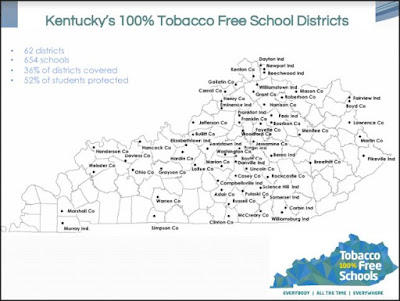
Just over half of Kentucky's public-school students are in school districts with tobacco-free policies: 62 of the state's 173 districts, covering 654 schools.

Jamie Sparks, coordinated school health director at the state Department of Education, told the committee that 23 districts have enacted such policies in the last two years, largely because of teens' increased use of electronic cigarettes. "Strictly enforced tobacco-free school policies can reduce youth smoking by 30 percent," he said.

Tom Shelton, executive director of the Kentucky Association of School Superintendents, told Kentucky Health News after the meeting that the association fully supports Alvarado's bill, but was able to do so only after it was changed to allow local school boards to set their own policies without the education department's involvement.

Noting that he was superintendent in Daviess and Fayette counties, which implemented tobacco-free campuses, he said "You can implement the policy without having to have an enforcement or discipline measure. It is really a matter of concentrating on communication, so that people will understand it; having appropriate policies and procedures; having signage; and then at each event simply making an announcement that says, 'This is a reminder that our campus is tobacco-free,' and making sure that people understand that. That, we believe is adequate."

The bill still has language that would require school boards and their employees to enforce their policies. It would repeal a 1988 law that bans smoking in schools except by adults in designated smoking areas.

Sen. Reggie Thomas, D-Lexington, said he supports the bill, but he pointed to the stark health and financial statistics that Alvarado shared and said, "In my opinion your bill doesn't go far enough in terms of what we need to do to address that problem," indicating his support for a statewide smoking ban.

Heather Wehrheim, director of advocacy for the American Lung Association, who worked with Alvarado on the bill, said it is "getting us closer to a comprehensive smoke-free law." She said the best way to decrease Kentucky smoking rates would be a statewide comprehensive smoke-free law and to raise cigarette taxes by $1. She added that increasing the legal age to buy tobacco products to 21 and increasing state funds for prevention and cessation, would also help.

"The American Lung Association just released our State of Tobacco Control Report and Kentucky got "F's" in every single area so we have a ton of work to do," she said. "But we applaud this and Senator Alvarado's work on it."

Elizabeth Anderson Hoagland, a youth tobacco-policy specialist with the state Department for Public Health, said in an interview, "Tobacco-free school policies are very important for role modeling tobacco free lifestyles for youth. We really need to make sure all students are protected from second-hand smoke."

A 2016 Kentucky Health Issues Poll conducted by the Foundation for a Healthy Kentucky and Interact for Health found that 85 percent of Kentuckians support tobacco-free schools.

"We applaud the Senate Committee on Education for recommending a bill to make Kentucky school campuses smoke-free," said Ben Chandler, president and CEO of the foundation. "We must protect Kentucky's children, who spend seven hours or more of their day during much of the year in school, from the harmful effects of second-hand smoke" He added, "This bill is also a cancer-prevention bill."

Thursday, February 9, 2017

Pharmacies dispensing opioids thrive in Clay County, which leads Kentucky in doses of hydrocodone per person: 150 a year

Pharmacies dispensing opioids are thriving in an impoverished, coal-depressed county in Eastern Kentucky, Phil Galewitz reports for Kaiser Health News. In Clay County (Wikipedia map) the unemployment rate is 8.4 percent, well above state and national averages, and 47 percent of residents live below the poverty line. Despite the downturn in the economy in the region, in Manchester, the county's seat and largest town, with 1,500 residents, there are 11 pharmacies, mostly independently owned, with four opening in just the past three years.

"Drug manufacturers and distributors have pumped prescription opioid painkillers into rural America, in response to demand—much of it from adults who had become physically addicted," Galewitz writes. "The expansion of Medicaid through the Affordable Care Act increased the percentage of Clay County residents with Medicaid and gave more of them access to free prescription drugs, including pain pills. Though Clay County’s opioid problem long preceded the act, the improved legal access helped bring a long standing problem out from the shadows. Statistics show residents are swallowing the preferred prescription opioid more."

Clay County's hydrocodone dosage leads the state. (Kaiser map)
In Clay County, which has 21,364 residents, "2.2 million doses of hydrocodone and about 617,000 doses of oxycodone" where dispensed during a 12-month period ending in September 2016, Galewitz writes. That's 150 doses for every resident. Even before the ACA, prescription drugs were a problem. From 2009 to 2013, Clay County had the state's third highest rate of hospitalizations for pharmaceutical opioid overdoses.

Clay County's health status is one of the worst in the nation, Galewitz notes: "Four in 10 residents rate their health status as being fair or poor, twice the share for the entire state population. Close to half the county is obese. The rate of diabetes is also higher than average."

The inpatient drug-treatment facility closest to Manchester carries a waiting list of 100 that’s grown more than 50 percent in recent years, said Tim Cesario, director of substance abuse services at the Cumberland River Comprehensive Care Center in Corbin. The facility—with 41 beds for men and 15 for women—has been at capacity for several years, he said."

"About 60 percent of Clay’s residents are on Medicaid, up from 35 percent three years ago. It is among the most highly concentrated Medicaid populations in the country," Galewitz writes. Steve Shannon, executive director of the Kentucky Association of Regional Programs, says Medicaid’s expansion has not created more addicts. He told Galewitz, “People who were uninsured were pretty resourceful when it came to finding drugs."

Most adults on Medicaid qualify because Ky. expanded program; at risk as Republicans in Congress work to replace Obamacare

By Melissa Patrick
Kentucky Health News

More than three-fourths of Kentucky adults on Medicaid were eligible only because Kentucky expanded its Medicaid program in 2014, according to a study done for the Foundation for a Healthy Kentucky.

Then-Gov. Steve Beshear expanded Medicaid under federal health reform to include those who earn up to 138 percent of the federal poverty level, $16,394 for an individual or $33,534 for a family of four. Before expansion, the state's income limit for those who weren't disabled or pregnant was 69 percent or less of the poverty line.

The study found that in the third quarter of last year, 650,867 Kentucky adults were covered by Medicaid, 78 percent (506,317) were covered by the expansion, and 69 percent were under the age of 44. In all, Kentucky has about 1.3 million people on Medicaid and about half of them are children.

Foundation President and CEO Ben Chandler pointed out that many of these Kentuckians have incomes just above the poverty level, but still too low to otherwise afford health insurance.

"The latest available numbers continue to show that expansion of Medicaid in Kentucky has greatly increased the number of low-income people who have health insurance," Chandler said in the news release. "Improving the health of Kentucky means making sure no Kentuckians have to rely on the emergency room for health care."

The report also found that every region of the state has large numbers of Medicaid enrollees, but only in Eastern Kentucky does a region's share of the state's Medicaid enrollees (31 percent) exceed the region's share of the state's population (21.6 percent).

Gov. Matt Bevin has said that Kentucky can't afford to have a third of its population on Medicaid and has asked the federal government to approve changes that would encourage enrollees to be more involved in their health care through things like income-based premiums, health savings accounts and work and volunteer or work requirements for those who aren't primary caregivers. Meanwhile, Republicans in Congress are working to repeal and replace the law that allows the expansion.

The study was done by the State Health Assistance and Data Center at the University of Minnesota.

Wednesday, February 8, 2017

Dr. David Stevens of Lexington, who led successful effort for Kentucky's first local-government smoking ban, dies at 87

Dr. David Stevens (Lexington Herald-Leader photo)
Dr. David Stevens, a retired orthopedic surgeon who was instrumental in getting a smoking ban in Lexington, died Monday at age 87.

Stevens, a Republican, served on the nonpartisan Lexington-Fayette Urban County Council from 1992 to 2008 as an at-large and 5th District member. He was a member of the merger commission that drafted the charter for the merged government, Tom Eblen reports for the Lexington Herald-Leader.

“David Stevens lived a life that lifted up and cared for others,” Mayor Jim Gray said in a statement. “He was a touchstone for all things good and generous in Lexington. He epitomized what a citizen and a gentleman should be, and indeed in countless ways, he made our city a better and healthier place to live.”

Ellen Hahn, a nursing professor at the University of Kentucky, and a leader of smoke-free efforts in the state, told Eblen that Stevens became convinced of the need for a smoking ban in Lexington after attending a two-day conference that she helped organize in 2000 about the dangers of second-hand smoke. It took him three years to persuade the other council members to enact the region's first municipal smoking ban.

“He was a visionary,” Hahn said. “And he provided the leadership in a steady, calm way. He cared about public health.”

Stevens was involved with the Lexington-Fayette Board of Health and many other agencies and civic efforts. Stevens was a founding member and board chairman of the Central Kentucky Blood Center in 1968, and its first donor. He  taught at the University of Kentucky College of Medicine, was president of the Fayette County Medical Society and was a member of the University Community Caucus of the National League of Cities, Eblen reports.

He was in private practice as an orthopedic surgeon for 20 years, and then spent two more decades as chief of staff of Shriners Hospital for Children. And for many years, he was the sports physician for Henry Clay High School and Paul Laurence Dunbar High School.  He grew up in Louisville and graduated from DePauw University in Greencastle, Ind., in 1951.

Visitation will be 4 p.m. to 7 p.m. Friday at Milward Funeral Directors on Broadway and at 10 a.m. Saturday at Crestwood Christian Church, 1882 Bellefonte Drive. The funeral will be at the church at 11 a.m. Saturday, with a reception afterward. There will be a private burial at Lexington Cemetery. 

Illnesses and possible flu outbreaks close schools for the week


Several counties throughout Kentucky have closed schools for the remainder of the week due to multiple illnesses "in response to what public health officials are calling a possible flu outbreak among young people," Austin Ramsey and Bobbie Hayse report for the Messenger-Inquirer in Owensboro. Butler, Ohio and Todd County schools announced their closings Tuesday, just after two- and three-day closures in Muhlenberg and Hancock County, respectively. "Barbourville, Jenkins, and Williamsburg Independent Schools, along with Knox, Clay, and Mercer Counties all closed on Thursday," WKYT reports.

Jessica Austin, an epidemiologist with the Green River District Health Department, told Ramsey and Hayes that "tests in Ohio County seem to be pointing to seasonal influenza, a contagious respiratory illness caused by a group of related viruses that can be of real concern to high-risk populations such as the elderly or young."

February is typically the height of most flu cases, Ramsey and Hayse write. "Persons can protect themselves somewhat with an annual vaccine that the U.S. Centers for Disease Control and Prevention reports indicate is a good match for common strains seen in patients this year. Austin said it remains unclear whether patients treated for influenza in the region received vaccines within the last six months."

Austin says that almost all local health providers confirm influenza using 'rapid flu tests'-- mouth or nasal swabs that can yield results within 15 minutes -- but "CDC officials warn that the quick tests often produce false-positive results and that their sensitivity hovers somewhere between 50-70 percent," Ramsey and Hayse write.

It's too early to raise any public health crisis alarms, so Austin "is now calling on all local hospitals and clinics in the seven-county region to send test samples to the Kentucky Department for Public Health for more accurate results."

"That's the only way we're going to tell if this really is influenza, what kind it is and how widespread the problem really is," she said.

"But officials with One Health Infectious Disease, which is monitoring flu cases at Owensboro Health facilities in all of western Kentucky and southern Indiana, said there were 113 confirmed cases of flu in the region in January and already 69 in the first seven days of February, representing what one official called a 'significant jump' in a short period of time," Ramsey and Hayse write.

Officials in Mercer County told WKYT that the decision to close was a proactive one. "Attendance numbers started to decline throughout the week with many parents saying their children were sick. Many teachers and members of the staff were also ill. Mercer County school leaders say they will spend the next two days disinfecting each classroom and building," WKYT writes.

"Everything that kids are coming in contact with. Desks, water fountains, door knobs, light switches, all those things. So all the surfaces that they clean regularly anyway, but this is just a more thorough, deeper cleaning," Esther Hayslett, the director of pupil personnel, told WKTY.

Disinfecting classrooms isn't the only solution. Dr. Katrina Hood, a doctor with Pediatric & Adolescent Associates in Lexington, told WKYT: "I think as best we can trying to teach kids during the winter about the triangle in the face; So your eyes, your nose, your mouth, try not to touch those during the day."

Updated February 10, 2017 at 2:43pm

Liberal group's study says Obamacare repeal without replacement would cost the state jobs in 2019

Repealing the Patient Protection and Affordable Care Act would not only take away health insurance from thousands of Kentuckians, but would also cause the state to lose about 55,949 jobs or nearly 3 percent of the state's workforce, according to a new report from a liberal-leaning research group. However, the report presumes that there would be nothing to replace the law, which Republicans have said they will do.

The Economic Policy Institute, a Washington-based non-profit research group, report looked at how the combination of tax cuts and spending cuts in the ACA would affect employment in the U.S. if it is repealed. “This report adds to the mounting evidence that ACA repeal will be very bad for Kentucky," Dustin Pugel, research and policy associate for the Kentucky Center for Economic Policy, said in an e-mail. "Repeal would not only hurt our people, but our economy."
Graphic from report. Click here to go to interactive map.

Nationally, the report estimates that a repeal of the ACA would eliminate almost 1.2 million jobs in 2019. These losses would come from the loss of federal spending that pays for the tax subsidies people get to help pay for their coverage on the marketplace, and the loss of spending for Medicaid services.

"If this support were withdrawn, people would have less money to spend on other basic necessities like food and rent," says the report. "Fewer dollars spent at grocery stores and other businesses means 1.2 million jobs would be lost."

The report says that while every state would lose jobs if the ACA is repealed, the poorest and those that expanded Medicaid under the law would lose the most. It says Kentucky would lose more jobs as a share of its overall employment than any state but New Mexico.

The report says that Kentucky would lose $4.1 billion in federal Medicaid spending, or about 2 percent of the state's GDP, while the tax cuts would only put $677 million back into the economy (largely benefiting the most wealthy Kentuckians). Thus, less money would be going into the state's economy and fewer jobs would be created.

It also notes that 486,000 Kentuckians would lose their health insurance if the law is repealed, causing the number of people without insurance to increase by 200 percent.

"Our state’s decision to expand Medicaid and cover more people resulted in a huge increase in federal funding and the evaporation of those dollars is the primary cause of the job loss," says the KCEP news release.

A similar study by The Commonwealth Fund and the Milken Institute School of Public Health at the George Washington University estimated that 2.6 million people would lose their jobs in 2019 if the Medicaid expansion program and the premium tax credits were removed from the ACA. The report said Kentucky would lose 45,000 jobs.

"Bivens said his job-loss estimates are lower than those in the Commonwealth study because his projections reflect potential job gains resulting from termination of the ACA’s higher Medicare taxes and its surcharge on earnings above $200,000," Tony Pugh reports for the Lexington Herald-Leader.

Both reports note that job losses would not only come from health care, but also from construction, real estate, retail, finance, insurance and other industries.

The repeal and replacement of Obamacare remains uncertain. While the Republican-controlled Congress is working toward this goal, it hasn't come up with a plan. President Donald Trump said this week that it may be next year before they do so.

The report involves estimates based on modeling, much like Kentucky's Deloitte Consulting report that projected the expansion of Medicaid would create more jobs than it actually did. The 2015 Deloitte report estimated that in 2014, the first year of the expansion, it would created more than 12,000 jobs, including 5,400 in health care. But the Bureau of Labor Statistics found that health care and social assistance jobs rose by only 3,100 jobs, despite Medicaid enrollments that were larger than Deloitte projected.

Tuesday, February 7, 2017

Most Kentuckians support raising the age to buy tobacco to 21; studies say this would decrease youth and adult smoking rates

By Melissa Patrick
Kentucky Health News

If increasing the minimum legal age from 18 to 21 to buy tobacco products would help decrease the smoking rate in Kentucky and the majority of Kentuckians support such a change, perhaps the question for the General Assembly is: "Why wouldn't we do that?"

That's the attitude of the Foundation for a Healthy Kentucky, which co-funds the Kentucky Health Issues Poll that found that 58 percent of Kentucky adults support increasing the minimum age to buy tobacco products to 21.

"The research shows that most tobacco use starts in the teen and young-adult years and that making it a little bit harder to buy the products significantly reduces their use," foundation President and CEO Ben Chandler said in a news release. "We also know that smoking damages nearly every organ in the body and leads to a myriad of diseases later on. So raising the legal age to buy tobacco is one of the easiest policy changes Kentucky can make to improve health and shrink health care costs. Our poll shows that the majority of Kentuckians support it, so why wouldn't we do that?"

The poll, taken Sept. 11 through Oct. 19, found that support for a higher legal-tobacco age was equal among Democrats and Republicans, at 59 percent.

This was about the same as the the last time KHIP asked this question, in 2015, but the poll saw an increase in support among independents, increasing to 65 percent from 55 percent.

Kentucky has the third highest youth smoking rate in the nation, with 17 percent of its high-school students smoking, and use of electronic cigarettes growing,

"The longer we can keep our youth from smoking, and the harder we make it to buy cigarettes, the healthier Kentucky will be. It's that clear-cut," Chandler said. 

California and Hawaii, along with more than 200 local jurisdictions in 14 other states, have raised the minimum legal age to buy tobacco products to 21. Chandler notes that Kentucky law prohibits local jurisdictions in Kentucky from passing youth access legislation for tobacco.

Rep. David Watkins, a retired physician from Henderson, submitted such legislation (House Bill 299) during last year's legislative session, but it did not come to a vote.

While a majority in every region supported increasing the age to 21, support was higher in Western Kentucky (61 percent), Eastern Kentucky (60 percent) and the Louisville area (59 percent) than in Northern Kentucky (51 percent) and the Lexington area (53 percent). The regional sample sizes are smaller than the overall sample, so they have higher error margins than the full sample's margin of plus or minus 2.5 percentage points.

The poll surveyed a random sample of  1,580 Kentucky adults via landlines and cell phones. It was conducted by the Institute for Policy Research at the University of Cincinnati for the foundation and Interact for Health, a Cincinnati-area health foundation. 

Sunday, February 5, 2017

Comparing national ratings that compare Kentucky hospitals

A federal agency, magazines and a consulting group have compiled ratings that allow comparison of hospitals. Now Dr. Kevin Kavanagh of Somerset-based Health Watch USA has compiled the ratings, allowing comparison of hospitals across rating methods.

"It needs to be stated on the front end that the hospital industry is not happy with the current quality measurements," Kavanagh writes for the Lexington Herald-Leader. "However, the vast majority of these measures were derived from, or had extensive input from, the health-care industry. The industry criticizes these measures as not being accurate. Of course, the exception is when a facility scores No. 1; then there seems to be no limit to marketing the result."

Kavanagh does not include the often-advertised ratings of the Joint Commission, explaining, "This accreditation organization was forged out of the health-care industry and all too often gives a gold star of approval." He uses the "star system" of the Centers for Medicare and Medicaid Services; and ratings by the Leapfrog Group, a purchasing alliance that mainly measures safety; Consumer Reports, which primarily measures safety by readmissions, complications, communication, overuse of CT scans and infections; and U.S. News and World Report, "which uses a variety of measures, including reputation, to determine quality. This score not only reflects safety but also the ability to handle complex problems. Thus, larger hospitals and educational institutions often do better with this ranking system. The University of Louisville exemplifies this dichotomy."

Comparing the ratings with prior years, Kavanagh writes: "In the Lexington region, they overall have improved and are doing rather well. St. Joseph and St. Joseph East both showed marked improvement. Overall, these safety-ranking systems measure different aspects of care and will give different results. However, if a hospital performs in the lower tier of several systems, one needs to take notice. This appears to have happened with several facilities in Louisville, which had dismal results." He says the publicized problems of the U of L Hospital are "a testament to the accuracy and usefulness of these quality-ranking systems."

Kavanagh's comparison chart also includes data on hospital complaint investigations by CMS. It does not include most hospitals in Kentucky; CMS, for example, does not rate "critical access" hospitals, which are in rural areas. For the Kentucky Health News reports on the CMS ratings of 82 hospitals, click here; on Leapfrog Group's ranking of 52 hospitals, go here; on the U.S. News rankings, here.

SELECTED KENTUCKY HOSPITAL RANKINGS ON QUALITY AND SAFETY

Some in Ky. worry about changes to Obamacare, Medicaid; others dislike insurance mandate and say coverage unaffordable

By Melissa Patrick
Kentucky Health News

As Republicans in Washington grapple with how to repeal and replace the Patient Protection and Affordable Care Act, Kentuckians are speaking out for and against it in interviews with state and national journalists.

Mathew and Clare Johnson told Deborah Yetter of The Courier-Journal that they were delighted to get coverage under the state's expansion of Medicaid soon after they moved to Louisville for his job as a Baptist pastor, a job with no health benefits.

"It was like a miracle," Claire Johnson said. The family was on Medicaid for a year until getting commercial coverage through her employer.

Under the reform law, Kentucky expanded Medicaid to those who earn up to 138 percent of the federal poverty level ($16,394 for an individual and $33,534 for a family of four).  Until then, the income limit was 69 percent or less of the poverty line.

Dr. Barbara Casper, a physician at the University of Louisville, told Yetter that she treats many low-income patients, most of them working and many covered by the expansion, and some have made "dramatic strides toward better health" because they now have coverage. "I don't want to see us go back to the way it used to be," she said.

Mathew and Claire Johnson and kids
(Courier-Journal photo by Matt Stone)
Mathew Johnson told Yetter that it's upsetting to hear comments, like those made by Republicans in Frankfort, suggesting that people on Medicaid are looking for a handout or unwilling to work.

"I've talked about it in my sermons," he said. "I thought it was important that we come out as someone on Medicaid. . . . There's an assumption that if you're on Medicaid, you're lazy, and a taker, and don't want to work. It's really shocking that elected officials don't have a basic knowledge of how these programs work that they're trying to get rid of."

Yetter notes that more than half the 440,000 people added to Medicaid through the expansion work at jobs that don't provide health coverage, such as food service, construction or farming, according to a study by the Kentucky Center for Economic Policy.

Republicans in Washington  are working to repeal the law and find a replacement. One broad proposal calls for turning Medicaid into a block-grant program, which would provide a set amount of money to states. Critics say this would eventually cause dramatic cuts to already scarce resources, and people on the program worry.

"We're watching every move they make, and it's scary," Diane Cahill, a Lexington mother whose disabled adult son relies on Medicaid for his health care, told Yetter.

Others are worried about losing the reform law's protections for pre-existing health conditions. Clare Johnson told Yetter that she was refused health coverage in North Carolina because she had asthma. Instead, she was placed in an expensive high-risk pool that provided few benefits, and Matthew and their son had to get a separate, high-cost plan.

PBS NewsHour also explored how Kentuckians felt about the reform law, with a trip to Corbin. Several believe strongly that it shouldn't require people to buy health insurance or pay a fine, even after being told that health insurance systems require both healthy and unhealthy people to enroll if the goal is to keep costs down.
Paul Salmon interviewed Perry Partin, Elisabeth Easton, Bobbie Smith and (not pictured) Kathy Oller.
"It was forced on me, shoved down your throat, whether you wanted it or not," said Perry Partin, a security guard who said he voted for President Donald Trump.

Agreeing with him was Bobbie Smith, who bought subsidized health insurance on the federal exchange in 2016 after being diagnosed with breast cancer in 2015, when she lacked coverage because she missed the enrollment deadline. "I think if I were to walk around here with no health insurance, and that's what I choose to do, then that's my right," she said.

Kathy Oller, who helps enroll people in Obamacare coverage, said enrollment had slowed down, probably because people expect the requirement to buy insurance, called the individual mandate, will be repealed. Experts say enrollment is down because coverage is more expensive, deductibles are higher and fewer insurance companies offer plans on the exchanges.

Anthony Flannery, a health-care worker, reminded PBS of how expensive premiums and other costs can be: "I was looking at like $280 with a $6,000 deductible that would then pay 60 percent of any medical expenses I may incur. And I was like, no, I'm not doing it. So I will pay the penalty. So, last year come tax time, I owed $652."

Elizabeth Easton, who said she didn't vote in the election she was "high and suicidal," now has coverage through the expansion, which covers mental-health and addiction treatment: "It saved my life," she said. "It's -- yes, it's great."

Republicans have called for the repeal of "Obamacare" since it became law in 2010, but now that they are in charge, they worry that eliminating or reducing coverage could hurt them politically.

Cornell University economist Robert Frank told PBS that people react badly when they have something taken away: "Millions have coverage now for the first time. And if they take people's coverage away from them with this new repeal measure, you're going to see a political firestorm unlike anything we have seen in recent history."

Republican Gov. Matt Bevin supports repeal and block grants, and is pursuing a proposal he made before the election, to require many if not most Medicaid recipients to work and pay premiums based on income. The Trump administration is expected to approve the plan.

"That's ridiculous," Ewell Scott told Yetter, who writes that he is "a retired Morehead physician who aid the additional money the Medicaid expansion has pumped into Kentucky — an estimated $3 billion — has revitalized struggling regional hospitals, including the St. Claire Regional Medical Center at Morehead, and created scores of new jobs."

Yetter notes that a Foundation for a Healthy Kentucky study found that uncompensated care at Kentucky hospitals dropped from $2.4 billion in 2012 to $552 million in 2015, a decline of 77 percent.

Friday, February 3, 2017

Powell County insurance agent and Democratic chair says connecting health insurance with Obama is a 'no-no' in her county

(Photo via oakmontlibrary.org)
Josie Hollon meets someone at least once a week in her community who depends on health coverage through the Patient Protection and Affordable Care Act, yet voted for President Donald Trump.

"They will come into the office and say, 'I don't want the Obamacare, but I would like the affordable health care'," Hollon, an insurance agent and chairwoman of the Powell County Democratic Party, told Kevin Wheatley of Spectrum News.

"But you try to explain it and they are so against that president that they don't want to talk about that, so we really don't even mention the Obamacare. It's just the affordable health care and try to get them to where they do have health coverage and they can get some help with their medical problems."

Trump, who campaigned heavily on the promise of repealing the ACA, perhaps better known by its Obamacare nickname, took Kentucky's eight electoral votes by nearly a 30-point margin on Election Day, Wheatley notes. The margin was even greater in Powell County, where he got 73 percent of the vote.

Kentucky has been called an ACA success story by many on the left. The state's uninsured rate plummeted more than any other state's. Expanded Medicaid has given nearly 2,000 Powell County residents health coverage since it began in 2014, among some 440,000 low-income Kentuckians newly eligible for the program, Wheatley writes.

Hollon said she doesn't bother anymore explaining that the Obamacare some in her community despise is the same federal health law that helps them get coverage.

"You don't even try," she told Wheatley. "The thing is, and the solution is, we need to get them health coverage, so stop trying to associate it with the president. That's a lost cause."

Hollon called Trump's executive action on the federal health law "destructive," but told Wheatley she would base her judgment against Republican efforts to repeal Obamacare on their place to replace it.

Hollon says Democrats could have done more to promote the benefits of the ACA during the last election cycle. She also has ideas about how Democrats could improve their prospects in Kentucky: Improve grassroots efforts and get more face-to-face interactions with voters, with the help of the state Democratic Party, Wheatley reports.

"I would hope that they would come here and help us get this word out that we're not un-Christian, we're not some horrible Democrat Party that's trying to give everything away and take things away from you," Hollon told Wheatley. "And I think a lot of that's got to do with our marketing ourself. We need to get out and do more talking and grassroots."

To read another story from Wheatley about how the ACA affects Powell County, click here.

Foundation asks Congress to consider that 70 percent of Kentuckians without health insurance are working

By Melissa Patrick
Kentucky Health News

Kentucky had the largest percentage decline in its uninsured population from the Patient Protection and Affordable Care Act. But 234,000 Kentuckians still don't have health insurance, and most of them are working, according to a study done for the Foundation for a Healthy Kentucky.

More than 70 percent of Kentuckians without health insurance are either working part- or full-time, and nearly half of them have incomes low enough to qualify for Medicaid but are not in the program, according to the latest installment of a study of Obamacare's impact in Kentucky, by the State Health Data Assistance Center at the University of Minnesota. 

The study found that 48.6 percent of the uninsured had household incomes at or below 138 percent of the federal poverty level, which means they qualify for Medicaid. Another 40.1 percent had incomes between 138 and 400 percent of poverty, meaning they qualify for subsidized health insurance under the reform law.

Foundation President and CEO Ben Chandler, who voted against the law when he was a member of Congress, encouraged his former colleagues to take these facts into consideration as they work to repeal and replace Obamacare.

"A significant majority of uninsured Kentuckians were working adults, and most had at least a high school education, yet many were still struggling to make ends meet," Chandler said in a news release. "Health system reforms must take these facts into account to ensure that hard-working, low-income Kentuckians have access to important wellness care and preventive health screenings that can improve the quality of their lives while reducing costs for the entire health care system."

The state's expansion of Medicaid under the law allows enrolment by individuals with annual incomes up to $16,394 and families of four with incomes up to $33,534. Before the expansion, the income limit was 69 percent or less of the federal poverty line.

The report says many of the still uninsured in the state are children, at 28.4 percent, or between the ages of 19 and 34, at 34.5 percent.

"We simply have to get the younger population covered by insurance, public or private, so they can get the health care they need to reduce their chances of developing chronic diseases later in life," Chandler said.

Thursday, February 2, 2017

New state senator, a former hospital boss, says health system needs fundamental repairs to increase access and affordability

By Melissa Patrick
Kentucky Health News

Four state legislators held to their party-line opinions about Obamacare on KET this week, but one said instead of creating another "piecemeal" replacement for the federal law, we should first address fundamental problems with the health-care system.

State Sen. Stephen Meredith
The 2010 law has “added millions of people to a fractured health-care delivery system that can’t sustain itself,” Sen. Stephen Meredith, a Republican from Leitchfield, said on "Kentucky Tonight" Jan. 30. “If you truly want to change health care, we’ve got to be more fundamental in our approach.”

Meredith, a retired CEO of Twin Lakes Regional Medical Center in Leitchfield, called for a reduction in bureaucracy and regulations, as well as tort reform and unspecified "radical incentives" for healthier lifestyles.

He said to improve access to health-care providers in rural areas, payment policies must be fair. He said rural providers make 25 to 30 percent less than their urban counterparts.

He also said it's time to stop the "profiteering" in health care, calling this practice morally wrong. "We should not make a fortune off the misfortune of others," he said. "We have to recognize that health care is not a commodity like anything else that is in our economy; it holds a special place."

In addition to Meredith, the program's guests included Sen. Reginald Thomas, D-Lexington, another member of the Senate Health and Welfare Committee; Rep. Addia Wuchner, R-Florence, chair of the House Health and Family Services Committee; and Rep. Mary Lou Marzian, D-Louisville, a member of that committee.

Repeal or tweak?

Host Renee Shaw asked the lawmakers if they agreed with Gov. Matt Bevin's Jan. 6 letter to Congress that called for the repeal of the federal law "in its entirety."

Rep. Addia Wuchner
Wuchner, a registered nurse and former hospital administrator, said she agrees with Bevin. She said the law is "very costly," causing insurance companies to increase their premiums and deductibles or pull out of the Obamacare exchanges. She also said the state can't afford to pay for its relatively small but growing share of Medicaid expansion costs.

Meredith, who said he has been against the federal law since its inception, also agreed with Bevin, saying, "It's too expensive. It's too much regulation. And all the things that we were promised would occur, have not occurred." And while he acknowledged that it had given many people access to care, he asked, "But you have got to ask at what price can we do that?"

About 1.3 million Kentuckians are on Medicaid, with about 430,000 qualifying through the program's expansion to those with adjusted income up to 138 percent of the federal poverty level. The federal government paid the full expansion cost through last year, but this year states are paying 5 percent, which will rise in annual steps to the law's limit of 10 percent by 2020, unless those provisions are repealed. Bevin estimates Kentucky's cost at $1.2 billion over the next five years.

Shaw noted that under the law, Kentucky's uninsured rate dropped from 14 percent to 6 percent and that Kentucky hospitals have saved more than $1 billion in uncompensated medical care costs.

Thomas and Marzian said the law needs "tweaking" to address costs and regulations, but didn't think it needed to be repealed "in its entirety."

Rep. Mary Lou Marzian
Marzian touted the benefits of the law, including access to preventive care, mental-health and addiction-recovery care, the elimination of lifetime caps on insurance payments, allowing young adults to stay on their parents' insurance until they turn 26, and requiring coverage of pre-existing conditions.

“Before the Affordable Care Act, when we just let insurance companies run things, which the state did, they cherry-picked,” Marzian said. “So you could get a low premium, but if you had to use it, then they dropped you … or it didn’t cover anything.”

Thomas said the law's mandate that requires everyone to have insurance or be taxed is necessary to make the law work, because insurance companies must have a large enrollment of healthy people who don't use many services in order to cover their costs for sicker people. "That is what makes insurance affordable," he said.

Thomas said he didn't like anything about U.S. Sen. Rand Paul's replacement plan, which would eliminate the individual mandate; eventually revert back to the old system of allowing companies to deny coverage based on pre-existing conditions; roll back many of the required benefits; and expand the use of health savings accounts, with a $5,000 tax credit.

“Most poor people are not going to have money to put into a health savings account; they barely have money to live from day to day,” Thomas said. “So his $5,000 tax credit is nothing more than a tax benefit to highly paid and middle income people.”

Block grants

Shaw asked the lawmakers if they agreed with Bevin's support for turning Medicaid into a block grant program, which would provide states with a set amount each year.

Thomas said, “The block grant program would be a horrendous step back for this state in terms of dealing with our medical care needs.” He said block grants would not keep pace with the growing need for services.

Sen. Reginald Thomas
He also said moving to a block grant program would create "death panels" because such a decrease in funding will require states to make hard decisions about who gets care and who doesn't.

Wuchner disagreed, saying that block grants would allow states flexibility to spend their money where it is needed the most.

“Our population may have some particular needs that we’re dealing with, let’s say addiction, where Arizona’s population may be aging and long-term care,” she said.

Meredith said he supports block grants, but took it a step further and said they should be distributed at the county level, because counties know best what their citizens need. He said county-level grants would encourage providers to do perform better and be more innovative.

Ideas to cut cost, without decreasing access to care

When asked for ideas to cut costs while not decreasing access to care, Meredith said tort reform and getting rid of unnecessary regulations would help. He also suggested "radical incentives" to help Kentuckians get healthy, instead of putting penalties on providers.

In response to this question, Marzian suggested increased preventive care, teaching people how to use their health care, more wellness and chronic-disease-management programs and anti-smoking legislation. She also said that insurance companies should be required to reveal their "book of business" before being allowed to raise premiums, noting that some insurance executives are making as much as $45 million a year. "Is that fair?" she asked.

Wuchner said tort reform and allowing companies to sell policies across state lines would help reduce costs, as would insurance pools for small businesses.