Sunday, May 24, 2020

Protesters hang Beshear in effigy, sparking bipartisan rebukes

Photo by Sarah Ladd, Courier Journal, via Twitter
Protesters hung Gov. Andy Beshear in effigy from a tree across from the governor's mansion and took their demonstration to its front porch, prompting objections from Kentucky politicians of both parties Sunday.

The event started as a Second Amendment rally "but turned into a protest of coronavirus restrictions and Beshear’s administration," reports Sarah Ladd of the Louisville Courier Journal. "As the rally wound down, organizers led the remaining crowd to the governor’s mansion to attempt to hand deliver a request for Beshear to resign. . . . No one came to the door. A few Kentucky state troopers got out of their cars to observe but did not attempt to stop the crowd. It’s not clear if Beshear was at home at the time. The crowd returned to the capitol, at which time an effigy of Beshear was hung from a tree outside the Capitol while 'God Bless the U.S.A.' played over the loudspeaker."

The effigy bore a sign saying "Sic semper tyrannis," Latin for "Thus ever to tyrants," the state motto of Virginia and the words John Wilkes Booth reportedly said after assassinating President Abraham Lincoln in 1865. "After hanging for a short time while people snapped photos," Ladd reports, "it was cut to the ground." But it brought objections from some protesters, and from politicians of both parties.

"I condemn it wholeheartedly," Secretary of State Michael Adams, a Republican, said on Twitter. "The words of John Wilkes Booth have no place in the Party of Lincoln."

State Senate Minority Leader Morgan McGarvey, D-Louisville, called on Republican leaders to "join me in condemning violent threats against any elected official."

Sen. Whitney Westerfield, R-Hopkinsville, who narrowly lost the 2015 attorney general's race to Beshear and has been one of his most frequent critics, replied, "Agreed, @MorganMcGarvey. This awfulness has no place in civil society."

Senate Majority Leader Damon Thayer, R-Georgetown, tweeted, "These actions are reprehensible. I absolutely condemn violence and threats of violence. If you want to protest, do it peacefully and respectfully."

Saturday, May 23, 2020

No deaths from covid-19 in Ky. for the first time in 1½ months

Kentucky Heath News chart shows that cases trended up this week, but the two-week trendline, a key federal metric used to guide states in reopening their economies, is down.
As news develops about the coronavirus and its covid-19 disease, this item may be updated. Official state guidance is at kycovid19.ky.gov.

“For only the second time in about a month and a half, we have zero new deaths to report,” Gov. Andy Beshear said in his daily coronavirus update, delivered by press release, not in person.

Beshear reported 148 more cases of the coronavirus, for an adjusted total of 8,571. At least 3,102 Kentuckians have recovered from the virus. For additional information, including lists of positive cases and deaths, as well as breakdowns of coronavirus infections by county, race and ethnicity, click here. The list does not include a breakdown of today's new cases.

While a key federal metric for states reopening their economies, a two-week trendline, is down in Kentucky, the state's cases have trended upward this week as Beshear has allowed all retail establishments to reopen, restaurants to reopen at limited capacity, and gatherings of 10 or fewer people, a step he advance to include Memorial Day weekend.

“I am urging Kentuckians to please be safe this weekend,” Beshear said in the press release. “As we recover, we are depending on Kentuckians to take the steps necessary to protect one another this weekend and every day and weekend moving forward.”

About 200 demonstrators gathered on the steps of the state Capitol to call for removal or reduction of restrictions imposed by Beshear. Few masks were in evidence as people stood within six feet of each other, and Republican U.S. Senate candidate Wesley Morgan went around shaking hands.

Four would-be protesters had sought an injunction from a federal judge to block any state enforcement at the event, but District Judge Gregory Van Tatenhove said no Thursday evening, noting that the Beshear administration said the rally could proceed, and the four men hadn't shown that they had suffered harm, the Courier Journal reports.

In other covid-19 news Saturday:
  • The "How Covid-19 Spreads" webpage of the U.S. Centers for Disease Control and Prevention no longer says that the coronavirus spreads easily from contaminated surfaces. A CDC spokeswoman told The Washington Post that the agency made the change after that the revisions were the result of “usability testing” and an internal review. The webpage still says,  “It may be possible that a person can get covid-19 by touching a surface or object that has the virus on it and then touching their own mouth, nose, or possibly their eyes. This is not thought to be the main way the virus spreads, but we are still learning more about this virus.”
  • President Trump’s move to block travel from Europe in March "triggered chaos and a surge of passengers from the outbreak’s center" before the ban went into effect, the Post reports, noting that "Harrowing scenes of interminable lines and unmasked faces crammed in confined spaces spread across social media." Trump banned travel from China in February, but allowed 48,000 Americans to return, and "Members of the administration’s coronavirus task force were even presented with charts showing that the number of flights arriving from Europe dwarfed the influx from China," the Post reports.

Friday, May 22, 2020

Beshear says virus is declining in Kentucky, but he and health chief warn that might not continue 'if we take our eye off the ball'

Johns Hopkins University chart shows how Kentucky testing is up and positive results are down.
By Al Cross
Kentucky Health News

Gov. Andy Beshear declared for the first time Friday that the coronavirus is declining in Kentucky, but he and his health commissioner warned of a possible resurgence as the Memorial Day weekend began with small gatherings allowed and restaurants opening on a limited basis.

“We now think that we have not just plateaued, but we are actually in a decline in overall numbers of cases, especially when you look at the amount of testing that we’re doing,” Beshear said as he announced 141 new coronavirus cases and five more deaths from covid-19, bringing the state's toll to 391.

“We have proven that when we have adversity like we have had, we are resilient, we take care of each other,” Beshear said at the start of his daily briefing. Looking ahead to the Memorial Day weekend, he said, “It’s about being able to more things that we have done in a while and to make sure we do them responsibly. . . . How we're able to keep our cases down depends on how we do this weekend, and every weekend thereafter.”

Health Commissioner Steven Stack praised Kentuckians for their sacrifice, then issued much more comprehensive warnings.

“This is a time that gets dangerous for us; people get complacent. We can have the tendency to reach the wrong conclusions sometimes,” he said. “The reason we’re not having a much serious crisis right now … is because of what you have done … staying healthy at home these last couple of months.”

Then he warned, “Because we’re not in that trouble some may conclude that the danger is not still there, and I’ve got to urge you, the danger is still there. If we take our eye off the ball . . . we could find ourselves in late June paying very dearly for our actions today.”

Beshear, replying to a question about Memorial Day, said “My chief concern is that we’re so excited to see each other we’ll forget all the rules.”

Primary election: Secretary of State Michael Adams and State Board of Elections Executive Director Jared Dearing appeared at the briefing to urge people planning to vote in the rescheduled June 23 primary to do it by absentee ballot, to avoid long lines at polls, which will be as few as one per county.

GoVoteKy.com, a site for absentee-ballot applications, will be open until midnight June 15. Dearing said it takes about two minutes to apply. Adams said voters can also call, email or fax their county clerk, but the clerks are overrun, "so the best way to be a respectful citizen is to go to the website."

Ballots and postage-paid envelopes will be mailed to applicants, who must mail or otherwise return them by June 23. The deadline to register to vote for the primary, or correct registration information, is 4 p.m. Tuesday, May 26.

Beshear said, "This might be the easiest that it ever is to vote. . . . I would love to see us have a better primary response through this than we normally see" in a primary, when about one in six voters usually cast ballots.

Unemployment: Deputy Workforce Secretary Joshua Benton said 14,000 claims from March and  38,000 from April remain unresolved. He said more reviewers and adjudicators and being hired, and the most experienced adjudicators are being assigned to the March cases.

Benton said the kcc.ky.gov website has been changed to allow employers to submit return-to-work dates for employees, which will stop their unemployment benefits, and to add a dialog box to "streamline email . . . A lot of people are emailing a lot of different staff."

Beshear, asked if people who are told to quarantine themselves because they have had contact with an infected person, didn't answer directly. “We’d contact their employer because their employer should not want them coming back in sick,” he said. “Every business ought to realize that at that point its dangerous for that person to come in.”

In other covid-19 news Friday:
  • Beshear said the five deaths were of an 88-year-old Jefferson County man, a 97-year-old Jefferson County woman, a 74-year-old Barren County man, an 88-year-old Hopkins County woman and a 72-year-old Shelby County woman.
  • He said the fatalities have been 77.6 percent white, 18.7% African American, 2% Asian American, and 1.3% multiracial; and 3% Hispanic and 97% non-Hispanic.
  • Counties with five or more new cases were Jefferson and Warren, 28 each; Kenton, 16; Boone, 11; Fayette, nine; Woodford, six; and Logan and Shelby, five each.
  • Beshear said the state more than 171,338 coronavirus tests have been conducted in Kentucky, and "I still think that number is low," because some negative results are not reported.
  • Asked how the state is reporting viral tests, which determine if someone has the virus, and antibody tests, which see if they've had it but are less accurate, Stack said positive results from antibody tests are counted as probable cases; that number stood at 121 Friday, part of a total case number of 8,426 -- 3,069 of whom have recovered.
  • Beshear's chief of staff, LaTasha Buckner, said the state Capitol would reopen to groups of 10 or fewer visitors, by appointment, on Wednesday, May 27. She said they would be asked, but not required, to wear masks.
  • Beshear said a private funeral for former first lady Phyllis George, with about 40 people, would be held in the Capitol rotunda on Monday and livestreamed on KET.org. He complimented her children, Lincoln and Pamela Brown, saying they saw "the difficulty in having the same types of services we have had in the past," presumably a public lying in state with visitation.
  • The governor said that on June 29, when he tentatively plans to allow gatherings of 50 or fewer people, he might allow opening of small, "community type" swimming pools "where there is the ability to limit folks to 50 and to enforce the social distancing." He said that would depend on "where the virus is."

Thursday, May 21, 2020

Child-care reopenings set; tentative date announced for larger gatherings and bars; Beshear says 'We may be in true reduction'

Kentucky Health News chart shows two-week trendline slightly down, more than Wednesday.
By Al Cross
Kentucky Health News

Small child-care centers in Kentucky will be allowed to reopen June 8, and larger ones with limited capacities June 15, removing much of a major obstacle to getting unemployed Kentuckians back to work in the covid-19 pandemic.

Gov. Andy Beshear announced several other openings at his Thursday briefing, including a tentative date of June 29 for bars and gatherings of 50 or fewer. Gatherings of 10 or fewer will be allowed starting Friday.

Beshear announced 135 new cases of the coronavirus, tipping further down the two-week trendline that is a key federal metric for reopening state economies. "We may be more than just plateaued," he said. "We may be in true reduction."

Cabinet for Health and Family Services Secretary Eric Friedlander said the child-care move made Thursday "a day of really good news for many people. . . . Child care is one of the areas that we know is critical to opening the economy."

Beshear has allowed people who are receiving unemployment benefits to keep getting them and not return to their jobs if they cannot find child care. He acknowledged that the limits on larger facilities will limit their capacity, but said that until a coronavirus vaccine is developed "our world . . . has to be based on reduced contacts."

The child-care centers allowed to open June 8 are those in homes, serving 10 or fewer children, "more in a family style atmosphere," Friedlander said.

The larger providers opening June 15 will have limited capacity because they must have 10 or fewer children in a room, and those groups must stay together all day, along with staff members. The groups must have staggered play times, and the centers must do temperature and wellness checks on everyone, and have centralized pickup and drop-off points with social distancing.

Friedlander said family events will not be allowed "for now," and there will be no field trips. Adults at the centers will be required to wear masks, and children under 5 will not be required to do so. "It’s a judgment call, [based] on a child’s developmental ability," he said. The state's guidelines say centers "may recommend to the parents of children over 5 that their child wear a mask, and provide information about the benefits of masking."

The state has continued to pay child-care providers, almost $62 million in the last two months, based on previous payments, to keep them in business, Friedlander said: "We can't afford to lose them."

Friedlander also announced additional food benefits for children who will no longer get meals at school this summer, using $163 million in federal relief funds. He said $313.50 per month will go to families on the Supplemental Nutrition Assistance Program (once called food stamps), Temporary Assistance to Needy Families and Medicaid.

He urged people who qualify for the programs, but are not enrolled in them, to apply beginning June 23 at benefind.ky.gov or at 855-306-8959. "Don’t feel like this is selfish, or something you shouldn’t do," he said, noting that the money will help grocers, farmers and "the rest of the food system."

Other openings: Beshear announced that auctions will be allowed starting June 1, and horse shows on June 8. On June 29, he plans to allow opening of bars, with social distancing, and gatherings of 50 or fewer people. But he said that isn't certain.

"It all depends on how good we do at being healthy at work," his catchphrase for the current phase of reopenings. He said he made the announcement because "We want to give those people dates to see and work toward. It relieves a lot of anxiety." He said his top priority is to "make healthy-at-work successful; my number-two goal is to get kids back in school this fall."

Health Commissioner Steven Stack, who said last week that he was worried that Kentuckians don't appreciate the danger posed by the virus, again alluded to the possibility that reopenings will be delayed or scaled back if cases start going up: "If we take our eye off the ball, we’re gonna find we have the problem in June and July that we have avoided."

Beshear said gatherings of up to 50 will facilitate weddings, which should still keep "groups of family units" together and practice social distancing. "The six feet’s gonna be really important," he said. "It's gonna require some creativity." He said the five weeks between now and then will allow Kentucky to learn best practices from other states.

Beshear said the 50-or-fewer rule could also provide "an opportunity to do something" with swimming pools. He said he hasn't allowed them to open because of the likelihood that social-distancing rules would be violated "outside the pool."

He said June 29 might also provide an opportunity to reopen indoor recreation facilities, which are "taking us a little longer" to figure out, due to capacity questions, differences among facilities, and the number of things that can be touched.

Asked about reopening gyms, he indicated that will take longer. "We can't go back right now to everything the way we used to do it," he said. Then he complimented retailers "for being really thoughtful" with their reopenings this week and said he thought restaurants would do likewise when they are allowed to open at one-third capacity plus outside seating on Friday.

And what about more personal activities, such as hug between friends this weekend? "We’re realistic," he said. "We know that people have missed each other . . . Limit your contact as much as you can."

In other covid-19 news Thursday:
  • The new-case number of 135, which brought the adjusted total to 8,286, was "one of the smallest in a while," Beshear said. He reported 122 new cases on Sunday, but Sundays and Mondays tend to be low due to limited lab activity on weekends; aside from that, Thursday's number was the lowest since the 105 reported on Monday, May 11.
  • Counties with more than five new cases were Jefferson, 23; Kenton, 18; Warren, 15; Boone and Grayson, nine each; and Fayette and Logan, seven each.
  • Beshear reported 10 more deaths, bringing the three-day total to 40 and the overall total to 386. Death numbers have gone up lately as new-case numbers have trended down; Stack said the average length of a fatal case of covid-19, from onset of symptoms to death, is 13 days.
  • The new fatalities were two Warren County women, both 56; an Adair County woman, 73; a Grayson County man, 62; a Jackson County woman, 93; a Jefferson County woman, 69; a Jefferson County man, 78; an Oldham County man, 81; and Oldham County woman, 86; and a Simpson County man, 72.
  • Six of the deaths were in long-term-care facilities, bringing their death toll to 207, including two staff members. State testing found cases in 39 more residents and 27 more employees, for respective totals of 1061 and 488. "All across the country we’re finding out there’s a lot of asymptomatic staff members," who can spread the virus without knowing it, Beshear said.
  • Asked if his administration had done enough, early enough, for nursing homes, which account for most covid-19 deaths, Beshear said "I believe we did everything in our power with the resources we had. We did done of the first visitor bans in the country," and other steps. He said there are things he would have done differently, having learned from experience, but said he had made "made the very best decisions based on the data in front of us and what we’ve known at the time."
  • The governor said he plans to issue guidance for youth sports Friday, so organizers and parents will have time to plan for the June 15 opening.
  • Asked if hospitals are falsely identifying patients as covid-19 so they can get more money from Medicare and Medicaid, Stack said "I have no sense that's occurring" and Friedlander said he was "very confident" that it is not, partly because such records are subject to federal audits.
  • Beshear, asked about Senate Majority Leader Mitch McConnell's opposition to continuing extra unemployment benefits, which some conservatives think discourage returns to work, Beshear said "I think we’re gonna have plenty of people ready to go back to work. What I want to make sure is that people who need help are getting help. … I am not for cutting the benefits at this time."

    Sen. Rand Paul makes claims about the coronavirus that aren't backed by science; WFPL reporter fact-checks them

    Sen. Rand Paul (Associated Press photo by Win McNamee)
    "You could say that Kentucky’s junior senator Rand Paul has assumed the position of contrarian-in-chief during the covid-19 pandemic. He’s challenged public health experts and claimed Democratic Gov. Andy Beshear is a 'dictator' because of restrictions imposed to help slow down the spread of the virus," Ryland Barton reports for WFPL.

    Barton reports that many of Paul's claims are not backed up by science, and sets out to correct them.

    At a Senate committee hearing, Paul said that people who have recovered from a coronavirus infection are immune from catching it again.

    Science doesn't yet support that claim, Dr. Gonzalo Bearman at Virginia Commonwealth University told Barton: “We suspect that there might be some immunity, but in terms of really understanding if someone is immune and if for how long, unclear. And anyone who states they know is probably misrepresenting the truth.”

    Paul, an ophthalmologist, is the only U.S. senator who has tested positive for and recovered from the virus. He says he doesn't have to wear a mask because he is immune from the disease.

    Paul also said the virus has been “relatively benign” outside New England, Barton reports.

    While the infection rate has been lower in Kentucky than in major metropolitan areas, University of Louisville Medical School professor Ruth Carrico told Barton that the risk of getting the virus exists everywhere, pointing out that it can spread anywhere people gather, it just happened more quickly in big cities.

    Paul lives in Bowling Green, seat of Warren County, which has more cases than any county but Jefferson (Louisville) and has an infection rate above the national average.
    State Department for Public Health map, labeled by Kentucky Health News, shows Warren County with a rate of 647 coronavirus cases per 100,000 people. For a larger version of the map, click on it.
    Next at the hearing, Paul said that there have been fewer deaths in Kentucky from covid-19 than from influenza.

    "That’s just not true," Barton reports. According to the state Department for Public Health, by May 9–the most recent report available–150 people in Kentucky had died from the flu. On that same day, the state announced that 304 Kentuckians had died so far from covid-19.

    Barton reports, "The state had more deaths due to the virus and had racked them up more quickly than the flu, a seasonal disease that the state begins counting every year in late September. Kentucky didn’t get its first coronavirus case until March 6," he writes.

    Flu deaths have been reported since September of last year. Others told Barton that they think the number of coronavirus deaths is likely undercounted.

    Finally, during the Senate committee hearing last week, Paul said that because children are dying from coronavirus at a much lower rate, schools should reopen.

    Few children have died from the coronavirus, but this statement ignores the fact that they can still spread it, Barton notes. Further, experts are also still trying to learn more about a serious coronavirus-related syndrome that has developed in some children, including four in Kentucky.

    Al Cross, a longtime Kentucky political journalist and director of the University of Kentucky Institute for Rural Journalism and Community Issues (publisher of Kentucky Health News), told Barton that Paul is not being reasonable when it comes to the coronavirus, and should know better.

    “When you start disputing a long history of public-health practice, in terms of surges when restrictions against infections are relaxed, you are dealing in dangerous business, and he shouldn’t be doing this kind of thing,” Cross said, later adding, “He is coming close to enabling a pandemic by putting out this kind of information and making people think that it’s not that much to worry about. It’s foolish, it’s dangerous."

    Barton reports that Paul’s Senate office did not respond to a request for an interview for his story. He notes that Paul, a libertarian-oriented Republican, was first elected in 2010 and is up for re-election in 2022.

    New designer opioid is linked to overdose deaths in Illinois and Indiana; Cincinnati coroner says she plans to start testing for it

    A new synthetic opiate is showing signs of penetrating new markets, Terry DeMio reports for the Cincinnati Enquirer.

    A new synthetic opiate, isotonitazene,
    may require more than a usual dose of
    naloxone (Narcan) to restore breathing.
    The drug has been detected in the blood of people in Illinois and Indiana, where it was mixed with cocaine, and other reports show it was also found during a drug raid last year on Canada's eastern seaboard, DeMio reports. The drug, called isotonitazene, comes in a white or off-white powder form, sometimes pressed into counterfeit opioid pills.

    Dr. Lakshmi Sammarco, coroner for Hamilton County, Ohio, which includes Cincinnati, told DeMio that she plans to get a standard test for this new drug so that it can be added to toxicity screens for those who die from overdoses in the county.

    "We only see what we test for," Sammarco told DeMio. "We're going to start looking for it. We will probably look back at some overdose deaths to see whether it was present."

    DeMio writes that "isotonitazene is not a fentanyl analog, the powerful synthetic opiates that have been plaguing Ohio and Kentucky and other parts of the United States during recent years of the opioid epidemic." Sammarco told her, "It is derived from etonitazene, a powerful analgesic opioid first identified in the 1950s that is explicitly illegal."

    And because it isn't yet on the U.S. Drug Enforcement Administration's controlled substances list, that means it's not illegal, DeMio reports.

    DeMio warns that like any opioid, this new drug can cause respiratory failure, and some reports say it is so strong that it may require more than a usual dose of naloxone (branded as Narcan) to restore breathing.

    Dr. Mina "Mike" Kalfas, a Northern Kentucky addiction specialist, told DeMio that the appearance of this and other designer drugs emphasizes the need for treatment, prevention and harm reduction, since new drugs keep showing up on the market. For example, he noted that fentanyl and methamphetamine have unsurped most heroin use in the region.

    "Just as soon as we kill one rat, another one pops up," Kalfas told DeMio. "The attitude of 'Let's just get rid of it' doesn't work."

    Newtown Police Chief Tom Synan, a coordinator with the Hamilton County Addiction Response Coalition who takes part in periodic meetings with the Office of National Drug Control Policy about new drugs, told DeMio that he was unaware of isotonitazene, but was not surprised that a new drug had slipped into the supply.

     "We will always be reacting when it comes to changes in the drug supply," he told DeMio. "It's why we have to make sure we have the resources needed to keep people alive and connect them to services – so that we can reduce deaths and reduce harm."

    Wednesday, May 20, 2020

    This weekend, governor says, focus on three things to stay safe: your hands, your face and your space; he also urges more testing


    As news develops about the coronavirus and its covid-19 disease, this item may be updated. Official state guidance is at kycovid19.ky.gov.

    By Melissa Patrick and Al Cross
    Kentucky Health News

    As the holiday weekend approaches and he allows gatherings of up to 10 people, Gov. Andy Beshear is urging Kentuckians to focus on three areas to minimize risk of coronavirus infection: their hands, their face and their space.

    Beshear encouraged Kentuckians to keep their hands washed; to not touch people who are not in their immediate family; to wear a mask in close quarters; to avoid touching your face; to maintain six feet of separation from each other; and to entertain outside if at all possible.

    He summarized it this way at his daily briefing: "Hands clean, and to yourself. Face covered if you’re close, and don’t touch it. And, finally, space. . . . We’re going to be really excited to see folks we haven’t in a while, but stay six feet apart; do it outside if you can; it’s going to make it very safe, comparatively.”

    The governor also stressed the importance of wearing masks as the state reopens its economy, and encouraged Kentuckians to share social-media posts about why they wear masks and to talk to others about it.

    "I wear a mask to protect my family, to make sure I am not bringing home this virus; because I want our economy to restart and thrive," he said. "And I wear this mask because of my faith. In my faith, Jesus was asked about the two most important commandments, and he talked about loving God with all your heart, and he also talked about loving your neighbor as yourself."

    Then he shifted from religion to science to politics, mentioning the last topic more explicitly than he usually does.

    He said "Every scientist out there says that this helps us protect our neighbor," and "This is not a battle between political parties or ideologies. It is plain, basic public-health guidance . . . it is the same guidance on the federal and on the state level. And it is just smart, right? There is a national health pandemic, there is a virus out there that spreads based on droplets coming from the mouth, and it spreads from person to person. So this is covering your mouth so you don't infect somebody else."

    Beshear also emphasized testing, saying it is absolutely critical to make sure Kentucky opens safely. It now has at least 155 testing locations, but the challenge is to get people to take advantage of them.

    Signups are available for new Kroger-sponsored drive-thru testing sites in Henderson, Bowling Green, Louisville and Lexington next week. “Let’s make sure we fill every spot. Let’s not have any no-shows,” Beshear said. “Let’s make sure that we get as much testing as possible. We have the capacity, now we’ve got to have the will.”

    He noted that this week's Kroger sites in Richmond and Louisville have gone well, but that Ohio County still has almost 300 spots available for tomorrow and Graves County has more than 350. Both counties have case numbers higher than the state average.

    "This will be the last day that they are in either of those places," he said. "This is your chance, folks, it doesn't cost you anything. It lets you know if you have this virus, ensures that you are not infecting other people; this is one of our duties as citizens in Kentucky."

    Beshear regularly says Kentucky has the capacity to test 2 percent of the population for coronavirus each month, as federal guidelines recommend, and the new challenge is a shortage of Kentuckians willing to get tested -- a problem in many states. The Washington Post explores some of the reasons, including a mistaken mindset among some that they don't need to get tested, even if they have mild symptoms, because that wouldn't change their course of treatment in any meaningful way. Also, there is confusion about who qualifies (no longer an issue in Kentucky), and "a lingering sense of scarcity, a lack of access in rural and under-served communities, concerns about cost and skepticism about testing operations," the Post reports. It notes Kentucky's success at securing testing materials from laboratories in the state when it, like other states, was facing severe shortages.

    Beshear announced 166 new cases of the coronavirus, bringing the state's adjusted total to 8,167. Click here for the daily summary.

    KHN chart shows two-week trendline is slightly down. Click on it to enlarge.
    The daily update shifted the state's two-week trend of new cases from slightly upward to slightly downward. One of the federal guidelines for reopening state economies say it should be preceded by a two-week downward trajectory in new cases. Wednesday was the day all retail establishments in Kentucky could reopen.

    In other covid-19 news Wednesday:
    • The counties with the most new cases are Warren (Bowling Green), 35; Jefferson, 31; Clark, 14; Fayette, 10; and Kenton, 10.
    • Beshear said if the two Bowling Green hospitals fill up with covid-19 patients, the overflow will go to UK HealthCare in Lexington.
    • Beshear announced 10 more deaths, raising the state's total to 376. He said six were in long-term-care facilities, about average.
    • The deaths were of a 73-year-old woman from Breckinridge County, a 90-year-old woman from Oldham County, a 70-year-old man from Boone County, a 79-year-old woman from Graves County, and four women and two men from Jefferson County. The women were 46, 70, 76, and 88; the men were 71 and 77.
    • In long-term-care, six more residents and six more employees tested positive for the virus, for respective totals of 1,022 and 461. There have been a total of 207 deaths in these facilities. Click here for the daily summary.
    • Health Commissioner Steven Stack said it will take several months to test all residents and staff in the 280 long-term care facilities, calling it a "big lift." The governor's daily news release said that so far more than 4,300 tests have been conducted, with plans to conduct another 2,100 over the next two days.
    • Stack also announced that the state would be providing personal protective equipment to the long-term-care facilities, since a federal shipment has been delayed until June.
    • Beshear said 474 covid-19 patients are in the hospital, 98 of them in intensive care units. The ICU number increased for weeks, reaching 269 on Tuesday, but Beshear said the state discovered that some hospitals hadn't been reporting when patients left ICUs.
    • Beshear said the state had checked on the 109 Kentucky minors who have tested positive for the coronavirus, to make sure none were developing pediatric multi-symptom inflammatory syndrome, a serious syndrome associated with covid-19. He said all were doing OK. Four Kentucky children have been diagnosed with PMIS.
    • The governor said it's too early to say what kinds of fall sports will be allowed, but the current trend looks to be games without fans. The state has not issued guidance for which youth sports will be allowed to resume June 15, but he did suggest it would likely be low-contact sports like baseball, tennis and swimming.
    • Beshear announced that $300 million from the Coronavirus Aid, Relief and Economic Security (CARES) Act will go to city and county governments to cover related expenses. An application will be available at 8 a.m. Thursday on the Department for Local Government website. Click here for eligible expenses and guidelines.
    • Experts encourage people who wear eyeglasses to disinfect them often because the coronavirus can stick to glass for nine days, the Lexington Herald-Leader reports, offering tips on cleaning.
    • Asked his view of hydroxychloroquine, which President Trump has said he is taking preventively for the virus despite warnings from the Food and Drug Administration that it can cause heart problems, Beshear said, "I believe that people need to listen to their medical provider, that none of us out there know how to treat covid-19, but our health-care professionals do. This is a drug that to date has not been proven an effective treatment. In fact, it has been proven that it can be harmful. So . . . don't push your health-care provider to prescribe to you something that they tell you can harm you."
    • The Associated Press reports that before covid-19 killed thousands of nursing-home residents across the nation, about four in 10 of the homes inspected were cited for infection-control problems, according to a Government Accountability Office report. In 2013-17, most of the violations were classified as not severe, so enforcement actions were only carried out for 1 percent of them, the AP reports. The investigators also found a recurring pattern of problems, showing that over that five-year period 82% of the homes inspected had at least one deficiency related to infection control and prevention, and about half had an infection-related deficiency in consecutive years.
    • Beshear has issued an emergency regulation for the Kentucky Health Access Nurturing Development Services, or HANDS program, which primarily serves first-time high-risk mothers in their homes. It allows admission of new families via telehealth, use of the online curriculum with currently enrolled families, and support of staff at a previously contracted rate. 
    • A study by researchers from the University of Kentucky, Georgia State University and the University of Louisville looked at the effect that certain social distancing practices had on the number of coronavirus cases between March 1 and April 27. It found that bar and restaurant closures and shelter-in-place orders slowed cases in a "statistically significant" way, while bans on large gatherings and closing schools did not have the same impact. Aaron Yelowitz, an economics professor at UK and co-author of the research, told the Post that he didn't infer from the data that schools should have stayed open, thinking that parents just traded one type of social setting for another. Likewise, he thinks people also traded social interactions that they would have had at mass gatherings for other social interactions. The study shows that cases would have been 10 times higher without stay-in-place orders and 35 times higher without any restrictions; those findings were previously reported.
    • UK Now reports on what you need to know about pediatric multi-system inflammatory syndrome, which is associated with covid-19. As of May 18, four Kentucky children had been diagnosed with it.
    • The Hill offers "A definitive guide to mask fashion on Capitol Hill," where most senators and House members are wearing them. It says Senate Majority Leader Mitch McConnell "looks pretty comfortable" in a World Series champions Washington Nationals mask, and has also worn disposable masks.
    McConnell in his Nationals mask (Photo by Tom Williams, CQ Roll Call)
    Paul (Win McNamee, pool/AP)
    The story ends with Sen. Rand Paul, whose face covering is "a scruffy beard he grew in quarantine at home after testing positive for the coronavirus," and he says he has immunity and can't spread the virus. However, "Health experts caution that little is definitively known about the novel coronavirus and immunity," The Hill notes. "He’s not breaking any rules. While many employees at the Capitol must now wear masks in the course of their jobs, it’s still a suggestion, not a requirement, for members of Congress. By going mask-free, Paul can skip all the hard and uncomfortable parts. He doesn’t have to worry about elastic digging into his ears or fabric muffling his voice. He doesn’t have to worry about logistical headaches, like removing it for speeches or touching it too much. Meanwhile, his colleagues are doing all that and more, with mixed results." The Hill says "far the largest mask-wearing category, in Congress and around the country" is people who say “I’m still figuring this out.”

    Tuesday, May 19, 2020

    20 deaths, most in one day; new-case trendline nearly flat; as three big reopenings loom, Beshear warns, 'Let's not screw it up'

    Guidelines for gatherings of 10 or fewer, which will be allowed starting Friday; click it to enlarge
    As news develops about the coronavirus and its covid-19 disease, this item may be updated. Official state guidance is at kycovid19.ky.gov.

    By Al Cross and Melissa Patrick
    Kentucky Health News

    As he announced 20 more deaths, the largest one-day total yet, but a continued plateau in new cases of the coronavirus, Gov. Andy Beshear tried to both reassure and warn Kentuckians as major reopenings and a holiday weekend approached.

    "I believe we can reopen, and reopen safely, if we do it carefully," Beshear said after he announced the daily covid-19 fatality figure, which he said could have been inflated by delayed reports. It raised the state's death toll to 346.

    Before and after he gave the day's statistics, he gave Kentuckians the same advice he says his father, former Gov. Steve Beshear, often gave him at big moments: “Son, this is really important. Don't screw it up.”

    Noting that all retail stores can open Wednesday, and restaurants can have limited openings Friday, when gatherings of up to 10 people will also be allowed, the governor said, “This is a big week. This is gonna be a lot of additional activity. We’ve just got to do this safely. . . . Let's not screw it up.” That, he said, would mean that he would have to “pause our economy again.”

    Asked what would cause him to do that, Beshear didn't answer directly. He defended his reopening plans, said he would be watching for effects of reopenings of the previous week and "We’re watching all the indicators."

    Health Commissioner Steven Stack, who recently voiced concern that too many Kentuckians think the virus isn't dangerous, showed a slide with recommendations of precautions to take in Memorial Day weekend gatherings: staying outdoors and six feet apart, wearing a mask, not sharing food and utensils, washing hands frequently, having hand sanitizer available, and not touching eyes, nose or mouth.

    The most controversial piece of advice is to wear a mask.

    "I don't like wearing a mask in public any more than anyone else does," Stack said. "It's something we choose to do because its; what we need to do, to keep ourselves, and the people we love, and to keep the others around us safe. . . . Our actions have direct implications on the health and safety of others."

    Beshear noted that health experts think about one-fourth of people who have the virus don't have symptoms but can spread it. He showed a video of Presbyterian ministers wearing masks, most of them saying “Wearing a mask is how I show that I love my neighbors.” Schuyler Olt of Carlisle Presbyterian Church said, “My mask shows I love you. Spread love, not germs.”

    The governor said wearing a mask observes the Golden Rule, and “My faith teaches me that if it helps other people, I will do difficult and uncomfortable things.” Earlier, he said, “You can object to a mask on your own personal health, but it's not your own personal health it’s gonna impact. It’s other people’s health.”

    New cases and trendline for last two weeks
    (Kentucky Health News chart; click on it to enlarge)
    The 164 new cases Beshear announced brought the state's adjusted total to 8,069, out of at least 153,800 tests. He said the state's rate of positive tests continues to decline, one criterion in federal guidelines for relaxing restrictions. The state is still not meeting another criterion, a two-week downward trajectory in daily new cases, but that trendline is nearly flat.

    In other covid-19 news Tuesday:
    • Counties with the most new cases are Jefferson, 50; Fayette, 33; Warren, 22; Kenton, 10; and Boone, 7.
    • The new fatalities were an 80-year-old Daviess County man, a 76-year-old Daviess County woman, a 63-year-old Breckinridge County man, a 70-year-old Campbell County man, a 61-year-old Allen County man, an 88-year-old Warren County man, an 84-year-old Boone County man, a 93-year-old Boone County woman; a 60-year-old Logan County woman, an 88-year-old Logan County man; two women from Kenton County, 89 and 84; two Jefferson County women, 84 and 77; three from Adair County, a man, 83, and women 83 and 76; and three from small Edmonson County: an 83-year-old man, an 87-year-old man and an 80-year-old woman.
    • Beshear said many of the deaths were in long-term-care facilities, which have had 207 deaths, or 56.6 percent of the state's total. He said testing in those facilities has found 12 more cases among residents and 32 among employees. "This is because we are testing everybody at these facilities," he said. "We have a lot of asymptomatic staff, which makes it really important." He said the state's program for the facilities, is one of the best in the country.
    • The governor said cases from long-term-care facilities might be one reason for the increasing number of patients in intensive care, which he said stood at 269 Tuesday, down from 277 Monday.
    • Asked when visitors might be allowed to return to such facilities, Beshear said "We need to see a stabilization, especially in our nursing homes. We need to get through the testing. ... We know how important visitation is. We also know how deadly this virus can be."
    • The governor announced that museums, outdoor attractions, aquariums, libraries and distilleries can reopen to the public June 8, with limitations on capacity and other precautions that will be announced later.
    • Asked if the one-shopper-per-household rule that has applied to essential retailers will apply to others, Beshear said the rule is hard to enforce, but he wants retailers to “highly encourage” it. He said shopping “can’t be social; these have to be experiences where we get in, get what we need, and get out,” because risk increases with density, enclosure and length of time.
    • The governor said summer camps would be able to open June 15 if they can meet the same requirements as child-care facilities, which will reopen that day but are awaiting guidelines. "They’re gonna be some pretty significant requirements," including limits on contacts and capacity, he said. He added that the state will encourage partnerships between employers and child-care centers "because employees are already in contact with each other."
    • New projections for Jefferson County show both a slight decrease in covid-19 death rates and a significant decrease in covid-19 hospitalizations by the end of August, assuming "current social distancing and strong containment measures are continued," says Seyed Karimi of the University of Louisville in a news release about a study report from UofL's School of Public Health and Information Sciences. Karimi, co-author of the study, is an assistant professor in the Department of Health Management and System Sciences and a health economist with Louisville Metro Public Health and Wellness. “Hospitalizations appear to have plateaued and are hopefully on a trend downward, but again, only if social distancing and stronger containment measures continue at least at the current rate,” he writes.
    • Experts caution that even if a coronavirus vaccine becomes readily available, there won't be enough doses at first for everyone who wants one, and first priority may be given to people who are most risk of contracting the virus, or of developing serious symptoms if infected, the Lexington Herald-Leader reports.  
    • The U.S. Centers for Disease Control and Prevention is planning a nationwide study of up to 325,000 people to track how the coronavirus is spreading across the country into next year and beyond, Reuters reports. The study is expected to launch in June or July and will test samples of blood in 25 metropolitan areas for covid-19 antibodies. Samples will be taken over 19 months to see how antibodies evolve over time, a CDC spokeswoman told Reuters. 
    • As President Trump reports that he is taking hydroxychloroquine to thwart infection but virus, despite warnings from the Food and Drug Administration that it can cause heart problems, The New York Times reports in detail about what you need to know about the drug. 
    •  A new study published in the CDC's Morbidity and Mortality Weekly Report shows again that large gatherings increase the risk for coronavirus transmission. The study found that among 92 attendees at a rural Arkansas church March 6-11, 35, or 38%, tested positive for the virus, and three died of covid-19. An additional 26 cases and one death were linked to the church. Stack talked about the study at Beshear's briefing and showed this slide:

    State health commissioner says he's worried that too many Kentuckians think the coronavirus doesn't pose a danger to them

    KET's Renee Shaw interviewed Dr. Steven Stack Friday, May 15 for broadcast Monday, May 18. 
    By Al Cross
    Kentucky Health News

    Dr. Steven Stack, the state commissioner of public health, said in an interview recorded Friday and broadcast Monday night that he fears Kentuckians aren't taking the coronavirus seriously enough.

    "I'm very worried that the public is becoming comfortable that this is not a danger," and does not realize that only about 5 percent of Kentuckians have had the virus, he told Renee Shaw for "Kentucky Tonight" on KET.

    "The entire crisis we have successfully avoided is still waiting to happen . . . in June or July," he warned, if too many Kentuckians don't take precautions.

    Stack said he has seen too few masks and too little social distancing, but it's impossible to police: "We rely on the multitude of people to do what needs to be done," and they need to be educated about the risks -- and the myths, such as the notion that the virus is much like the flu.

    "To say this is influenza is like saying a rowboat is a cruise ship or a fireworks display on the Fourth of July is a thermonuclear bomb," Stack said, reversing his metaphors while making his point, which was made in detail in a recent article in JAMA Internal Medicine.

    Stack and Gov. Andy Beshear have repeatedly warned of a resurgence of the virus that could overwhelm hospitals and first responders. "This happened in China; this happened in northern Italy; this happened in New York," he told Shaw.

    He said to protect themselves, Kentuckians shouldn't focus on what others are doing, other than to avoid them if they're not wearing a mask.

    Stack acknowledged that part of Beshear's recent relaxation of some restrictions came from "a sense of what the public will tolerate."

    Beshear has begin gradually lifting restrictions though the state's daily number of new cases has not been on a downward trajectory for 14 days, as called for in guidelines issued by the White House and the Centers for Disease Control and Prevention.

    Beshear has justified that by saying the state finally has the capacity to test 2 percent of its population each month, as the guidelines recommend, but like other governors he now faces a possible shortage of people willing to be tested.

    Stack said the state is working on ways to get faster, real-time information about the spread of the virus, and "We are going to have to hope" that it can be tracked fast enough and "the public will be responsive."

    Asked if it would have been better to have had a national strategy, Stack said "I would like to have has much more cohesion across the country," because the varying rules in states make it difficult for the public to know what to do.

    He repeated his advice to limit daily activities to avoid unknowingly spreading the virus, which can be most contagious before people realize they have it. He said people "should think twice about what is really important for them" as they choose where to go each day.

    Appearing on the same KET program was Allison Adams, president of the Kentucky Health Department Association and director of the Buffalo Trace District Health Department. She said public- health policy is mostly about getting people to do the right thing, and viewers should think about "how much you care about your fellow Kentuckians."

    Monday, May 18, 2020

    Beshear promotes contact tracing to find people with virus, 1/4 of whom may have no symptoms, and need for testing signups

    Click above for a video about contact tracing in Kentucky. Official guidance is at kycovid19.ky.gov

    By Melissa Patrick
    Kentucky Health News

    Gov. Andy Beshear spent much of his coronavirus update Monday talking about the importance of testing for the virus and tracing the contacts of people who have it -- and then their contacts -- to keep the virus in check as the state begins to re-open its economy.

    "Contact tracing along with testing is absolutely critical for our re-opening and for being healthy at work," Beshear said, adding later, "It doesn't work without you buying in, without your voluntary commitment to making sure that we are safe as we reopen."

    The concept is that increased testing will determine who actually has the virus, including many who are infectious but have no symptoms -- about one in four, said Health Commissioner Steven Stack, noting that studies vary.

    Testing leads to contact tracing: tracking down people who have been in contact with an infected person, then asking them and their contacts to isolate for two weeks, the incubation period for the virus.

    All this is called for by the guidelines from the White House and the Centers for Disease Control and Prevention for reopening the economy, Beshear noted.

    "So when we are talking about calling you and you picking up, this isn't just me, this is the president, too," he said. This is Democrats and Republicans, federal government, state government, this is just public-health experts saying what's got to happen for us to have a safe reopening and to restart our economy without pausing it."

    Beshear assured Kentuckians that any information provided through the tracing would be kept private. "Information provided is completely confidential, entirely," he said. "And we will be looking at every privacy concern out there."

    He said contact tracing is not a new process, but something public-health agencies have long done to fight communicable diseases, in ways that also "require significant privacy and trust of Kentuckians. We can do this the same way."

    The state's contact-tracing program will be led by Mark Carter, a certified public accountant with 40 years of experience in health care, most recently as CEO of Passport Health in Louisville, the state's only nonprofit Medicaid managed-care company. He was widely mentioned as Beshear's likely secretary of health and family services, but Eric Friedlander got that job last week after being acting secretary for five months.

    Carter showed a video about contact tracing and said, "So we have to reopen the economy, but we also have to protect our children and our families, our friends from another outbreak of covid. One of the key ways to do that, in addition to effective and expanded testing that has been accomplished, is through the contact tracing program. . . . I've always been an optimist, and I know we can have it both ways. It's not a binary choice between reopening the economy and protecting people's health. We can do both, but we need to do it together."

    Health Commissioner Steven Stack stressed that the effort will require Kentuckians' cooperation. His sales pitch: "Contact tracing is the way we get back as much as possible to what normal used to be like."

    But to be effective, tracing must be backed up with robust testing, Beshear said, because so many people with the virus don't have symptoms.

    Map shows high numbers of cases in Western Kentucky counties.
    In particular, he pointed to two covid-19 hotspots: Ohio and Graves counties, which have had very few signups for free, Kroger-sponsored testing available this week.

    He said that in Ohio County, only 87 people had signed up for testing Tuesday, 45 on Wednesday and 13 on Thursday, at a site with a capacity of 300 or more spots each day.

    In Graves County, he said 136 had signed up for Tuesday and just over 55 had signed up for Wednesday and Thursday combined, with similar capacity. Testing at these locations are open to anyone in the region.

    "Folks, if we are going to combat this, if we are going to reopen our economy in these areas, we've got to do better than that," he said.

    Ohio and Graves counties are in Western Kentucky, the part of the state hit hardest by the virus. As of May 18, Graves County had 154 cases and 18 deaths, and Ohio County had 116 cases.

    In other covid-19 news Monday: 
    • Noting that gathering of 10 or fewer people will be allowed starting Friday, Beshear said, "There is a way to do it that is not safe, there is a way to do it that is safer and we want to make sure that we spend this week, all of us together, thinking through all the different ways we can protect ourselves while seeing people for the first time in a while."
    • Beshear announced 122 new cases of the coronavirus on Sunday (when he did not hold a briefing) and 138 new cases today, bringing the state's adjusted total to 7,935. Click here for Sunday's daily summary and here for Monday's daily summary. 
    • He reported three deaths on Sunday and nine on Monday, all in Jefferson County, raising the state's total to 346. Sunday's were men aged 68,78 and 79; Monday's were two men, 50 and 96, and seven women, aged 69, 76, 77, 79, 83, 89 and 102. 
    • He said 447 covid-19 patients are in the hospital, 277 in intensive care, and 2,785 have recovered. The Lexington Herald-Leader reports that this is the highest number of people hospitalized since April 16.
    • Beshear said two more Kentucky children have been diagnosed with pediatric multi-symptom inflammatory syndrome, which is associated with covid-19: a five-year old who has been allowed to return home after being hospitalized, and an 11-year-old who is in the hospital. Of last week's cases, he said a 10-year-old remains in intensive care and a 16-year-old is recovering at home.
    • In long-term care facilities, 22 more residents and 19 more employees have tested positive for the virus, for respective totals of 1,004 and 423. Beshear reported two new deaths, for a total of 198 resident deaths and two staff deaths. Click here for the daily update. 
    • Stack said the state continues to ramp up testing in long-term-care facilities, and this week would be testing at 23, with more than 3,000 tests expected to be completed in the next two days.  
    • Signature HealthCare at Fountain Circle in Winchester, which has "a history of infection control deficiencies, including inadequate hand washing, reported on Monday that at least 13 residents and five staff have been infected," John Cheves reports for the Lexington Herald-Leader. The firm said the numbers reflect the fact that it is testing everyone in the facility. Asked if employees had unwittingly brought the virus into the facility, a spokeswoman said patients and staff are screened daily, but acknowledged that some infected people are asymptomatic. She also said some patients could have had exposures from medical appointments outside the facility. 
    • The state's "Healthy at work" website now has guidance for barbershops, cosmetology, hair salons, tanning salons, and tattoo parlors. The businesses will be allowed to open May 25.

    Sunday, May 17, 2020

    Testing, contact tracing are planned to thwart spread of virus as economy opens; Beshear says public needs to 'buy in,' get tested

    By Melissa Patrick
    Kentucky Health News

    As Kentucky begins to reopen its economy, increased testing and contact tracing are the primary lines of defense to suppress a resurgence of the coronavirus and its covid-19 disease.

    University of Illinois at Chicago graphic illustrates the
    spread of disease and the trails followed by contact tracing.
    Gov. Andy Beshear says the state is more than able to do the recommended 2 percent of testing that is called for in White House guidance to re-open the economy, which amounts to almost 21,000 tests per week, or almost 3,000 a day, counting weekends.

    It recorded about 5,700 a day last week, but Beshear says it will remain a challenge to persuade Kentuckians to get tested.

    "I believe that we can get there, but it's also going to take the public buying in," the governor said Friday. In many states, "testing capacity outstrips the supply of patients," The Washington Post reports.

    Testing leads to contact tracing, tracking down people who have been in contact with an infected person, then asking them and their contacts to isolate for two weeks, the incubation period for the virus.

    Beshear says the state is preparing to hire more than 700 people to help with contact tracing and is scheduled to say more about the effort on Monday. He said Friday:

    "Now those that are ready for the economy to re-open, great. But the only way to do it, and this is coming from the White House, from the president himself, from the experts they have for our public health, is testing plus tracing," he said. "So the only way to do it safely is people have got to be willing to test, and then on the tracing -- you have to be willing to pick up the phone when your local health department or the state calls. . . . That's the only way this works."

    Beshear added that it will take some time to integrate the new tracers with local health departments, which have long done contact tracing and have been doing it as they can during the pandemic. Local health directors voiced concern that they weren't consulted before the plan was announced.

    "We are all on the same team," Beshear said, "and it's just going to take making sure that everybody knows that this is a support role that we are going to provide to them."

    Phil Pendleton of Lexington's WKYT-TV visited the Anderson County Health Department, which has traced the contacts of the county's nine coronavirus cases and asked their more than 100 contacts to quarantine for 14 days.

    "I think it has helped keep the numbers down in Anderson County and has slowed the spread of the virus," Tim Wright, director of the department, told Pendleton.

    The health department has the support of the county attorney and first responders if the need arises for assistance if people are not willing to self-isolate, but so far that has not been necessary, Wright told Pendleton.

    Saturday, May 16, 2020

    Trendline for new cases of the coronavirus remains up, but Beshear says cases at two Louisville facilities skew the numbers

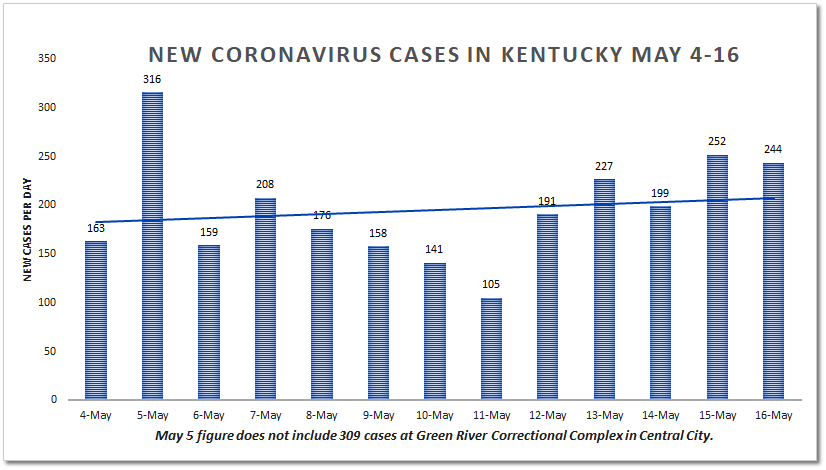
    Kentucky Health News chart shows trendline of new cases since May 3 (where there were 173) is up.
    By Al Cross
    Kentucky Health News

    As Kentucky prepares to allow all retail stores to open Wednesday, its two-week trend of new coronavirus cases is up, contrary to the federal guidelines that say such reopening shouldn't begin unless cases have shown a downward trajectory for the previous two weeks.

    Gov. Andy Beshear announced 244 new cases Saturday, the second day in a row that tilted the state's two-week trendline upward. That moved Kentucky into the red "criteria not met" category on the CovidExitStrategy.org website, which monitors states' compliance with the guidelines.

    The day before, the site ranked Kentucky it as yellow, "making progress." The day before that, it was one of the two states rated green, for having met the guidelines. Saturday it was one of 22 states rated red. That was all the more notable because some labs don't report test results on weekends.

    CovidExitStrategy.org says Kentucky's two-week trend shows an increase of 19 percent.

    Beshear couldn't be asked about the numbers because he didn't hold a news briefing Saturday. Instead, he issued a five-minute video report.

    "Today we've got a higher number of cases, but thankfully we're continuing to see a lower number of deaths," he said. The two deaths brought the state's total to 334.

    He noted that 94 of the new cases were from Jefferson County, and attributed that partly to outbreaks at Maryhurst, a residential treatment facility for abused and neglected girls, and the JBS meat-processing plant. Other counties reporting more than five new cases were Boone, 30; Warren, 25; Fayette, 19; Shelby, 10, and Kenton and Logan, seven each.

    So far 7,688 Kentuckians have had the coronavirus, and 2,768 of have recovered from it, Beshear said. At least 129,405 people have been tested and 1,967 have been hospitalized; 438 are still in hospital and 270 are in intensive care -- a sharp uptick from recent days, when the number had been increasing slightly.

    "That's up," Beshear acknowledged, "and we gotta be thinking about those folks. We gotta watch that number."

    The governor reported five more deaths in long-term-care facilities, which account for most of the state's deaths but lag the other date in reporting. He said 13 more residents and 13 more employees have tested positive, as the state mounts an effort to test everyone in nursing homes.

    Beshear concluded his report with an appeal to limit activities and take precautions. "If we want to reopen this economy we've got to remember there is still a virus out there that spreads aggressively and to cert populations it can be deadly, so be healthy at home," he said. "Look our for one another ... be kind to one another, be a good neighbor and I will see you Monday at 5 p.m."

    The governor has stopped giving reports on Sundays, noting that reporting on weekends is incomplete.