Monday, October 26, 2020

To 'celebrate' or not to celebrate Halloween; that is the question


As Halloween 2020 approaches, many families want to know if it's safe to let their children go trick-or-treating in the middle of a pandemic. There is no easy answer to this question, but here is some expert advice on how to make the experience as safe as possible.
  
Step 1: Figure out how much health risk your household is comfortable assuming.

Do you live or regularly interact with people who are especially vulnerable to covid-19? Then you'll want to err on the side of caution and consider staying in on Halloween. That's always the safest option, of course, but there are still reasons some families might want to observe the High Holiday of American Children.

"Not having a routine really impacts kids, and as we come into the holidays, trick-or-treating and participating in Halloween activities can help kids with their minds,” Phoenix pediatrician Kristin Struble said in a recent Perspective article for The Washington Post.

Step 2: Try to figure out the general risk level in your community. Infection rates are trending up in most U.S. states right now, but what really matters are the specifics of your trick-or-treat route, which for most people will be their neighborhood. For example “the risk may be higher in a crowded apartment building than spread-out houses in the suburbs,” the article says.

What you really need is public-health data for your area, but this isn't always easy or possible to find. Jon McGreevy, chief of pediatric emergency medicine at Phoenix Children’s Hospital, told The Post that some form of trick-or-treating would be acceptable so long as your community's daily rate of positive tests does not exceed 10 percent. 

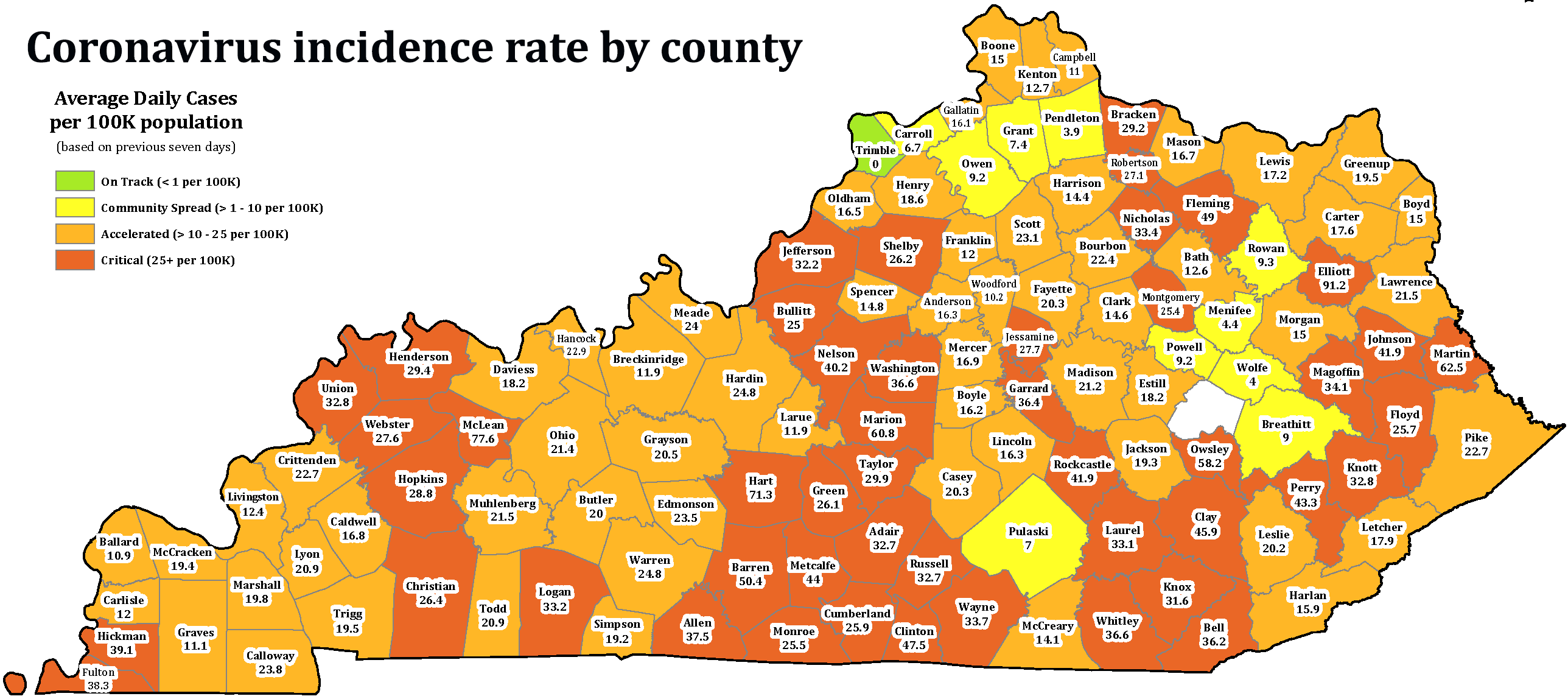
Kentucky offers a regularly updated color-coded map that shows the coronavirus incidence rate in each county as well as a daily statewide positivity rate. Both can be found on kycovid19.ky.gov
  
Step 3: After weighing the amount of covid-19 risk your family can afford to take on against your kids' mental health and the infection level in your community, the Post offers some safety tips if you do go trick-or-treating:  
  • Have kids wear a face mask. (Many costumes could easily incorporate one.)
  • Adhere to social-distancing guidelines by standing six feet apart.
  • Have a parent accompany children, regardless of age, to hold them accountable with mask-wearing and social distancing.
  • Avoid congregating around doorsteps and porches.
  • Use hand sanitizer after receiving candy from each house.
  • Do not eat candy while trick-or-treating: Parents should make certain hands are clean before kids start touching their faces and eating candy.
  • Make sure kids wash their hands as soon as they get home.
  • Have kids remove their costumes and shower.
  • No need to disinfect candy wrappers.
If you don't, check out the article for suggestions from experts and parents to make Halloween a treat for your kids, even without the walkabout. They can still dress up and show off their costumes, for example! There are also tips for how to hand out candy without putting you or your neighbors at unnecessary risk. 

Dr. Kevin Kavanagh, a retired Somerset physician who heads Health Watch USA, which focuses on infection control, reminded Kentuckians on the Jack Pattie Show on Lexington's WVLK that just because an activity is outdoors doesn't mean it's safe. He noted that the Centers for Disease Control and Prevention has declared traditional trick-or-treating, in which treats are handed to children who go door to door, a high-risk activity. 

Don't think that wearing a Halloween mask, is going to protect you from the coronavirus, Kavanagh said. "If screaming will likely occur, greater distancing is advised," he said. "The greater the distance, the lower the risk of spreading a respiratory virus.” 

The CDC also advises against wearing both a regular mask and a costume mask: "Do not wear a costume mask over a cloth mask because it can be dangerous if the costume mask makes it hard to breathe. Instead, consider using a Halloween-themed cloth mask."

The state Department for Public Health has issued Halloween safety guidance at https://chfs.ky.gov/agencies/dph/covid19/cv19halloweenguidance.pdf.

While children's cases are often asymptomatic or less severe than adults, it's important to remember that they can spread it to others unknowingly. 

As of Oct. 8, more than 697,633 children had tested positive for the coronavirus, according to the American Academy of Pediatrics. Children represented 10.7% of all cases. The report says between Sept. 24 and Oct. 8, there was a 13% increase in child cases. 

As of Oct. 14, 12,950 Kentucky children between the ages of 1-19 have tested positive for the coronavirus, making up 15.8% of the total cases, according to the state health department. 

The bottom line, there's no easy answer to this question and whatever you choose will involve tradeoffs. But that's life in a pandemic.

Sunday, October 25, 2020

'Covering the Pandemic' program is available for viewing

Reporters and news managers who are covering the pandemic discussed their work and the challenges they face Thursday night in an online program held by the Bluegrass Chapter of the Society of Professional Journalists. A recording of the Zoom meeting is available here.

The panelists were Alex Acquisto, health reporter for the Lexington Herald-Leader; Jennifer P. Brown of Hopkinsville, who recovered from covid-19 and wrote about it in her online newspaper, Hoptown Chronicle; Ben Sheroan, editor of The News-Enterprise of Elizabethtown, who spoke to the pushback newspapers receive from coverage of the pandemic; and Brian Neal, news director of Lexington’s WLEX-TV, who addressed the fatigue factor experienced by journalists.

School Nurse Task Force says every Ky. school needs a full-time nurse; asks lawmakers for $3 million to conduct a pilot program

By Melissa Patrick
Kentucky Health News

"Every school needs a nurse every day, all day."

So says the Kentucky Nurses Association School Nurse Task Force, which has worked for this goal for more than five years. It says only 43% of Kentucky schools meet the National Association of School Nurses recommendation for a minimum of one nurse for every 750 students

On Oct. 20, the task force made its case to the legislature's Interim Joint Committee on Education, saying there is no more important time than now for it, in the middle of the coronavirus pandemic, when a coordinated school health approach is most needed.

"We know that when students are healthy, they succeed academically," task-force spokesperson Gannon Tagher told the committee. She is a pediatric nurse practitioner and the associate dean for academic affairs on Northern Kentucky University's College of Health and Human Services. 

National Association of School Nurses chart
Tagher ticked off a long list of well-documented reasons why every Kentucky school needs a nurse every day, all day. She said, among other things, that schools with nurses have improved attendance rates, higher high-school graduation rates, reduced transmission of infectious diseases, and positive outcomes related to covid-19.

She also spoke to the major health and socioeconomic challenges facing Kentucky's children, noting that they rank in the bottom 10 states for physical and mental health, diabetes, asthma, obesity, oral health and substance abuse. She said 16% live in high-poverty areas, and the share of Kentucky children without health insurance increased 29% from 2016 to 2019. 

"The ability to learn is affected by health," she said. "If children are hungry, if they're tired, if they haven't had a home to sleep in, if their chronic conditions such as diabetes and asthma are poorly controlled -- then learning falls to the bottom of the hierarchy. They just don't have the ability to learn." 

Tagher said that in addition to addressing the health needs of students, school nurses also regularly address the "social determinants of health," which include very practical things such as housing and transportation.  

School nurses are an integral part of a school's trauma-informed care team, she said, and are often the first to recognize factors like bullying and mental-health issues that increase the risk of a student becoming a perpetrator or a victim of school violence.

She also stressed that school safety is more than just preventing violence: "When we have children with food allergies and children with asthma, children with diabetes in our schools, they have the potential to face life threatening emergencies during the school day, and a nurse can prevent these life threatening emergencies from happening."

During the 2018-19 school year, according to Tahger's slides, 21,074 Kentucky students had food allergies, 47,805 had asthma, and 1,507 had Type I diabetes.

Patricia Burkhart, co-chair of the task force said in an e-mail, "Legislators need to prioritize school nurses just as they did school safety. We would argue that health and safety go hand-in-hand."

Tagher said funding is often the reason given for a district's inability to have a full-time nurse in every school. With an annual salary for a full time nurse, including benefits, estimated at $52,406 a year, it would cost about $65 million for every school to have a full time nurse, according to task-force calculations.

To fund a full-time nurses in every school, the task force offered three solutions, including:

  • New rules that allow Kentucky schools to bill Medicaid for "medically necessary" care for students who qualify for the program; 
  • Partnerships with community agencies, like local health departments, federally qualified health centers or local health systems, who can share the cost of full-time nurses in each school; or
  • Kentucky's share of funds from the Every Student Succeeds Act, the main source of federal money for elementary and secondary education.

The task force has talked about funding sources since it started asking for a full-time nurse in every school, but this year for the first time it is asking legislators to fund a $3 million pilot program that would allow it to place 56 school nurses in schools with the greatest need and measure the impact.

"A nurse in every school all day every day is an integral part of ensuring the health of our children and the future of our state," said Tagher. "We cannot afford to not fund school nurses right now."

There was no public reaction from legislators at the meeting because time ran out as Tagher concluded her presentation. 

Worst-ever Sunday for novel coronavirus cases makes for worst week yet as escalation steepens; hospitalizations remain high

Kentucky Health News graph, based on unadjusted daily reports
By Al Cross
Kentucky Health News

On Sunday, Kentucky recorded 1,462 new cases of the novel coronavirus, the most of any Sunday and more than the state recorded in an entire week after the initial surge in cases began to subside five months ago.

The state also counted a record number of covid-19 hospitalizations, 841, one more than the day before, with 231 of those patients in intensive case and 106 of them on ventilators.

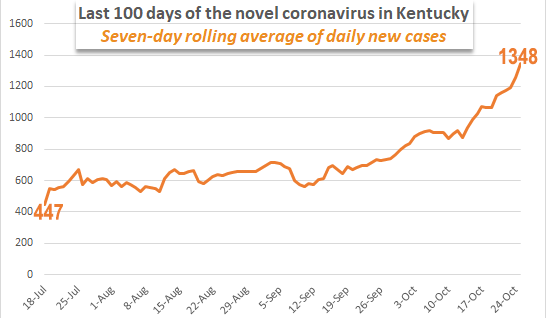
The new-case number increased the steepest sustained growth in the seven-day rolling average of daily new cases. It is now 1,348, almost double what it was a month ago and far above the previous record of 1,255, set Saturday. In the last 100 days, since the second major surge of cases in mid-July, it has more than tripled.

The new case numbers also gave the state the most in an official Monday-through-Sunday reporting week, with 9,335. The numbers will be adjusted downward slightly on Monday, once duplicate test results are eliminated.

“Since March 6, Kentuckians have been fighting covid -19, yet we are facing the highest number of cases ever reported on a Sunday, and the highest week of new cases. We must do better,” Gov. Andy Beshear said in a press release. Sunday usually has a lower number of cases due to limited testing and reporting.

Beshear added, “We all know the steps we need to take to stop the spread of this virus – wear a facial covering, wash your hands, stay six feet apart and limit gatherings and travel – let’s all do these simple things to protect each other.”

The release noted that Beshear said after Saturday's "frightening" new daily record of 1,738 cases that he would talk Monday about new recommendations to counties that are in the "red zone," those with 25 or more average daily cases per 100,000 residents.

Beshear reported three more deaths from covid-19: an 87-year-old woman from Fayette County; a 74-year-old woman from Grayson County and an 83-year-old man from Spencer County. They brought the state's death toll to 1,407.

Jefferson County, which has 17% of Kentucky's population, had 26% of Sunday's new cases, 379. Tiny Elliott County again had a huge number, 137. The Little Sandy Correctional Complex, a state prison there, has 55 cases (32 employees and 23 inmates), said Susan Dunlap, chief spokeswoman for the state Cabinet for Health and Family Services.

Other counties with more than 10 new cases were Kenton, 53; Fayette, 40; Warren, 37; Bullitt, 36; Shelby, 35; Boone, 33; Campbell, 32; Montgomery, 29; McCracken, 28; Barren, 26; Christian, 26; Hardin, 19; Calloway, 18; Scott, 17; Daviess, 16; Hart, 16; Nelson, 16; Jessamine, 15; Marion, 15; Knox, Madison and Mercer, 14 each; Allen and Henderson, 13 each; Boyd and Pike, 12 each; and Muhlenberg, 11.

Saturday, October 24, 2020

New cases hit another record; Beshear calls it 'frightening,' says he will talk Monday about new recommendations for red zones

Kentucky Health News graph, from unadjusted reports of daily cases, discounting large backlogs
By Al Cross
Kentucky Health News

Calling the total "frightening," Gov. Andy Beshear announced 1,738 new cases of the novel coronavirus Saturday, the state's highest one-day total yet.

“This is exploding all over the country. Yesterday was the highest amount of cases ever reported in a single day in the United States,” Beshear said in a news release. That record was repeated Saturday, it was announced later.

“We've got to do better, and on Monday we'll be talking about new recommendations to counties that are in the red,” Beshear said. “We've got to tamp down these cases. The more cases, the more people that end up in the hospital and the more people die.”

Hospitalizations also set a record, at 840, including 208 in intensive care and 107 of those on ventilators. And the percentage of Kentuckians testing positive for the virus jumped again, to 5.63%. Eight additional covid-19 deaths were reported, raising the state's toll to 1,404.

Health Commissioner Steven Stack said, “We’re all tired of covid-19 and the problems it has brought. People are hurting, whether from the virus itself or the impact it has had on the rest of our lives. It’s all worse, though, when we don’t do simple things like wearing masks and socially distancing. As October comes to a close, please be kind to each other and remember that we help each other, and ourselves, when we focus on defeating the virus rather than arguing with each other.”

Beshear said on Twitter that he was "officially out of quarantine after following the advice of the Department for Public Health" after a member of his security detail tested positive and then developed covid-19. He said he and his family have tested negative "multiple times, which I contribute to the fact we were wearing masks at the time of contact." He added, "Thank you to all who have sent supportive messages. We are very blessed."

The previous high for number of cases found in a single day was 1,487, on Wednesday. The state announced more cases on Oct. 7, but more than 1,400 of them were from a backlog in Fayette County.

The growth of cases in the last 10 days appears to be the worst since the first two months of the pandemic, and shows in the county-by-county list. Elliott County, which has about 7,500 people, reported 74 new cases -- about 1 per 100 in just a single day. Lee County, with about the same population, reported 27 cases; a nursing home there has counted 128 in a current outbreak.

In other covid-19 news Saturday:

  • Other counties with more than 10 new cases were Jefferson, 390; Fayette, 86; Shelby, 63; Kenton, 57; Boone, 44; Hardin, 44; Daviess,  McCracken and Nelson, 39 each; Clark, 35; Calloway, 34; Warren, 31; Campbell, 30; Lee and Whitley, 27 each; Christian and Hopkins, 24 each; Bullitt and Laurel, 23 each; Knox, 22; Pike, 20; Barren, 18; Franklin and Marion, 17 each; Henderson and Logan, 16 each; Hart, 14; Adair, 13; Floyd, Garrard, Montgomery and Taylor, 12 each; and Bourbon, Jessamine, Madison and Oldham, 11 each.

  • The state's report on long-term care showed 55 new cases among residents and 25 among employees.

  • Maggie Menderski of the Courier Journal writes about Demetrius Booker, 40, of La Grange, who was hospitalized in four different facilities for 95 days with covid-19.

Friday, October 23, 2020

Judge tells state to keep Anthem in Medicaid managed care, cites role of former Beshear aide working for another successful bidder

A Frankfort judge ordered the state Friday to keep Anthem Inc. as one of its managers of Medicaid, an $8 billion program that pays for health care for one of every three Kentuckians.

Franklin Circuit Judge Phillip Shepherd's order "comes just days before the state is set to begin enrolling people in Medicaid health plans for 2021 on Nov. 2, and as the state is facing record enrollment of 1.6 million Kentuckians in Medicaid, largely because of the covid-19 pandemic," notes Deborah Yetter of the Courier Journal.

Judge Phillip Shepherd
Shepherd ruled in a lawsuit Anthem filed in May after it lost out in bidding for new contracts. He said the huge insurer had raised "a substantial question" about the contract-award process and demonstrated "a substantial likelihood" that it would win the case.

Anthem alleged, among other things, that one of the new contractors, California-based Molina Health, had hired a former employee of Gov. Andy Beshear who was privy to key documents that other bidders couldn’t see. Shepherd said the role of Emily Parento "creates the appearance that Molina had the inside track on the bidding process."

"He also cited multiple irregularities of the scoring and evaluations process the state used to select the five companies that initially won the contract," Yetter reports. "Shepherd found the process to be 'arbitrary' and poorly documented."

Passport Health Plan, the main Medicaid manager for the Louisville region, also lost out in the bidding but sold its assets to Molina, which is using the Passport name and says it plans to complete a new headquarters in western Louisville, a major boost in jobs for a poor and Democratic-voting area.

Emily Parento
Parento, who was health-policy director for the governor’s father, then-Gov. Steve Beshear, signed a non-disclosure agreement to see “non-public files” about the bidding as part of the transition team at the start of Andy Beshear's administration. She “had unfettered access to inside information” about other bidders “as well as the evaluators’ notes regarding the strengths and weaknesses of each of those bids,” Anthem said in its suit.

Molina "denied there was any conflict with Parento working for it as a consultant," Yetter reports, and said "she did not get access to any confidential information that would have helped it win a contract."

The Finance and Administration Cabinet said Molina swore that Parento did not have access to confidential information about the proposals and didn't "divulge any confidential information she obtained prior to working as a consultant to the company," Yetter writes. "But Shepherd found otherwise and devoted a considerable portion of his order to examining Parento's role in the case."

Shepherd "said that under state ethics guidelines, she should have been barred for at least a year from working for any company involved in the Medicaid contracts after leaving the Beshear transition team," Yetter writes. The judge said that created at least "the appearance of impropriety."

Anthem also objected to Molina making confidential required information about lawsuits in which it had been involved and any official sanctions levied against it. It says in a footnote, “It appears that the decision to waive scoring of this item occurred at the final stages of the process and apparently after the individual evaluators had completed their preliminary scoresheets.”

The scores were close. WellCare got 1,662; Aetna 1,653, Humana 1,605, United HealthCare 1,520, Molina 1,507, Anthem 1,491 and Passport, 1,409, according to the bid protest.

Shepherd had already ordered the state to delay sending notices to Medicaid beneficiaries asking them to choose a managed-care provider until he could decide on Anthem's request for an injunction or a temporary restraining order.

His latest order says, "Public interest supports allowing Anthem to participate in this contract, bringing more competition and a wider variety of choices to Medicaid recipients," his order said. "Most significantly, Medicaid recipients currently enrolled in Anthem will not be required to change providers and disrupt their medical care."

2nd highest number of new virus cases; week already deadliest, with a day to go; Beshear says his experience shows masks work

State health department map, relabeled by Kentucky Health News; for a larger version, click it.
Lee County is blank, but had many new cases this week, many at a nursing home; see below.
By Melissa Patrick
Kentucky Health News

Kentucky recorded 1,457 new cases of the novel coronavirus Friday, the second highest daily total, exceeded only by 1,487 on Wednesday. That pushed the seven-day rolling average to 1,191, the highest yet, and 29 above yesterday, the previous record. 

“This week has been a tough week, with three out of the five highest days,” Gov. Andy Beshear said in a news release. “This virus is everywhere. It is in your community. We need every community doing what it takes to defeat it.”

Beshear reported 16 more deaths from covid-19 on Friday, bringing the state's death toll to 1,396. The Lexington Herald-Leader reports that even with one day left in the week, Kentucky has already had 84 covid-19 deaths, surpassing its highest previous weekly toll, 72 between Aug. 30 and Sept. 5. 

The fatalities were a 69-year-old woman from Boyd County; two women, 77 and 84, from Daviess County; a 71-year-old woman from Fayette County; three women, 84, 101 and 102, and three men, 73, 76 and 84, from Jefferson County; a 64-year-old man from Knott County; an 87-year-old woman from Lee County; an 84-year-old woman from Leslie County; a 75-year-old woman from Logan County; an 86-year-old woman from Marshall County; and an 80-year-old man from Todd County.

The release said a record 818 people were hospitalized in Kentucky for covid-19 on Friday, up 18 from Thursday; 205 are in intensive care, nine fewer than Thursday; and 97 are on a ventilator, eight fewer than Thursday.  

The share of people testing positive for the virus in the past seven days continued to inch up, to 5.34 percent.

Beshear and his family will finish their two week quarantine on Saturday after being potentially exposed to the virus on Oct. 10 by a member of their security detail who tested positive for the virus, the release said.

“Wear a mask. It saves lives. I’ve now tested negative four straight times after sitting in the passenger seat next to someone driving who was infectious with covid,” Beshear said. “I was wearing a mask. He was wearing a mask. That shows you that it works.”

In other covid-19 news Friday: 
  • Counties with 10 or more new cases Friday are Jefferson, 312; Fayette, 112; Warren, 60;  Hardin, 47;  Barren, 35; Daviess and Lee, 27 each; Hart, 26; Pike, 25; McCracken, 24;  Kenton and Madison, 22 each; Boone, 21; Clay, Laurel, and Nelson, 20 each; Scott and Shelby, 19 each; Henderson, Montgomery, Perry, and Whitley 17 each; Bullitt and Christian, 16 each; Campbell and Floyd, 15 each; Clark, Logan and Martin, 14 each;  Bell and Hopkins, 13 each; Johnson and Marion, 12 each; Boyd, Franklin, Jessamine, Knott and Oldham, 11 each; Adair, Calloway, Fleming, Marshall, McLean and Wayne, 10 each.
  • The Lee County Care & Rehabilitation Center is reporting 128 cases of the virus, involving 75 residents and 53 staff, Hazard's WYMT reports. “A person can be asymptomatic -- they can contract the virus and not show any symptoms, like a fever, which allows them to pass health screenings at work.” said Scott Lockard, the district public-health director. “This is by far the biggest outbreak in the Kentucky River District and we have seen some bigger outbreaks in nursing homes across the state, but this is the event that we have feared that would happen the most.”
  • In long-term care facilities, 35 more residents and 73 more staff have tested positive for the virus, with 941 active resident cases and 567 active staff cases reported. The facilities have seen 827 residents and six staff die of covid-19. 
  • The K-12 school dashboard shows 366 students and 202 staff tested positive for the virus this week, resulting in 3,080 students and 532 staff being quarantined. 
  • The college and university report shows 301 more students have tested positive, 499 of them in the past 14 days. Eight staff and faculty tested positive in the past 14 days. 
  • "The U.S. Food and Drug Administration on Thursday approved the antiviral drug remdesivir for the treatment of hospitalized coronavirus patients in the U.S. -- the first and only approved covid-19 treatment as of yet," the Herald-Leader reports in an article headlined "Coronavirus weekly need to know: remdesivir, air filters, national lockdown & more." 
  • Grace Schneider and Deborah Yetter of the Courier Journal write about "pandemic fatigue" that is resulting in a surge of cases. They write that public-health messaging and practices known to slow the spread of the virus, like social distancing and wearing a mask, are not resonating with worn-out Kentuckians, especially at a time when President Donald Trump is telling his rally-goers that "we are rounding the turn" on the pandemic -- even though that is not true. Click here for a Kentucky Health News story about pandemic fatigue and how to overcome it.
  • Schneider and Yetter report that pandemic fatigue is also wearing down doctors and nurses. Donald Lloyd, chief executive at St. Claire HealthCare in Morehead, which serves five counties and is a regional testing site, told the CJ that the hospital had recently hired additional emergency room doctors and travel nurses to spell staffers who are beyond exhausted, especially those working in the three virus “hot spots” inside the 149-bed facility.  
  • Jefferson County high-school sports, after a delayed start, have been suspended because of a rise in local virus cases, WDRB reports. Jefferson County moved to the most dangerous "red zone" this week, which under state guidance requires schools to assess whether they will hold classes or sporting events in the following week. Following the guidance, JCPS will: Allow contests this weekend and those such as volleyball that are already under postseason jurisdiction; follow the state high-school athletic association's guidance that allows practice, but no games or game-like simulations for teams not already in postseason play; reschedule regular-season contests planned for next week, when possible; and review the data again on Thursday evening and make another determination about athletics next Friday morning.

Even as the pandemic becomes more dangerous, 'pandemic fatigue' makes some take risks; here are tips to cope with it

Photo illustration from Skagit County, Washington, Public Health
As coronavirus cases surge across the country with no end in sight, many of us are experiencing "pandemic fatigue" and are heading into the fall with "an odd mix of resignation and heedlessness," the New York Times reports. 

"In sharp contrast to the spring, the rituals of hope and unity that helped people endure the first surge of the virus have given way to exhaustion and frustration," Julie Bosman, Sarah Mervosh and Marc Santora write as they report on how this mindset has also settled across much of Europe.

“People are done putting hearts on their windows and teddy bears out for scavenger hunts,” said Katie Rosenberg, the mayor of Wausau, Wis., a city of 38,000 where a hospital has opened an extra unit to treat covid-19 patients. “They have had enough.”

Some of this shift in attitude can be attributed to improved medical treatments to treat the virus, which have reduced its mortality rate and severity, but much of it is the result of people just wanting to return to normal. 

Mark Harris, county executive for Winnebago County, Wisconsin, told the Times that he is frustrated by the "loud minority" in his county who are successfully pushing back on all public-health measures taken against the pandemic. They have a singular frame of mind, he said: “This has been inconveniencing me long enough and I’m done changing my behavior.”

Gov. Andy Beshear offered examples Wednesday of how such returns to normal activities have opened the door for infection, citing examples from the state's contact tracers. A wedding was connected to 44 cases, a family gathering was connected to 14 cases, a college party was connected to 63 cases, a bingo-hall event was connected to five cases, a yard sale was connected to seven cases, a funeral was connected to six cases and a coffee gathering was connected to eight cases and two deaths.

"There is so much spread at family gatherings, events at the house, weddings and funerals. It's where we are seeing a huge amount of spread," said Beshear, who regularly warns Kentuckians that such gatherings will become even more dangerous as we move them indoors during the fall and winter.

"Pandemic fatigue" is hitting Kentucky at a time when cases, hospitalizations and deaths are at record highs.   

In a separate Times article, Marie Tae McDermott and Jill Cowan talked to Elissa Epel, professor at the University of California, San Francisco’s Department of Psychiatry and Behavioral Sciences, about how to prevent pandemic fatigue from slipping into unsafe behavior. 

Epel told the Times that psychological distress conditions that look like depression and anxiety are not necessarily psychiatric disorders in the classic sense, but instead can be a "normal response to what's happening." Epel offered tips for how to cope with these stressors:
  • Limit exposure to upsetting news.
  • Be kind to yourself and others who are experiencing emotional distress.
  • Spend some time thinking about what personal care means to you because this is different for every person. For example, she said some people need more sleep, while others need to exercise.  
  • Avoid long periods of sedentary behavior. 
  • Epel also  noted that a little anxiety is good, because it propels us to socially distance, keep our hands washed and to wear a mask. 
Psychologist Carisa Parrish of Johns Hopkins Medicine also writes about "pandemic fatigue" and says: "Trying to adhere to anything extra is always a challenge. You can add extra steps to your routine for a few days, but sustained behavior change is hard. Especially when no one around you is sick, and you just don’t feel like wearing a mask or saying no to things you like to do. But the fact is, the precautions work.”

She offers these tips for dealing with coronavirus burnout and pandemic fatigue:
  • Just like you make a commitment to putting on a seatbelt, she says make a commitment to washing your hands, maintaining social distance and wearing a mask in public. 
  • Stick with reliable, trustworthy information sources and stay flexible as recommendations change because new facts are emerging as we learn more about the virus. 
  • Practice precautions until they become second nature.
  • Keep necessary supplies, like hand sanitizer and mask, handy.
  • Make sure you are reading about others who have gone through covid-19 to make it personal, because for many getting sick with covid-19 is an abstract idea.
  • Allow kids to pick out a mask and hand sanitizer scent that they like and give them permission to remind other family members if they aren't following safety guidelines. 
Studies show that stress, anxiety and depression have been on the rise since the pandemic hit.

A study, recently published on JAMA Network, found that depression rates are three times higher during the pandemic; a Centers for Disease Control and Prevention study in late June found 40% of U.S. adults report they are struggling with mental health or substance abuse; and the annual Stress in America 2020 survey, conducted by The Harris Poll on behalf of the American Psychological Association, found that 78% of adults said the pandemic is a significant source of stress for them and 67% said they have experienced increased stress over the course of the pandemic. 

Thursday, October 22, 2020

Thurs. report: 1,330 new cases and a record 800 hospitalizations, 214 of them in intensive care; positive-test rate jumps to 5.3%

State Department for Public Health graph, relabeled by Kentucky Health News
By Al Cross
Kentucky Health News

Kentucky recorded 1,330 new cases of the novel coronavirus Thursday, the third-highest daily total, and a record 800 hospitalizations for covid-19, continuing a hospital-case increase that began just over a month ago.

Intensive-care cases rose to 214, the highest since May, and 105 of those patients are on ventilators, "fighting for their lives," Gov. Andy Beshear said at his last daily briefing of the week.

Beshear announced 17 more covid-19 deaths, for a two-day total of 38. The seven-day rolling average of new cases rose by 10 to 1,172, another record. A month ago, the seven-day average was under 700. The share of Kentuckians testing positive for the virus in the last seven says was 5.3 percent, the highest since Aug. 19, Beshear said.

"We have fought and defeated escalation twice; we can do it a third time; it takes all of us," he said. He added that "the big difference" between now and the initial escalation in March is "We know how to do this. The question is, are we willing to? And we need to answer that question with the affirmative. It’s gotta be 'yes,' because if it’s 'no,' we lose more people around us. It’s gotta be yes. We’re in the business of saving lives right now, folks, every single one of us. It’s your job, it’s my job, its all of our jobs. Let's do it."

Beshear said "We're going to be looking for additional recommendations we can make to communities." Asked if he sees more enforcement of measures designed to thwart spread of the virus, he said "It is uneven in some areas but we are seeing a stronger push . . . sometimes the encouragement, sometimes the enforcement. But let's admit that we can't enforce our way to into really good practices. We have to encourage our way into really good practices."

Halloween: Beshear's briefing and daily news release had much on preparations for Halloween, nine days away.

"You need a plan, because our kids are excited," he said. "They want to have some way to celebrate Halloween," but that could pose more danger than usual if not done correctly. He noted that the Centers for Disease Control and Prevention "doesn’t think we ought to be trick or treating at all."

Beshear said trick-or-treaters should go to fewer houses this year, avoid mass gatherings, wear face masks even when wearing a costume mask, sanitize their hands often, maintain six feet of distance from others and walk in groups limited to families.

To those providing treats, he said "You can't be individually handing it out; that will spread this virus."  He said candy should be set out only after sanitizing hands, and said "Step on the other side of the glass of your door so that those kids can be safe. . . . Parents, wipe down candy wrappers when you get home."

New CDC guidance: Health Commissioner Steven Stack said the CDC's new guidance, that the virus can be spread by frequent, brief exposures, "doesn’t represent a meaningful change in Kentucky" because his agency said Sept. 18 that exposure does not necessarily need to be a consecutive 15 minutes, as the CDC said then.

"I’ve very proud of our team," said Stack, an emergency-room physician by trade. "I think we have had multiple instances now where our guidance has been ahead of the curve."

He added, "In order for all of this to work, people have got to follow the guidance … If you have a high-risk exposure, we’re gonna expect you to quarantine . . . Follow the great example set by the first family." He said Beshear and his family would soon end the quarantine that they entered when a member of their security detail tested positive for the virus.

Beshear said the state trooper still has symptoms but "He's gonna be OK."

Treasurer's report: State Treasurer Allison Ball delivered an 87-page report to a legislative committee criticizing Beshear's use of state funds to have police place quarantine notices on the vehicles of people attending church services held on April 12, Easter, despite Beshear's order against mass gatherings.

Ball told the Interim Judiciary Committee that five churches were involved: Maryville Baptist Church in Hillview in Bullitt County, which was widely covered; two in Louisville, one in Falmouth and one in Morgantown. The notices said people not self-quarantining could be charged with misdemeanors.

“Kentuckians should never be faced with a misdemeanor when they want to go to church, to a synagogue or any house of worship,” Ball said..

The report gave no details about the taxpayers' money spent. Such investigations are typically conducted by the state auditor. Kentucky Health News asked Auditor Mike Harmon, also a Republican, if any GOP elected or party official asked him to do such an investigation. His office said he had received no such "formal" request.

Committee Chair Whitney Westerfield, R-Hopkinsville, called the report important and said it would be "one of the factors that will be taken into consideration of what changes might happen come January 2021," when the legislature is expected to trim the governor's emergency powers.

Democrats on the committee said the report was politically motivated, and questioned its timing, 12 days before a general election. Ball said she had planned to release the report in the summer, “`but needed more time to get her information ready,” WKYT reports.

Beshear spokeswoman Crystal Staley said, "As a deacon in his church, the governor believes the treasurer is wrong to use faith to create fear and stoke division between Kentuckians. As Governor, he has regularly featured religious leaders in his press conferences and often speaks about his strong faith." She said Beshear "took the same steps as other governors by prohibiting mass gatherings."

In other coronavirus news Thursday:

  • The day's 17 deaths include one worker at a long-term-care facility, raising to six the number of LTC employees killed by covid-19. Another six resident deaths were attributed to the disease, bringing that total to 824, or 59.7 percent of the state's death toll of 1,380.
  • The 17 fatalities were two women, 69 and 74, from Allen County; a 73-year-old man from Fayette County; two women, 60 and 78, from Greenup County; a 65-year-old woman from Hancock County; a 64-year-old woman from Hardin County; a 52-year-old man from Henderson County; a 95-year-old woman and an 84-year-old man from Jefferson County; an 87-year-old man from Jessamine County; a 93-year-old woman from Knott County; a 77-year-old woman from Lee County; a 76-year-old man from McCracken County; a 63-year-old man from Nicholas County; an 87-year-old man from Rockcastle County; and a 96-year-old man from Scott County.
  • The state's K-12 dashboard showed 73 more students and 31 more employees testing positive for the virus, and 585 more students and 85 employees quarantined, for a total of 2,455 students and 409 employees.
  • Counties with more than 10 new cases were Jefferson, 272; Fayette, 115; Nelson, 37; Hardin, 36; Warren, 35; Barren, 33; Shelby, 29; Daviess, 27; Laurel, 27; Madison, 27; Marion, 24; Boone, 20; Henderson, 20; Scott, 20; Christian, 19; Hart, 19; Bell, 17; Meade, 16; Calloway; 15; Jessamine, 15; McCracken, 15; Kenton, 14; Bullitt, 13; Allen, 12; Campbell, 12; Clay, 11; Grayson, 11; Perry, 11; Pike, 11; and Rockcastle, 11.
  • Fayette County health officials, who report on a different schedule than the state, recorded 118 new cases Thursday, "the third-most in a single day in October," the Lexington Herald-Leader reports. "The city’s rolling seven-day average of new cases has increased to 86.4. It swelled to over 100 in September before falling as low as 70 earlier this month. After hitting a plateau' earlier in October, the Lexington-Fayette County Health Department said the city is trending upward at this time,' according to spokesman Kevin Hall," who said, “We are likely exiting that plateau.”
  • First lady Britainy Beshear said Humana Inc. donated 100,000 reusable masks to the Coverings For Kids campaign, making the overall total more than 150,000. The deadline for donations is Oct. 30 at firstlady.ky.gov/coveringsforkids

Wednesday, October 21, 2020

Virus cases set a record, deaths a near-record; Beshear says he might ask that all Ky. social gatherings stop for a week or two

Kentucky Health News graph, based on numbers in initial, unadjusted daily reports

By Melissa Patrick
Kentucky Health News

Kentucky had the highest day of new coronavirus cases and second highest number of deaths Wednesday, reporting 1,487 new cases and 21 deaths.

"The third escalation is very real and it's very concerning. It’s already more concerning than the [escalation] we had in July,” Gov. Andy Beshear said at his daily briefing.

The state recorded 2,398 new cases on Oct. 7, but that included 1,426 backlogged cases from Fayette County.

Beshear listed the reasons why the current surge is so much more concerning. The escalation is starting at a significantly higher number of cases; the whole country is experiencing an escalation at the same time; the state's hospitalizations, intensive-care occupancy and deaths are all increasing; and because this surge is happening when the weather is getting colder and people are moving inside, the risk of virus spread becomes even greater. 

Beshear said there is still much to learn about the virus, "but we do know how to stop the spread," which includes wearing a mask, limiting contacts and keeping gatherings small.  

"Think about it," he said. "It's like being in a challenge or a battle of your lifetime. It's like being in a war, because we are at war with this virus. Except, you know 100 percent how to win. And the question is, are you going to execute the plan to win?"

Beshear said 794 people are hospitalized with covid-19, an increase of 18 from Tuesday and another record. He said 203 are in intensive care and 94 are on a ventilator. 

Citing the latest White House Coronavirus Task Force report, Beshear called on Kentuckians in the most dangerous red and orange zones to stop holding social gatherings with anyone outside their immediate families. The state's current guidance limits non-commercial social gatherings to 10 or fewer people.

Beshear often says he has rules in place that will work, if only people will follow them, but today he suggested that he might consider asking Kentuckians to stop all social gatherings for a short while.

"It may be, if we continue to see our numbers going up the way they are," he said, "we may need to ask that we have a period of a week or a couple of weeks where we just don't have any of these backyard barbecues or the rest at all, because we can over the course of a couple of weeks make a real impact in the spread of this virus, but we got to be willing to.

To demonstrate how small social gatherings can lead to an outbreak, Beshear offered examples from Kentucky's contact tracers in September and October. One wedding was connected to 44 cases, a family gathering was connected to 14 cases, a college party was connected to 63 cases, a bingo-hall event was connected to five cases, a yard sale was connected to seven cases, a funeral was connected to six cases and a coffee gathering was connected to eight cases and two deaths.

"There is so much spread at family gatherings, events at the house, weddings and funerals. It's where we are seeing a huge amount of spread," Beshear said. “What we need at the very least is for people to be a lot more cognizant of the danger of these gatherings, a lot more diligent in making sure that everybody wears the mask the whole time that they are at one of these."

Beshear acknowledged many Kentuckians feel like they've had enough of the virus and its restrictions, but said, "It hasn't had enough of us. And so, while it's tough, I need you to do these things," including wearing a mask, social distancing, washing hands, staying home if sick and getting tested for the virus.

The governor mandated mask wearing indoors in early July, but compliance has been spotty. He said Wednesday, "The effectiveness of any steps we take depend on the number of people who are willing to follow them."

The share of people testing positive for the virus in Kentucky in the last seven days was 4.99%. 

Beshear announced 21 more deaths from covid-19, the second highest number yet, bringing the state's death toll to 1,363. 

Beshear honored the life of Ed Pantoja of Louisville who died at 84 from covid-19 in September. He said Pantoja was married for 60 years, a father of three, ran 20 miles a week and worked out daily at the gym. His son asked the governor to share his father's story and emphasized the importance of wearing a mask, saying, "Those who knew Ed loved him." 

In other covid-19 news Wednesday:

  • Jefferson County continues to be hit hard by the virus, with 346 new cases. Other counties with 10 or more new cases were Hardin, 75; Kenton, 53; Boone, 45; Fayette, 42; Elliott, 39; Hopkins, Laurel, and Pike, 35 each; Madison, 34; Bullitt and Campbell, 28 each; Barren, 27; Knox and Whitley, 26 each; Oldham and Warren, 24 each; Nelson, 23; Marion, 21; Shelby, 20; Daviess, 19; Hart, 17; Christian and McCracken, 16 each; Meade, 15; Jessamine, 14; Scott, 13; Boyd, Greenup and Logan, 12 each; Washington, 11; and Boyle and Calloway, 10 each. 
  • The release from Beshear's office said the 21 fatalities were "an 84-year-old Kentuckian, gender unknown;" an 81-year-old man from Adair County; a 65-year-old woman from Boyd County; a 91-year-old woman from Christian County; a 69-year-old man from Clark County; a 52-year-old man from Clinton County; a 74-year-old woman from Daviess County;  two women, 84 and 89, and two men, 84 and 93, from Henderson County; four women, 70, 82, 85 and 86, and two men, 63 and 83, from Jefferson County; two women, 42 and 77, from Madison County; a 76-year-old woman from Marion County; and a 57-year-old man from Todd County.
  • In long-term care, 70 more residents and 40 more staff have tested positive for the virus, with 960 active resident cases and 537 active staff cases. There have been 818 resident and five staff deaths attributed to covid-19 in the facilities. 
  • Beshear said the Thomson-Hood Veterans Center in Wilmore has 71 veterans who have tested positive for the virus, 13 veterans in the hospital, and six veterans who have died from covid-19.  Beshear said this is the only one of the state's four veterans' nursing homes with any active cases. 
  • The K-12 dashboard reports 86 more students and 28 more staff and faculty have tested positive, and 587 more students and 77 more staff are quarantined. So far this week, 199 students and 113 staff have tested positive and 1,817 students and 318 staff have been quarantined. 
  • The latest Centers for Disease Control and Prevention report, published in the Morbidity and Mortality Weekly Report, says that at least two-thirds of this year's "excess deaths," the number above the typical total during the same period in previous years, were from covid-19. The report says, "Overall, an estimated 299,028 excess deaths occurred from late January through Oct. 3, 2020, with 198,081 (66%) excess deaths attributed to covid-19. The largest percentage increases were seen among adults aged 25–44 years and among Hispanic or Latinx persons.
  • The CDC released an updated definition for what it means to be in "close contact" with someone with the virus. It now says close contact means you were within six feet of someone who has tested positive for the coronavirus for a total of 15 minutes at any time over a 24-hour period. The prior guidance said the 15 minutes had to be all at one time. Dr. William Schaffner, a Vanderbilt University infectious diseases expert, told The Associated Press that this shows  the virus can spread more easily than many people realize. The change was prompted by a study of a 20-year-old Vermont correctional officer who wore a mask and goggles, but ended up testing positive for the virus after video footage showed he had had 17 minutes of brief interactions with other prisoners, some with mask and others without, during an eight-hour shift. "In a statement, CDC officials said the case highlights again the importance of wearing masks to prevent transmission," AP reports.
  • Peer-reviewed studies cited by NPR shows that the rate of covid-19 deaths in hospitalized patients has dropped. The research found patients had a 25.6% chance of dying at the start of the pandemic; they now have a 7.6% chance. That is a great improvement, but it's still higher than many other infectious diseases, including influenza, Leora Horwitz, an author of one of the studies, told NPR. Another study set out to determine if the drop was due to improvements in treatment or because more young people are being hospitalized with covid-19. It found that after adjusting for age and other diseases, the death rates dropped for all groups.
  • More than $780,000 in federal funding has been awarded to Kentucky public-safety agencies and offices to help protect seniors and other Kentuckians against pandemic scams and fraud, and respond to price gouging. Most of the funding went to the attorney general's office, according to a news release form Beshear's office.

Tuesday, October 20, 2020

White House report: 70% of Ky. counties had a moderate or high level of virus spread; advises trading with stores that follow rules

White House Coronavirus Task Force table; for a larger version, click on it.

By Melissa Patrick
Kentucky Health News

The latest report from the White House Coronavirus Task Force again has Kentucky in the task force's worst danger zone for number of cases, with 12 more counties being put in that zone than the previous week. 

"Kentucky is in the red zone for cases, indicating 101 or more new cases per 100,000 population last week, with the 21st highest rate in the country," said the report. "Kentucky had 158 new cases per 100,000 population in the last week, compared to a national average of 117 per 100,000." 

The report places the state in the orange zone for the percentage of residents testing positive for the virus, representing a rate of 8% to 10%, with the 14th highest rate in the country. 

Gov. Andy Beshear regularly points out that the White House report uses a different data stream than the state uses, which means the state's positive-test numbers are lower. Tuesday he announced a rate of 5.08%, the highest since late August.  

"We don't present this to confuse anybody we present it to be 100 percent fully transparent," Beshear said at his daily briefing. "If the White House is going to send us an analysis, we want to make sure that you can see it." 

The report covers Oct. 10-16. It puts 84 of the state's 120 counties into one of the danger zones, up from 76 the previous week. Twenty-one more counties (62) were in the top two danger zones in this week's report.

The number of counties in the red zone increased from 31 to 43; the orange zone number increased from 10 to 19; and the yellow zone decreased from 35 to 22. 

The report says 70% of Kentucky's counties had a moderate or high level of community transmission, with 36% of them having high levels of transmission. 

"The virus is truly everywhere at this point," said Beshear. "So it's going to take a full statewide effort to address it. . . . If just one community isn't doing what it takes to defeat this virus, it can spread to every community around it."

The report calls for counties in red and orange zones to optimally stop having social gatherings in homes beyond immediate family. It also encourages community members to frequent establishments that follow the rules.

"The White House thinks that we need to be spending our money in those places and trying to encourage maybe establishments that aren't working as hard to work harder," Beshear said. "Because we are going to go where it's safest and we're going to spend our dollars where it's safest. It's a White House recommendation, and I agree that it is a good strategy."

Communities in the red zone had positive-test rates higher than 10% and more than 1 new case per 1,000 residents. Those in the orange zone had 0.51 to 1 new cases per 1,000, and a weekly positive-test rate of 8% to 10%, or one of those two conditions and one condition qualifying for the red zone. Yellow-zone communities have new cases between 0.1 and 0.5 cases per 1,000 and a positive-test rate of 5% to 8% -- or one of those, with the other in a higher zone.

White House Coronavirius Task Force maps; for a larger version, click on the image.

Cases and hospitalizations keep escalating; state prepares for a medical surge; in-home gatherings discouraged in 43 counties

Dark blue line on K-12 school dashboard shows number of quarantined students; light blue line is the number of quarantined staff; red line is new student cases; the orange line is new staff cases.

By Lisa Gillespie
Kentucky Health News

Gov. Andy Beshear announced the state’s fourth highest day of coronavirus cases on Tuesday, 1,312, along with increases in almost every other measure indicating the state is headed for trouble, including hospitalizations, the rate of people testing positive for the virus, cases in schools, and deaths.

"Today’s report is grim," Beshear said. "It is grim because it shows that we are not just continuing in our third escalation, but this one is probably now the second most worrisome escalation we have seen surpassed only by that original March increase."

Beshear noted that both Monday and Tuesday's new cases have been the highest yet for each of those days of the week. He said the state is now preparing for a surge, including looking at increasing capacity in hospitals for covid-19 patients. 

“Because of what we are seeing with this escalation, you should know that we have begun as a state, surge preparations,” Beshear said. “We are now going back to our plans about capacity in hospitals, looking if we have to add hotel options and the use of state parks and ensuring that we have the operational plans to stand up the field hospital if necessary.” 

Beshear said 776 people in Kentucky are hospitalized with covid-19, which set a record for the second day in a row. He said 202 of them are in intensive care, up 12 since yesterday, and 96 of those are on a ventilator, seven more than yesterday.

The statewide positivity rate – a seven-day rolling average of the number of coronavirus tests that come back positive out of the total number of tests done each day – is now 5.08%, the highest it’s been since late August. 

The school coronavirus dashboard, where schools report new cases that haven’t yet been verified, tallied 97 new cases on Tuesday morning, Beshear noted. And 1,109 students are in quarantine because of potential exposure. The dashboard also shows 75 new staff and faculty have tested positive for the virus, and 218 are in quarantine. 

"That tells us how the virus is out there and spreading and how we've got to tamp it down and lessen the spread in a community to protect the education of our children," the governor said. 

Beshear urged churches and other venues to enforce guidelines like mask wearing inside and keeping six feet of distance. He pointed out that nationwide, the spread of the virus has been linked to social gatherings and funerals.

“Different venues that are out there, we need you to double down on what you're doing,” Beshear said. “Our houses of worship, just please make sure that you're following all the protocols and redouble your efforts, all the way through.” 

The governor also mentioned the most recent White House Coronavirus Task Force report recommends that residents of the 43 Kentucky counties in its red zone, including Jefferson, Laurel and Pike, not have any gatherings at all in their homes.

“The White House recommends that we don't have gatherings in our homes at all while we're in the red and just stay there with our close family; that is the recommendation from them,” Beshear reiterated. “They are also encouraging us in each community to spend your money at businesses that are following the rules.” 

The report said about 70% of Kentucky counties have moderate to high levels of community transmission. Beshear noted that the report, which uses different metrics than the state, advises Kentucky to continue its mask mandate and encourages states that haven’t done it yet, such as Tennessee, to do so. 

Kentucky’s guidance for social gatherings is not so strict, limiting such gatherings to 10 people or less. 

Beshear announced 16 new deaths from covid-19 on Tuesday, bringing the state's death toll to 1,342. 

Rev. Robert L. Boyd
Beshear honored the life of 89-year-old Rev. Robert L. Boyd of Cadiz, a veteran who died of covid-19. Boyd was a relative of a member of Beshear’s security team. Beshear said Boyd was a boxer, a farmer and a historian who came from a large family. 

“He loved retelling the stories of his family and church, and could recount historic dates and stories from the local area,” Beshear said. “A man of many talents, Rev. Boyd was a talented singer and a former member of the gospel group, Israel Life Travelers. Family was everything to him. . . He was loved by so many who will carry his strength and encouragement in their hearts.” 

In other coronavirus news Tuesday:

  • Counties with 10 or more new cases were Jefferson, 324; Fayette, 47; Laurel, 45; Boone and Nelson, 36; Christian and Pike, 35; Kenton, 29; Bullitt, 28; Scott and Warren, 27; Madison, 22; Daviess and Fleming, 19; Barren and Hardin, 18; Bell; 17; Allen, Henderson and Wayne, 15; Johnson, Martin and Whitley, 14; Floyd, Hopkins and Perry, 12; Franklin, Jessamine and Magoffin, 11; and Campbell, Clay, Clinton, Knox, McLean and Todd, 10. 
  • The 16 deaths were a 56-year-old woman from Bell County; a 73-year-old man from Boyd County; an 86-year-old woman from Daviess County; two women, 96 and 97, from Fayette County; an 82-year-old woman from Hopkins County; four women, 67, 74, 76 and 80, from Jefferson County; a 92-year-old woman and three men, 64, 94 and 96, from Jessamine County; an 89-year-old man from Marshall County; and a 78-year-old man from Muhlenberg County. 
  • In long-term care, 44 more residents and 29 more staff have tested positive for the virus, with 979 active resident cases and 569 active staff cases. Beshear said nine more deaths can be attributed to the facilities, for a total of 811 resident and five staff deaths attributed to covid-19. 
  • Beshear said there’ve been a total of five deaths at the Thomson-Hood Veterans Center in Wilmore, with 71 residents and 42 staff testing positive. Thirteen of the veterans have been hospitalized. Beshear said 15 nursing staff have been provided to the center after the Kentucky Department of Veterans Affiars asked for more assistance. The Paul E. Patton Eastern Kentucky Veterans Center has reported two deaths and has eight active cases. 
  • The college and university report shows 19 more students have tested positive for the virus, bringing the number of  newcases in the past 14 days to 363 students.
  • The Centers for Disease Control and Prevention has issued new guidance that strongly recommends all passengers and workers on planes, trains, buses and other public transportation wear masks to control the spread of the coronavirus. “Face masks help prevent people who have covid-19, including those who are pre-symptomatic or asymptomatic, from spreading the virus to others,” the CDC guidelines say. “Masks are most likely to reduce the spread of covid-19 when they are widely used by people in public settings.” The Post reports that the new guidance has received mixed reaction from the transportation industry, saying it falls short of what is needed because the recommendation is only that, and not a mandate. 
  • The Lexington Herald-Leader talks to experts about whether air filters can help prevent coronavirus spread in your home. The bottom line, there is still a lack of evidence that they work, but the potential benefits outweigh the cost. That said, one expert says they should be part of your plan rather than your whole plan.
  • The head basketball coach of Washington County High School, Stephen Woodson, describes his "tough" battle with covid-19 in hopes that it will encourage others to share their stories, WDRB reports."Covid is real," he posted on Facebook. "I couldn't even go to the bathroom on my own. I had to have oxygen to help me breathe and wasn't even strong enough to open my eyes. Honestly, one night, I didn't think I was going to make it, my body felt pain I have never felt and I didn't know what to do."
  • "Prospects for an economic relief package in the next two weeks dimmed markedly on Tuesday after Senate Majority Leader Mitch McConnell revealed that he has warned the White House not to strike an agreement with House Speaker Nancy Pelosi before the Nov. 3 election," The Washington Post reports, citing three anonymous sources after Republican senators' weekly lunch, where McConnell spoke. The New York Times cited four and reported, "He made it clear that he knew his counsel was likely to leak out, making reference to the possibility that his remarks could appear in the news media, two of the Republicans said."
  • A large national poll released Monday by the Public Religion Research Institute found that 49% of Americans trusted Dr. Anthony Fauci, the nation's top infectious-disease expert who has served under six presidents, "a lot" as a source of information about the coronavirus pandemic, ranking him second on the list of eight choices. University research centers ranked first, at 51% and President Trump ranked last, with only 14% saying they trusted him "a lot" when it comes to the pandemic, the Post reports. On a Monday conference that included reporters, Trump criticized Fauci, calling him a "disaster" and said "people are tired of covid" and "are tired of hearing Fauci and all these idiots."
  • The New York Times/ Siena College poll, taken Oct. 15-18, found that regardless of how Americans might vote, 52% said they trusted Joe Biden to do a better job with the coronavirus pandemic and 40% said they trusted Trump to do a better job. The poll found that 59% would support a national mask mandate and 39% would oppose it. 
  • The Aug. 7-16 motorcycle rally in Sturgis, S.D., may have helped spark a major outbreak of the virus, the Post reports: "Experts say they will never be able to determine how many of those cases originated at the 10-day rally, given the failure of state and local health officials to identify and monitor attendees returning home, or to trace chains of transmission after people got sick. Some, however, believe the nearly 500,000-person gathering played a role in the outbreak now consuming the Upper Midwest."