Monday, December 20, 2021

As highly contagious Omicron variant becomes dominant in U.S., Beshear says Ky. cases will rise and he will watch hospitalizations

Ky. Dept. for Public Health graph, adapted by Ky. Health News; click on it to enlarge.
By Melissa Patrick
Kentucky Health News

Cases of the coronavirus cases and the share of Kentuckians testing positive for it remain on high plateaus, but Gov. Andy Beshear warns that these numbers will go up because of the highly contagious Omicron variant of the virus, which is now the predominant strain in the United States.

"Case numbers will go up," Beshear said at a Monday news conference. "We'll be watching hospitalizations real closely, that will end up being our major metric that we follow during Omicron. But given that it is more contagious, unless a whole lot of people go out there and get boosted and vaccinated for the first time, these case numbers are going to shoot up." 

Kentucky has reported 5,321 new coronavirus cases since Saturday, 1,215 of them on Monday. That brings the seven-day rolling average to 2,269, 6.3% above the average on Friday.

Beshear said he has not been alerted to any more counties with the Omicron variant, but  said, "Omicron is probably in every county by now." On Saturday, he announced that it had been identified in Kenton, Campbell, Fayette and Jefferson counties. 

The Centers for Disease Control and Prevention reported late Monday that the Omicron variant now accounts for 73% of new coronavirus cases in the U.S.

At the start of Christmas week, Beshear encouraged everyone to get vaccinated for the virus or get a booster shot, and to take a Covid-19 test as close to any event as possible and to wear a mask when appropriate. 

The share of Kentuckians testing positive for the virus over the last seven days is 9.2%, essentially returning it to the peak it reached before this month's decline. It was 9.21% on Dec. 3. 

Covid-19 hospital cases are down 3.75% in the last week. Kentucky hospitals reported 1,206 Covid-19 patients, a decrease of 49 from Friday, 325 in intensive care (down four) and 176 on mechanical ventilation (down 19). 

Eight of the state's 10 hospital readiness regions reported using at least 80% of their intensive-care beds, with four of them above 90%. The Northern Region is still at 100% capacity. 

Beshear said as hospitals prepare for Omicron, they should reconfirm their relationships with nursing schools so that they can get their help if needed, as they did earlier in the pandemic. He also said it's important to find virtual ways to connect with some patients, to ensure that people who need care have access to it. 

The state's seven-day infection rate is 45 daily cases per 100,000 residents. Counties with rates more than double that rate were Robertson, 216.9; Wolfe, 119.8; Menifee ,114.5; Union, 109.3; Lewis, 103.3; and Trimble, 102.9. Kentucky's infection rate ranks 22nd among the states and Washington, D.C., according to The New York Times. 

Nearly 87% of the state's counties are in red on the state infection map, representing those with more than 25 daily cases per 100,000 people, considered a high level of transmission. 

Moderna announced today a booster dose of its Covid-19 vaccine protects against the Omicron variant. It said the dose, half as much as used in the shots for adults, raised antibody levels against Omicron by 37 times; a full-dose booster, recommended for people with weak immune systems, increased antibody levels by 83 times.

Pfizer-BioNTech said last week that its booster increased antibody levels by 25 times.

The CDC recommends either the Moderna or Pfizer Covid-19 vaccine, which are created with messenger RNA, unless the one-dose Johnson & Johnson vaccine is the only one available. 

According to state data, only 18% of the 2.4 million Kentuckians who are fully vaccinated have gotten their booster shot. Beshear said boosters are needed for protection against Omicron because it is one of the most contagious viruses ever identified and most monoclonal antibodies for Covid-19 don't work against it.

“The message here is pretty simple: Omicron is spreading faster than anything we’ve ever seen. It looks like it's one of the most contagious viruses in modern history,” he said. "Some of the therapeutics, the ways that we help you out, won't work on it. . . . But you know what does? being vaccinated and being boosted." 

Beshear specifically encouraged parents and guardians of school-age children to get them vaccinated. Only 15% of children 5-11, 45% of those 12-15, and 48% of those 16-17 have received at least one dose. 

"Omicron is going to be really hard on schools," Beshear said. "Those that have universal masking are going to be in the best shape. But those that have the highest percentage of kids that are vaccinated are also going to be in the best shape to stay in person."

The state reported 93 more Covid-19 deaths since Saturday, with 32 of them reported on Monday. That brings the pandemic death toll to 11,847. Beshear said one of the deaths was a 29-year-old in Franklin County and another, in Martin County, was 34. 

Sunday, December 19, 2021

Flu cases in Ky. more than double in a week; health officials encourage everyone 6 months and older to get a flu vaccine

Dept. for Public Health map shows flu cases by county; for a larger version, click on it.
By Melissa Patrick
Kentucky Health News

As influenza cases in Kentucky more than doubled in one week, health officials said it's not too late to get your flu vaccination. Flu season typically peaks in February, but runs through May. 

"So it is very important that people get their flu vaccine," said Brooke Hudspeth, chief practice officer at the University of Kentucky College of Pharmacy. "We know that flu vaccines work and they are very well tolerated. And they are a key way to help prevent complications that we see from the flu."

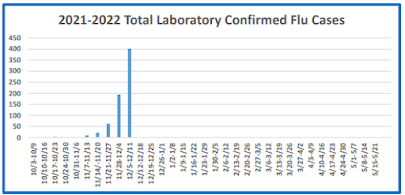
The latest weekly report from the state Department for Public Health shows that in the week ended Dec. 11, Kentucky counted 402 new flu cases, up from 195 the previous week prior, an increase of 106%. The state has recorded 695 cases this season. No flu-related deaths have been reported this year.

Fewer adults in Kentucky got a flu vaccine last season, but the state also saw a big drop in cases. During the same reporting week last year, Kentucky had only seven confirmed cases of the flu, and a total of 125 for the season. 

The drop was likely due to the strict public-health measures taken against Covid-19 at that time, such as masks and social distancing. 

According to the Centers for Disease Control and Prevention, the number of adults getting a flu vaccine in Kentucky dropped to 44.9% in the 2020-21 flu season, compared to 48.4% in the 2019-20 flu season.

Kentucky Department for Public Health graphic, click on it for a larger version.

A county-by-county report shows that Jefferson County, which has more than 750,000 people, had the highest number of cases, reporting  233 in the week ending Dec. 11. Other counties with the highest number of cases that week were Pike, 26; Warren, 22; Oldham, 20; Allen, 18; and Fayette, 18. 

Health Commissioner Steven Stack has repeatedly encouraged Kentuckians to get both a Covid-19 vaccination or booster and a flu vaccine.

 "With Covid-19 cases escalating and the added threat of circulating flu viruses, it is imperative that every Kentuckian take the essential steps to protect themselves, their loved ones and their communities," Stack said in a news release.

Hudspeth said it is safe to get both the Covid-19 vaccination and the flu shot at the same time, and it's important to get both, since having Covid-19 and the flu at the same time can increase a person's risk of  severe complications. 

“If you are vaccinated, you are less likely to get the flu and spread the flu to those at greatest risk for becoming dangerously ill, including young children, pregnant women, people 65 and older and those with underlying medical conditions," said Stack.  

At a Dec. 18 news conference, Stack said this year's flu vaccine should be quite effective because it contains the H3N2 strain, which is the one that is circulating. "So this year's vaccine should be very helpful," he said. 

Flu shots are recommended for everyone six months and older and are strongly encouraged for people who may be at higher risk for complications or negative consequences. 

Kentucky has a long way to go to get all of its adults vaccinated against the flu. 

A Foundation for a Healthy Kentucky poll, taken Aug. 4-Sept. 4, found that almost two-thirds of Kentucky adults said they are very or somewhat likely to get the vaccine by the end of the year; 28.4% said they were very unlikely to get the flu vaccine and 5.9% said they were somewhat unlikely to get it.
Kentucky's influenza level is considered to be regional, a classification that is applied when increases in flu cases have been confirmed in at least two, but fewer than half, of the state's 16 regions.

Masks can prevent Covid-19, and there ways to make them more effective; claim that they trap excess carbon dioxide is false

Photo by Kemal Yildirim, Getty Images
Wearing a face mask can help prevent the spread of Covid-19, ad certain mask combinations and modifications can increase a mask's effectiveness.

A study led by researchers from the National Institute for Occupational Safety and Health looked at how efficiently different mask types, combinations, and modifications blocked respiratory aerosols like those that carry the coronavirus. The study involved humans and simulator mannequins in various experiments to simulate coughs and exhalations to see how well aerosols were blocked.

The study found that layering a three-ply cloth mask over a medical mask (double masking) or securing a medical mask with an elastic brace provided the best protection. Using earloop toggles or an earloop strap, or knotting and tucking the mask, also increased performance as compared to medical masks without modification. Two other modifications, crossing the earloops or placing a bracket under the mask, did not increase performance. The study is published in the peer-reviewed American Journal of Infection Control.

“Since the start of the Covid-19 pandemic, there has been considerable confusion about the most effective use of face masks, especially among the general public, to reduce the spread of infection,” said Ann Marie Pettis, president of the Association for Professionals in Infection Control and Epidemiology. “The NIOSH study findings are important and timely because they identify specific, practical combinations of face masks and mask modifications that may improve mask seal and thereby measurably reduce the expulsion of infectious aerosols into the environment.”

A claim that masks trap dangerous levels of carbon dioxide is false, medical experts say. "Wearing a mask does not raise the carbon dioxide (CO2) level in the air you breathe," says the Centers for Disease Control and Prevention. "A cloth mask does not provide an airtight fit across the face. The CO2 completely escapes into the air through the cloth mask when you breathe out or talk. CO2 molecules are small enough to easily pass through any cloth mask material. In contrast, the respiratory droplets that carry the virus that causes Covid-19 are much larger than CO2, so they cannot pass as easily through a properly designed and properly worn cloth mask."

Nations with mask policies had fewer Covid-19 deaths early on

Photo by David J. Phillip, Associated Press
Mask policies in various countries have been shown to reduce deaths from Covid-19, regardless of the role of vaccines.

A study published in the American Journal of Preventive Medicine looked at 44 countries in Asia and Europe to see how mask policies enacted at the beginning of the pandemic affected Covid-19 deaths. Countries included Greece, Germany, Korea, Italy, Sweden, Hong Kong and the United Kingdom, among others. Mask policies in the U.S. and Canada were not included in the study because they are made by states or provinces.

The study analyzed Covid-19 deaths from February 2020, when the first Covid-19 deaths were confirmed, and May 2020, and the point when some countries began lifting restrictions. It found that nations without mask policies had 288 deaths per million residents; those with policies had 48 per million.

Overall, deaths were “significantly lower” in countries that enforced mask policies, suggesting face coverings offered an additional layer of protection that “could prevent unnecessary Covid-19 deaths,” researchers said in a news release.

The findings also emphasize the important role face masks play in regions that still don’t have access to Covid-19 vaccines, researchers say, especially as more dangerous variants continue to emerge and spread. “Across variants, vaccines may reduce mortality but not necessarily morbidity, and face masks continue to protect against both,” said lead study investigator Dr. Sahar Motallebi of Lund University in Sweden. “So, we don’t have to choose between these two good policies of vaccination and face masks or substitute one for the other when we can and must do both in parallel.”

Saturday, December 18, 2021

Omicron variant, one of most contagious ever, seen in 4 counties; Beshear urges vaccines, boosters, masking, caution for holidays

              Reuters graphic
Updated Dec. 20, 2021: The number of deaths from the tornadoes in Western Kentucky has been updated to reflect a total of 76 deaths.   

By Melissa Patrick
Kentucky Health News

The highly contagious Omicron Covid-19 variant has been identified in Kenton, Campbell, Fayette and Jefferson counties, prompting Gov. Andy Beshear to plead that Kentuckians get a Covid-19 vaccine or booster shot, and to urge schools and businesses to require rigorous masking. 

“This thing is going to spread so fast that any school that is not doing mandatory masking, any business that is not having their folks wear masks could see entire schools, entire shifts get infected very, very quickly,” Beshear said at a Saturday news conference. “Folks, I’m telling you, If we don’t make the decision to put back on that mask in these situations, it’s going disrupt everything we’ve worked so hard to get back up and going.”

In September, the Republican-run legislature stripped the Democratic governor of much of his ability to manage the pandemic, including his ability to impose mask mandates and other public-health measures.

Asked what that will mean for Kentuckians in the coming months, since experts are saying it will require more than just vaccine or booster shots to slow its spread, Beshear said all he can do is level with the people and hope they will make good decisions. 

"This is a moment where stripping authority from a governor may come back to bite us, but what I can do is give people the facts, just the straight facts about how quickly that this is going to spread," he said. "But listen, just getting Covid is a significant disruption to your life and to our economy. So we just need people to make the smart decision -- for them, for their businesses, for their schools and for the people around them."

He added, "If you've got one of the most contagious viruses that we've known, that's what we think this will be, in modern history, if you're not making the right decisions, you're absolutely infecting people around you. Listen, we've seen an outpouring of love and support this last week; let's just continue to be good people and and to protect one another."

Beshear was referring to the response to last weekend’s tornadoes that devastated parts of Western Kentucky and killed 78 76 people. 

Health Commissioner Steven Stack called Omicron "one of the most transmissible or contagious infections we've had in the last century," explaining that it may be that every one person with Omicron could infect up to 18 or 20 other people. 

For perspective, he said every one person who gets the flu may infect one or two other people and every person with the Delta variant may infect between one and five people. 

Stack added that with the rapid spread of the Omicron variant, it could become the predominant strain of Covid-19 in Kentucky in a month. Right now, almost all of the cases in Kentucky are the Delta variant.

"So it's more important than ever that we take the benefit of the things we have learned over the last nearly two years so that we can take relatively focal steps to minimize it spread, to minimize the harm it causes and still be able to go on on with our lives," he said.

That includes getting the Covid-19 vaccine, getting a booster, wearing a mask when indoors or in crowded situations, social distancing, practicing good hand hygiene, staying home when you are sick, and doing a rapid Covid-19 test before attending a social gathering if possible. 

Further, Stack advised that if you will be in an indoor space for an extended period, to upgrade your mask to an N-95 because the Omicron variant is so much more contagious. 

The good news is that so far Omicron appears to cause milder symptoms and has not led to a spike in hospitalizations in South Africa and the United Kingdom, where there has been significant spread, said Stack. 

Stack said the Pfizer-Bio-NTech and Moderna Covid-19 vaccines are effective against Omicron, but you need to get a booster. And because the Omicron variant is so effective at infecting people, there will be an increase in breakthrough cases. 

"But remember the vaccines, if they keep you from ending up in the hospital and they keep you from dying --they have done their job," Stack said.

He said "widely available data" shows that having a prior Covid-19 infection is unlikely to be sufficient to protect you from re-infection and that this group needs to get vaccinated and boosted too.  

He also noted that the Centers for Disease Control and Prevention has recently changed its guidance and is encouraging people to get the Pfizer or Moderna vaccine, which are created with messenger RNA, instead of the Johnson & Johnson Covid-19 vaccine

So far, 2.7 million Kentuckians have received at least one dose of a vaccine, or 62% of the total population; 2.4 million are fully vaccinated, 54% of the total; and 744,729 have received a booster shot, 17% of the total.

Stack cautioned that Kentucky still has counties where less than one in three people are vaccinated.

 "Folks, that's a recipe for disaster, particularly with something like Omicron because if it sweeps through your community, it'll hit everybody quickly," he said.  "So please, we're just trying to help you and help keep you safe. I hope you'll be open to going and getting vaccinated." 

He also encouraged unvaccinated Kentuckians to not count on monoclonal antibodies to protect them against Covid-19, saying that recent data shows that two of the three available brands of these synthetic antibodies are not effective against Omicron. 

Friday, December 17, 2021

Ky. coronavirus cases trickle down as positive-test rate inches up; Beshear reports state's first case from Omicron variant

Ky. Dept. for Public Health map, adapted by Ky. Health News; for a larger version, click on it.
UPDATE: The first case of the coronavirus from the highly contagious Omicron variant has been found in Kentucky, "as expected," Gov. Andy Beshear reported on Twitter Friday evening. Beshear said he and Health Commissioner Steven Stack would hold a press conference at 1 p.m. Saturday. "Kentucky is at risk for rapid spread of the new variant, with just 54% of the state population fully vaccinated," notes Alex Acquisto of the Lexington Herald-Leader. "Only 17% of residents have received a booster dose of a coronavirus vaccine," and health experts say a booster is needed for full protection against Omicron.

By Melissa Patrick
Kentucky Health News

As the nation faces what experts say will be exponential growth of the Omicron variant over the holidays, Kentucky is seeing a slow decline in cases but a two-day uptick in the share of residents testing positive for the coronavirus and a continued increase in Covid-19 hospitalizations.

The state reported 2,582 new cases Friday, lowering the seven-day average by 28, to 2,135. Of the new cases, 24% were in people 18 and younger. 

The share of Kentuckians testing positive in the past seven days went up for the second day in a row, but stayed in the same range it's been for nine days. Today's rate is 8.94%, up from 8.84% on Thursday.

The seven-day infection rate is 42.17 daily cases per 100,000 residents, down from 43.53 on Thursday. Counties with rates more than double that rate were Robertson, 196.5; Menifee, 116.7; Lewis, 116.2; Wolfe, 115.8; and Hancock, 91.7. Kentucky's infection rate remains 21st among the states, according to The New York Times.

For the first time in a long time, a Kentucky county is in the green zone, for counties with less than one daily case per 100,000 people. Hickman County, with a population of about 4,900, has reported no cases in the last seven days. 

Of the state's 120 counties, 82.5% are in red on the state infection map, representing those with more than 25 daily cases per 100,000 people, considered a high level of transmission.

Hospitals reported 1,255 Covid-19 patients, 19 more than Thursday; with 329 in intensive care (up 14) and 195 of them on mechanical ventilation (up 2). The increase is part of a worrying national trend.

Nine of the state's 10 hospital readiness regions reported at least 80% of their intensive-care capacity in use, with seven above 90%. Northern Kentucky remains at 100%. 

As health officials continue to encourage Kentuckians to get vaccinated and boosted, the Centers for Disease Control and Prevention has changed its guidelines for the one-dose Johnson & Johnson vaccine, which 7% of Kentuckians have received.  

On Dec. 16, the CDC endorsed updated recommendations made by its Advisory Committee on Immunization Practices (ACIP), saying that people shouldn't get the Johnson & Johnson vaccine when they can get Pfizer-BioNTech and Moderna vaccines, created with messenger RNA.

The decision followed an update from the U.S. Food and Drug Administration on the risk of rare but potentially life-threatening blood clots linked to the Johnson & Johnson vaccine.

The CDC news release says, "Given the current state of the pandemic both here and around the world, the ACIP reaffirmed that receiving any vaccine is better than being unvaccinated. Individuals who are unable or unwilling to receive an mRNA vaccine will continue to have access to Johnson & Johnson’s Covid-19 vaccine."

So far, 2.7 million Kentuckians have received at least one dose of a vaccine, or 62% of the total population; 2.4 million are fully vaccinated, 54% of the total; and 744,729 have received a booster shot, 17% of the total.

The state reported 35 more Covid-19 deaths, bringing its pandemic death toll to 11,754.

Campaign aims to get more kids 5 to 11 immunized for Covid-19

By Melissa Patrick
Kentucky Health News

A new public-service campaign aimed at getting more of Kentucky's young children vaccinated against the coronavirus places a strong focus on getting parents to talk to their doctor or pediatrician about it. 

"Parents trust their own pediatrician and their own family physician," Ben Chandler, president and CEO of the Foundation for a Healthy Kentucky, said at an online news conference. "They want a personalized recommendation about whether their child ought to get the Covid-19 vaccine or not." 

One of the biggest generators of vaccine hesitancy has been misinformation, so "Being able to get the facts from a trusted adviser, and that trusted adviser, being the pediatrician is really what we're striving to do," said Leon Lamoreaux, president of Anthem Blue Cross and Blue Shield Medicaid in Kentucky, which launched the campaign with the foundation.

The campaign, called High Five for Health, was designed to address concerns voiced by parents in focus groups, where a topic is discussed to get ideas for messages about it. The campaign provides answers to frequently asked questions and offers five steps for parents to consider when getting their child vaccinated.

The five-step action plan calls on parents to talk with their pediatrician or family doctor, to talk with their child, to schedule the vaccine appointment; to prepare a vaccine-ready kit that includes fluids and a non-aspirin pain reliever; and finally, to get your child vaccinated. 

"This is the winter break, and this is a great time to get the jab while maybe some of the required activities are not happening," Chandler said.

He said people in the focus groups pointed out that parents need to be able to fit a child's vaccine appointment into their busy schedules, and at a time that allows for dealing with possible side effects, including pain, redness and swelling at the injection site or tiredness, headache, muscle pain, chills fever or nausea. 

Parents also wanted the process to be easy, and wanted assurance that a record of the vaccine would be included in their child's medical records, especially if they got the vaccine from someone other than their primary care provider. Chandler said all vaccination records are sent to the state immunization registry, "so no matter where you get the Covid-19 vaccine, your doctor will be able to access your child's records." 

At this time, the Pfizer-BioNTech Covid-19 is the only vaccine approved for children 5 to 11. It is one-third of the adult dose, comes in an orange-capped vial and is delivered with a smaller needle, designed specifically for children. The vaccine requires two doses, three weeks apart. To find a location near you that offers this vaccine, go to vaccine.ky.gov. 

So far, only 14% of Kentucky's children from 5 to 11 have received at lease one dose of a vaccine and just 7% have been fully vaccinated. 

State health department data shows that 21% percent of all Covid-19 cases in Kentucky have been in people 18 and younger, and 7.2% have been in children younger than 9. Ten Kentuckians under 19 have died from Covid-19; two of them were younger than 9. 

Lamoreaux said Anthem is offering incentives to its providers who encourage the vaccine and to patients who get the Covid-19 vaccine. So are "multiple"  all of the managed care organizations, according to the Kentucky Association of Health Plans. 

"Vaccines are proven safe, and a highly effective way to protect our kids and the entirety of the commonwealth," Lamoreaux said. "We believe that this public service campaign will help to reinforce that critical message to parents and families."

Chandler acknowledged that some parents aren't rushing to get their children vaccinated because children don't get sick as often as adults, and if they do, most have mild or no symptoms. However, he said it's important to get them vaccinated because they can spread  the virus to those more vulnerable to severe illness and death. 

"It's important to talk with parents about creating a wall of immunity around people that you love, around your family, your friends, your community -- basically around those who for one reason or another cannot get vaccinated or who are especially vulnerable," Chandler said. 

Some vaccine-reluctant people say they fear side effects from vaccination, but Chandler said parents need to know that the possible effects of the virus are much worse than any possible side effect from the vaccine, especially if a child has asthma, diabetes or other vulnerabilities. 

The campaign's public-service announcement does not mention childhood obesity as a vulnerability, even though obese children have a greater chance of more severe Covid-19 disease, hospitalization and even death. Kentucky leads the nation in childhood obesity.

The High Five for Health campaign is a multi-faceted education and awareness effort that includes animated videos, social media graphics, message points and materials for use in doctors' office, youth organizations and various other organizations. Download the toolkit here.

Thursday, December 16, 2021

Virus cases still lag, but Beshear says a surge is coming, and its size will depend on how many people get booster shots

Times of India illustration
By Al Cross
Kentucky Health News

As the fast-spreading Omicron variant of the coronavirus takes hold in some areas of the country, Gov. Andy Beshear says he expects it to cause a surge in cases in Kentucky over the holidays, and urged more vaccination to fight it.

Beshear said Thursday that the big factor in the coming surge “is how many people get their booster” shot of a Covid-19 vaccine. He also urged initial vaccinations, saying any natural immunity from having Covid-19 may not protect as well against the Omicron variant, which is still being researched.

With a booster shot, “You’re pretty well protected. You’ll free up that hospital capacity, if it comes in a crunch, that others will need,” he said. “So please, for the holiday season, if you haven’t gotten vaccinated, go get vaccinated. Even if it’s your first shot, go ahead and get it; it’ll help. If you've been fully vaccinated and it's time for your booster, go get it; don’t wait until after the holidays; go get it as quickly as you can.”

Beshear also asked Kentuckians to think about how they hold holiday gatherings, keeping in mind the vaccination status of the attendees, using masks and perhaps having smaller gatherings than planned.

“Try to protect one another,” he said, relating the pandemic to the tornado disaster in the western half of the state. “We’ve seen horrific loss of life . . . I see the outpouring of love; take care of each other.”

Beshear said he had not been notified that the variant is in Kentucky, but “It’s unquestionably here” and is spreading faster than previous variants. Researchers still don’t know how strong it is, but Dr. Anthony Fauci, director of the National Institute of Allergy and Infectious Diseases, said current vaccines will work on it. Fauci said he expects the variant to dominate cases in the U.S. by mid-January.

In response to a question at a press conference that focused on the disaster, Beshear said he is worried about spread of the virus as a result of it.

“That's one of reasons we’re trying to get people out of a shelter and into a state park,” he said. “We can create a little more distance.” After reporting that hundreds of victims are at park lodges, a reporter told him concern had been expressed about undocumented immigrants being housed at state facilities. Beshear said, “Anybody who lost their home, we want to have a place to stay.”

Daily report: New coronavirus cases continued on a slowly declining plateau Thursday, but the percentage of people testing positive for the virus in the last seven days went up 0.07 points, to 8.84%.

The state reported 2,507 new cases, lowering the seven-day rolling average by 32, to 2,163. The average has fallen for the last nine days, by 8.7% over that time. Of the new cases, 28% were in people 18 and younger.

The seven-day infection rate is 43.53 daily cases per 100,000 residents. Counties with rates more than double the statewide rate were Robertson, 176.2; Menifee, 151.9; Wolfe, 125.8; Lewis, 106.5; Union, 98.3; Hancock, 93.4; and Trimble, 92.8.

Kentucky's infection rate remains 21st among the states, according to The New York Times. The paper says that among the 3,100-plus counties in the nation, Lewis County has the 27th highest rate of new cases, with a 129% increase in the last 14 days. These figures, from the Centers for Disease Control and Prevention, differ from state figures due to methodological differences; for example, the state says it removes duplicate test results.

Kentucky hospitals reported 13 fewer Covid-19 cases and 12 fewer Covid patients in intensive care than Wednesday, but 14 more Covid patients were on mechanical ventilation; that number, 193, was the most since Oct. 20.

Intensive-care units have more patients in the winter, and they continue to fill up. In eight of the state's hospital regions, more than 90 percent of ICU beds were occupied, and Northern Kentucky remained at 100%.

The state reported 26 more Covid-19 deaths, raising the death toll to 11,719. Over the last seven days, 34.3 deaths per day have been reported; the 14-day average is 49.4 per day.

One good day: Beshear and others have expressed concern about the mental-health effects of the tornado disaster, but he said they got a boost Wednesday when President Biden visited two devastated towns.

Asked what surprises he had during the tour, other than Biden's announcement that the federal government would cover all cleanup costs for the first 30 days of recovery, Beshear said:

“There were really tough moments yesterday. I had not been able to get that far back into Dawson Springs, and it was even worse than I could tell, and it was painful, but to also the number of people who would say that they were blessed to be alive was pretty special . . . 

“Remember, eight blocks in any direction, nothing standing, everybody who is sporting through the rubble knows each other. I’ve said before, the trauma kind of seeps into your skin, but I will say that having the president there, and especially in Mayfield, created an energy, and you know what, I was just happy for one day – because it had been, what, five or six days? – for just one day since this happened, that there seemed to be this really positive energy, that the president of the United States was there.

“I’m not sure I expected to feel that, and you could see it on people’s faces . . . Whether or not you voted for him or you voted for me, we’re both trying to do our very best for you.”

Wednesday, December 15, 2021

New coronavirus cases in Kentucky continue slow decline, but hospitals' Covid-19 numbers are still going up, and ICUs are filling

Ky. Cabinet for Health and Family Services table, adapted by Ky. Health News; click on it to enlarge.
By Melissa Patrick
Kentucky Health News

For the eighth consecutive day, Kentucky saw a slight decline in coronavirus cases. However, hospital numbers are up, and intensive-care units are filling.    

Kentucky reported 2,913 more coronavirus cases Wednesday, lowering the seven-day average by 17, to 2,195. Of those, 26 percent are in people younger than 18. 

The share of Kentuckians testing positive for the virus in the past seven days is 8.77%, virtually the same it has been since Monday. 

Hospitals reported 1,249 Covid-19 patients, an increase of 33 from Tuesday; 327 of them in intensive care (up 11); and 178 of them on mechanical ventilation (up three). 

Nine of the state's 10 hospital readiness regions are using at least 80% of their intensive care unit capacity, with eight above 90%. Northern Kentucky remains at 100% capacity, according to the state's daily report.

Kentucky's daily infection rate over the last seven days is 43.83 cases per 100,000 residents, virtually the same as Tuesday. Counties with rates more than double that rate were Robertson, 196.5; Menifee, 156.3; Wolfe, 123.8; Lewis, 107.6 and Trimble, 89.4. The New York Times ranks Kentucky's infection rate 21st among states. 

The state reported 17 more Covid-19 deaths, bringing the pandemic death toll to 11,693. Nationwide, more than 800,000 Americans died of Covid-19, the highest recorded toll of any nation in the global pandemic, reports the BBC: "The last 100,000 deaths came in just the past 11 weeks, a quicker pace than any at other point aside from last winter's surge." 

Tuesday, December 14, 2021

New coronavirus cases in Ky. down 6.6% in the last seven days

Ky. Dept. for Public Health map, adapted by Ky. Health News; to enlarge, click on it.

By Melissa Patrick

Kentucky Health News

Kentucky has seen a slight daily decline in coronavirus cases for each of the past seven days, putting the state on a short but declining plateau.

The state reported 2,559 new coronavirus cases Tuesday, lowering the seven-day rolling average by 14, to 2,212. A week ago, the seven-day average was 2,369, so it has fallen 6.6 percent. The nation has seen a similar trend.

Kentuckians 18 and younger accounted for 26% of Tuesday's new cases.

The share of Kentuckians testing positive for the virus in the past seven days is 8.79%, about the same as Monday. More than 100,000 tests were completed to gain that average. 

Kentucky hospitals reported 1,216 Covid-19 patients, 37 fewer than Monday; 316 in intensive care units (up one); and 175 in need of mechanical ventilation (down six).

Nine of the state's 10 hospital-readiness regions were using at least 80% of their intensive-care-unit capacity, with six over 90%. Northern Kentucky reported the highest ICU usage, at 100%. 

Kentucky's daily infection rate over the last seven days is 43.49 cases per 100,000 residents. Counties with rates more than double that rate were Menifee, 162.9; Robertson, 149.1; Wolfe, 117.8; Lewis, 96.9; and McLean, 88.4. The New York Times ranks Kentucky's infection rate 21st among the states. 

Statewide, 89% of counties are in the red zone, for more than 25 cases per 100,000, which is considered a high level of transmission.

If you want a booster shot for added protection against the virus between Christmas and New Year's Day, experts say it's important that you get it as soon as possible, since it takes about two weeks after receiving a booster to get the added protection. 

So far, 2.7 million Kentuckians, or 62% of the total population, have received at least one dose of a vaccine; 2.4 million are fully vaccinated, or 54% of the total; and 725,415 have gotten a booster, 16% of the total. 

The state reported 14 more Covid-19 deaths, bringing the pandemic death toll to 11,676.

Monday, December 13, 2021

Tornadoes leave health issues, Beshear says; state's 14-day average of Covid-19 deaths is 53.5 per day, the highest yet

Dept. for Public Health graph, adapted by Ky. Health News, shows case numbers flat; click to enlarge.
By Melissa Patrick
Kentucky Health News

The tornadoes that ripped through Western Kentucky Friday night will leave environmental, physical and mental health issues that will need to be addressed, Gov. Andy Beshear said Monday.

"There's gonna be a lot of health issues that come out of this," he said at a news conference. "There is everything that is inside some of these older buildings that people were exposed to. And then there's, the trauma is going to impact people who live there, their family members, the first responders, those that have been down there trying to help. It is very, very, very real. 

"And so we're gonna need to be vulnerable enough to admit that this has really impacted our mental health as people even and then at the appropriate time, to get the help, to set an example. And I know people out there want to help all of us process everything that we are feeling."

Beshear said at least 74 Kentuckians have been confirmed dead and 109 remain unaccounted for in the tornado outbreak. He said many injuries have also been caused by the storms, but the state has not collected data on them. 

Click here for a more detailed storm response report, including details about the Western Kentucky Christmas Toy Drive that was announced Monday.

Beshear said the state Department for Public Health, including Commissioner Steven Stack, will visit local health departments to assess their needs.

"We are ensuring that the vaccination program is not interrupted or that others can come in and help," Beshear said. "We want to make sure that as many of the services that can continue, continue, especially at the at the most difficult times."

Covid-19 report: New coronavirus cases have declined slightly in the last six days, but state listings of deaths from Covid-19 recently reached a record level.

The state reported 120 more Covid-19 deaths since Friday, 28 of them on Monday. That brings the  pandemic death toll to 11,662. Over the last 14 days, the state has reported 53.5 deaths per day, the highest average yet. Deaths have declined the last four days, so the average is likely to fall. Death reports can be delayed weeks or even months by the state's confirmation process.

Beshear said one of the deaths reported Saturday was 38 and one of Sunday's reported deaths was 27. 

Kentucky reported 4,386 new coronavirus cases since Saturday, 1,089 of them on Monday. Beshear noted that was less than the previous Monday, which drove the seven-day rolling average down for the sixth straight day, to 2.236. He said the disaster may have limited testing and reporting.

After several weeks of increase, except for Thanksgiving week due to less testing and reporting, Kentucky's latest weekly coronavirus case number is 22 fewer than the week before, at 15,875 cases. 

"Certainly we are grateful that this week had fewer cases than the week before," Beshear said. "I think it's still too early to determine if that might mean cases are stabilizing or plateauing." He noted that Covid-19 hospitalizations, intensive-care cases and ventilator use are "all going up."

The positive-test rate for the Monday-to-Sunday reporting week also went down, to 8.9%, after going up for five consecutive weeks. As of Monday, the share of Kentuckians testing positive for the virus in the last seven days is 8.78%. Beshear said this rate is "still way too high." 

State Dept. for Public Health graph, adapted by Ky. Health News; to enlarge, click on it.

All the hospital numbers remain on the rise. On Monday, Kentucky hospitals reported 1,253 Covid-19 patients, 61 more than Friday; 315 in intensive care, four fewer than Friday; and 181 on mechanical ventilation, down 10.

"[We] do not have hospitals sounding the alarm yet, but everybody is watching this very, very closely," said Beshear.  

Eight of the state's 10 hospital-readiness regions are using more than 80% of their intensive-care beds, with four above 90%. Northern Kentucky is fullest, at 97.62%. 

The state's seven-day infection rate is 43.71 daily cases per 100,000 residents, down from 45.76 on Friday. Counties with rates more than double that rate were Menifee, 162.9; Wolfe, 107.8; Lewis, 100.1; McLean, 93.1; and Union, 91.4. The New York Times ranks Kentucky's infection rate 19th among the states. 

All but 14 of the state's 120 counties are in red on the state infection map, for counties with more than 25 cases per 100,000 residents, considered a high level of transmission. Twelve counties are in orange, for counties with more than 10 to 25 cases, considered a substantial level of transmission; two are in yellow, for counties with more one to 10 cases, considered moderate transmission. more and more Kentuckians are getting vaccinated, said Beshear. He said over the weekend, 14,880 Kentuckians got a first shot; 16,813 became fully vaccinated; and 46,373 got a booster. So far, 2,731,731 Kentuckians have received at least one dose. 

Beshear encouraged parents and guardians of children between the ages of 5 and 15 to get their children vaccinated, noting that his 11-year-old daughter is now fully vaccinated. As of Monday, 14% of 5- to 11- year-olds and 45% of 12-to-15-year-olds have gotten at least one shot. 

"It does appear that many parents are waiting on the 5-to-11-year-olds," Beshear said. "It is safe. It provides protection for your child. It is a smaller dose They even packaging differently. . . . I would not have taken my own children to get vaccinated if I didn't not only believe [this]."

Tuesday marks the anniversary of the first Covid-19 vaccination given in Kentucky, Beshear noted.

Sunday, December 12, 2021

Evangelical Christians should balance their faith in God with faith in science, evangelical pastor writes

By Paul D. Prather

I’ve been an evangelical Christian all my life, with the exception of my exuberantly misspent teenage years and early 20s.

Raised a Southern Baptist, the son of a Baptist preacher and a Sunday school teacher who hauled me to church three times a week, I later converted as a young adult, along with my parents and sister, to the even more enthusiastic charismatic/Pentecostal movement. I’ve been an ordained minister in that tradition 40 years.

I buy into all—OK, not all, but nearly all—of evangelicalism’s core tenets. I believe I’m saved by grace through faith in Jesus. I believe the Bible is the inspired word of God. I believe in sharing my faith (something I’m doing at this minute). Heck, as I demonstrated in my 1996 book “Modern-Day Miracles,” I even believe in divine healing, prophecy and, yes, speaking in tongues.

Paul D. Prather
Despite all that, from childhood I’ve felt out of sync with my own people. I believe in God and the Bible and miracles, but I also trust science and secular experts. To me, those things don’t necessarily cancel each other.

I felt my old discomfort flare up again when I read about the recent death of Marcus Lamb, 64, a big-time televangelist killed by Covid-19. Lamb led his global Christian TV network, Daystar, “in spreading inaccurate information about coronavirus vaccines and instead promoting treatments that are not proven remedies,” wrote religion reporter Michelle Boorstein.

Lamb’s milieu was “a deep base of politics, conspiratorial thinking and a skepticism of anything that appears secular. And that makes frank discussion of Daystar’s activism against vaccines, even in the face of death, unlikely.”

The pandemic has brought evangelicals’ anti-science, conspiratorial thinking into fresh relief, but there’s nothing new about it. It dates back at least to the 1925 Scopes monkey trial over the teaching of evolution in public schools. Historians of religion mark this as a turning point. The Scopes debacle left a rancid taste in the mouths of evangelicals and their ultra-conservative cousins, fundamentalists, that has never abated.

Those earlier evangelicals and fundamentalists felt the national press and other wise-acre elites had intentionally, almost sadistically, abused them during the Scopes trial.

The arrest of John Scopes for teaching evolution was planned by civic boosters of Dayton, Tenn., in a misguided but good-natured attempt to promote the town, historian Garry Wills has written. Scopes volunteered to be the defendant, even though it wasn’t clear to anybody, including him, that he’d actually taught evolution.

In the evangelical view, secularists seized on this non-event as an opportunity to lampoon and discredit low-church Christians and wildly misrepresent their beliefs. (I’ve read a bit of the Scopes coverage, including that of influential newspaper columnist H. L. Mencken. It truly was reprehensible.)

Scalded by the experience, evangelicals withdrew into what commonly has been called the “evangelical ghetto,” where they nursed their wounds and preached to each other in an echo chamber. Some devolved into conspiracy theories. A hostility toward secular authorities and many things scientific has festered for a century. Thanks a lot, Mencken.

Some came to suspect the government was secretly controlled by communist atheists. Some obsessed over progressive denominations that didn’t share their theology. Some saw an ongoing media campaign against them. Others decided barcodes foretold the Antichrist’s rise. Everything rose from a nefarious plot. Nothing was what it appeared on the surface. This sort of thinking feeds on itself.

Then came Covid-19. Evangelicals have proved the most hostile of skeptics toward the disease, vaccines and public health efforts. It’s odd, kind of. Evangelicals historically have embraced technologies and products created by science. They were pioneers in their use of radio, TV, cable, communication satellites and the internet. When they have headaches, they take ibuprofen.

But now, when science might save their lives, a disproportionate number dismiss it as a deception from the devil or a plot by unbelievers, or both.

This is simultaneously tragic and infuriating. Even after all these years, it still won’t compute in my head.

Of course, I’m not the only evangelical who feels that way, thank God. There’s a terrific website called BioLogos, founded by evangelical and renowned geneticist Francis Collins, who led the Human Genome Project and directs the National Institutes of Health. BioLogos explores the complimentary roles played by science and faith.

BioLogos’ president, Deborah Haarsma, an astrophysicist with a doctorate from MIT, declares in one website article that Christ gives us hope, but science equips us to act. Elsewhere, she says God both inspired the Bible and created the universe. The natural laws by which the universe works—the subjects of science—reflect God’s mind.

The folks at BioLogos don’t see science as a threat, then, but as a blessing, even when the truths it reveals sometimes appear to contradict their theology. I agree. I believe in the Lord and simultaneously believe in vaccines and the methods scientists employ to develop them. Just because science did it doesn’t mean God wasn’t behind it. Science can be one way the Lord relieves us from suffering.

Sometimes science is the miracle.

Paul Prather pastors Bethesda Church near Mount Sterling. His email is pratpd@yahoo.com. This was first published in the Lexington Herald-Leader.