Saturday, February 19, 2022

Bill aims to ease Kentucky's nursing shortage by relaxing licensing and instruction requirements, enrollment caps

By Melissa Patrick
Kentucky Health News

A state Senate committee plans to hear a bill Wednesday to address the nursing shortage in Kentucky, which has been exacerbated by the pandemic. 

Sen. Robby Mills
Senate Bill 10, sponsored by Sen. Robby Mills, R-Henderson, offers four key measures to address the shortage: licensing reciprocity between other states and countries, higher enrollment caps, looser nursing-instructor qualifications and restructuring the state Board of Nursing. If passed, it would become effective immediately. 

"I think it's going to do away with some of the kind of obstacles that are there to keep folks from getting into the nursing profession and getting into work quicker and faster as they're needed," said Mills.

The bill is scheduled to be heard at 10 a.m. ET Feb. 23 by the Senate Health and Welfare Committee.

Mills and Senate President Robert Stivers announced the bill Feb. 15, calling it priority legislation. They were joined by Sens. Ralph Alvarado of Winchester and Donald Douglas of Nicholasville, both physicians and Republicans. 

"I think we've come up with a good product, working with various institutions and entities and discussing with the public how we increase the nurses in this state to help provide medical services," Stivers said.

Asked what ensures that the state's nursing programs will maintain their quality as they are allowed to increase their enrollment, Stivers said that will be accomplished by requiring schools to only be able to increase enrollment if they maintain at least an 80% average rate of students who pass their licensure exam.

The bill would expand the qualifications for who can be an nursing instructor, allowing a nurse with a bachelor's degree to teach in a bachelor's-degree program as long as they are pursuing their master's degree, and allow licensed nurses from other countries to practice in Kentucky, with some testing requirements.

It also would allow the nursing board to immediately issue temporary work permits and licenses to nurses who are licensed in other states outside the state's existing compact with 23 other states, as long as they are in good standing. Similar rules are included for licensed practical nurses.

The bill would restructure the board to require two members from each of the state's six congressional districts, with no more than six of the members being nurse educators, each of those appointed from a different district. All other nurse members of the board are required to be practicing nurses. It also limits members to three four-year terms. 

Mills said they had talked to "multiple folks in the health-care field" in drafting the bill. He added that it is a "live" piece of legislation will likely require some "give and take" going forward, noting that the nursing board had already made some suggestions for change. The nursing shortage was also discussed at length during an Interim Joint Committee on Health, Welfare and Family Services. 

The Kentucky Nursing Association CEO Delanor Manson told Kentucky Health News, "The KNA was not contacted prior to the filing of SB10."

The KNA projects that the state will need more than 16,000 additional nurses by 2024, to replace those who will retire or leave the profession, as many have in the pandemic. A CBS News report Friday night, focusing on St. Claire Regional Medical Center in Morehead, said 40% of the hospital's nurses have quit during the pandemic.

Gov. Andy Beshear declared an emergency in mid-December to allow the state to take special measures to educate and license more nurses. 

His executive order requires the board to approve requests for enrollment increases if a school has sufficient resources to do so; to report vacant student seats to the board each month to post online; requires nursing schools to send the board a list of needed faculty; increases the speed in which a school could open new campuses; and improves reciprocity between states. Beshear's budget proposal also included scholarship and loan-forgiveness money to attract and retain nurses. 

The governor has also formed a "Team Kentucky Nursing Advisory Committee" that meets virtually to discuss the challenges contributing to the nursing shortage in Kentucky and potential solutions. Its next meeting is set for 4 p.m. ET Feb. 21.

Friday, February 18, 2022

Bill would allow a year of Medicaid for new mothers, almost 1/2 of whom don't get routine care in Ky., where death rate is highest

By Melissa Patrick
Kentucky Health News

A bill that would extend Medicaid coverage to new mothers up to 12 months after giving birth passed unanimously out of the House Friday and now heads for the Senate for consideration. 

Rep. McKenzie Cantrell
House Bill 174, sponsored by Rep. McKenzie Cantrell, D-Louisville, would extend Medicaid eligibility for persons who have given birth for up to 12 months postpartum. It also requires the Cabinet for Health and Family Services to seek a Medicaid waiver to achieve this additional coverage if necessary. 

Cantrell told the House that the small addition that the bill would make to state law "is a seven-word change that can have a huge impact on women and families in our commonwealth." 

Rep. Kim Moser, R-Taylor Mill, co-sponsor of the bill, told the House that the United States is the only industrialized nation that has a consistently rising maternal mortality rate, and Kentucky's rate is the highest. 

"Kentucky has rates of maternal death that really rival Third World countries," Moser said. "We have 37.7 maternal deaths per 100,000 live births, which is the highest in the nation." 

Rep. Lisa Willner, D-Louisville, added that nationwide, 60% of pregnancy-related deaths are preventable, but in Kentucky, 80% are. Willner is chair of the House Democratic Women's Caucus, which created the Kentucky Maternal and Infant Health Project that includes a slate of bills and resolutions to improve maternal health outcomes. 

"This is one step toward preventing those complications from pregnancy," she said, "and there are many more steps we can take."

In an e-mail encouraging Kentuckians to sign a letter of support for the bill, Kentucky Voices for Health explains that the expanded coverage is possible through the American Rescue Plan Act, the pandemic relief bill Congress passed a year ago. It allows postpartum care to go from 60 days to a full year following the birth of a child for mothers with incomes up to or slightly higher than 138% of the federal poverty level. That is the limit for Medicaid coverage. 

KVH said, "This is important because about one in three pregnancy-related deaths occur one week to one year after delivery. Of those deaths, three in five are preventable and the ratios of pregnancy related deaths among people of color are up to five times higher than white birthing people."

Kentucky Youth Advocates Executive Director Terry Brooks said, "Despite the increased risk of postpartum death and illness, nearly half of women do not receive routine care after birth, regardless of whether or not they experienced complications during pregnancy. HB 174 is good news for the health and well-being of new moms and their babies."

The bill also has the support of the Kentucky Association of Health Plans, the insurance companies doing business in the state, including Medicaid managed-care companies.

“Postpartum depression affects a significant portion of new mothers, and when left untreated is one of the leading causes of pregnancy-related death. Kentucky’s Medicaid managed-care organizations are well-positioned to ramp up outreach and connect moms to supports services that can change and save lives,” KAHP Executive Director Tom Stephens said in a statement issued after the bill passed out of committee.

Kentucky's new-case rate is tops among the states for the fourth day in a row, even as most pandemic metrics in state decline

New York Times map, adapted by Ky. Health News, illustrates state's No. 1 ranking. Click to enlarge.
Ky. Health News graph, from state data
By Al Cross
Kentucky Health News

Kentucky's coronavirus-infection rate remains first among the states even as all measures of the pandemic, except deaths, continue to decline in the commonwealth.

The state reported 4,388 new virus cases Friday, slightly lowering the seven-day average to 3,765, with an infection rate of 62.55 daily cases per 100,000 residents. That is half what it was two weeks ago.

However, all states but Maine and Idaho had greater declines, so for four days in a row Kentucky has been the No. 1 state in The New York Times' rankings of rates, based on Centers for Disease Control and Prevention data.

CDC and state figures differ due to methodologies, but have most of the same counties in the top 10. Counties with seven-day infection rates more than double the state rate are Lee, 318; Perry, 200; Leslie, 168; Floyd, 143; Breathitt, 139; Estill, 129; and Carter, 126. All are in Eastern Kentucky.

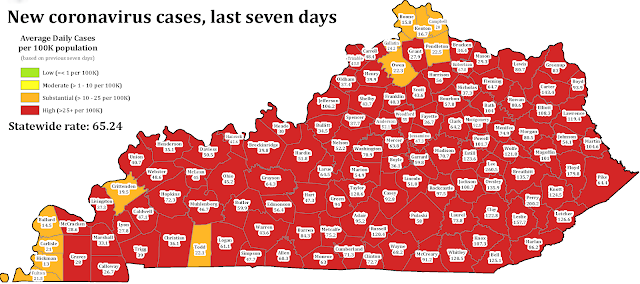
The state's westernmost county, Fulton, became the first to drop into the state map's yellow zone (for a moderate level of transmission) since the recent surge began in December. Its rate is 7.2. Four other counties in the Jackson Purchase (Ballard, Graves, Hickman and Calloway) are in orange, for 10 to 25 daily cases per 100,000, and rates in the other three counties (Carlisle, Marshall and McCracken) rates are around 27. But the rest of the state has only eight orange counties: Lyon, Todd, Owen, Gallatin, Boone, Kenton, Campbell and Pendleton.

The percentage of Kentuckians testing positive for the virus in the last seven days declined again, to 14.34%. Its high was 33.1%, 26 days earlier.

Kentucky hospitals reported 96 fewer patients with Covid-19, a drop of almost 6% in one day. Of the 1,540 Covid patients, 292 were in intensive care (down 10) and 144 were on mechanical ventilation (down four).

Intensive-care units stayed busy. Of the state's 10 hospital regions, only one, the northeast, reported less than 80% of ICU beds in use. Barren River and Northern Kentucky were highest, at 97.6% and 97.4%. Covid-19 patients' share of ICU beds ranged from 8% to 31.5%.

The state attributed 46 more deaths to Covid-19, one of the higher daily figures recently. In the last seven days, the state has averaged almost 38 deaths per day; the 14-day average is almost 36 per day.

Chart by The Washington Post, adapted by Kentucky Health News; click on it to enlarge.

Senate Republicans want to end Covid-19 state of emergency March 7, more than a month earlier than they voted last month

Most of the Republicans in the GOP-controlled state Senate are supporting a resolution that would end the state of emergency that Gov. Andy Beshear declared last March 6 to deal with the Covid-19 pandemic.

The legislation would undo a bill the General Assembly already passed to extend the state of emergency until April 15, with the limitations that the legislature imposed on it in September's special session.

Senate Joint Resolution 150 would end the state of emergency on March 7. It has 17 sponsors.

Sen. Donald Douglas, R-Nicholasville
Its lead sponsor, new Sen. Donald Douglas, a Nicholasville physician, Douglas said that date would give Beshear and legislators time to negotiate it and make changes.

“This is what our people want,” Douglas said in a Senate floor speech Friday. “This is what our constituents need. Dare I say; this is what they demand.”

Douglas said the state of emergency, which allowed Beshear to exercise special powers, including closure and limitation of businesses, "caused great harm."

“Some will say that this emergency certainly saved lives,” he said. “Well, others will say that the changes that were forced by this emergency caused great harm not only to our economy, but also to our workforce, and to our supply chain.”

The Lexington Herald-Leader's Austin Horn reports, "The only senator who spoke up against the joint resolution was Sen. Karen Berg, D-Louisville, who pointed out that Kentucky’s Covid-19 positivity rate is still about 15% and that legislators should be focusing more on getting more people vaccinated than ending the state of emergency." Berg is a physician.

Responding to Senate President Robert Stivers' point that California and other states that have imposed stronger restrictions than Kentucky are relaxing them, Berg said California has a 5% positive-tesr rate and 70% of its population is fully vaccinated, while Kentucky’s corresponding rates are 15% and 56%.

Beshear Communications Director Crystal Staley issued a statement saying Kentucky is still using the state of emergency to activate 300 National Guard members to help overwhelmed hospitals, and noted that the state reported 700 Covid-19 deaths last month.

“The state of emergency helps Kentucky receive federal dollars to fight the pandemic and provide relief,” Staley added, concluding, “Gov. Beshear is focused on beating the pandemic and not playing politics. He hopes others will follow that example.”

Douglass came to the Senate in November through a special election to fill the term of Republican Tom Buford, who had died. He is seeking re-election this year, and has an opponent in the May 17 primary election: Andrew Cooperrider, a Lexington coffee-shop owner who defied some of Beshear's orders and helped lead protests against them.

Physicians in Senate show partisan divide over legislation that would equate most positive antibody tests with Covid-19 vaccine

By Melissa Patrick
Kentucky Health News

A resolution to require Kentucky to recognize most positive Covid-19 antibody tests as equivalent to full vaccination for the disease has passed the Senate and awaits action in the House. 

Sen. Ralph Alvarado
Senate Joint Resolution 80, sponsored by Sen. Ralph Alvarado, R-Winchester, passed by a party-line vote of 28-6-1 on Feb. 15. The "pass" vote was cast by Sen. Robin Webb, D-Grayson. 

The bill says it would require the state to "recognize individuals, including but not limited to state employees, whose serology test results show measurable neutralizing antibodies to Covid-19, quantified above the 20th percentile of the population of immunized individuals, as equivalent to being fully vaccinated against the virus that causes Covid-19." Below the 20th percentile is the lower fifth of test results.

"If someone has below the 20th percentile, that would not be sufficient," Alvarado, a physician, told the Senate. "In fact, it would likely encourage people to go get a booster to try to increase the amount of antibodies they would have present in their body.” 

While presenting the bill, Alvarado noted that measuring antibodies to measure immunity is already done with diseases like measles, mumps and rubella and that his legislative approach is no different. 

Sen. Karen Berg, D-Louisville, also a physician, said current research does not support this approach. She said the newest data from multiple countries shows when you compare a native infection to being vaccinated, "You are 5.7 times more likely to require hospitalization with Omicron."

Alvarado said there are "emerging studies" that show people with coronavirus infections are protected "perhaps equal or even superior at times" to those who have been vaccinated, and that 23 countries in Europe now recognize Covid-19 recovery to be equivalent to being fully vaccinated. 

Berg said, "We do not have the science on this data. It does not yet exist. . . . I want this to be true. It is not yet true. And anybody who votes in favor of this is spitting in the eye of science, and really hurting our commonwealth." 

Gov. Andy Beshear, a Democrat, said Feb. 14 at a news conference that he does not support the resolution because it goes against current science. 

"It's politics and not science," he said. "And the Kentucky Department for Public Health should be able to give the best scientific advice without their advice being legislated. Now they could legislate a different formula for gravity, but that doesn't make it right." 

The Senate passed similar resolution by Alvarado in last September's special legislative session, but the House didn't take it up. 

If the resolution becomes law, it would only be effective through Jan. 31, 2023 to allow for waning immunity, which Alvarado says studies show is between six to 12 months from a natural infection. Berg disagreed, saying that "substantiated data" shows that natural antibodies start waning at 90 days.

So far, 56% of Kentucky's total population has been fully vaccinated and nearly 43% of the eligible population has received a booster shot.

Thursday, February 17, 2022

New cases of coronavirus continue to drop in Kentucky, but state still ranks No. 1 in nation, and deaths from Covid-19 remain high

Ky. Dept. for Public Health map, adapted by Ky. Health News; to enlarge, click on it.
By Melissa Patrick and Al Cross
Kentucky Health News

The leading indicators of the pandemic dropped by big, round numbers Thursday, but the state's weekly rate of new coronavirus cases remained first among the states, and deaths from Covid-19 remained high. 

Kentucky reported 4,867 new virus cases, bringing the seven-day rolling average to 3,808, exactly 300 less than yesterday and a 7.3% decline. Of today's cases, 26% are in people 18 and younger. 

The share of Kentuckians testing positive for the virus in the past seven days dropped a full percentage point, to 15.19%. The decline has bee rapid lately; on Tuesday, it was 17.16% Today's rate is half what it was three weeks ago. 

The state's daily report shows Kentucky's seven-day infection rate is 65.24 daily cases per 100,000 people, down from 69.78 on Wednesday. State data show Lee County, with 260.5 cases per 100,000 and Perry County, with 200.2, have the highest infection rates in Kentucky. 

Twelve counties are now out of the red zone, for counties with more than 25 cases per 100,000 people and considered a high level of transmission. They are Gallatin, Pendleton, Owen, Todd, Fulton, Carlisle, Campbell, Crittenden, Kenton, Boone, Ballard and Hickman. 

For the third day in a row, The New York Times ranks Kentucky's infection rate first among the states. The Times uses Centers for Disease Control and Prevention data, which differs from state data due to different methodologies; for example, the state says it removes duplicate test results of individuals before calculating the rate.

On the Times map, over half the nation's top 20 counties in cases per 100,000 people in the last seven days are in Kentucky: Lee, 409; Floyd, 303; Perry, 295; Owsley, 272; Leslie, 263; Butler, 257; Estill, 252; Clay, 217; Letcher, 213; Carter, 205; Knott, 202; Taylor, 201; Bell, 199; Russell, 198; and Morgan, 196. But the statewide infection rate has dropped 45% in the last 14 days.

"Things are getting better," but caution is still called for, Gov. Andy Beshear said at a regular press conference. "Be excited, be hopeful, be optimistic that we're moving the right way, but be patient at let us get there." Monday, he said he expected to relax his prevention recommendations around March 14.

Kentucky's Covid-19 hospital numbers are also dropping. Hospitals reported 1,634 patients with Covid-19 on Thursday, down 55 from Wednesday, with 302 in intensive care (down 14) and 148 on mechanical ventilation (down seven). 

Seven of the state's 10 hospital regions are using at least 80% of their intensive-care beds, with four above 90%. The share of intensive-care patients with Covid-19 ranges from 12% in Northern Kentucky to 32% in the easternmost region (Lee County to Pike County). 

Dept. for Public Health graph, adapted by Ky, Health News
Since Covid-19 vaccinations became readily available in March 2021, state data shows that 73.7% of coronavirus cases, 84.4% of Covid-19 hospitalizations, and 82.3% of Covid-19 deaths have been in Kentuckians who were either partially vaccinated or unvaccinated.

Beshear displayed a graph showing the age and vaccination status of people who have died of Covid-19 since July 2021, when the current Omicron variant became dominant in the state. 

If you are under 60 and vaccinated, "This thing isn't going to kill you," he said. Since vaccines became available, "Virtually every death we've had over 60 was avoidable."

The Washington Post reports Kentucky has seen a 23% jump in Covid-19 vaccination doses given in the last week over the previous week, with the daily average back above 6,000 per day after dropping below 5,000. Beshear said about 1,000 people a day are getting their first dose of a vaccine. 

The state reported 37 more Covid-19 deaths, bringing Kentucky's pandemic death toll to 13,519.

Markey Cancer Center gets $10 million to expand, consolidate many of its operations on Limestone Street in Lexington

UK HealthCare will use a $10 million gift from Lexington's Central Bank to build an outpatient cancer treatment center and advanced ambulatory complex for its Markey Cancer Center. The gift is the largest ever to UK HealthCare and "launches an initiative to raise $90 million to improve cancer care in Kentucky," a UK news release said.

“Cancer represents an area where our ingenuity and innovation are most needed,” UK President Eli Capilouto said. “Kentucky leads the nation in cancer incidence and mortality. As such, we are determined to meet this moment — to channel our fierce resolve and address this stubborn and heartbreaking challenge.”

The new building, with 260,000 square feet, will be erected on currently residential parcels across from the Albert B. Chandler Hospital on South Limestone Street. UK has an agreement to buy them for $6.9 million.

Bank Chairman and CEO Luther Deaton and bank owner Joan Kincaid
(Photo by Mark Mahan, Mahan Multimedia, via University of Kentucky)
“No Kentuckian should have to leave the state to receive the highest quality care,” Capilouto said. “Luther Deaton, Joan Kincaid and the whole team at Central Bank recognize what it means to serve Kentucky. We are deeply grateful for this generous gift that will help us build a better tomorrow.”

Giving to UK HealthCare by the bank and its owner, Kincaid, now exceeds $20 million, the news release said.

The bank's chairman and CEO, Luther Deaton, said in the release, “For 75 years, our commitment to community service has supported our 500 employees, their families, and our customers from all 120 Kentucky counties. Too many Kentucky families have been devastated by cancer, and it is our hope that this gift will help future generations of Kentuckians avoid this terrible diagnosis.”

The Markey Cancer Center is the only National Cancer Institute-designated center in Kentucky, so it is able to offer new therapies not available to patients being treated anywhere else in the state.

Since getting that designation in 2013, the center's outpatient clinic visits have increased 57%, and surpassed 120,000 in fiscal year 2021. The center's cancer-related research funding has increased by 109% since 2012; at the end of the last fiscal year, Markey researchers held grants of more than $59 million.

“Markey is the go-to cancer center in the state, and that is evident by the growth we have seen on all fronts,” said Dr. Mark Newman, UK's executive vice president for health affairs. “While this growth is tremendous, we need to increase our physical footprint to continue expanding our potential, and most importantly, to further enhance the experience and care for our patients.”

Dr. Mark Evers, director of the Markey Cancer Center, said “This building is a dream come true and will be hugely transformative for our state. Currently, our facilities are spread out and our patients oftentimes have to go to multiple buildings to see their physician and obtain laboratory studies and treatments, which can be quite stressful. This new building will allow our patients to be dropped off at the front door, see their physician and obtain their lab work, X-rays and treatments, all in one place.”

The new facility "is part of a larger strategy to elevate Markey’s national reputation by achieving NCI Comprehensive Cancer Center status," the news release said. "The NCI has awarded this designation — its highest — to only about 50 cancer centers in the U.S., and none within a 200-mile radius from Lexington."

Anti-overdose drug Narcan available to people under Corrections community supervision in eight counties, eight more this summer

Ky. Health News map shows counties in HEALing Communities Study
The anti-overdose drug Narcan is now available free of charge to people under community supervision by the state Department of Corrections in eight Kentucky counties, thanks to the state and a federal grant to the University of Kentucky, which is studying how to reduce overdose deaths.

Narcan is available free to supervisees, their families and and friends who live in or report to state probation-and-parole offices in Boyd, Boyle, Clark, Fayette, Floyd, Franklin, Kenton and Madison counties. Eight more counties will be added this summer: Bourbon, Campbell, Carter, Greenup, Jefferson, Jessamine, Knox and Mason.

The 16 counties are in the HEALing Communities Study (Helping End Addiction Long-term), funded by an $87 million grant, UK's largest ever. More than 500 units of Narcan have already been distributed, the state said.

“I have witnessed firsthand how Narcan can save the life of someone who has overdosed, and my administration remains committed to providing this life-saving medicine,” Gov. Andy Beshear said in the release.

People interested in getting Narcan must watch a nine-minute training video, answer a few brief questions and submit a mailing address. To receive a free dose, click here. Participation is confidential, and personal information is not shared with other agencies, the state release said.

Kentucky is one of four states in the national study funded by the National Institutes of Health and the Substance Abuse and Mental Health Services Administration to investigate how tools for preventing and treating opioid misuse and opioid-use disorder are most effective locally. A major goal of the study is to expand access to Narcan to help prevent and stop opioid overdoses, the release said.

“We appreciate this partnership with HEAL to provide life-saving medication to our clients,” said corrections department Division of Addiction Services Director Sarah G. Johnson. “This program is essential, along with making sure people have access to treatment for their opioid use disorder and are able to work toward recovery.”

HEALing Communities Study Co-Investigator Carrie Oser said, “We are grateful to DOC for their partnership in reducing opioid overdose deaths. It’s well-documented that overdose education combined with naloxone saves lives.”

The state Office of Drug Control Policy also offers free Narcan to law-enforcement agencies, and assists Kentuckians with locating a Narcan dispenser. The office's 2020 Overdose Fatality Report said more than 1,964 Kentuckians died from overdoses in 2020, a 49% increase from 2019.

For more information on the study’s research on the impact community intervention has on reducing overdose deaths in Kentucky, click here.

Harvard study concludes that it's too soon to lift mask mandates in most elementary schools

As the Omicron surge wanes, many school districts are lifting mask mandates. But coronavirus transmission rates are still far too high to lift such mandates in elementary schools, according to a study recently published in the Journal of the American Medical Association. Lifting them sooner would put students, staff and families at too high a risk of transmission, say researchers from Harvard University's T.H. Chan School of Public Health and Massachusetts General Hospital.

The study notes that little information exists that can help school districts figure out when it's safe to lift and reinstate mask mandates. So the researchers created simulations to quantify how mask mandates could affect virus transmission. They based the models on the virulence of the Delta variant; that's noteworthy, since the Omicron variant is even more transmissible, though less likely to cause serious illness.

Researchers said the appropriate time to lift or reinstate mandates varies based on what goals the school district is aiming for, such as keeping the number of cases low, or minimizing absences due to isolation and quarantining so schools can continue in-person learning. It also varies based on the size of the school, the number of vaccinated students and teachers, and more. In general, the researchers said that instituting weekly screening or increasing vaccination rates would allow schools to lift mask mandates even when there are higher rates of transmission in the community. 

Wednesday, February 16, 2022

A good news, bad news day in Kentucky: Covid-19 metrics keep falling, but our infection rate remains highest among the states

To enlarge this map, click on it. For the original New York Times map and data, click here.
By Melissa Patrick
Kentucky Health News

The good news is that the metrics of the pandemic in Kentucky keep falling, with new-case numbers about a third less than they were a week ago and the positive-test rate dropping almost a percentage point in one day. But the bad news is that Kentucky is still a hotbed for infection; its new-case rate remains the highest of any state. 

Kentucky reported 5,166 new coronavirus cases Wednesday, bringing the seven-day rolling average down to 4,108 per day, which is 32% less than a week ago. Of today's new cases, 26.5% are in people 18 and younger. 

The share of Kentuckians testing positive for the virus in the past seven days dropped to 16.19% Wednesday, one of the biggest recent declines; on Tuesday, it was 17.16%. 

The seven-day infection rate in Kentucky also continues to fall. Today, the state says it is 69.78 daily cases per 100,000 people, down from 74.39 on Tuesday. Today's rate is about where it was Dec. 30, the third day of the latest surge.

Most of the state's 120 counties still have what is considered a high rate of Covid-19 transmission, with more than 25 cases per 100,000 people. Two counties remain above 200: Lee, 287.5 and Perry, 203.5. Eight counties have less than 25 cases per 100,000:  Todd, 23.2; Campbell, 23.1; Grant, 21.1; Ballard, 19.9; Kenton, 18.5; Boone, 17.0; Hickman, 16.3; and Carlisle, 12.0.

The New York Times ranks Kentucky's infection rate first among states for two days in a row, even though the rate has dropped 48% in the past 14 days. The Times uses Centers for Disease Control and Prevention data, which differs from state data due to different methodologies; for example, the state says it removes duplicate test results of individuals before calculating the rate.

The Times puts Perry County's rate at 294 per 100,000, sixth in the nation. Floyd County, at 280, is ninth. Estill and Butler counties, at 261, are 14th and 15th, respectively.

On the brighter side, Kentucky has 21% fewer hospital patients with Covid-19 than a week ago. On Wednesday, hospitals reported 1,689 Covid-19 patients, 76 fewer than Tuesday, with 316 in intensive care (down six) and 155 on mechanical ventilation (down 12).

That said, eight of the state's hospital regions are using at least 80% of their intensive-care beds, after falling to six regions on Wednesday. The easternmost region (Lee to Pike counties) and the Barren River region (which includes Bowling Green) were at 94% and 95%, respectively. These numbers only reflect capacity, and not the types of patients using them; the share of ICU capacity used by patients with Covid-19 ranges from 15% in the Lake Cumberland region to 36% in the easternmost region.

The state reported 32 more Covid-19 deaths, bringing the pandemic death toll in Kentucky to 14,482. The seven-day average of reported deaths is 38; it was 28 nine days ago. The 14-day average is 34.7, up from 28.3 nine days ago. Deaths are a lagging indicator of the pandemic.

'Fighting to Breathe,' a look at lung diseases in Ky., their causes and new treatments, premieres Monday night on KET


Kentucky Educational Television is airing a three-part series and forum that will examine the under-told story of lung cancer and other lung diseases in Kentucky: the causes, the impact on those afflicted, and the exciting new developments in treatment and prevention. 

Kentucky leads the nation in lung cancer and deaths from it, largely in part to the state's high smoking and radon-exposure rates and low rates of early detection. 

"Fighting to Breathe: Lung Disease in Kentucky" will be hosted by Renee Shaw and Dr. Wayne Tuckson, who will speak with researchers, experts, advocates and survivors who reveal eye-opening information that challenges some basic assumptions about lung health. Viewers will also learn about the anatomy of the respiratory system as well as the resilience and vulnerability of the human lung, which inhales and exhales over 400 liters of air every hour.

The first episode in the series is titled "The Threats Around Us" and will premiere at 9 p.m. ET Monday, Feb. 21. It will examine the major threats to lung health, especially in lower-income communities, and look at what happens when the lungs' defenses are overwhelmed.

The second episode, "Chronic Obstructive Pulmonary Disease and Asthma," will air at 9:30 p.m. ET Monday. It will look at two of the most common chronic lung diseases in Kentucky, exploring the causes, diagnosis (and misdiagnosis) and best practices for clinical treatment. It will also present new research from the University of Kentucky and the University of Louisville and look at innovative public-health measures to address these conditions. 

America's Health Rankings reports that 12.3% of Kentucky adults have COPD, second highest among the states. Nationally, the rate is 6.2%. The same report says 11.5% of Kentucky adults have Asthma, ranking it fourth among the states. Nationally, this rate is 9.6%. 

The third episode, "Lung Cancer," will air the following Monday, Feb. 28 at 9 p.m. ET, and will be followed by a one-hour forum starting at 9:30 p.m. 

The third episode will examine how low-dose CT scans are saving lives by finding lung cancer early, and the need for more people to take advantage of them. "Until very recently, the news about lung cancer was uniformly bleak. However, with the advancement of low dose CT scans for detecting early lung cancers in smokers and formers smokers, the tide is changing," KET says in a news release. 

The episode will also explore new treatments for lung cancer—targeted therapies and immunotherapies—that are increasing survival rates. And it will provide information about the 20% of lung-cancer patients who never smoked and are desperate for others to understand that we are all at risk for lung cancer.

The final episode will be a one-hour forum to explore the next steps in the fight to reduce the burden of lung disease in the state and enhance the respiratory health of all Kentuckians.

"Fighting to Breathe" is funded, in part, by grants from the Foundation for a Healthy Kentucky and the Kentucky Medical Association (through a grant from the Anthem Foundation).

Tuesday, February 15, 2022

Bill to prohibit schools from requiring masks passes first hurdle

By Melissa Patrick
Kentucky Health News

A bill to prohibit public schools, colleges and universities from requiring masks has passed out of committee and is on its way to the full House. 

Rep. Lynn Bechler
House Bill 51
, sponsored by Rep. Lynn Bechler, R-Marion, would prohibit mask requirements "on any public school premises," school-sponsored transportation and at school-sponsored events. It would also ban requirements at public colleges and universities, and allows parents of children enrolled in publicly funded child-care facilities to refuse masking for their children without any retribution. 

The bill conflicts with a Centers for Disease Control and Prevention order that required students and drivers to wear masks on buses, regardless of their vaccination status. The rule applies to all public transportation conveyances. 

The bill, with a committee substitute that drops references to viruses other than Covid-19, passed out of the House Education Committee on a 12-7 vote, with Republicans Adam Koenig of Erlanger and Killian Timoney of Lexington voting "no" with the Democrats. 

Explaining his "no" vote, Timoney, who works in the Fayette County Public Schools, said his constituents are asking him to do what it takes to keep kids in school rather than at home with non-traditional instruction.

"So for me, this is a mask versus an NTI," he said. "And all the evidence about mask wearing and harms, it's anecdotal. What's not anecdotal is NTI being a detriment. So that's why I'm a no vote today. To keep local control and . . . making sure that we're keeping kids in person." 

The General Assembly removed the governor's authority to issue mask mandates during the 2021 special legislative session, allowing those decisions to be made at a local level.

Koenig said he voted "no" because local school officials should decide. He said each of the superintendents in the three school districts he represents is handling the issue differently, and "I respect their understanding of their school district, and their ability to do what they feel like is best for their districts."

Rep. Tina Bojanowski, D-Louisville, said, "Again and again during this special session, members of this body spoke about the importance of local control. With this bill, we are taking away local control and jeopardizing a mitigation strategy that is endorsed by the American Academy of Pediatrics."

When asked about the issue of local control, Bechler said, "I don't know of anything that more local than a parent making the decision whether or not their child should have to wear a mask." In a news release, he said, “Giving local control is ultimately about giving people a choice in what impacts them the most. . . . Parents can make their own informed decision when it comes to this, and college students should be able to do the same. I look forward to seeing all the smiles on children’s faces.”

Earlier, Bechler offered a long list of what he said are "problems brought on by mask wearing," including an increase in suicides among youth; that masks don't allow people to fully communicate with others because they block facial expressions; that they can make it hard for children to learn phonics, that they cause asthma and breathing issues, and that they create an environment prone to grow yeast, thus increasing acne. He cited no specific evidence for his assertions. 

State and federal public health officials have strongly recommended universal masking in schools as part of a holistic strategy to decrease the spread of Covid-19 and to keep students in the classroom.

One of those officials is Dr. Lindsay Ragsdale, interim chief medical officer at Kentucky Children’s Hospital. 

"During this pandemic, we have relied on the best evidence for protection and safety against coronavirus and the recommendations by the American Academy of Pediatrics and the CDC which recommend vaccinations for children that are eligible as well as an emphasis on hand-washing and mask wearing. The best mask choice during this recent surge has been a multi-layered medical grade mask that fits closely to the face," Ragsdale said in an e-mail. 

Rep. Attica Scott, D-Louisville, asked Bechler why he was proposing a bill that removes protections from "our most vulnerable, our children." He answered, "Because masks don't work." Scott replied, "That's not true." 

Rep. Mark Hart, R-Falmouth, asked for studies showing masks work, saying "doctors and reputable people" testified in other committees that they don't.

Rob Weber, communications and policy director at the Kentucky Academy of Science, the largest organization of scientists in the state, with over 4,000 members, said he would send committee members a study published in the Journal of the American Medical Association, and told Kentucky Health News later that his group would gather other studies to send them as well.

He told the committee, "House Bill 51 would remove the ability of colleges and schools to be guided by science when decisions are made on masking policies."

The CDC has compiled a list of studies that show how the use of masks control the spread of Covid-19. Most recently, a CDC study, released Feb. 11, found that consistent use of a face mask or respirator (KN95 or N95) in indoor public settings was associated with lower odds of getting Covid-19.

Among the 534 study participants who reported the type of mask they used, cloth masks offered 56% more protection against the virus than wearing no mask indoors; surgical masks offered 66% more; and respirator mask, such as N95 or KN95, offered the most additional protection, 83%.

Kristen Worthen, an Oldham County mother of three, one a 4-year-old who is medically fragile and still too young to get vaccinated, urged the committee to defeat the bill, saying community spread of the virus is still so high that masks are still needed. Oldham County Schools recently went mask-optional.

"To take away this protection from my family, to take away my children's ability to attend school by advocating for this bill -- you're actively advocating against medically fragile kids and their families," Worthen said. 

The American Civil Liberties Union of Kentucky also spoke to the needs of people with disabilities in a letter to the members of the committee urging them to vote against HB 51. It wrote, "HB 51 undermines the rights of all Kentuckians, especially Kentucky kids, with disabilities. By denying local institutions the right to put in place reasonable accommodations for children with disabilities, as it relates to masking, you undermine the fundamental rights afforded to people with disabilities under federal law and the Constitution."