Sunday, May 22, 2022

Carter County student goes to hospital with adverse vape reaction

A Carter County ambulance (Carter County Times photo)
An ambulance took a student from East Carter High School in Grayson to Kings Daughters Medical Center in Ashland Thursday after the student had an adverse reaction to an electronic cigarette, Carter County school officials said. They said the student was being treated for non-life threatening symptoms, and school administrators and law enforcement were investigating the incident while students were being asked to stay in their classrooms, the Lexington Herald-Leader reported.

The student lost consciousness but "didn't appear to suffer any lasting harm," reports Jeremy Wells of the Carter County Times, paraphrasing Supt. Paul Green. He told the Times that vaping “is a huge issue, not just for Carter County Schools, but schools all across the state. . . . What they don’t understand is that while there are perhaps some of these  aren’t as harmful as others – though they’re all harmful – but a lot of times kids don’t know what’s in these.”

Wells reports, "That became an issue on Thursday when the students who had the vape got rid of it, fearing punishment, and medical personnel had to wait on toxicology reports to determine what the student was in fact reacting to."

Green said, “The first thing they [the first responders] want to know is what was in it. Because they don’t know how to treat a student, or anybody, if they don’t know what they’ve actually consumed or inhaled. So, it’s a scary situation where we’re glad that today didn’t end in anything worse, but we want to make sure we continue to work hard with everybody to prevent this from happening in the future. . . . We’re still trying to find out exactly what caused that adverse reaction.”

The school district issued a statement saying, “The safety of our students is of the utmost importance across the district. We ask that parents and guardians discuss the dangers of vaping with their children.”

Saturday, May 21, 2022

Appalachian counties continue to dominate lowest level of County Health Rankings in Ky.; most counties moved at least 10 notches

By Melissa Patrick
Kentucky Health News

The annual County Health Rankings & Roadmaps report, showing how the health status of every county in the United States compares to that of every other county in the state, has been released.

Many Kentucky counties showed little change, but 76 of the state's 120 counties shifted up or down by at least 10 notches in the rankings, which essentially measure of how long and how well we live. 

The rankings measure health outcomes, gauged by life expectancy and measures of quality of life; and health factors, such as access to physicians and areas to exercise, tobacco use, children living in poverty, violent crime, long commutes and other environmental factors. The report is issued by the Robert Wood Johnson Foundation and the University of Wisconsin Population Health Institute.

The rankings are meant to be viewed more as a general categorization of a county's health status, rather than making specific comparisons with counties that are relatively close in the rankings. Because the differences in rankings for most counties are so small that they are statistically insignificant, the researchers have placed counties in four groups of 30 counties each, called quartiles (each with one-fourth of the total of 120 counties). 

The bottom quartile for both health outcomes and health actors in Kentucky continues to be made up of almost entirely Appalachian counties. The exceptions for health outcomes are Carroll County, between Louisville and Cincinnati, and Fulton County, at the state's western tip. The relatively poor county is the only non-Appalachian county in the bottom quartile for health factors. 

In health outcomes, Fulton County moved down 17 spots from last year's report to rank 116th. Owsley County ranks 117th, followed by Perry County, which dropped 22 spots from last year's ranking, and Wolfe and Breathitt counties. The last four counties form a cluster.

Oldham and Boone, two of Kentucky's wealthiest counties, continue to be the top two in health outcomes, as they have been since 2011. No. 3, Scott County, has ranked between fifth and eighth since 2011. Campbell County in Northern Kentucky ranked fourth for the second year in a row and Calloway County, home of Murray, ranked fifth after moving up 19 notches from last year's rankings. 

Oldham and Boone are also the top two counties for health factors, and have been since 2015. They have been in the top five since 2011. Woodford, Campbell and Fayette counties are ranked third, fourth and fifth, respectively, for the second year in a row. 

The bottom five counties for health factors are Breathitt, Lee, Clay, Harlan and McCreary, all in Appalachian Kentucky.

Some big changes in health outcomes

Altogether, 26 Kentucky counties improved more than 10 notches in health outcomes from last year, and 13 of them improved by more than 20 places; 27 of them dropped more than 10, and 12 of those dropped by more than 20. 

Edmonson County improved the most for health outcomes, with a 50-notch jump up to No. 31 and the second quartile. However, its No. 81 rank last year was not typical for the county, which had been in the second quartile for health outcomes most years since 2011, so its latest rank is a return to form.

Several counties showed big improvements that moved them into the first quartile for health outcomes. Graves County improved 29 notches, to No. 28 from No. 57; Carlisle moved up to 20th from 45th; and Livingston moved up to 26th from 46th. 

Breckinridge County also saw a 37-notch gain (to 35th from 72nd) in outcomes that moved it into the second quartile.

Because the rankings are relative, county to county, they tend to have about as many drops as gains. Bracken County saw the greatest drop in health outcomes, 46 notches, to 81st from 35th. Clark County had the second greatest drop for outcomes (30th to 70th), moving from the first quartile to the third.   

Two Appalachian coalfield counties also saw big drops in outcomes, which moved them into the bottom quartile. Johnson fell to 96th from 71st, and Whitley dropped to 100th from 67th.  

Some big changes in health factors

Twelve Kentucky counties improved more than 10 notches for health factors, with three improving by more than 20. Eleven counties fell more than 10 notches; only one moved down by more than 20.

Livingston and Crittenden counties showed the most improvement for health factors. The adjoining counties in West Kentucky each moved up 24 slots into the second quartile. Livingston moved to 46th from 70th and Crittenden moved to 54th from 78th.  

Allen County's 17-notch improvement in health factors moved it into the 55th from 72nd, and into the second quartile. Simpson County moved into the first quartile by rising to 29th from 39th.  

McLean County had by far the biggest drop in health factors, falling 24 notches to 80th from 56th, which moved it down to the third quartile. Gallatin County fell to 65th from 53rd and Montgomery County fell to 62nd from 46th, both moving to the third quartile. Henry County dropped to 38th from 25th, moving it to the second quartile.

The report challenges Kentucky counties to take this data and turn it into action. Evidence-based resources to do that can be found in the "Take Action To Improve Health" section of its website. Here are the rankings (click image to enlarge):

Friday, May 20, 2022

In Mental Health Awareness Month, New York Times focuses on Glasgow as an example of children's mental-health troubles

"The setting for adolescent mental health care looks ever more like Dr. Melissa Dennison's office . . . the next patient arriving every 15 minutes," says The New York Times. (NYT photo by Annie Flanagan)
May is Mental Health Awareness Month, and that increasingly means looking after teenagers.

"Over the last three decades, the major health risks facing U.S. adolescents have shifted drastically," Matt Richter of The New York Times writes from Glasgow, Ky. "Teen pregnancy and alcohol, cigarette and drug use have fallen while anxiety, depression, suicide and self-harm have soared. In 2019, the American Academy of Pediatrics issued a report noting that 'mental health disorders have surpassed physical conditions' as the most common issues causing 'impairment and limitation' among adolescents. In December, the U.S. surgeon general, in a rare public advisory, warned of a “devastating” mental health crisis among American teens. But the medical system has failed to keep up, and the transformation has increasingly put emergency rooms and pediatricians at the forefront of mental-health care."

Richter's object example is Glasgow and Dr. Karen Dennison, a pediatrician who is now unofficially a part-time psychologist or psychiatrist. His story begins with a 14-year-old girl who told Dennison she was depressed "and had been cutting her arm to relieve her emotional pain. Dr. Dennison suggested therapy, but the girl said she would not go," Richter reports. Dennison told her, “You need to get off the phone and the computer. When it’s pretty outside like this, put on a bunch of clothes and go for a walk.” She also gave the girl and her mother a prescription for the antidepressant Zoloft, though "She wasn’t sure the girl was clinically depressed."

“I’d rather they see a psychiatrist,” Dennison told Richter. “But if I’ve got this child and they’re cutting and saying they’re going to kill themselves, I’ll say, ‘Well, I’ll see them today.’ If I call a child psychiatrist, they say, ‘I’ll see them in a month.’” In Barren County, "There are counselors in the schools and therapists in town, including four at Dr. Dennison’s clinic. But they are often booked months out. Psychiatrists are scarce, here and nationwide," Richter reports. "Over two days, Dr. Dennison had 66 appointments, 20 of them related to mental and behavioral health."

"The causes of this crisis are not fully understood," Richter reports. "Experts point to many possible factors. Lifestyle changes have led to declines in sleep, physical activity and other healthful activities among adolescents. This generation professes to feeling particularly lonely, a major factor in depression and suicide. Social media is often blamed for these changes, but there is a shortage of data establishing it firmly as a cause." The Washington Post reports, "No group has ever slept as little as the modern adolescent."

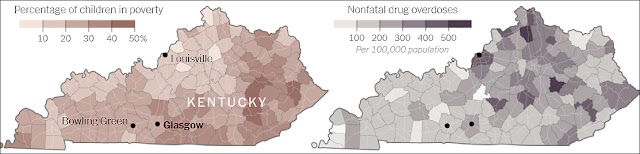
"In Glasgow, a town of 14,000, the challenges are intensified by high rates of drug addiction and poverty and their effect on families," Richter writes. "Glasgow has a poverty rate of 27 percent and a median household income of $28,000, according to 24/7 Wall Street, a data company that in 2020 ranked Glasgow the poorest town in Kentucky."
New York Times maps; to enlarge any image, click on it.
Mallie Boston, executive director of the Boys & Girls Club of Glasgow-Barren County, "said that today’s teens were less physically active and spent less time just hanging out," Richter reports, quoting her: “If you come to Glasgow right now, the options for what you can do are the movie theater, which is identical to when I was a child, or you have Ralphie’s, the bowling alley. . . . TikTok is such dopamine fuel,” she said. “I worry it is their dopamine.”

Richter interviewed several adolescents at the club, on the condition that he wouldn't use their names. "Some described struggling with anxiety, depression, suicidal thoughts or self-harm," he reports. "Katrina Ayres, the mental-health coordinator for the local school district, pointed to another change: Students were deeply focused on themselves, selfie-obsessed, which led them to “think everybody is looking at me,” she said. “We’re raising a generation that is very ‘me’ focused. . . . They need to see they’re part of a bigger picture.”

Attorney general issues alert about scam sales of infant formula

Image from WKDQ.com
Attorney General Daniel Cameron issued a consumer alert Wednesday warning Kentuckians of scams related to the nationwide shortage of infant formula. 

“Scammers often attempt to take advantage of those in stressful situations, and right now that can include Kentuckians who are desperately trying to find formula for their babies," Cameron said in a news release. "We encourage parents to report suspected baby formula scams to our office immediately at ag.ky.gov/scams.”

The release notes that baby-formula scammers may use ploys similar to those used by online-purchase scammers who pose as legitimate sellers and claim to have scarce products. Often, these items are sold at prices that are too high or too good to be true.

"The items are often sold on social media platforms, independent websites, or online vendors like Facebook Marketplace or Craigslist," the release says. "Sellers often require upfront payment for the product or shipping. Payment is usually required through gift cards or online payment platforms. Consumers who are victims of these scams never receive the promised product."

To avoid such scams, Cameron's office offers these tips: 
  • Purchase baby formula from known, reputable sources and, when possible, use a credit card to make the purchase.
  • Avoid paying for infant formula up front, if purchasing from an unknown source.
  • Be suspicious of sources advertising infant formula at prices that are too good to be true. If it seems too good to be true, it is likely a scam.
To report baby formula or other scams, contact the Attorney General’s Consumer Protection Hotline at 1-888-432-9257, or complete the online scam complaint form at ag.ky.gov/scams.

Thursday, May 19, 2022

Judge keeps new abortion law on hold, pending high-court ruling

Key portions of Kentucky's new abortion law are on hold, at least until the U.S. Supreme Court rules on a Mississippi law that would ban abortions after the 15th week of pregnancy, one part of the new Kentucky law.

U.S. District Judge Rebecca Grady Jennings had previously suspended enforcement of the law, The Associated Press notes: "The judge’s order Thursday extended the suspension of the measure’s ban on abortions after 15 weeks . . . and the requirement that women be examined by a doctor before receiving abortion pills. It also applies to new restrictions and reporting requirements that the Kentucky clinics said they couldn’t immediately comply with." Both Kentucky abortion clinics are in Louisville.

Covid-19 cases in Kentucky are on the rise, but cases are less severe; booster shots approved for children aged 5 to 11

By Melissa Patrick
Kentucky Health News

As Covid-19 cases and the share of Kentuckians testing positive for the virus went up again this week, Gov. Andy Beshear stressed that his constituents are not getting as sick from the virus as they once did. 

"We should be mindful of what's going on. We should be cognizant. We should make good decisions to protect ourselves," Beshear said at his weekly news conference. "We should not be scared because these numbers again are staying low, which suggests that whatever we are dealing with now does not cause severe illness nearly at the level of what we have dealt with before." 

The state's weekly report, for the last Monday-to-Sunday reporting period, showed Kentucky is averaging 920 cases per day, 63 percent more than the 565 daily cases the week before. The positivity rate last week was 9.35%. This rate has been increasing steadily for six weeks, rising from a rate of 1.97%.  The figures do not include results of home tests. 

The report also shows hospitalization rates went up just a bit last week, while intensive care and ventilator patients remained low. 

Public Health Commissioner Steven Stack encouraged Kentuckians to use the Centers for Disease Control and Prevention risk map as their guide for what type of Covid-19 precautions they need to take, rather than the state infection-rate map, because the CDC's weekly ratings are based on new virus cases, Covid-19 hospitalizations and the percentage of staffed inpatient beds occupied by Covid-19 patients, instead of just cases per 100,000 people. 

The CDC updates its three-color map on Thursday afternoons and the state Kycovid.ky.gov site posts it on Friday mornings, along with community level guidance for each color. The state's four-color map of county infection rates is updated on Mondays.

"Cases are not translating in the same proportion to serious or severe illness or death," Stack said. "Now, please don't misunderstand me, Covid is still a serious disease. It's really important that you go out and get vaccinated and stay boosted with your vaccine. . . . But this composite map now reflects the reality that getting Covid doesn't necessarily mean you're going to end up in an ICU or on a ventilator or dead even if you have some medical risks." 

He added that this change in the way we measure risk to the virus is possible because so many people have been vaccinated or have natural immunity. He added that while it's important to not ignore the virus as we learn to live with it, it's also time to stop "navel gazing" every little detail related to it. 

Stack encouraged Kentuckians who have been exposed to the virus or have tested positive to the virus to go to the state's website to find tests and treatment locations, including monoclonal antibodies and a link to pharmacies that are participating in the national Test to Treat program. This program allows you to get tested for Covid-19 and, if eligible, to receive a prescription for an oral antiviral medication all at one time. 

The website also has a link to order free at-home Covid-19 tests, of which the Biden administration just approved eight more.  

"U.S. households are now able to order an additional eight free at-home tests at CovidTests.gov—bringing the total number of free tests available to each household since the start of the program to 16," the White House said in a fact sheet. 

On Tuesday, the U.S. Food and Drug Administration approved a Pfizer-BioNTech booster vaccine for children ages 5 to 11 who have completed their primary vaccine series at least 5 months prior. CDC's independent advisory committee approved the measure Thursday and CDC Director Dr. Rochelle Walensky approved it later that same day. 

Vaccination with a primary series among this age group has lagged behind other age groups leaving them vulnerable to serious illness," Walensky said in a news release. "With over 18 million doses administered in this age group, we know that these vaccines are safe, and we must continue to increase the number of children who are protected. I encourage parents to keep their children up to date with CDC’s Covid-19 vaccine recommendations."

In Kentucky, only 23% of 5-to-11-year-old children have received at least one dose of the Covid-19 vaccine. Of last week’s 6,443 new cases, 16% were in people 18 and younger.

Beshear said his 11-year-old daughter will get the booster when it becomes available. 

Asked why it's important for this age group to get vaccinated, Stack said a key reasons is that we don't fully understand all there is to know about "long Covid," a condition that affects people of all ages. 

"We do know that those vaccines reduce the severity of the disease for people who are vaccinated. And there is some early evidence that getting vaccinated may help lower your risk for long Covid," he said. "It may even help people who have long Covid generate a response that helps them to improve." 

Stack encouraged parents to talk to their pediatrician about getting their child vaccinated if they have not yet done so. 

Also today, the CDC strengthened its recommendation that those 12 and older who are immunocompromised and those 50 and older should receive a second booster dose at least 4 months after their first.

The CDC release says, "Whether it is your first booster, or your second, if you haven’t had a vaccine dose since the beginning of December 2021 and you are eligible, now is the time to get one."

CDC says McCracken Co. has high level of virus transmission; most West Ky. counties, 33 total in state, have medium levels

Centers for Disease Control and Prevention map shows 34 counties with elevated risk of Covid-19.
By Melissa Patrick
Kentucky Health News

McCracken County and its seat of Paducah are red on the Centers for Disease Control and Prevention's latest national Covid-19 risk map, indicating a high level of coronavirus transmission. Thirty-three Kentucky counties, most in the west, are yellow, indicating a medium level of transmission.

Those counties are Hickman, Carlisle, Ballard, Graves, Marshall, Trigg, Lyon, Livingston, Christian, Caldwell, Crittenden, Todd, Muhlenberg, Hopkins, Webster, Union, Henderson, Simpson, Clinton, Cumberland, Hardin, Jefferson, Oldham, Henry, Shelby, Woodford, Fayette, Menifee, Martin, Lawrence, Boyd, Carter, and Greenup. 

This is the first time since the April 1 weekly report that Kentucky has had a red county on the map, and the yellow counties more than doubled in this week's report; last week Kentucky had only 12 yellow counties. West Virginia has a cluster of red counties, including Kanawha County, site of Charleston.

Because of McCracken County's high level of virus transmission, the CDC recommends that everyone there should wear masks in indoor public spaces. Kentucky's state guidelines also recommend limiting indoor in-person gatherings, limiting the size of gatherings, and encouraging social distancing. 

The CDC says people in yellow counties who are immunocompromised, or at high risk for severe illness from the virus, should talk to a health-care provider about whether they need to wear a mask or take other precautions. 

State Public Health Commissioner Steven Stack encouraged Kentuckians to use the CDC risk map to determine the level of Covid-19 precautions that are needed in their community, rather than the state's daily seven-day infection rate map that is updated on Mondays. The Kycovid.ky.gov site posts the CDC's color-coded map on Friday mornings, along with community level guidance for each color.

Stack said the CDC map is a better guide to managing risk because the agency's weekly ratings are based on new virus cases, Covid-19 hospitalizations and the percentage of staffed inpatient beds occupied by Covid-19 patients, instead of just cases per 100,000 people in each county.

"The composite map is the one that really shows you what your risk is, if you're likely to get exposed," he said. 

The CDC says 9.2% of counties and county equivalents in the U.S. have a high level of Covid-19 transmission, up from 4.25% last week; 15% have a medium level, up from 14% last week; and 76% have a low level of transmission, down from 82% last week.

Monday, May 16, 2022

New Ky. cases up 63%, hospitalizations up 42% as experts warn new variants threaten the vaccinated as well as the unvaccinated

State Department for Public Health map, adapted by Kentucky Health News; click on it to enlarge.
By Melissa Patrick
Kentucky Health News

Kentucky’s weekly Covid-19 report largely mimics what is going on across the nation: 63 percent more new cases than the prior week, a rising positive-test rate remains on the rise and a 42% increase in the number of Kentuckians hospitalized with the virus today than last Monday. And danger ahead.

Experts are warning that two new subvariants of the virus, Omicron BA.4 and BA.5, are not just a risk to those who are unvaccinated, but also to those who are vaccinated.

“It’s not gonna get better,” Dr. Eric Topol of the Scripps Research Translational Institute in La Jolla, Calif., said on PBS NewsHour Monday.

Topol said the variants are “transmitting at levels that are really inconceivable,” with a great deal of “immune escape,” and “Our immune system doesn’t see the virus as it saw previous versions of the virus.”

He said the Covid-19 vaccines remain effective against the variants, but less so, at an 80-85% rate, leaving four times as many vaccinated people vulnerable to severe disease and hospitalization as before.

Meanwhile, “The virus continues to spread at an alarming pace nationwide, with daily reports of new cases increasing threefold since the start of April,” The New York Times reports.

Kentucky Health News graph, from state data; click on it to enlarge.
The state’s weekly report, for the last Monday-to-Sunday reporting period, showed 6,443 new cases of the virus, an average of 920 cases per day. That’s 63% more than the 565 daily cases the week before. Of last week’s new cases, 16% were in people 18 and younger.

The share of Kentuckians testing positive for the virus last week was 9.35%, up from 7.19% the week before. This rate has been increasing steadily for six weeks, rising from a rate of 1.97%. The figures do not include results of home tests.

The state attributed 96 more deaths to Covid-19 last week, an average of 13.7 deaths per day. The week before it was around 24 deaths per day. The state pandemic death toll is now 15,830.

Kentucky hospitals reported 340 Covid-19 patients Monday, up 101 from 239 a week earlier. Numbers of intensive-care patients (30) and patients on mechanical ventilation (eight) remain low.

The statewide seven-day infection rate is also on the rise. That rate is now 19.64 cases per 100,000 residents, up from 11.95 daily cases per 100,000 the week before.

Twelve counties have rates higher than the statewide rate; the number is small because Jefferson County, the state’s most populous, has a rate of 45.8 cases per 100,000. Other counties higher than the state rate were Hardin, 35.5; Menifee, 33; Fayette, 28.8; Henry, 25.7; Woodford, 25.6; McLean, 24.8; Oldham, 24.6; Boyd, 23.2; Campbell, 21.4; Clark,21.3; and Simpson, 20.

This week’s CDC risk map, which considers both cases and hospitalizations, says 12 Kentucky counties are in yellow, indicating a medium level of coronavirus transmission. They include: Union, Henderson, Jefferson, Greenup, Carter, Boyd, Lawrence, Johnson, Magoffin, Floyd, Martin and Pike.

The Times ranks Kentucky’s infection rate 28th among states and Washington, D.C., with a 55% increase in cases in the last 14 days.

Fortune reports that the Centers for Disease Control and Prevention has provided the magazine with the 14 states where the probable variant cases are and said that they make up less than 0.1% of circulating virus samples collected in the week ended April 16. It has not yet been detected in Kentucky.

But Fortune notes that lab testing is down in the U.S. and that the U.S. only sequences a small fraction of test received.

Vaccinations went up last week in Kentucky. The Washington Post reports that in the last week, an average of 3,543 doses were administered per day, an 18% increase over the week before. The Post reports that 61.2% of the state’s eligible population, 5 and older, are fully vaccinated and 44.5% of the fully vaccinated people have received a booster shot.

New campaign to combat Covid-19 vaccine hesitancy in pregnancy is launched; only 31% of the pregnant are vaccinated

The Foundation for a Healthy Kentucky, with support from the Kentucky Association of Health Plans, has launched a statewide campaign to educate Kentuckians about the risks of Covid-19 during pregnancy and the benefits of getting vaccinated. 

“This is not about scaring people, rather having an honest conversation about what Covid-19 can mean for pregnant women and their babies,” Ben Chandler, president and CEO of the foundation, said in a news release. “We hope to spur conversations between patients and their health care providers.”

The campaign asks the question, "What’s right for you?" and encourages people who are pregnant to talk with their obstetrician-gynecologist about their individual situation. 

"I think every doctor is going to tell you, based on all of the data that we've got, that getting the vaccine is the appropriate and safe response," Chandler said at a news conference. "In fact, it is tremendously safer than not getting the vaccine. . . . What we know about  the vaccinations is that they are safe for the mother, they are safe for the baby. They do not cause infertility. They are safe in every way, shape and form." 

The campaign was launched after the sponsors held focus groups and individual interviews with Kentuckians who were pregnant and said they wanted more information about the potential impact of the virus and how the vaccine works. They also wanted to have a discussion with their doctor about what it all means for them, personally.

“Covid poses unique risks for both mother and child during pregnancy,” Katherine Kington North, director of external affairs for KAHP, said in the release. “We can improve outcomes when we encourage conversations between moms and their healthcare providers. It is critical to have a trusted, real dialogue, not a one-way conversation.”

Studies show unvaccinated pregnant people do not seem to be at a higher risk of contracting Covid-19. However, research shows they are about 40% more likely to develop serious complications during pregnancy if they get the virus, compared to those who are not infected. The Centers for Disease Control and Prevention adds that unvaccinated pregnant people are also at higher risk for pre-term labor, still births, or death.

The CDC says more than 200,000 pregnant women in the U.S. have received a Covid-19 vaccine without any safety or health concerns. The agency also reports that fewer than one-third (31%) of people who are pregnant in the U.S. are vaccinated against Covid-19.

The campaign provides a toolkit that includes materials available for use by health care providers and advocates, including social media graphics and videos, educational resources, and talking points for providers. All of the content has a common message: people who are pregnant or thinking about becoming pregnant should discuss the Covid-19 vaccine with their health care team to decide what is best for them.  Download the toolkit here. 

It also includes links to the research that supports the need for people who are pregnant to get a Covid-19 vaccine:
  • Unvaccinated pregnant women are 15 times more likely to die from Covid-19. [source]
  • Unvaccinated pregnant women are 22 times more likely to have a pre-term birth than those who have been vaccinated against Covid-19. [source]
  • The risk of still birth among pregnant women with Covid-19 is twice as high compared to uninfected patients. [source]
  • Receiving a messenger RNA Covid-19 vaccine does not affect fertility and does not increase the risk of miscarriage or stillbirth. [source]
  • Vaccinated and breastfeeding mothers can pass on Covid-19 antibodies, giving their babies passive immunity against the virus for their first six months of life. [source]
“We know the pandemic adds extra layers of concern for expecting mothers,” said Chandler. “We are proud to partner with KAHP to encourage women to ask questions and learn more from reliable sources about Covid-19 vaccines. In the end, we hope to improve the health outcomes of Kentucky moms and their newborns.”

Here's what you need to know about the baby formula shortage

By Heather Chapman
Institute for Rural Journalism and Community Issues, University of Kentucky

Families nationwide are scrambling to find baby formula amid a widespread shortage. Rural families are likely having an even harder time since there are fewer local places to buy formula, and because families who use federal assistance can only buy certain formulas. It's even more difficult to find certain medically necessary specialty formulas. Here's what you need to know:

What happened: In February the Food and Drug Administration ordered Abbott Nutrition, the nation's leading formula maker, to shut down its plant in Sturgis, Michigan, after four infants were hospitalized with bacterial infections from contaminated formula and two of them died. The FDA issued a voluntary recall on three products (Similac, Alimentum, and EleCare) and warned customers not to use certain specialty formulas produced at the facility, but the warning didn't get much public attention, so parents didn't know to stock up. Formula was already low in stock since at least December because of inflation, supply-chain shortages and product recalls.

How bad is it? Formula stockpiles in stores are 43 percent lower than normal, compared to 30-40% short in April, says retail data tracker Datasembly. Only about a quarter of children are exclusively breast-fed up to the age of six months, so most parents and caregivers depend at least partially on formula. 

Why not buy another brand? Almost all formula in the U.S. is manufactured domestically because of strict FDA standards, and 90% of the nation's supply comes from four companies. Abbott makes over 40% and Perrigo Nutritionals, Mead Johnson, Gerber (owned by Nestlé) combined account for another 50%. Perrigo makes store-brand formulas for stores such as Walmart, Kroger and Walgreens formula can't be purchased by people using federal assistance through the Women, Infants and Children nutrition program, which pays for about half of all formula. In addition, many babies require specialty formulas and can become very sick if they switch.

Why not breastfeed? Many babies who require specialty formulas can also get sick from drinking breast milk. Adoptive families and many others also have difficulty accessing or affording a reliable supply of breast milk, and some survivors of sexual violence may find it traumatizing. Some mothers find it difficult to maintain a steady supply of milk, and others can't breastfeed at all because they must take medications that would taint the milk. Though state and federal laws protect women's right to breastfeed in public—including at work—many women are embarrassed, intimidated, or even discouraged from the practice, and many women are not knowledgeable about the health benefits of breast milk.

Is homemade baby formula a safe alternative? No. Homemade formulas can be too high in sodium, too low in calcium, contaminated, and/or lack critical nutrients. Babies can suffer long-term damage after using homemade formula alternatives or straight cow's milk for even a few days, according to the National Committee on Nutrition for the American Academy of Pediatrics. It's also dangerous to dilute baby formula with too much water. If there is absolutely no other alternative, formula made for toddlers can be ok for a few days for infants who are close to a year of age. 

How long could the shortage last? At least 10 weeks. On Monday the FDA agreed to allow Abbott to reopen its Sturgis plant within two weeks, as long as it passes a safety inspection. After that it will take six to eight weeks for formula to hit store shelves. However, inspectors say there are still problems at the plant. In the meantime, Abbott says it's shipping in formula from its FDA-registered plant in Ireland on a daily basis. The FDA has been allowing more formula imports meant for the U.S. since February, and is now allowing some formula meant for foreign markets to enter the U.S., but only after a safety evaluation.

Could this have been prevented? Growing evidence indicates the FDA failed to act quickly about warnings of safety violations at the Sturgis plant. A whistleblower at the plant warned the FDA in October about safety problems, weeks after the children were hospitalized with bacterial infections, but the agency didn't interview the whistleblower until December and didn't inspect the plant until Jan. 31. That dovetails with a recent Poitico investigation that revealed deep-seated issues with the FDA's plant inspections. Current and former employees described the agency as slow to make decisions and lacking enough staff or budget for years to deal with the modern food system even as its regulatory responsibilities have grown.

What is happening in Kentucky? "The state WIC Program quickly requested and began to execute all waivers available to the states as soon as the USDA provided for them. However, that has only been a small part of their response," said Susan Dunlap, spokeswoman for the state Cabinet for Health and Family Services. "They have worked to develop additional infant formula packages in the WIC system and have updated the approved product list to now include a substantial number of additional products in a variety of sizes. All of this was aimed at ensuring WIC families were able to use their benefits to access whatever formula was available on the shelves."

Also, local health departments are being updated and supported, and the state is pushing updates to WIC families via the WIC Shopper App, Dunlap said. "They have been in constant contact with Abbott about reports of regional supply deficiencies so Abbott can work to shift supply to harder hit areas of the state," she said. "However, the supply chain demand and disruption is affecting nearly all families that use infant formula."

In the meantime, if you need formula, here are some do's and don'ts:
  • Check with your church or local nonprofits to see if they have any.
  • Shop online from reliable sources. 
  • Don't make your own.
  • Don't hoard formula.
  • Network with other families on social media.

Owensboro Health plans education facility for health professions

Google map locates business center where health-professions training facility will be housed.
Owensboro Health, which operates the largest hospital in Western Kentucky and owns two others in Greenville and Leitchfield, is planning to build a training facility for nurses and other medical professions.

The Commonwealth West Healthcare Workforce Innovation Center will be funded with $38 million in the state budget through the work of Rep. Suzanne Miles of Owensboro, chair of the House Republican Caucus, reports James Mayse of the Owensboro Messenger-Inquirer.

President and CEO Mark Marsh said his hope is to have the center ready to start operating by January in the company's business center at 25th and Frederica streets. It will train nurses, radiologists and professionals in fields such as behavioral health and community health, a press release said.

"Roughly, there area about 30 different disciplines" that will be taught at the facility, Marsh told the Messenger-Inquirer.

Courses will be taught by faculty members from nine colleges and universities, including Kentucky Wesleyan College and Brescia University of Owensboro, Owensboro Community and Technical College, Western Kentucky University and the University of Louisville's nursing school.

Marsh said the institutions will create the curriculum with the advice of Owensboro Health, and students will get degrees from their parent universities. He said it could be possible for students to get degrees or certifications from more than one university.

The center will include both classroom space and "simulation labs," where students will practice being in patient rooms and operating rooms, Marsh said.

He said the facility "will also offer mathematics and science instruction to high school students, and it can teach classes through remote learning to high schools across western Kentucky," Mayse reports. "Marsh said the center will be a way for high school students to learn about health-care careers."

"I think a lot of kids slip through the cracks," he said. "It is imperative on us to create the enthusiasm and create the pathway" to a healthcare career.

The center is an effort to address anticipated shortages in healthcare workers. Its operations will be headed by Bart Darrell, former Kentucky Wesleyan president. "Darrell, an attorney who led KWC for five years until 2019, was named vice president" of the center, Mayse reports.

Sunday, May 15, 2022

Legislature funds health insurance for Kentuckians who make too much to qualify for Medicaid but too little to buy private coverage

Kaiser Health News graphic
Kentucky Health News

Kentucky is taking advantage of a little-used provision of the 2010 Patient Protection and Affordable Care Act to create a health-insurance plan for Kentuckians who make too much to qualify for free Medicaid coverage but not enough to pay for private insurance. 

The policy, known as the basic health program, was included in the ACA, but only Minnesota and New York took advantage of it. Kentucky and Oregon are now pursuing this option, Megan Messerly reports for Politico. 

The move comes "amid growing concern that the looming end of the Covid-19 public health emergency could result in millions of people being kicked off Medicaid and fear that Obamacare subsidies that helped millions of people buy coverage will expire at the end of 2022," Messerly writes. 

The Kentucky General Assembly, led by supermajorities Republicans, approved $4.5 million in state funds and $4.5 million in federal funds in the 2022-24 state budget to set up the program.

Messerly reports that at least 37,000 Kentuckians will be eligible to enroll in the program's plans as soon as next year. 

A basic health program offers low-cost insurance for people who make up to twice the federal poverty level – about $55,000 for a family of four – and do not qualify for Medicaid. New York and Minnesota offer plans with little or no premiums, co-pays or deductibles.

While the expansion of Medicaid under the ACA to Kentuckians making up to 138% of the federal poverty line has been criticized by some Republican legislators, this program offers more appeal to them because it is seen a a way for low-wage workers to work more without fear of losing their health insurance because they would no longer qualify for Medicaid. 

“Kentucky is not known for our great health metrics, and we’re doing our best to really address some of the gaps and the barriers in the system,” Rep. Kim Moser, R-Taylor Mill, told Messerly. “We know that this is the group of people who churn in and out of health coverage.”

Kentucky health advocates have pushed for a basic health plan for years and it's finally gaining some traction. 

The plan came form a work group the legislature created to explore establishing a "bridge" insurance plan. The group said a basic plan would “allow individuals who would otherwise lose their health care coverage through Medicaid to be able to accept work and pay raises and take away the disincentive to accept increased pay or work.”

Emily Beauregard, executive director of Kentucky Voices for Health, told Messerly, “It’s clear to see where the gaps lie, and which populations technically have coverage options, but not coverage options that work for them.” 

A spokesperson for the Cabinet for Health and Family Services told Messerly that  the goal is to enroll people this fall for coverage starting in January.

Critics of the plan say states should focus on making coverage in federally subsidized plans ("Obamacare") more affordable. Kaiser Permanente told the federal Centers for Medicare and Medicaid Services that the basic plans could undermine the Obamacare program, and hospitals are worried about the plans' reimbursement rates.

The legislature also recently passed House Bill 708, sponsored by Rep. Jonathan Dixon, R-Corydon, that requires the health cabinet to develop a proposal for the establishment of a "benefits cliff" calculator and an online job posting database to help Kentuckians who want to explore the impact on their health insurance benefits of taking a job that offers more money.

A benefit cliff is the loss of eligibility for public assistance due to a wage increase. The law also creates the Benefits Cliff Task Force to examine the impacts of the cliff on workforce participation, employment, wages and other employment issues.