Showing posts sorted by relevance for query House Bill 604. Sort by date Show all posts

Thursday, April 7, 2022

Beshear and Senate president discuss medical marijuana, hero pay; Stivers says PBM bill stuck in Senate over cost concerns

By Melissa Patrick
Kentucky Health News

FRANKFORT — State Senate President Robert Stivers said he favors funding more research on medical marijuana before making it legal in Kentucky, but Gov. Andy Beshear says medical cannabis has overwhelming support in the state and should pass when the legislature returns to reconsider vetoed bills. 

At separate press conferences in Frankfort Thursday, the two leaders also discussed the Republican legislature's rejection of the Democratic governor's plan to give Kentuckians who worked throughout the pandemic a "hero bonus;" and Stivers said a House bill to rein in pharmacy benefit managers died in the Senate for fear it would raise consumers' and employers' costs.

Medical marijuana: Stivers said the House-passed cannabis bill "would be difficult" to pass the Senate next week, but he supports a bill by Rep. Kim Moser, R-Taylor Mill, to create a cannabis research center at the University of Kentucky and expects it to pass. "I think it not only would be good locally but nationally and internationally to understand the medicinal and therapeutic values of marijuana," he said.

Senate President Robert Stivers

Stivers acknowledged that studies show cannabis helps with certain medical conditions, "but every study I've read said the sample sizes have been too small, the duration is too long and therefore more study is needed."

Moser's House Bill 604 has had two of its three required readings, so it could clear the Senate Appropriations and Revenue Committee and the full Senate quickly on April 13 and/or 14.

Beshear urged the legislature to pass the medical-cannabis bill in those two remaining days, which would require suspension of the three-readings rule. "Its time has certainly come."  

He added, "Kentuckians deserve the passage of a medical-marijuana bill. They overwhelmingly support it. When 70-plus percent of a state is in favor of something, it's time for the General Assembly to step up and do something about it. Represent the people." 

Asked later if he could do anything by executive order to make it easier for people with certain conditions to have access to medical cannabis, Behsear said, "We're going to explore that. . . . I am for medical marijuana and I will continue to push it until we make it a reality." 

The House passed its cannabis bill, HB 136, by a vote of 59-35, with just over half of the Republicans who voted on the bill favoring it. A similar bill passed the House in 2020 but died in the Senate. 

Pharmacy benefit managers: House Bill 457 would ensure that patients could pick their pharmacy, instead of being required to use one affiliated with a pharmacy benefit manager; increase transparency between insurers and PBMs; and ban PBMs from retroactively denying a pharmacy claim after adjudication, commonly referred to as "clawing back." It passed the House 88-3.

Asked why the bill didn't gain any traction in the Senate after such overwhelming support in the House, Stivers said, "When it got here, we started getting, from business sector and provider sector, various questions and comments about what the overall cost would be to various plans." 

The bill was opposed by one of the session's heaviest lobbying campaigns. The Pharmaceutical Care Management Association, the PBM trade group, spent $38,369 to get its message to lawmakers before March, when it ran television commercials urging voters to ask their legislators to defeat it.  

Stivers said it had been assigned to the Appropriations and Revenue Committee "because it has potential fiscal impact -- local, individual, personal and state fiscal impact." He indicated that the bill would not pass, since that would require suspension of the three-readings rule, and more education would be needed among Republican senators about what it would do. 

Hero bonuses: Stivers said the General Assembly took a different approach to hero bonuses that he said would benefit everybody, mainly because it was too hard to determine just who would qualify for bonuses. He said the legislature is giving income-tax reductions and workforce incentives, and investing in  infrastructure and higher education. 

Gov. Andy Beshear
Beshear disagreed, reflecting on how scary it was early in the pandemic when the mortality rate from the virus was 10 percent in some places and essential workers were asked to show up at work every day.

"I believe this legislature needs to spend some of the last two days including hero bonuses. They deserve those hero bonuses. . . . I think it's really disappointing."

Health bills become law: Beshear signed three more health-related bills into law Thursday.

House Bill 525, sponsored by Moser, would allow Medicaid to pay certified community health workers. CHWs aren't trained medically, but are trained as patient advocates who come from the communities they serve. They help clients coordinate care, provide access to medical, social and environmental services, work to improve health literacy, and deliver education on prevention and disease self-management.

Senate Bill 10, sponsored by Sen. Robby Mills, R-Henderson, addresses the nursing shortage with both short-term and long-term solutions, including streamlining the process for out-of-state and foreign trained nurses to practice in Kentucky without compromising the standards of care; improving access to nursing education by removing "arbitrary" enrollment limits without compromising the quality of the programs; and adding term limits and geographic requirements for the Board of Nursing.

Senate Bill 105, sponsored by Sen. Max Wise, R-Campbellsville, will increase awareness and screenings for the cytomegalovirus (CMV), a virus that can cause childhood deafness and other health conditions. Most CMV infections are not diagnosed without newborn screening, resulting in missed opportunities for needed care. It is titled Bella Dawn Streeval’s Law, after a woman who died two years ago Thursday after suffering from CMV.

Friday, April 15, 2022

Health bills were among those that passed (some with overrides of vetoes) and failed in the last two days of the legislative session

By Melissa Patrick
Kentucky Health News

The Republican legislature overrode more than two dozen of Democratic Gov. Andy Beshear's vetoes Wednesday and Thursday, including a wide-ranging abortion bill that was immediately challenged in court and another that sets new rules for public-assistance programs, including Medicaid. 

Tulips in front of the state Capitol
The General Assembly ended its session after passing a number of health-related bills on a wide range of topics, including youth mental health, increased access to mental health and addiction recovery care, a behavioral-health pilot program for low-level offenders, postpartum care for low-income Kentuckians, research into medical marijuana, and the recruitment and retention of health-care providers. 

The anti-abortion measure, House Bill 3, bans mailing of medications that have become the means for most abortions in Kentucky, strengthens parental-consent rules and bans abortion after the 15th week of pregnancy, mimicking a Mississippi law that is awaiting a decision from the U.S. Supreme Court. 

Beshear said he vetoed the bill because there were no exemptions for rape or incest, also noting that it is likely unconstitutional, among other reasons. 

Kentucky's only abortion providers said they had to stop conducting the procedure because other restrictions and reporting requirements in the 72-page bill went into effect as soon as it was finally passed because of an emergency clause.

EMW Women's Surgical Services and Planned Parenthood, both in Louisville, have each filed federal lawsuits challenging the new law and are asking a judge to suspend it. 

The American Civil Liberties Union of Kentucky said in a news release, "The lawsuits argue that the law would create unnecessary abortion requirements while simultaneously making those requirements impossible to comply with given the immediate effective date of the law, forcing providers in the state to stop offering abortion services. Because the law is impossible to comply with, it amounts to a de facto abortion ban, thus violating patients’ federal right to abortion under Roe v. Wade," the 1973 Supreme Court decision creating a constitutional right to abortion before a fetus can live outside the womb. 

Lawmakers also overruled Beshear's veto of HB 7, a public-assistance reform bill aimed at reducing fraud and getting able-bodied adults without dependents back into the workplace. Beshear vetoed the bill because, among other things, he said it will result in making it harder for people who need the benefits to get them and will result in people losing benefits. 

Health bills that passed in the last days of session

HB 44, sponsored by Bobby McCool, R-Van Lear (Johnson County), allows local school boards to include mental health as a reason for an excused absence. Rep. Lisa Willner, D-Louisville, praised the passage of this bill, noting that it came from students at several Kentucky schools. This bill also removed part of a new law that would have created criminal penalties for teachers who didn't teach racial history the way called for by the new law, Senate Bill 1, also passed over a veto. 

Senate Bill 102, sponsored by Sen. Max Wise, R-Campbellsville, requires local school superintendents to provide a yearly census of all school-based mental-health providers and their duties to the state Department of Education, not just a list of school counselors. 

SB 90, sponsored by Sen. Whitney Westerfield, R-Crofton, creates a pilot program to divert some qualifying low-level offenders away from jail and into treatment for substance-use disorder or mental-health issues. 

Negotiated in a late House-Senate conference committee, the bill gives the project $11 million a year from the settlement that Kentucky and other states received from opioid manufacturers and distributors.

HB 573, sponsored by Rep. Kim Moser, R-Taylor Mill, establishes the Healthcare Worker Loan Relief Program for qualifying health-care workers with jobs that require four-year degrees. This program is meant to help recruit and retain healthcare workers in rural and underserved areas of Kentucky.

The program would be aligned with the Kentucky State Loan Repayment Program and administered by the University of Kentucky's Center for Excellence in Rural Health. The budget has $2 million in each fiscal year from the American Rescue Plan Act of 2021, the last pandemic-relief bill.   

SB 178, sponsored by Sen. Julie Raque Adams, R-Louisville, ended up being a catch-all bill for several health-related issues. It requires Medicaid to provide coverage to new mothers up to 12 months after giving birth; sets new rules for certification of alcohol and drug counselors; allows licensed narcotic treatment programs to use buprenorphine products to treat patients; and requires third-party oversight over the state's single Medicaid pharmacy benefit manager; and bars termination of parental rights of a mother whose child suffers from neonatal abstinence syndrome if the mother agrees, prior to discharge from the hospital, to participate in a court-ordered treatment program that includes peer supports. 

HB 604, sponsored by Moser, also became a catch-all bill that at its core establishes the Kentucky Center for Cannabis Research at the University of Kentucky. The budget allocates $2 million in the fiscal year that begins July 1 to start the center. Other health provisions in this bill create the mobile crisis services fund and to the Commonwealth West Healthcare Workforce Innovation Center. 

Health bills that got stuck in the Senate

HB 136, sponsored by Rep. Jason Nemes, R-Louisville, which would have legalized medical cannabis in Kentucky did not gain any traction in the Senate after passing out of the House. Senate President Robert Stivers has long said that he believes more research is needed before such a bill should pass. 

HB 354, sponsored by Rep. Russell Webber, R-Shepherdsville, would have created a path for Kentucky's advanced practice registered nurses to prescribe controlled substances independently. "I'm sure that bill will come back some time in the future," said Senate Majority Floor Leader Damon Thayer in the closing hours of the session.

Sunday, April 10, 2022

Beshear vetoes public-assistance, abortion bills; gets one more month of pandemic food benefits; more health bills could pass

Gov. Andy Beshear, signing and vetoing bills on Thursday, April 7 (KHN photo by Melissa Patrick)
By Melissa Patrick
Kentucky Health News

Kentucky lawmakers will return to Frankfort Wednesday to consider overriding Gov. Andy Beshear's vetoes of several bills, including two related to health. They would put new limits on abortion and set new rules for public assistance programs, including Medicaid.

The General Assembly will also consider passing other bills, but because it is required to adjourn by Friday, the Democratic governor could veto them without fear of being overridden by the Republican legislature.

The wide-ranging anti-abortion measure, House Bill 3, would ban mailing of medications that have become the means for most abortions in Kentucky, strengthen parental-consent rules and ban abortion after the 15th week of pregnancy, mimicking a Mississippi law that is awaiting a decision from the U.S. Supreme Court. 

In his veto message, Beshear noted that the bill makes no exemptions for pregnancies caused by rape or incest, and described how the proposed parental-consent rules would require both parents to be notified if a girl under 18 wants an abortion. He said that could create a situation where a young girl who has been raped and impregnated by her father would have to notify him of her intent to get an abortion or go through an onerous process of getting a court order to allow it.

"Rape and incest are violent crimes," Beshear said. "Victims of these crimes should have options, not be further scarred through a process that exposes them to more harm from their rapists or that treats them like offenders themselves."

Further, he said the bill is likely unconstitutional and that the new reporting and oversight systems would create an "unfunded mandate" for the state Cabinet for Health and Family Services

Beshear said he vetoed the public-assistance reform bill, HB 7, "because it will hurt Kentuckians by threatening access to health care and making it harder for those in need to access crucial benefits." He said the administrative burdens could cause people to lose benefits, said the bill could violate federal Medicaid requirements, and said it provides no appropriations for the health cabinet to implement the bill's requirements. He pointed out that when Kentuckians lose health and food benefits, that not only affects them, but physicians, hospitals and the economy.

The bill's sponsor, Rep. David Meade, R-Stanford, has said the added rules in Medicaid and food-benefit programs are needed to reduce fraud and encourage able-bodied adults without dependents to get off Medicaid and other public-assistance programs and back into the workplace. 

It is expected that both bills, priorities for Republicans, will be repassed over Beshear's vetoes, just as they overrode his veto of a resolution ending the Covid-19 state of emergency about a month early, costing 544,000 Kentuckians an extra $100 a month in pandemic-related food benefits. 

Federal law required the state to have a state of emergency were needed to get those additional benefits as long as the national state of emergency is in place, but also allowed Kentucky to apply for a "phase out" month of the benefits after its state of emergency ended, and that has been approved. 

On March 30, a spokesperson for the U.S. Department of Agriculture, which houses the Supplemental Nutrition Assistance Program, formerly called food stamps, told Kentucky Health News that the additional month of Covid-19 benefits had been approved for April. 

Bills hanging fire 

One of the health bills to watch is HB 174, sponsored by Rep. McKenzie Cantrell, D-Louisville, that would extend Medicaid coverage to new mothers up to 12 months after giving birth. This bill sailed unanimously out of the House in February, passed out of its Senate committee unanimously on March 23 and was placed on the consent calendar, used to pass bills without debate.

Since then, five floor amendments have been filed, including one by Sen. Adrienne Southworth, R-Lawrenceburg, that includes provisions of HB 51, sponsored by Rep. Lynn Bechler, R-Marion, that would allow a parent or guardian to opt out of any masking, testing or vaccination requirements imposed in response to the coronavirus. HB 51 passed the House 56-35 on March 8, but has lingered in the Senate Health and Welfare committee without a hearing. 

Another bill to watch is HB 604, sponsored by Rep. Kim Moser, R-Taylor Mill. It would create the Kentucky Center for Cannabis Research at the University of Kentucky. It is supported by Senate President Robert Stivers, who has said the idea of medical marijuana needs more study to become law.

It also appears that three health bills that were added to a catch-all bill, Senate Bill 58, are set to pass. They are HB 645, sponsored by Rep. Danny Bentley, R-Russell, to create the mobile crisis service fund; HB 751, sponsored by Majority Caucus Chair Suzanne Miles, R-Owensboro, to create the Commonwealth West Healthcare Workforce Innovation Center; and HB 573, sponsored by Moser, to establish the Healthcare Worker Loan Relief Program for qualifying health-care workers. 

Wednesday, September 21, 2022

UK creates Cannabis Research Center, following new state law

Cannabis research at UK (UK photo by Arden Barnes)
By Elizabeth Chapin
University of Kentucky

The University of Kentucky is home to a new center that will advance research on the medical use of cannabis.

The UK Cannabis Center will conduct research on the health effects of cannabis, including its risks and benefits when used to treat certain medical conditions.

Based in the College of Medicine’s Center on Drug and Alcohol Research, the center will build on cannabis research already taking place at UK and expand the profile of clinical cannabis research.

Established by House Bill 604 of the 2022 legislative session, the center is intended to accelerate research on cannabis that is relevant to the health and well-being of Kentuckians. The law provides the center with a $2 million appropriation over the next two years.

House Bill 136, a measure to legalize medical marijuana in Kentucky, failed to make headway in the state Senate after passing the House. As Kentucky considers legalizing the use of medical marijuana, research conducted at the new center will help educate medical providers, legislators and citizens on the risks and benefits of the use of cannabis and cannabinoids.

“The legislature is interested in having us explore the conditions for which medical cannabis might be useful, as well as the most effective dosing and route of administration for each condition,” said Shanna Babalonis, director of the Cannabis Center.

Babalonis, an assistant professor in the Department of Behavioral Science, is increasingly recognized as a leader in the cannabis field and an expert on the topic of medical cannabinoids. She has three active National Institutes of Health grants, totaling nearly $3.5 million, aimed at examining cannabis-opioid interactions, cannabis effects in those with opioid use disorder and the effects of cannabis on simulated driving performance.

“The new center will allow us to expand our clinical research, particularly focusing on medical conditions that may be helped by medical cannabis,” Babalonis said.

In addition to clinical studies, the center will engage in preclinical research on new and innovative applications and analysis of public health data.

HB 604 requires UK to apply to the U.S. Drug Enforcement Administration for a license to grow and cultivate cannabis. If approved, the center will be able to conduct agricultural research pertaining to optimal growing conditions.

UK President Eli Capilouto recently appointed a multidisciplinary team of UK faculty members that will oversee the research center’s work and finances. The 12-member board includes an executive or steering committee that will work with Babalonis to establish the center’s research goals and agenda and make key financial decisions, and an advisory board to help guide and provide feedback on the center’s progress and overall direction.

The executive/steering committee is Center for Drug and Alcohol Research Director Sharon Walsh, Linda Dwoskin, Dr. Peter Akpunonu, Dr. Laura Fanucchi, William Stoops and Joshua Lile. The advisory board includes Patricia Rippetoe Freeman, Danelle Stevens-Watkins, Joseph Chappell, Dr. Susanne Arnold, Dr. Michelle Lofwall, and James Matthews. The non-M.D.s have Ph.D.s.

The board is working to determine the center’s research goals and agenda. The center will hold an annual symposium to present research findings and will also invite outside experts to report on cutting-edge, high-impact research.

Thursday, April 21, 2022

Beshear says he is looking at ways to bring medical marijuana to Ky. by executive action, while seeking public's opinion on topic

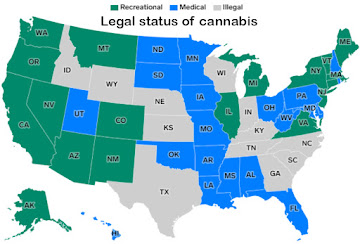
Business Insider map provided by Beshear's office, adapted by Ky. Health News
By Melissa Patrick
Kentucky Health News

After a bill to legalize medical marijuana in Kentucky failed again in the legislature, Gov. Andy Beshear announced a plan to ask Kentuckians how he might address the issue through executive action. 

"This session, like the last one and many before, the General Assembly did not get the job done, despite broad support from the public," Beshear said at his regular weekly news conference. A medical cannabis bill again passed the House this year but couldn't even get a committee hearing in the Senate.

The Democratic governor, who is seeking re-election next year, said his move isn't political.

"This issue's time has come," he said. "I think it's pretty clear where everybody falls on it. I believe if it had been given a committee vote, depending on the committee, it would have passed. If it would have been brought to the floor, it would have passed. You know, it's time that a couple of individuals that are out of touch with the vast majority of Kentuckians on this issue. Stop obstructing it, and we're able to move forward."

Senate President Robert Stivers has long said that he believes more research is needed before such a bill should pass. The Republican-controlled legislature passed a bill to create a cannabis research center, but the medical cannabis bill went nowhere in the Senate after passing the House 59-34.

Stivers issued a statement saying, “The public should be concerned with a governor who thinks he can change statute by executive order. He simply can’t legalize medical marijuana by executive order; you can’t supersede a statue by executive order because it’s a constitutional separation-of-powers violation.”

Beshear said, "We're looking through our legal options right now. If someone has just told you carte blanche, it's, it's against the law, then they haven't done the full analysis as we are looking at what different options there are out there."

He said he did not have an example of another state that had done this by executive action, and offered no details on what legalizing medical cannabis that way would look like, but outlined a plan to explore how it could be accomplished that would seek input from Kentuckians.

First, his lawyers will analyze options under the law regarding executive action on medical cannabis; then a Governor's Medical Cannabis Advisory Team will travel the state to hear from Kentuckians; and they will have an e-mail address to communicate with him about it: GovMedicalCannabisAdvisoryTeam@ky.gov

Beshear noted a long list of medical conditions that can be treated by cannabis, and stressed that 37 states, plus Puerto Rico, the U.S. Virgin Islands, Guam and Washington, D.C., already allow it for medical use and said it's time for Kentucky to do the same. 

"We are actually behind Mississippi," he said. "This time, we can't make that joke. Mississippi was actually the latest state to permit the use, and their legislature had the courage that ours did not." 

The bill that would create the research center and do several other things, HB 604, passed on the last day of the session. It would create the Kentucky Center for Cannabis Research at the University of Kentucky, which would get $2 million in the fiscal year that begins July 1. Stivers noted that Beshear has had the bill for a week and still hasn't signed it.