Watching TV commercials, not the sedentary act of watching TV itself, contributes to obesity in children, according to a study published by the American Journal of Public Health. Events, trends, issues, ideas and independent journalism about health care and health in Kentucky, from the Institute for Rural Journalism at the University of Kentucky
Thursday, March 17, 2011
Link found between kids watching food-based TV commercials and childhood obesity
Watching TV commercials, not the sedentary act of watching TV itself, contributes to obesity in children, according to a study published by the American Journal of Public Health. Friday, April 29, 2011
New regs could change way food industry markets to children
Thursday, November 30, 2023
Uncle Sam wants you ... to help stop health-insurance companies from using misleading tactics to sell Medicare Advantage plans
![]() |
| iStock/Getty Images Plus illustration via KFF Health News |
KFF Health News
After an unprecedented crackdown on misleading advertising claims by insurers selling private Medicare Advantage and drug plans, the Biden administration hopes to unleash a special weapon to make sure companies follow the new rules: you.
Officials at the Centers for Medicare & Medicaid Services are encouraging seniors and other members of the public to become fraud detectives by reporting misleading or deceptive sales tactics to 1-800-MEDICARE, the agency’s 24-hour information hotline. Suspects include postcards designed to look like they’re from the government and TV ads with celebrities promising benefits and low fees that are available only to some people in certain counties.
The new rules, which took effect Sept. 30, close some loopholes in existing requirements by describing what insurers can say in ads and other promotional materials as well as during the enrollment process.
Insurance companies’ advertising campaigns are in high gear because Dec. 7 is the end of open-enrolment season, when seniors can buy policies that take effect Jan. 1. People with traditional government Medicare coverage can add or change a prescription drug plan or join a Medicare Advantage plan that combines drug and medical coverage. Although private Advantage plans offer extra benefits not available under the Medicare program, some services require prior authorization and beneficiaries are confined to a network of health care providers that can change anytime. Beneficiaries in traditional Medicare can see any provider.
Catching Medicare Advantage plans that step out of line isn’t the only reason to keep an eye out for marketing scams. Accurate plan information can help avoid enrollment traps in the first place.
Although insurers and advocates for older adults have generally welcomed the new truth-in-advertising rules, compliance is the big challenge. Expecting beneficiaries to monitor insurance company sales pitches is asking a lot, said Semanthie Brooks, a social worker and advocate for older adults in northeast Ohio. She’s been helping people with Medicare sort through their options for nearly two decades. “I don’t think Medicare beneficiaries should be the police,” she said.
Choosing a Medicare Advantage plan can be daunting. In Ohio, for example, there are 224 Advantage and 21 drug plans to choose from that take effect next year. Eligibility and benefits vary by county.
“CMS ought to be looking at how they can educate people, so that when they hear about benefits on television, they understand that this is a promotional advertisement and not necessarily a benefit that they can use,” Brooks said. “If you don’t realize that these ads may be fraudulent, then you won’t know to report them.”
Meena Seshamani, CMS’s Medicare director, told KFF Health News in a written statement that the agency relies on beneficiaries to help improve services: “The voices of the people we serve make our programs stronger,” she said, noting that complaints from policyholders prompted the government’s action. “That’s why, after hearing from our community, we took new critical steps to protect people with Medicare from confusing and potentially misleading marketing.”
Although about 31 million of the 65 million people with Medicare are enrolled in Advantage plans, even that may not be enough people to monitor the tsunami of advertising on TV, radio, the internet, and paper delivered to actual mailboxes. Last year more than 9,500 ads aired daily during the nine-week marketing period that started two weeks before enrollment opened, according to an analysis by KFF. More than 94% of the TV commercials were sponsored by health insurers, brokers, and marketing companies, compared with only 3% from the federal government touting the original Medicare program.
During just one hourlong Cleveland news program in December, researchers found, viewers were treated to nine Advantage ads.
This year, for the first time, CMS asked insurance and marketing companies this year to submit their Medicare Advantage TV ads to make sure they complied with the new rules. Officials reviewed 1,700 commercials from May 1 through Sept. 30 and nixed more than 300 they deemed misleading, according to news reports. An additional 192 ads out of 250 from marketing companies were also rejected. The agency would not disclose the total number of TV ads reviewed and rejected this year or whether ads from other media were scrutinized.
The new restrictions also apply to salespeople, whether their pitch is in an ad, written material, or a one-on-one conversation. Under one important new rule, the salesperson must explain how the new plan is different from a person’s current health insurance before any changes can be made.
That information could have helped an Indiana woman who lost coverage for her prescription drugs, which cost more than $2,000 a month, said Shawn Swindell, the State Health Insurance Assistance Program supervisor of volunteers for 12 counties in east-central Indiana. A plan representative enrolled the woman in a Medicare Advantage plan without telling her it didn’t include drug coverage, because the plan is geared toward veterans who can get drug coverage through the Department of Veterans Affairs instead of Medicare. The woman is not a veteran, Swindell said.
In New York, the Medicare Rights Center received a complaint from a man who had wanted to sign up just for a prepaid debit card to purchase nonprescription pharmacy items, said the group’s director of education, Emily Whicheloe. He didn’t know the salesperson would enroll him in a new Medicare Advantage plan that offered the card. Whicheloe undid the mistake by asking CMS to allow the man to return to his previous Advantage plan.
Debit cards are among a dizzying array of extra nonmedical perks offered by Medicare Advantage plans, along with transportation to medical appointments, home-delivered meals, and money for utilities, groceries, and even pet supplies. Last year, plans offered an average of 23 extra benefits, according to CMS. But some insurers have told the agency only a small percentage of patients use them, although actual usage is not reportable.
This month, CMS proposed additional Advantage rules for 2025 plans, including one that would require insurers to tell their members about available services they haven’t used yet. Reminders will “ensure the large federal investment of taxpayer dollars in these benefits is actually making its way to beneficiaries and are not primarily used as a marketing ploy,” officials said in a fact sheet.
Medicare Advantage members are usually locked into their plans for the year, with rare exceptions, including if they move out of the service area or the plan goes out of business. But two years ago, CMS added an escape hatch: People can leave a plan they joined based on misleading or inaccurate information, or if they discovered promised benefits didn’t exist or they couldn’t see their providers. This exception also applies when unscrupulous plan representatives withhold information and enroll people in an Advantage policy without their consent.
Another new rule that should prevent enrollments from going awry prohibits plans from touting benefits that are not available where the prospective member lives. Empty promises have become an increasing source of complaints from clients of Louisiana’s Senior Health Insurance Information Program, said its state director, Vicki Dufrene. “They were going to get all these bells and whistles, and when it comes down to it, they don’t get all the bells and whistles, but the salesperson went ahead and enrolled them in the plan.”
So, expect to see more disclaimers in advertisements and mailings like this unsolicited letter an Aetna Medicare Advantage plan sent to a New York City woman: “Plan features and availability may vary by service area,” reads one warning packed into a half-page of fine print. “The formulary and/or pharmacy network may change at any time,” it continues, referring to the list of covered drugs. “You will receive notice when necessary.”
The rules still let insurers to boast about their CMS one-to-five-star ratings, even though the ratings do not reflect the performance of specific plans that may be mentioned in an ad or displayed on the government’s Medicare plan finder website. “There is no way for consumers to know how accurately the star rating reflects the specific plan design, specific provider network, or any other specifics of a particular plan in their county,” said Laura Skopec, a senior researcher at the Urban Institute, who recently co-authored a study on the rating system.
And because ratings data can be more than a year old and plans change annually, ratings published this year don’t apply to 2024 plans that haven’t even begun yet — despite claims to the contrary.
How to spot misleading Medicare Advantage and drug plan sales pitches (and what to do about it)
The Centers for Medicare & Medicaid Services has new rules cracking down on misleading or inaccurate advertising and promotion of Medicare Advantage and drug plans. Watch out for pitches that:
- Suggest benefits are available to all who sign up when only some individuals qualify.
- Mention benefits that are not available in the service area where they are advertised (unless unavoidable because the media outlet covers multiple service areas).
- Use superlatives like “most” or “best” unless claims are backed up by data from the current or prior year.
- Claim unrealistic savings, such as $9,600 in drug savings, which apply only in rare circumstances.
- Market coverage without naming the plan.
- Display the official Medicare name, membership card, or logo without CMS approval.
- Contact you if you’re an Advantage or drug plan member and you told that plan not to notify you about other health insurance products.
- Pretend to be from the government-run Medicare program, which does not make unsolicited sales calls to beneficiaries.
KFF Health News is a national newsroom that produces in-depth journalism about health issues and is one of the core operating programs at the Kaiser Family Foundation, an independent source of health policy research, polling and journalism. Reporter Susan Jaffe is at Jaffe.KHN@gmail.com.
Tuesday, January 3, 2012
"Stop Meth, Not Meds," ad sponsored by drug industry advises
Tuesday, March 14, 2023
Long Covid update: There's still reason to avoid Covid-19, even if you've had it already; it's 'annoyingly stubborn,' expert says
Covid-19 is not the common cold. Here’s an effort to keep you up to date on long-Covid developments.
What we knew: Long Covid after first infection was clearly a risk. The risk of long Covid after re-infection was not known.
New info: In the U.K., risk of long Covid dropped after second infections compared to first infection (4% → 2.4%). This is good and bad news: Risk drops, but risk is clearly not zero.
Why it matters: There is still reason to avoid Covid-19, even if you’ve had it already.
![]() |
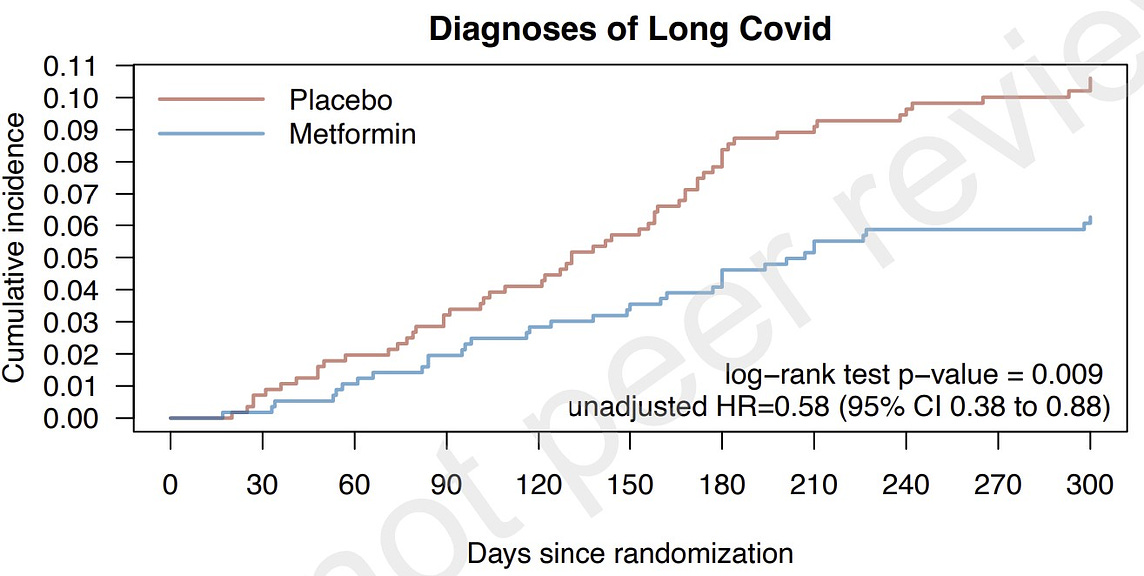
| Cumulative incidence curve of long-Covid diagnoses over 10 months after randomization. Source: Lancet preprint. |
Metformin had a 42% reduced risk in long Covid cases compared to the placebo; 63% reduced risk if taken within four days of symptoms.
For every 100 people who took the drug, four fewer cases of long Covid nine months after infection occurred. Ivermectin and fluvoxamine had no impact.
Why it matters: People should consider Metformin, especially women who are at higher risk for long Covid. It’s best taken within four days of infection. This is a challenging timeframe in the U.S. medical care system, though.
Paxlovid may help… a little?
What we knew: Paxlovid helps reduce severe disease by 50-90%. We didn’t know if it helped with long Covid, though.
New info: Paxlovid reduced risk of long Covid by 26%, regardless of vaccination status and history of prior infection. We need more studies, particularly among young people, as Paxlovid’s effect will likely increase among younger people.
Why it matters: There may be small, proxy benefits from taking Paxlovid, including among younger populations that aren’t “eligible.”
Long Covid is annoyingly stubborn
What we didn’t know: We didn’t know the longevity of severe symptoms.
New info: Among those with long Covid, the rate in which symptoms affected daily life decreased from 45% → 25% over seven months.
Why it matters: If you get severe long Covid, there is a chance that symptoms will get better after seven months. Then again, there’s a chance that they won’t.
What we know: People living with long Covid report profound stigmatization because people disbelieve that long Covid is a “thing.”
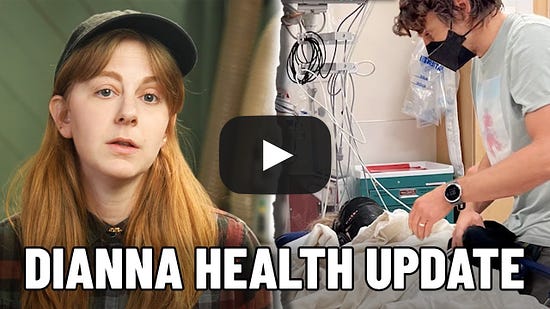
New info: A community member of this newsletter, Dianna Cowarn (also known as Physics Babe on YouTube), was diagnosed with long Covid last summer. Her crew made a 4-minute video. Check it out here if you’re still not convinced. It’s painstaking [and is preceded by commercials].
Katelyn Jetelina (MPH, PhD) is an epidemiologist, data scientist, wife, and mom of two little girls. She works at a nonpartisan health policy think tank and is a senior scientific consultant to the CDC and other organizations.
Wednesday, September 6, 2017
Trump administration says Obamacare ads are no longer necessary, but research in Kentucky says otherwise
The Trump administration said last week that it is is planning to cut the Patient Protection and Affordable Care Act's advertising budget from $100 million to $10 million for the 2018 enrollment season.
Advocates of the law are concerned that the cut, plus a 41 percent cut for the in-person assistance program, will reduce outreach efforts that are critical to enrollment, especially during an enrollment period fraught with uncertainty. Some claimed the cuts are part of an effort to sabotage the program.
U.S. Department of Health and Human Services officials say advertising isn't necessary because most people already know about Obamacare and the money isn't being spent efficiently. HHS officials told reporters in August that they haven't done any "specific study" to prove that, and research argues against the claim.
A Commonwealth Fund study found that 38 percent of Americans who remain uninsured are unaware of the health law's marketplaces. Another study, published in Health Affairs, found increased ACA advertising was associated with increased insurance coverage during the first enrollment period and more recent research, using Kentucky data and summarized on The Incidental Economist, found similar results.
The Kentucky research, conducted by researchers associated with the Robert Wood Johnson Foundation and the Wesleyan Media Project, examined what happened when Kentucky shifted from a supportive Obamacare administration to a hostile one that cut back on outreach.
Under then-Gov. Steve Beshear, a Democrat who embraced Obamacare, Kentucky's uninsured rate dropped from 20.4 percent to 7.5 percent in two years. But when Republican Gov. Matt Bevin took over, "He abruptly cut off the state funding for Obamacare advertising, leading to four weeks of enrollment without any ad support," Scott notes.
Using advertising data from the Wesleyan Media Project and Kynect, the state's now-closed marketplace, researchers compared the first two years of Obamacare, which had robust advertising, to the four weeks without ads.
They found that without TV commercials there were 450,000 fewer page views per week on the Kynect website; 20,000 fewer unique visitors per week to the website; and no notable changes in calls to the marketplace's call center.
"Our analysis tells us that state-sponsored television advertising was a substantial driver of information-seeking behavior in Kentucky during open enrollment –– a critical step to getting consumers to shop for plans, understand their eligibility for premium tax credits or Medicaid, and enroll in coverage," the researchers wrote.
Of note, Obamacare enrollment fell from 106,300 in 2015, under Beshear, to 93,700 in 2016, when Bevin took over during the enrollment period, to 81,200 in 2017, the first full enrollment period under Bevin. Scott adds that Obamacare sign-ups also "tailed off" earlier this year when the Trump administration cut off advertising during the last days of open enrollment.
Friday, August 31, 2012
Kentucky ranks third among the states in child obesity, a problem that has a broad scope and deep roots (first in a series)
![]() |
| (Photo by Tara Kaprowy for Kentucky Health News) |
Kentucky Health News
At every Girl Scouts meeting, Christmas concert, soccer field and swimming pool in Kentucky lies a trend that is easy to spot. It doesn't have to do with the Toms on the children's feet or the feathers affixed to their hair. It's the fact that every third child in Kentucky is overweight, and many of them are obese. As they stand in front of the crowd or struggle to swim to the other side, the problem is plain. Its consequences are not so plan, but are far-reaching.
Kentucky has the third-highest childhood obesity rate in the country and the seventh-highest rate in adult obesity, Trust for America's Health's "F as in Fat" report shows. Sixty percent of Kentucky women and 80 percent of men living the state are either overweight or obese.
![]() |
| CHILD OBESITY RATES from Trust for America's Health |
Obese children can also have breathing problems like sleep apnea and asthma. They struggle with low self-esteem and the depression that can result from it. And they are the first American generation expected to live a shorter life than their parents. "They're taking medicine we used to give to old people," said Duff Holcomb, the schools nurse in Laurel County. "They're 15 and 16, so what are they going to be like when they're 36?"
The issue stems from "a perfect storm" of factors, said Elaine Russell, the state's obesity prevention coordinator. "Our food is high in calories with little nutrients," she said. "A lot of physical education has been taken out of normal daily routines."
And food is everywhere, from billboards to unexpected places like cash registers at T.J. Maxx and Office Depot, Russell said. One study found kids see about 4,000 television commercials advertising food each year. During Saturday morning cartoons, they see a food ad nearly every five minutes, and about 95 percent are pushing food with poor nutritional value. "And it's not just TV," Russell said. "Look at all the billboards, look at the Internet, look at your packaging, with characters that say, 'Come see me and do the Web game.'"
The variety of food is also staggering, Russell pointed out. "Look and see how many Oreos there are. It's not just Oreo or double-stuffed. There's also ones with mint and peanut butter. How many different chips? How many different sodas? Our choices are so unlimited."
![]() |
| Halloween candy displays are already set up in grocery stores, pharmacies and other stores across the state. (Photo by Tara Kaprowy) |
Children adopt bad eating habits from their parents, who "gatekeepers" of the kitchen, Russell said. "If Mom and Dad are feeding you [junk food] then you tend to eat that because that's what available to you."
Parents blame busy schedules and lack of time — and they are busier, in large part because both parents work in most households. Also, many of today's parents either don't like to cook, or can't.
Debra Cotterill teaches cooking classes for the University of Kentucky's Nutrition Education Program and is often shocked at the decline in cooking skills. "There's people out there who have said to me that they literally did not know how to boil water," she said. "I've also met people who live on candy and packaged chips because they don't know how to cook." Ginger Gray, director of food services in Kenton County Schools, was not surprised, saying many of today's parents "are a generation of microwave users."
Exacerbating the problem is a lack of exercise. Gone are the days of students heading to the change room to get ready for gym class. In Kentucky, elementary schools must offer some type of physical activity for 30 minutes each day, but that can include unsupervised recess. There are no physical education requirements in middle schools, and high-school students just need to take one half-credit of phys-ed to graduate. The decline in phys-ed is coupled with the fact that kids lead an increasingly sedentary lifestyle. In Kentucky, nearly one in three high school students watch three or more hours of TV each day and more than 60 percent of kids have a TV in their bedroom.
A lack of play time after school is another culprit, in large part because "There's a lot of media that say it's not safe to go outside and play," Russell said. In fact, just over 100 children are kidnapped in a stereotypical way each year in the U.S., according to the National Center for Missing & Exploited Children, and the number of violent crimes was lower last year than it has been in 40 years. Yet, fear of the unknown is embedded in parents, Gray said, who sees parents waiting in their running cars for their children to be dropped off at bus stops. "What a huge impact changing that attitude would make," she said.
| (Photo by Tara Kaprowy, Kentucky Health News) |
Starting this school year, the state board of education started requiring that there be a place on the state health exam form that includes a student's BMI, though physicians are not required to fill it in. The exams are required when a student enters school in Kentucky, generally in kindergarten, and again when a student is about to enter the sixth grade. "I would say it's a start but this is not a mandate on students or parents or physicians or schools. This is an option," said Lisa Gross, spokeswoman for the Kentucky Department of Education. Still, the BMI information could be shared at the aggregate level if the Department of Public Health asked for it as part of an analysis, Gross said.
But regardless of what data is collected, there is a problem "showing us basically whatever age group you look at, you've got too high of a proportion of children who are overweight and obese," said Amy Swann, senior policy analyst for Kentucky Youth Advocates. Some data show obesity rates are higher in children living in the Appalachian part of the state. Many studies also correlate children from low-income families with higher obesity rates. Giving counties an idea of where they stand is essential to getting a handle on the fight. "There is an old adage that 'what gets measured gets done,' and it couldn't be more true in this case," said Susan Zepeda, president and CEO of the Foundation for a Healthy Kentucky. "Local communities need to know where they stand on this important health issue so they can track progress and really make changes with childhood obesity."
NEXT: What is being done in nationwide, in Kentucky, and in individual communities to address the problem.
Kentucky Health News is a service of the Institute for Rural Journalism and Community Issues, based in the School of Journalism and Telecommunications at the University of Kentucky, with support from the Foundation for a Healthy Kentucky.
Wednesday, January 22, 2020
Ads touting McConnell's record on surprise billing, Medicare for All could be a surprise of their own, since they confuse the issues
![]() |
| This ad promoting Sen. Mitch McConnell conflates the issues of surprise billing and Medicare for All. |
Kentucky Health News
A conservative group has started television and radio commercials in Kentucky and other states thanking Senate Majority Leader Mitch McConnell and others in Congress for blocking legislation that would offer consumers some protection from surprise medical bills.
The TV ad says, "Some politicians are too scared to stand up to the special interests. But not Mitch McConnell. He fights for us, like on health care and surprise medical billing. Special-interest groups have tried to use the issue to implement a government-run Medicare for All scheme, putting our hospitals and care at risk. But Mitch said NO, because he knows how devastating that would be, for us and our children. So, thank you, Mitch McConnell, for putting patients first."
The Taxpayers Protection Alliance said that in December, McConnell "and legislative allies halted attempts by members of Congress such as Sen. Lamar Alexander (R-Tenn.) and Rep. Frank Pallone (D-N.J.) to have the government impose rate-setting in cases of surprise medical billing. Surprise bills occur when patients receive unwanted and unexpected healthcare bills in the mail days or even weeks after a hospital room visit."
Yes, but the surprise-billing issue has little if anything to do with "Medicare for All," one possible exception being that proponents of the latter cite the former as one problem it would solve. TPA says the two are related this way: "Surprise medical billing is only an issue because of rampant government intervention in the medical sector due to Obamacare and Medicare’s disastrous rural price controls. This is a problem that was specifically caused by misguided government intervention. In fact, three-quarters of Obamacare networks are now considered ‘narrow’ with few choices for patients, leading to many patients receiving ‘surprise bills.’"
TPA says its campaign in Kentucky, Kansas, Texas, and New York is intended to thank McConnell "and like-minded lawmakers for standing up for patients and opposing the federal government dictating health-care prices across the country."
This isn't the first time that a group with undisclosed sources of money has tried to mischaracterize the issue of surprise billing. Last summer, a "dark money" group called Doctor Patient Unity ran an ad campaign in Kentucky and other states saying that Alexander's bill would hurt patients and help insurance companies. The campaign targeted McConnell, Sen. Rand Paul and six other senators.
Saturday, June 11, 2022
Pharmacy benefit managers' group ranked No. 7 in spending for lobbying the General Assembly, after laying out $53,634 for ads
|
Kentucky Health News
The lobbying organization for pharmacy benefit managers, the middlemen between insurance companies and drug manufacturers, spent $86,168 in its successful effort to defeat a bill in the recent legislative session that would have reined them in. They prevailed over pharmacists with the help of insurers, who argued that the bill would raise costs.
The Pharmaceutical Care Management Association ranked seventh in spending by lobbying interests in the session that ended in mid-April, mainly because it spent tens of thousands of dollars in television commercials attacking the bill. The ads started the day the bill overwhelmingly passed the House, where a pharmacist-legislator was the sponsor. PCMA said it spent a total of $53,634 on TV, internet and newspaper ads.
The bill got nowhere in the Senate, where President Robert Stivers said "When it got here, we started getting, from business sector and provider sector, various questions and comments about what the overall cost would be to various plans."
Tom Stephens, executive director of the Kentucky Association of Health Plans, cited a state Department of Insurance statement that a family of four would have paid up to $167 more a year for coverage if the bill had passed.
House Bill 457 would have ensured that patients could pick their pharmacy, instead of being required to use one affiliated with a pharmacy benefit manager; increase transparency between insurers and PBMs; and ban PBMs from retroactively denying a pharmacy claim after adjudication, commonly referred to as "clawing back." It passed the House 88-3.
Several other health-care interests, or lobbying groups with interests in health care, were big spenders on lobbying the session, according to their post-session reports. The Kentucky Chamber of Commerce was again No. 1, spending $183,949; the Kentucky Hospital Association was second with $149,046. Third and fourth were the American Civil Liberties Union of Kentucky, whose issues include abortion rights, $128,258, and Altria Client Services (Philip Morris Cos.), $126,793. Insurer Anthem Inc. ranked 10th by spending $70,597.
Tuesday, February 12, 2013
Nursing homes push for lawsuit protection with fast-moving bill and broadcast ads; newspaper editorials excoriate sponsor, industry
• Kentucky currently has about 23,000, mostly frail, elderly people who are residents in about 280 nursing homes. About half the homes have been cited by federal inspectors for a serious deficiency since 2009.
• 40 percent of the homes are rated at below average by the U.S. Center for Medicare and Medicaid Services when it comes to basic health and safety.
• In 2012, Kentucky ranked first in overall federal fines for violations and one Kentucky nursing home racked up the nation’s highest fines for the year.
• Kentucky ranks first in serious nursing home deficiencies that threaten the safety of residents. (Read more)
Sen. Ray Jones, D-Pikeville, who called Denton's move "blatantly wrong." has filed several floor amendments to the bill, which remained in the Senate Rules Committee Monday.
The Kentucky Association of Health Care Facilities is pushing the bill with TV and radio commercials urging calls to legislators. It placed $9,464 worth of ads on Lexington TV stations through Feb. 14.
Thursday, February 3, 2011
Decongestant prescription bill passes panel; both parties split
Fifth District Rep. Harold "Hal" Rogers of Somerset made what the Lexington Herald-Leader called "a rare Frankfort appearance" for the bill, at two committee meetings and a Capitol rotunda rally, but perhaps the rarer event was the contrary testimony of a colleague's spouse -- Pat Davis, wife of 4th District Rep. Geoff Davis of Hebron.
Rogers, accompanied by House Speaker Greg Stumbo, D-Presonsburg, and Senate President David Williams, R-Burkesville, told the Senate Judiciary Committee that prescription laws in Mississippi and Oregon greatly reduced the number of meth labs in those states. "Our future is gravely at stake here," Rogers said. He said he was testifying to counter the heavy advertising and lobbying by decongestant manufacturers, who are running full-page newspaper ads and heavy flights of radio commercials.
The radio ads say the MethCheck electronic tracking system designed to prevent multiple purchases of decongestants for meth making "is working" and "effective," and some law-enforcement officials testified likewise yesterday, "but others in law enforcement said that the number of meth labs in Kentucky has skyrocketed even with MethCheck and that most law enforcement officers find meth labs through regular police work, such as traffic stops, not with MethCheck," Jack Brammer writes for the Herald-Leader.
On the other hand, Pat Davis "told the committee that, as a mother of six and grandmother of one, she is concerned the bill will lead to more trips to the emergency room and to the doctor," Brammer reports. Davis said all her children have allergies or asthma, and "This will drive already high medical costs higher."
The two Republican senators on the committee from Davis's district, Jack Westwood of Erlanger and John Schickel of Union, voted against the bill, along with Democrats Perry Clark of Louisville and Jerry Rhoads of Madisonville. Voting for the bill were four Republicans Carroll Gibson of Leitchfield, Tom Jensen of London, Robert Stivers of Manchester and Dan Seum of Louisville, and Democrats Ray Jones of Pikeville and Robin Webb of Grayson.
The division among Republicans appeared to short-circuit Williams' plan to have the full Senate vote on the bill later in the day. No vote was held. (Read more) Jessie Halliday of The Courier-Journal expects a Senate vote next week. (Read more)
Tuesday, November 17, 2015
Myths about colds abound; here's good advice: wash your hands to prevent infection, and if you get a cold, chicken soup can help
1. Colds can be spread only if someone sneezes or coughs. Actually, direct contact with a cold sufferer "is even more likely to make you sick, whether or not they cough near you," Frayha writes. "Several major studies have shown that hand-to-hand touch is the most common way to spread rhinovirus, the family of viruses that causes most colds. One of these studies . . . also demonstrated the importance of hand hygiene — it recommended applying a liquid iodine solution to the fingers, though soap works well, too — in reducing the spread of the virus."
You can get a cold from someone else's sneeze even if you aren't around. "Viruses can live on furniture, toys, phones and other common household or office surfaces for several hours," Fyarha writes. "A study in the American Journal of Epidemiology in 1982 showed that when young, healthy adults touched either coffee-cup handles or plastic tiles that had been contaminated with rhinovirus, and then touched their faces, half of them came down with a cold. Fewer of them became sick if they touched a plastic tile that had been sprayed with a disinfectant."
2. Hand-sanitizing gels are as effective as hand-washing to prevent the spread of the cold. "If given a choice between washing with soap and water or coating your hands in a dollop of sanitizer," Frayha writes, "the old-fashioned soap-and-water combination is the safer bet. Sanitizing gels don’t work well if your hands are visibly dirty. And they must contain at least 60 percent alcohol to reduce the spread of diseases such as the cold, but some varieties at your local pharmacy contain significantly less."
3. Air travel increases your risk of catching a cold. "There is no evidence that air travel makes us any sicker than our normal working environments on the ground," Frayha writes. "A large study published in the Journal of the American Medical Association in 2002 showed that traveling in a commercial aircraft with recirculated air did not increase the risk of catching a cold compared with flying in a plane that pumped in fresh air."
4. Colds cause fevers. Usually not in adults. "Fever is listed as a symptom of the common cold in television commercials for over-the-counter remedies . . . and in young children, fever is common in most upper respiratory infections," Frayha writes, but in adults, "fever — defined as a temperature of 100.4 degrees Fahrenheit or higher — is actually very rare in rhinovirus infections. It is much more common for a cold to cause a sore throat, a stuffy and/or runny nose, sneezing and cough, but with a normal body temperature. If you have these symptoms plus a fever, then you and your health-care provider should think about other possibilities, including strep throat, sinusitis, pneumonia or the flu. A true fever often means something else is going on in your body."
5. Home remedies such as chicken soup don’t work. "In 2000, researchers at the University of Nebraska studied homemade chicken soup and found that it had anti-inflammatory benefits, which can ease cold symptoms," Frayha writes. "Chicken soup exerted an anti-inflammatory effect — which could help a person feel better faster." She cautions, "There are dozens of home remedies that are said to help speed up recovery: ginseng, zinc, vitamin C, neti pots. There is little evidence to support them; some can even be harmful (for example, some zinc formulations can lead to permanent loss of smell)."
Monday, February 26, 2018
$100,000 advertising campaign for cigarette-tax hike will remind Kentuckians of the damage done to them by smoking
![]() |
| Screenshot of opening segment of one TV commercial |
Kentucky Health News
Kentuckians will be being reminded of their state's suffering from smoking in a way not seen before, a $100,000 advertising campaign advocating a $1-a-pack increase in the state cigarette tax.
Television commercials, billboards, digital media and print ads from the Coalition for a Smoke-Free Tomorrow use health concerns as the reason to raise the 60-cent tax to $1.60, which would be the same as Ohio's but less than Indiana's 99.5 cents and Tennessee's 62 cents. The ads are to run through March, when the General Assembly will deal with the state budget and a shortage of revenue.
"Kentucky is the cancer capital of the nation," one TV spot begins. "Isn't changing this fact worth a dollar more?" Those last three words are the theme of the campaign, which calls on Kentuckians to learn more on the coalition's website and then ask legislators to vote for the tax increase. Another spot cites estimates the hike would reduce smoking enough to improve the health of 1,180 babies.
"Nearly 21 percent of Kentucky women smoke cigarettes during pregnancy, double the national rate," the coalition noted in a news release. "The rate exceeds 30 percent in 35 Kentucky counties, and 40 percent in four counties. Among high school-aged youth, 14.3 percent smoke, compared to a national rate of 8 percent."
The ads are part of a lobbying contest with tobacco manufacturers, who have enlisted tobacco farmers and convenience stores as allies. Kentucky has fewer than 5,000 tobacco growers, but its long history of tens of thousands of small farmers raising tobacco has left a lingering resistance to anti-tobacco measures in the General Assembly.
Voters seem less reluctant. The coalition notes a December poll done for it by Mason-Dixon Polling & Research, which found that 69 percent of Kentucky voters supported raising the tax $1 per pack. Support rose to 73 percent when voters were told that the tax hike would generate an estimated $266 million a year and save even more in health-care expenses by reducing smoking.
The coalition says it has more than 150 business, health, education, faith-based and advocacy organizations, led by the Foundation for a Healthy Kentucky, "working together to reduce tobacco use and exposure to secondhand smoke in Kentucky." It notes that the surgeon general has called raising cigarette prices "one of the most effective tobacco-control interventions," especially among people under 18 and those with low incomes.
The $1 increase would be much more than the last one, in 2009, when the tax was raised from 30 cents. Advocates say the increase must be at least $1 per pack, because experience in other states has shown that "tobacco companies will undermine the price impact of a lesser tax increase with coupons and other discounts," said Amy Barkley of the Campaign for Tobacco-Free Kids.
Tuesday, April 9, 2013
To keep kids from getting fat, use smaller plates and portions, limit TV viewing and make sure they get 10 hours of sleep a night
In Kentucky, almost 18 percent of middle-school-age children and 16 percent of elementary-age kids are obese, and every third child born who was in the U.S. in 2000 will develop Type 2 diabetes if current trends continue, says a recent report from the University of Kentucky's College of Public Health.
The three suggestions are based on three new studies in the April issue of Pediatrics.
One study found first-graders served themselves larger food portions and consumed almost 50 percent of the extra calories they put on their plates when using adult-sized dinner plates instead of child-sized salad plates, reports Michelle Healy of USA Today.A second study examined the relationship between heavy use of media and increased body mass index, a measure based on height and weight that can classify someone as being overweight or obese. It found that TV usage is the most problematic and leads to higher BMI scores, reports Healy. One reason for this may be that TV advertising includes commercials for unhealthy snack foods. Or, perhaps kids are missing out on exercise because they watch so much TV.
A new sleep study adds to research saying that insufficient sleep may contribute to the rise in adolescent obesity because it changes hormone levels that could lead to overeating and weight gain, reports Healy.
These findings support existing recommendations to help children attain and keep a healthy weight according the UK report. Portion sizes should be a third of adult portions for younger children and two-thirds of adult portions for older children; children's TV screen time should be limited to two hours per day; and children should get 10 hours of sleep each night.
Monday, February 14, 2011
As meds-for-meth bill languishes, some seek compromise, but bill's sponsor says proposals would render it ineffective
Institute for Rural Journalism and Community Issues
As the bill to require prescriptions for three widely used decongestants remains short of votes to pass the Senate, there is talk of a compromise measure to thwart the use of the medicines for making methamphetamine. But the bill's sponsor says he is not open to the compromises he's heard.
Lobbyists for drug manufacturers are circulating alternative proposals, such as applying the prescription rule only to the estimated 5,500 people convicted of a drug-related crime. Another industry proposal would cut the annual non-prescription purchase limit by more than half, from 108 grams per year to 50.
A Senate committee approved the bill on a 6-4 bipartsan vote last week, but the full Senate has passed over it for more than a week, and Jensen acknowledged in today's interview that it lacks the votes to pass.
He said manufacturers of the 15 cold remedies "have spent a tremendous amount of money opposing it and getting a lot of misinformation out there ... We, unfortunately, don't have the funds to get out and make full-page ads and radio statements and TV commercials that say 'That's just not true.'" For example, the ads say the registration and tracking system is effective, but the law-enforcement officers on the radio show last week said it is not.
Opponents of the bill say having to get prescriptions would increase costs for cold and allergy sufferers, and meth makers would simply cross state lines to get their supplies. The opponents are backed not only by heavy spending, but by the Kentucky Chamber of Commerce. The Chamber has suggested "banning all online retail sales, distribution and shipment of products containing ephedrine and/or pseudoephedrine from non-Kentucky licensed pharmacies to individuals in Kentucky."
Rep. David Floyd, R-Bardstown, filed a bill last week to make the pill forms of the three substances “legend” drugs, those that are "available through the determination of a pharmacist or by prescription," reports The Kentucky Standard of Bardstown. "It would not be classified as a controlled substance." The bill would also prohibit purchases of any of the three medicines by anyone under 18 without a prescription.
“While many of us are sympathetic to those who have been adversely affected by the meth trade in Kentucky, I don’t believe making pseudoephedrine only available via a doctor’s prescription will curtail the meth problem in our commonwealth,” Floyd said in a press release. “By placing more responsibility on pharmacists who already have a monitoring system for pseudoephedrine sales, we can gain better control on those who are purchasing the product to make meth while not punishing those who need pseudoephedrine for legitimate health purposes.”
Floyd's House Bill 376, which he said he wrote after consulting with Bardstown pharmacists, would allow pharmacists to dispense the drugs to "a person evidencing physical symptoms treatable by those products," according to the bill summary, and "would require pharmacists to ask a series of questions to those trying to purchase a pseudoephedrine product," the Standard reports. It would also require thrm to put the information into the state's electronic tracking system for prescriptions.
"Local pharmacist Leon Claywell already uses a screening system to determine why a customer is buying medicine containing pseudoephedrine, Floyd said. If he thinks it is not for a legitimate purpose, he refuses to sell it," the Standard reports.
Thursday, April 7, 2022
Beshear and Senate president discuss medical marijuana, hero pay; Stivers says PBM bill stuck in Senate over cost concerns
By Melissa Patrick
Kentucky Health News
FRANKFORT — State Senate President Robert Stivers said he favors funding more research on medical marijuana before making it legal in Kentucky, but Gov. Andy Beshear says medical cannabis has overwhelming support in the state and should pass when the legislature returns to reconsider vetoed bills.
At separate press conferences in Frankfort Thursday, the two leaders also discussed the Republican legislature's rejection of the Democratic governor's plan to give Kentuckians who worked throughout the pandemic a "hero bonus;" and Stivers said a House bill to rein in pharmacy benefit managers died in the Senate for fear it would raise consumers' and employers' costs.
Medical marijuana: Stivers said the House-passed cannabis bill "would be difficult" to pass the Senate next week, but he supports a bill by Rep. Kim Moser, R-Taylor Mill, to create a cannabis research center at the University of Kentucky and expects it to pass. "I think it not only would be good locally but nationally and internationally to understand the medicinal and therapeutic values of marijuana," he said.
![]() |
| Senate President Robert Stivers |
Stivers acknowledged that studies show cannabis helps with certain medical conditions, "but every study I've read said the sample sizes have been too small, the duration is too long and therefore more study is needed."
Moser's House Bill 604 has had two of its three required readings, so it could clear the Senate Appropriations and Revenue Committee and the full Senate quickly on April 13 and/or 14.
Beshear urged the legislature to pass the medical-cannabis bill in those two remaining days, which would require suspension of the three-readings rule. "Its time has certainly come."He added, "Kentuckians deserve the passage of a medical-marijuana bill. They overwhelmingly support it. When 70-plus percent of a state is in favor of something, it's time for the General Assembly to step up and do something about it. Represent the people."
Asked later if he could do anything by executive order to make it easier for people with certain conditions to have access to medical cannabis, Behsear said, "We're going to explore that. . . . I am for medical marijuana and I will continue to push it until we make it a reality."
The House passed its cannabis bill, HB 136, by a vote of 59-35, with just over half of the Republicans who voted on the bill favoring it. A similar bill passed the House in 2020 but died in the Senate.
Pharmacy benefit managers: House Bill 457 would ensure that patients could pick their pharmacy, instead of being required to use one affiliated with a pharmacy benefit manager; increase transparency between insurers and PBMs; and ban PBMs from retroactively denying a pharmacy claim after adjudication, commonly referred to as "clawing back." It passed the House 88-3.
The bill was opposed by one of the session's heaviest lobbying campaigns. The Pharmaceutical Care Management Association, the PBM trade group, spent $38,369 to get its message to lawmakers before March, when it ran television commercials urging voters to ask their legislators to defeat it.
Stivers said it had been assigned to the Appropriations and Revenue Committee "because it has potential fiscal impact -- local, individual, personal and state fiscal impact." He indicated that the bill would not pass, since that would require suspension of the three-readings rule, and more education would be needed among Republican senators about what it would do.
Hero bonuses: Stivers said the General Assembly took a different approach to hero bonuses that he said would benefit everybody, mainly because it was too hard to determine just who would qualify for bonuses. He said the legislature is giving income-tax reductions and workforce incentives, and investing in infrastructure and higher education.
![]() |
| Gov. Andy Beshear |
"I believe this legislature needs to spend some of the last two days including hero bonuses. They deserve those hero bonuses. . . . I think it's really disappointing."
Health bills become law: Beshear signed three more health-related bills into law Thursday.
House Bill 525, sponsored by Moser, would allow Medicaid to pay certified community health workers. CHWs aren't trained medically, but are trained as patient advocates who come from the communities they serve. They help clients coordinate care, provide access to medical, social and environmental services, work to improve health literacy, and deliver education on prevention and disease self-management.
Senate Bill 10, sponsored by Sen. Robby Mills, R-Henderson, addresses the nursing shortage with both short-term and long-term solutions, including streamlining the process for out-of-state and foreign trained nurses to practice in Kentucky without compromising the standards of care; improving access to nursing education by removing "arbitrary" enrollment limits without compromising the quality of the programs; and adding term limits and geographic requirements for the Board of Nursing.
Senate Bill 105, sponsored by Sen. Max Wise, R-Campbellsville, will increase awareness and screenings for the cytomegalovirus (CMV), a virus that can cause childhood deafness and other health conditions. Most CMV infections are not diagnosed without newborn screening, resulting in missed opportunities for needed care. It is titled Bella Dawn Streeval’s Law, after a woman who died two years ago Thursday after suffering from CMV.
Friday, April 1, 2022
Latest bill to aid independent pharmacies stalls in Senate after running into one of the session's heaviest lobbying campaigns
By Melissa Patrick
Kentucky Health News
FRANKFORT – The latest bill to help independent pharmacies compete with pharmacy benefit managers sailed out of the House with overwhelming support but came to a resounding halt in the Senate. No one is saying why, but the PBMs mounted one of the session's heaviest lobbying campaigns.
PBMs determine what drugs are offered in insurance plans, where and how a patient gets their drugs, how much is paid for the drug, and how much the pharmacist gets. The leading PBM in Kentucky is CVS Caremark, a sister company to one of the nation's largest pharmacy chains.House Bill 457 passed the House 88-3 on March 21, with 56 sponsors. The next day it went to the Senate Appropriations and Revenue Committee, not a usual location for such a bill, and never got a hearing. It has had none of its regularly required three daily readings, and only two legislative days remain.
Key parts of the bill would ensure that patients could pick their pharmacy, instead of being required to use one affiliated with the PBM; increase transparency between insurers and PBMs; and ban PBMs from retroactively denying a pharmacy claim after adjudication, commonly referred to as "clawing back." Opponents say the bill would raise costs for consumers.
![]() |
| Rep. Steve Sheldon, R-Bowling Green |
Those companies' heavy lobbying efforts appear to have worked.
The Pharmaceutical Care Management Association, PBMs' trade group, was one of the state's top 10 lobbying spenders in the first two months of the legislative session, spending $38,369 to get their messages to lawmakers, according to reports they filed with the Kentucky Legislative Ethics Commission.
That ranked the PCMA ninth in spending, and it seems likely to end the session at a higher rank, because it spent thousands of dollars from March 21 to April 1 on television commercials asking viewers to contact their legislators and ask them to vote against HB 457, saying it would raise drug prices.
Sheldon fought back on his Facebook page March 28, pleading with senators to consider the bill.
"I would appreciate the Senate looking at HB 457," he said. "We are down to 2-3 days … I realize bills that inject millions back into Kentucky and allow our seniors patient choice are not as glamorous as the status quo, but please take a real close look at this. Don’t let your Kentucky dollars get mandated by PBMs out of state while our seniors wait by the mailbox for their medicine !! Don’t believe the lies, propaganda and rhetoric. It’s not TOO late."
The only group that appeared to spend money lobbying in favor of the bill through February was EPIC Pharmacies, a nonprofit buying group for independent pharmacies, which reported spending $7,416. Lobbying groups' spending reports for March are due April 15.
CVS Health reported spending $21,528 through February. In a statement dated March 21, it said, "House Bill 457 will only increase the costs of prescription drugs in Kentucky, making it more difficult for Kentuckians to access affordable medications. Dozens of Kentucky employers are opposed to this bill because it does not help control the cost of prescription drugs and hurts their employees. We urge the Senate to reject HB 457. We should protect consumers from increased health care costs, and lawmakers should focus on the high prices set by big drug companies."
The Kentucky Association of Health Plans, comprising companies selling health insurance in the state, reported spending $11,316 on legislative lobbying through February, and the Kentucky Association of Health Underwriters reported spending $5,000. Both spoke against the bill in a House committee.
Individual insurance companies, which have a wide range of interests, also opposed the bill. Anthem Inc. and its affiliates reported spending $35,597 on lobbying in the first two months, ranking 11th; United Healthcare reported spending $14,000.
Senate Appropriations and Revenue Committee Chair Sen. Chris McDaniel, R-Ryland Heights, did not respond to several e-mails from Kentucky Health News asking why he did not give the bill a hearting.
Angela Billings, spokeswoman for the Senate majority, said in an e-mail that she had reached out to McDaniel with the question and that it would have to be "tabled" until the General Assembly returns April 13 to reconsider bills and budget lines vetoed by Gov. Andy Beshear.
"I daresay that he was extraordinarily busy with the budget and could not get to many bills worthy of hearing," Billings said.
Sen. Max Wise, R-Campbellsville, who has been instrumental in getting PBM-control bills passed in prior legislative sessions, said he didn't know why this one hadn't moved in the Senate, but said in a text message, "I do support the concept and the language of HB 457." Asked if it was discussed in Republican senators' private caucus, he said, "Policy discussions stay within the caucus."
Kentucky lawmakers have been working on PBM issues for years, most recently passing 2020 Senate Bill 50 to make the state hire a single PBM to manage Kentucky Medicaid's prescription-drug business of more than $1 billion a year. A 2019 state analysis found PBMs made $123 million through spread pricing.
During the bill's House hearing, Sheldon, a pharmacist and businessman who is not seeking re-election, said it had taken three years of collaboration to produce, with upwards of 20 organizations supporting it. Not all of them lobby.
Lobbying groups must list the bills on which they are lobbying, but not whether they are for or against them. Other than those above, those that listed HB 457, and their total expenses between Jan. 1 and Feb. 28, were: American Pharmacy Services Corp., $550; Appalachian Regional Healthcare, $10,209; Chewy Inc., $10,000; Ford Motor Co., $17,500; GE Appliances, $5,000; St. Elizabeth Healthcare of Northern Kentucky, 16,358; and University of Louisville Health, $6,000.