Tuesday, May 3, 2011

Legislators need to help cities tackle pill abuse, mayor says

Winchester's mayor is displeased with the Kentucky attorney general's recent finding that local governments do not have the right to ban pain clinics within their borders. "The opinion carries no legal authority, but it does represent a major roadblock for local governments," Ed Burtner writes. "It highlights the fact that local officials are limited to a reactive role in addressing the problems associated with prescription drugs abuse. That's unacceptable."

The Kentucky League of Cities supported three bills this year that would have regulated "pill mills," notes Burtner, who is on the league's executive board. None made it out of committee. "City officials throughout the state are committed to working with legislators, the Kentucky Medical Association and other interested parties to develop legislation that tackles prescription drug abuse head-on," Burtner wrote.

According to the Kentucky Office of Drug Control Policy, the abuse of prescription pain relievers in Kentucky is second only to marijuana. Prescription drug-related offenses increased by more than 13 percent in 2008. (Read more)

Monday, May 2, 2011

Adair hospital board broke meetings law, attorney general finds

Adair County Hospital's board of directors was wrong to hold a closed-session discussion about the future of an interim CEO because the discussion was about his retention, not posible discipline or dismissal, the Kentucky attorney general's office found. It also concluded the hospital board did not have sufficient cause to discuss a report by Spectrum Health Partners in private.

Adair County Community Voice Publisher Sharon Barton submitted a written complaint to the board chairman March 30 alleging the violations. To remedy the matter, she asked for a copy of the PowerPoint presentation that had been viewed during the meeting as well as any minutes, notes, records and any other documents that had been reviewed.

The board replied that it was "clearly entitled to discuss this issue in executive session" because it was a personnel issue and so exempt from public discussion.

Assistant Attorney General Amye Bensenhaver disagreed, saying the personnel exemption applies only to discussions that might lead to the appointment, discipline or dismissal of an employee, member or student. "This exception shall not be interpreted to permit discussion of general personnel matters in secret," she wrote. "The board acknowledges that the closed session discussion focused on securing the continued employment of the interim CEO and not on reviewing the comparative qualifications of competing applicants for the purpose of identifying the best qualified applicant to fill a vacant position. Although the potential for reputational damage exists where several individuals apply for a position and some must be eliminated based on their lesser qualifications, such potential does not exist where the discussion relates to the continued employment of a current employee."

Bensenhaver also said the board should not have discussed the Spectrum report in closed session. The board was obligated to give notice "in regular open meeting ... of the general nature of the business to be discussed in closed session," she wrote. In correspondence, the board said that the report "contained information on specific individuals that might lead to discipline or dismissal" or might lead to litigation. "Even with this additional information, we believe the board's ... compliance fell short of the statutory requirements," Bensenhaver wrote.

Ambulance providers raising fees to deal with rising costs

Ambulance services are being forced to raise their fees in order to pay the bills, USA Today's Greg Latshaw reports. "Ambulance providers nationwide are coping with rising costs, decreased support from local government, low Medicare reimbursement rates and a jump in the number of uninsured Americans," Stephen Williamson, president of the American Ambulance Association, told Latshaw.

Medicare reimbursement rates were between 6 and 17 percent below cost, a 2007 report by the Government Accountability Office showed. Since, that gap has grown even wider. Moreover, in the past 18 to 24 months, far more people are using ambulance services who don't have health insurance. "We're having to raise the rate on everyone else because of the people who don't have insurance," said Steve Weigland, director of servicing for the International Association of EMTs and Paramedics. (Read more)

Friday, April 29, 2011

New regs could change way food industry markets to children

"The federal government proposed sweeping new guidelines on Thursday that could push the food industry to overhaul how it advertises cereal, soda pop, snacks, restaurant meals and other foods to children," The New York Times' William Neuman reports.

The guidelines, which were released by the Federal Trade Commission, target TV commercials, print ads, websites, product placement in movies, kids meals at fast food restaurants (Getty Images photo by David Paul Morris) and online games that serve to promote a product. "The inclusion of digital media, such as product-based games, represents one of the government's strongest efforts so far to address the extension of children's advertising into the online world," Neuman reports.

"Our proposal really covers all forms of marketing to kids, and the product packaging and the images and themes on the cereal boxes have tremendous appeal to kids," said Michelle K. Rush, a trade commission attorney. "The goal is to encourage children to eat more healthy foods because obesity is a huge health crisis."

Advertised food would have to be made of healthy ingredients, such as whole grains, fresh fruit and vegetables, or skim or 1 percent milk. They could not have high amounts of sugar, trans fats, salt or saturated fat. Cereals would only be able to have 8 grams of sugar per serving — they now often contain 12 grams — and salt would be limited to 450 milligrams per serving in packaged foods. A 15-ounce can of Chef Boyardee beef ravioli now has 750 milligrams.

Following the guidelines will be voluntary, but there will be pressure for companies to adopt them, Neuman reports. Those that elect to do so will have five to 10 years to revamp their products and marketing strategy.

A recent study in the American Journal of Public Health found that in 1997 to 2002 the average child saw about 4,000 television commercials advertising food each year. During Saturday morning cartoons, kids saw a food ad about every five minutes. Of that food advertised, about 95 percent of it was of poor nutritional value. In 2006, food companies spent almost $2.3 billion in children's advertising, the Federal Trade Commission found.

In response to the new guidelines, the food industry said it has "already taken significant steps to improve recipes and change the way it advertises to children," Neuman reports. (Read more)

National campaign targets distracted driving

With the aim of raising awareness about the dangers of distracted driving, national public-service campaign "Decide to Drive" kicked off this month.

With former boxer Joe Frazier as spokesman, the campaign features a website, as well as posters, postcards and displays for surgeons to use to educate their patients. "The goal is to get people to think before they do something dangerous behind the wheel, such as using a cellphone, sending a text, eating or even reaching for a child's toy," The Courier-Journal's Darla Carter reports.

The undertaking is funded by the American Academy of Orthopaedic Surgeons and the Orthopaedic Trauma Association. Orthopedic surgeons can mend a lot, but "there are some injuries you just can't make normal," said Dr. Marc Zussman, who practices in Rockford, Ill.

In 2009, 5,474 people died nationwide and another 448,000 were hurt in accidents thought to have involved distracted driving. In 2010, more than 54,000 accidents took place in which distracted driving was believed to be a factor. In July, it became illegal to text while driving in Kentucky. Drivers under the age of 18 cannot use cell phones at all while their vehicle is moving. As of January, texting and teen drivers can be stopped and fined for the violations.

To combat the issue, "a change in the entire safety culture is needed," as occurred with seat-belt awareness, said Boyd Sigler, director of the Kentucky Office of Highway Safety. (Read more)

Thursday, April 28, 2011

More county-specific health data are available, painting detailed pictures of your local area's health

Five years' worth of county-specific data are now available for many types of health indicators on the Kentucky Health Facts website. The site features data on demographics, social and behavioral indicators, health outcomes, access to care, and maternal and child health, much of which can be useful to journalists all over Kentucky.

The Health Outcomes category, for example, looks at a county's premature-death rate, motor-vehicle deaths, prevalence of asthma, diabetes prevalence and cancer deaths. The Maternal and Child Health category looks at adequacy of prenatal care, infant mortality rates, teen birth rates and prevalence of youth who smoke cigarettes. It compares that data to the rest of the state and nation.

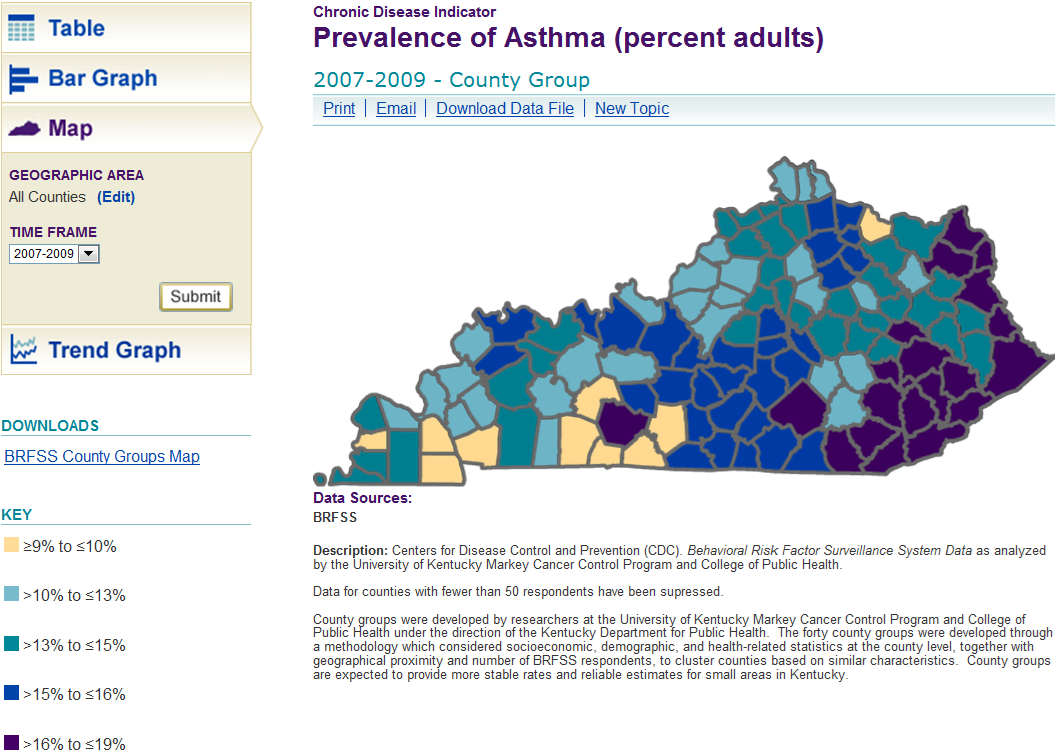
The data paint a detailed picture of what is happening in a specific area. One interesting nugget in the newly updated data on asthma show that in Warren County (Bowling Green), the percentage of adults with the respiratory condition has nearly doubled from 10 percent in 2003-05 to 19 percent in 2007-09. Here is the county asthma map:
The data come from the Centers for Disease Control and Prevention's Behavioral Risk Factor Surveillance System, which is the world's largest ongoing telephone health survey. It has tracked health conditions and risk behaviors in the United States on an annual basis since 1984.

The data can be viewed by going to www.kentuckyhealthfacts.org or by clicking here. Kentucky Health Facts is a service of the Foundation for a Healthy Kentucky.

High gas prices = fewer traffic accidents, including DUI mishaps

There is one benefit to gasoline prices reaching nearly $4 a gallon: The rate of traffic accidents, including drink-driving accidents, goes down as gas prices go up.

These were the findings in a study by Mississippi State University's Social Science Research Center, which "analyzed total traffic crashes between April 2004 and December 2008, comparing gas prices to traffic safety statistics," research reporting service Newswise reports. SSRC demographer Guangquing Chi looked at factors including age, gender and race.

"The results suggest that prices have both short-term and intermediate-term effects on reducing traffic crashes," Chi said. The short-term impact involves younger drivers. Intermediate-term impact is related to older drivers and men. Short-term impact "refers to immediate effects, for example how a current month's average gasoline prices affect the same month's traffic crashes. Intermediate-term impact refers to effects over a one-year subsequent time period," Newswise reports. (Read more)

Diabetic youth have medical costs of more than $9,000 a year

Children who have diabetes incur medical costs of more than $9,000 a year, a number that is six times greater than for children who don't have the disease, a new study by the Centers for Disease Control and Prevention has found.

Most of the expenses are for prescription drugs and outpatient care. "Most youth with diabetes need insulin to survive and the medical costs for young people on insulin were almost 65 percent higher than for those who did not require insulin to treat their diabetes," said Ann Albright, director of CDC's Division of Diabetes Translation.

Type 1 diabetics cannot produce insulin and so must receive insulin treatment. Type 2 diabetics, whose bodies no longer handle insulin properly and slowly lose the ability to make it, are generally treated with oral medications that control glucose levels in the blood. More than 90 percent of young diabetics are on insulin. Type 2 diabetes is extremely rare in children younger than 10 years of age. It is infrequent in children and teens 10 to 19 years old.

The study looked at medical costs for children and teens less than 20 years of age who were covered by employer-sponsored private health insurance plans in 2007. Estimates were based on administrative claim data from almost 50,000 children, including 8,226 diabetics. (Read more)

More than half of Ky. 18-to-24-year-olds have a weight problem

"More than half of 18-to-24-year-olds in Kentucky are overweight or obese — the highest percentage in the nation," The Courier-Journal's Laura Ungar reports. Their weight is not only bad for their health, but limits their ability to serve effectively in the military. (C-J chart)

These findings come from a report called "Too Fat to Fight," released Wednesday and compiled by Mission: Readiness, whose members are retired generals and other high-ranking military officials concerned about the physical fitness of the services' recruitment pools. The reports shows 51 percent of young adults in Kentucky were either overweight or obese in 2007-9, up from 38 percent in 1997-99. Nationwide, only about 1 on 4 17-to-24-year-olds were too heavy to serve in the military.

Another report released by the U.S. Centers for Disease Control and Prevention looked at what is being done to fight the obesity epidemic in each state, by examining behavioral indicators and environmental factors. The report showed nearly 36 percent of Kentucky students, such as those at Bloom Elementary in Louisville (C-J photo by David R. Lutman), drink at least one soft drink a day, compared to 29.2 percent nationwide. More than 68 percent of Kentucky middle and high schools allow the advertising of unhealthy foods, compared to 49 percent nationwide.

Both reports concluded schools can play a key role in helping children lose weight. "Mission: Readiness urges Congress to help upgrade school equipment such as freezers, ovens and salad bars and train cafeteria workers to prepare meals with fresh ingredients," Ungar reports. (Read more)

New network including UK, Ohio State and Marshall joins leading researchers to address health issues in Appalachia

Seven academic centers and community organizations have come together to pool their resources and improve the health of Appalachian residents. They have formed the Appalachian Translational Research Network, which includes experts representing The Ohio State University, the University of Kentucky, Marshall University and the Appalachian Regional Commission.

"The causes of health issues in this region are multifactorial — poverty, education, access to care," said Kelley Kelleher, director of the Community Engagement Program at OSU's Center for Clinical and Translational Science. "A collaborative approach that pairs experts from many different specialties with organizations already working within the Appalachian community will help us reach better solutions faster."

"We are dedicated to seeing this region escape from being one of the sickest parts of America," said Phillip Kern, director of UK's Center for Clinical and Translational Science and Barnstable Brown Diabetes and Obesity Center.

Experts with the ATRN were among those who organized and attended the recent Appalachian Health Summit. It focused on the obesity epidemic, a major chronic health issue in the region. It also featured many research projects related to or complicated by obesity, including one to evaluate web-based smoking cessation programs with teen smokers; one using church communities to address obesity; and one to establish more than 60 diabetes community collaboratives in nine Appalachian states.

Appalachia runs from southern New York to northern Mississippi. With a population of 24.8 million, it stretches across all of West Virginia and part of 12 other states, including 54 Kentucky counties. Residents of many Appalachian counties are three times more likely to die from diabetes than others either living in the same state or in non-Appalachian states, Centers for Disease Control and Prevention numbers show.

Wednesday, April 27, 2011

Oldham faith-based clinic to reopen under oversight of nonprofit

A clinic that was the only one of its kind in Oldham, Henry, Trimble and Carroll counties will reopen under the oversight of a nonprofit organization. The facility, formerly known as the Community Care Clinic, will be re-christened the Hope Health Clinic. It will serve patients who do not have health insurance. Before it closed due to a $30,000 deficit, the clinic served about 700 people a year. A group of church leaders will form the nonprofit agency, which will be called the Oldham County Ministerial Association, The Courier-Journal's Andrea Uhde Shepherd reports.

The clinic will be in the same space off New Moody Lane, which will be leased to the nonprofit agency by Baptist Hospital Northeast for $1 a year. La Grange Baptist Church Executive Pastor Rick Davidson said he "hopes to run the clinic on donations from residents, churches, civic groups and businesses," Shepherd writes. Most of the staff will be volunteers. The facility will be modeled after Mercy Medical Clinic in Shelbyville, a faith-based facility that serves 2,300 people. (Read more)

Kenton Co. smoking ban yields 15 complaints; citations next?

There have been 15 complaints to the Northern Kentucky Health Department since Kenton County's smoking ban took effect nearly two weeks ago. Because enforcement does not take effect until next week, no one has been cited yet, Cindy Schroeder of the Kentucky Enquirer reports.

The ban went into effect after the outgoing Kenton Fiscal Court approved the ordinance in December. It bans smoking in most workplaces, including "restaurants, churches, factories, offices, bingo halls, bowling alleys and stores," Schroeder reports. It does allow exemptions for bar and private clubs. So far, 65 drinking establishments and five private clubs have applied for exemptions, 62 of which have been approved.

The biggest the challenge to the health department so far has been to inform owners what they need to do to comply with exemption requirements. "Those include having a separate enclosed smoking section with its own air system and its own entrance," Shroeder wrote. "Also, no one under 18 can be employed or admitted." (Read more)