Friday, July 8, 2022

Commission that will allocate money from state's settlement with opioid companies will hold its first meeting Tuesday

The first meeting of the commission that will allocate half the money from the state's settlement with opioid companies will be held at 1 p.m. ET Tuesday in Frankfort.
    
The 11-member Kentucky Opioid Abatement Advisory Commission will meet in the attorney general's offices at 1024 Capital Center Dr., Suite 200. The meeting is open to the public, and will be livestreamed here.

Katie Marks, Ph.D.
The meeting agenda is available here. It includes a presentation from commission member Van Ingram, director of the state Office of Drug Control Policy, and Katie Marks of the University of Kentucky, project director of the Kentucky Opioid Response Effort, which oversees federal grants.

The state will get $483 million from the settlement. State government will get half and local governments will get the other half.

Thursday, July 7, 2022

CDC: 37 Kentucky counties are at high risk of Covid-19 and 44 at medium risk; many have been at highest risk level for weeks

Centers for Disease Control and Prevention map shows estimated risk.
By Melissa Patrick
Kentucky Health News

The Centers for Disease Control and Prevention estimates that just over two-thirds of Kentucky counties have an elevated risk of coronavirus transmission, with many of them at high risk for more than three weeks in a row. 

Thirty-seven counties are orange on the latest CDC risk map, indicating a high level of risk. That's down from 43 on last week's map, but several counties are newly orange.

Forty-four counties are yellow, indicating a medium level of risk. Last week, 35 were yellow. 

The rankings are based on new coronavirus cases, hospital admissions and hospital capacity.

Two Kentucky counties have been orange for seven consecutive weeks: Greenup and Boyd. Eight have been orange for five weeks in a row: Lyon, Livingston, Woodford, Fayette, Wolfe, Breathitt, Leslie and Perry. And nine have been orange for three weeks in a row: Hickman, Carlisle, Ballard, Graves,  McCracken, Marshall, Crittenden, Powell and Pike. 

Other orange counties are Daviess, Barren, Metcalfe, Cumberland, Pulaski, Boyle, Mercer, Scott, Jessamine, Clark, Letcher, Rowan, Lewis, Carter, Lawrence, Johnson, Martin and Floyd. 

Gov. Andy Beshear referred to the orange counties as red at his weekly news conference and encouraged Kentuckians living in these counties to take precautions. "If you are in a red county, you ought to consider what steps you take to protect yourself," he said. "Certainly we recommend in large public gatherings without significant circulation that people consider wearing a mask and a good mask. But the number one thing you can do, if you're in a red county to protect yourself is get vaccinated. And if you're vaccinated get boosted. If you have all that, good, consider wearing the mask." 

Beshear stressed that getting a vaccine booster shot provides a significant amount of protection to you and your family, adding that only about one-third of Kentuckians have been boosted.
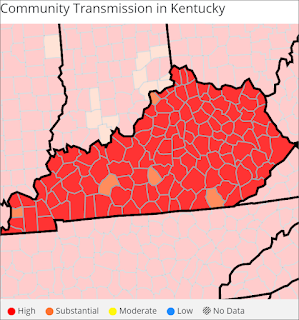
Centers for Disease Control and Prevention map
On the CDC's map of coronavirus transmission, all but five of the 120 counties are red, indicating a high level of virus transmission. The risk map, with orange indicating the highest range, is the one that Kentucky officials say should be used when deciding on what types of precautions to take to protect yourself and others from the disease. 

On the risk map, five counties have been yellow for three weeks in a row: Allen, Anderson, Washington, Taylor and Menifee. Two of them have been on this list for five weeks: Lee and Owsley.

Other yellow counties on this week's map are Calloway, Hancock, McClean, Ohio, Muhlenberg, Logan, Simpson, Monroe,  Hart, Harlan, Larue, Franklin, Spencer, Nelson, Marion, Adair, Russell, Clinton, Wayne, McCreary, Casey, Lincoln, Garrard, Madison, Estill, Rockcastle, Laurel, Knox, Bell, Harlan, Bracken, Bourbon, Montgomery, Elliott, Morgan, Magoffin, and Knott.

In orange counties, state guidelines call for wearing masks in indoor public spaces, limiting in-person gatherings, limiting the size of gatherings, and social distancing. 

People in yellow counties who are immunocompromised, or at high risk for severe illness from the virus, should talk to a health-care provider about whether they need to wear a mask or take other precautions, the CDC says.

Kentucky's weekly pandemic report, released on Monday, showed the state had an average of 1,456 new cases a day last week, up 1,368 from the week before. Deaths and hospitalizations remain low, but continue to inch up. The positive-test rate increased to 15.75%, up from 13.36% the prior week.

Only 2.5% of Kentucky's 6,561 National Guard soldiers have refused vaccination for Covid-19; federal deadline was June 30

By Melissa Patrick
Kentucky Health News

As of July 6, only 2.5% of Kentucky Army National Guard soldiers have refused a Covid-19 vaccine, thus missing the June 30 federal deadline to get vaccinated. Another 2.5% have asked for an exemption, so 95% are largely in compliance, according to the agency's public-affairs office. 

Of the 6,561 Kentucky Guard soldiers, 6,233, or 95%, have had at least one dose of Covid-19 vaccine, are awaiting vaccination during their initial training, or are fully vaccinated, well above the national average of 89%, Lt. Col. Carla A. Raisler, the state guard's director of public affairs, said in an e-mail.

As for the rest, she said 2.5%, or 164, have refused vaccination, and the same share are awaiting adjudication of requests for an exception to the policy on religious or medical grounds.

When it comes to consequences, Raisler said the Kentucky National Guard is following the guidance from the National Guard Bureau in the Department of Defense. 

"NGB has declared drill periods, annual training and exercises as 'mission-critical.' Therefore, unvaccinated personnel who are pending adjudication for a medical or religious exemption for the coronavirus vaccination are authorized to continue attending training," she said. "Service members who are not fully vaccinated and do not have an approved or pending exemption may not attend training."

Raisler said 6% of guard members are either in the training pipeline or have not been fully vaccinated. She said those in training will not be affected by the mandate and those who have received one dose of the Moderna or Pfizer vaccine near the deadline of July 1 will only miss the July drill period. 

"This does not negatively impact them, their military career or their unit," she said. 

Further, she said soldiers whose exceptions are denied will be given the opportunity to receive the vaccination before any action is taken.

"If they refuse the order to be vaccinated they will be subject to certain adverse administrative actions, including flags, bars to continued service, and memoranda of reprimands," she said. "Soldiers who continue to refuse will be subject to administrative separation. However, we are giving them every opportunity possible to get vaccinated before mandating separation."

Raisler stressed that the Kentucky Guard has been proactive in educating and encouraging its service members to get vaccinated as a means to ensure they maintain their readiness. 

She said, "Kentucky National Guardsmen train all over the country and the globe, so it is essential to the health of our service members and their families that they receive their coronavirus vaccination, especially when training in areas of the world that have higher infection rates."

Study to find best ways to prevent opioid overdoses has started testing and interventions in second and last group of 8 counties

Kentucky Health News map shows counties in study; click it to enlarge.
By Elizabeth Chapin
University of Kentucky

The $87 million study to find the best ways to battle the opioid epidemic at the local level in Kentucky is expanding to more communities across the state.

The second wave of the University of Kentucky’s HEALing Communities Study was launched in Bourbon, Campbell, Carter, Greenup, Jefferson, Jessamine, Knox and Mason counties on July 1. The communities will implement new recovery, treatment and prevention strategies proven to reduce opioid-overdose deaths.
 
Launched in 2019 with a federal grant, the four-year study has tested ways to reduce OD deaths in Boyd, Boyle, Clark, Fayette, Floyd, Franklin, Kenton and Madison counties. Starting in 2020, a multidisciplinary team of more than 25 UK researchers worked with local and state behavioral-health and criminal-justice agencies.

Their evidence-based practices include delivery of medication for opioid-use disorder, reducing risky prescribing, education on how to prevent overdoses, and distribution of naloxone, a lifesaving drug that reverses opioids' effects.

Sharon Walsh, Ph.D.
In the second group of eight counties, “The HEALing Communities Study will bring life-changing outreach and access to treatment to thousands of Kentuckians,” said HCS principal investigator Sharon Walsh, a professor in UK’s College of Medicine and College of Pharmacy and director of the Center on Drug and Alcohol Research.

“The intervention will also help us better understand what’s needed in each community and where to focus and ramp up efforts to best support individuals to reduce opioid overdose deaths,” Walsh said. “What we learn will create sustainable solutions for the opioid epidemic in Kentucky that can also be replicated in communities throughout the nation.”

The study's goal is to reduce overdose deaths in the study counties by 40 percent. OD deaths increased 15% in the first eight counties from 2020 to 2021, but that's not a valid measurement of the study's impact, Walsh told Kentucky Health News. She said the metric will be rates in the first group versus the second group after the study period, and "The comparison must be among counties that received the intervention versus those that did not receive the intervention."

In 2021, OD deaths reached an all-time high in Kentucky and the U.S., with the Centers for Disease Control and Prevention reporting 107,000 deaths nationally and 2,250 in Kentucky. The HCS team has been adjusting intervention strategies to address the rapidly evolving opioid crisis, including increasing naloxone distribution and expanding outreach and services in communities of color.

The second wave of counties includes community engagement to assist key stakeholders in applying evidence-based practices and a communications campaign to build demand for treatment and reduce stigma toward people with opioid-use disorder. The HCS team is also working with various pharmacies and health care providers to implement safer opioid prescribing and dispensing.

The first group of counties are now in a sustainability phase, which is intended to build capacity to help community coalitions and partner organizations sustain the evidence-based practices after the study ends.

HCS researchers will  analyze data from all 16 counties, using pre-intervention usual care in the group as a control element. The comparison will show how evidence-based practices work in different settings in each community. The second-wave intervention is expected to end in early 2024.

Wednesday, July 6, 2022

FDA goes along with court order allowing Juul e-cigarettes to stay on the market while it conducts 'additional review' of products

Photo from The Hill
By Melissa Patrick
Kentucky Health News

The Food and Drug Administration has decided to stop, temporarily, its fight to ban Juul Labs' electronic cigarettes, saying there are "scientific issues unique to the Juul application that warrant additional review." 

"This administrative stay temporarily suspends the marketing denial order during the additional review but does not rescind it," a July 5 FDA news release says.

This decision follows an FDA order issued June 23 for Juul to stop selling and distributing its products in the U.S., on grounds the company did not provide enough data for the FDA to determine relevant health risks. The next day, a federal appeals court temporarily blocked the ban, allowing the products to continue selling while the decision was challenged in court. 

In its initial ban of the Juul products, the FDA said the company's marketing applications “lacked sufficient evidence regarding the toxicological profile of the products to demonstrate that marketing of the products would be appropriate for the protection of the public health.” Juul said the information it provided was sufficient and met the standard of being "appropriate for the protection of the public health."

Anti-smoking advocates praised the FDA's initial ruling, largely because of the role Juul has played in the rise of youth vaping, but supporters of the products maintain that they are safer than combustible tobacco products and are an important tool to help people stop smoking.

Op-ed calls for passage of a bill sponsored by Rep. Brett Guthrie that would increase innovative cancer screenings for seniors

Bio Nebraska graphic
Federal legislation has been proposed to require Medicare to evaluate and pay for multi-cancer early-detection tests once they are approved by the Food and Drug Administration. Currently, such tests are not covered by insurance.

"Congress has stepped in before and cut through this red tape to make coverage for mammograms and colonoscopies possible. It should do the same here by passing this bill," Amanda Smart, executive director of the Colon Cancer Prevention Project, said in a Northern Kentucky Tribune op-ed. 

Guthrie (WBKO image)
The bipartisan bill, which would be called the Medicare Multi-Cancer Early Detection Screening Coverage Act, is sponsored by U.S. Rep. Brett Guthrie of Kentucky's 2nd District and more than 200 of his colleagues in the House and Senate, Smart says. 

Smart also says there are only five cancers for which we have common screening technologies, and that seven of every 10 cancer deaths today come from cancers for which there are no approved screenings. 

"Huge clinical research programs are demonstrating the promise of new tests that can detect dozens of variations of the disease from the analysis of a patient’s blood. . . . Guthrie’s Healthy Future Task Force has proposed that seniors – the population group with the highest cancer susceptibility – must have access to these innovative blood tests," Smart writes. 

The passage of this legislation would be especially important to Kentucky, a state that has more cancer deaths than any other state in the nation. According to the American Cancer Society, nearly 10,000 Kentuckians will die from cancer this year alone. 

Smart urged Congress to pass the Medicare Multi-Cancer Early Screening Coverage Act this year. 

"We now need politicians to recognize the urgency of this situation. If Congress doesn’t pass Medicare screening legislation before the end of the current Congress, the entire legislative process starts over from the beginning next year," she writes. "It is our hope that this priority set by Congressman Guthrie’s thoughtful leadership, the Healthy Future Task Force, more than 200 bipartisan members of Congress, and indeed President Biden’s Cancer Moonshot, moves forward without delay."

The measure is also supported by the Prevent Cancer Foundation and more than 400 organizations. The foundation explains that  the bill needs to pass before FDA approval to "prevent significant patient access delays. If Congress decides not to introduce legislation until tests are approved by the FDA, patients could face several years of access delays."

How to use sunscreen to protect your skin, reduce cancer risk

Photo from Harris Dermatology
By Penn State Health


Summer has arrived and with it so have dreams of beach vacations, trips to the waterpark and outdoor activities. After months of winter’s colder temperatures, you’re ready to get outside in search of that warm feel of sun on your skin and the resulting “healthy glow.”

Sure, the sun feels good, but while everyone needs limited sun exposure to produce vitamin D to strengthen bones, unprotected exposure to the sun’s ultraviolet rays can damage skin and increase the risk for skin cancer.

But there’s no need to be a recluse, says Dr. Charlene Lam, a Penn State Health dermatologist. Just be smart about your time in the sun and protect your skin by taking a few preventive steps, including routinely using sunscreen.

How sunscreen keeps you safe

“It is not just the day out at the beach or waterpark when you need sunscreen, but every time you go out – when you get the mail, walk the dog – all of that exposure to the sun can add up to damage and lead to skin cancer, aging skin, dark spots and wrinkles,” she said. “Although there is no single method that protects you perfectly, there are different modalities we can be smart about and adopt into our lifestyle as daily habits.”

One is the regular use of sunscreen, which protects your skin by absorbing or reflecting the sun’s ultraviolet (UV) rays that damage skin cells.

“There are two types: UVB rays, which cause sunburn and play a key role in skin cancer, and UVA rays, which cause skin damage that leads to tanning, aging of skin and wrinkles,” Lam said. “That’s why it’s important to choose a broad-spectrum sunscreen that protects you from both.”

She also recommends choosing a sunscreen with a sun protection factor – or SPF – of 30 or higher. Although high SPF sunscreens protect from burning for longer periods of time than those with lower SPF, they can give the user a false sense of security.

“Sometimes what I see are people who use an SPF 50 will stay in the sun longer and won’t reapply. They end up getting more sun damage, and it defeats the purpose,” Lam said. “If you use a 30, know that you need to reapply every two hours, more if you get wet or wipe it off.”

How to properly apply sunscreen

The best type of sunscreen is the one that you’ll use regularly. Whether you prefer a cream or an aerosol, there are a few tips when it comes to application that can make the difference in its effectiveness. In addition to applying it 30 minutes before you go outside, remember that coverage counts.

“The big thing is to make sure you are using enough. On average, an entire body requires about an ounce or shot glass full for full coverage. A nickel-sized dollop is required for the entire face alone,” Lam explained, adding that with a spray sunscreen, it is important to get an even sheen across the skin and to spread it out. “Typically, a family of four should use one four-ounce bottle per person for a day-long event.”

Don’t forget those sensitive areas, such as the top of your ears, back of the neck, the scalp along the part, tops of your feet and behind your knees.

All skin types deserve sunscreen

Despite what you may have heard, everybody can get sunburned, no matter what type of skin color they have. Men, women and children over six months should use sunscreen, including those who tan easily. The best defense is to use multiple modalities of sun protection, Lam said.

“Protective clothing, hats, sunglasses, avoiding mid-day sun from 10 a.m. until 2 p.m. and seeking shade are all good ways to protect yourself from the sun,” she said. “But shade isn’t a perfect shield. Some UV rays can still reach out, reflecting off water, sand, glass, concrete and snow.”

But protection from sunburn isn’t the most important reason to wear sunscreen.

“Your skin is damaged by sun exposure over your lifetime, not whether or not you burned. If you have skin, you can get skin cancer,” Lam said. “Once you burn, it is a clear indication that you’ve had too much sun. The burn will heal, but the damage is done. The thing is to learn from that burn, and make it your last.”

What are the best sunscreens for children? Los Angeles Children's Hospital has advice.

Tuesday, July 5, 2022

Kentucky's Covid-19 positive-test rate (not including home tests) is now near 16%, but hospital numbers and deaths remain low

Kentucky Health News graph from state data; click to enlarge.
By Melissa Patrick
Ky. Health News

Even as the share of Kentuckians testing positive for the coronavirus last week jumped to 15.75%, and other key metrics of the pandemic such as hospital numbers and deaths rose, both of those remained relatively low.

The positive-test rate last week increased 2.39 percentage points from 13.36% the week before. It has been on a steady incline since April 4, when the rate was 1.97%. The figures do not include at-home tests.

The state's Monday-through-Sunday report shows 10,191 new coronavirus cases, an average of 1,456 per day. After four weeks of steep increases ranging from 21% to 41%, the latest increase was only 6.4% more than the prior week, when the rate was 1,368 per day. 

The statewide incidence rate increased to 30.77 cases per 100,000 residents, up from 26.6 in the previous report. Two counties have rate smore than double the state rate: Breathitt, 63.3, and Washington, 62.6. Rounding out the top 10 were Perry, 59.3; Muhlenberg, 51.8; Leslie, 49.2; Lyon, 48.7; Larue, 47.6; Powell, 46.2; Wolfe, 45.9; and Hardin, 45.1.

The New York Times shows Kentucky with a much lower incidence rate, so low that it ranks last among the states and Washington, D.C., with  a 78% drop in cases in the last two weeks. The Times shows Kentucky with a rate of 7 per 100,000, with only 328 cases per day in the last week.

On the state report, 12% of the new cases were in people 18 and younger. Covid-19 vaccinations were recently approved for children aged 6 months to 5 years old. So far, 941 Kentucky children in this age group have received their first dose of vaccine, according to the state's Covid-19 Vaccination Dashboard. 

The state reported 38 more Covid-19 deaths last week, an average of 5.4 per day. That was an increase from 4.3 per day the prior week, which was the lowest it had been since last August. The state's pandemic death toll is 16,182. 

And while Kentucky's Covid-19 hospitalization numbers remain low, they continue to tick up. Kentucky hospitals reported 405 patients with Covid-19 Monday, up from 377 a week ago, with 49 in intensive care (down five) and 23 on mechanical ventilation (up five). 

The latest CDC national Covid-19 risk map, which measures cases and hospital capacity, shows 43 counties with a high level of coronavirus transmission and 35 with a medium risk. The map is updated on Thursday evenings.

Sunday, July 3, 2022

National report highlights challenges rural hospitals face as they move out of the pandemic, offers federal policy solutions

Our Lady of Bellefonte Hospital, before it closed
By Melissa Patrick
Kentucky Health News

Federal pandemic money helped to shore up rural hospitals as they worked to care for increased volumes of critically ill patients, but many of them were at risk of closure before Covid-19 hit, and the financial challenges creating that risk have not gone away.   

"Rural hospitals that were struggling before the pandemic will once again be at risk of closure unless additional action is taken to shore up these facilities," says a new report from the Bipartisan Policy Center.

In 2020, a report from the Kentucky Hospital Association said "anywhere from 16 to 28" of the state's 68 rural hospitals were at risk of closing. An analysis in 2021 by the Center for Healthcare Quality and Payment Reform found that 16 of the 69 Kentucky hospitals it considered rural were at risk of closing.

Five hospitals have closed in Kentucky since 2009, four since 2014. The most recent was Our Lady of Bellefonte Hospital in Russell. It closed in April 2020, but has since been purchased in part by Addiction Recovery Care, which plans to make it a comprehensive center for treating substance-use disorder. 

The BPC report, The Impact of COVID-19 on the Rural Health Care Landscape, examined the ongoing financial and personnel challenges facing rural hospitals through the lens of eight states: Iowa, Minnesota, Montana, Nebraska, Nevada, North Dakota, South Dakota and Wyoming.

It lays out short- and long-term policy recommendations to strengthen rural care, and to serve as a bridge as health-care systems exit the pandemic.

It says that during the pandemic, the pace of rural hospital closures slowed, due mainly to the pandemic-relief money they received: "In 2021, only two hospitals closed, down from 19 in 2020, marking a significant reduction from the 138 closures between 2010 and 2020."

George Pink, deputy director of the North Carolina Rural Health Research Program at the University of North Carolina, said in a June 29 webinar that the federal help came largely from the relief funds allocated for providers and the broader Paycheck Protection Program.

"The estimated distribution of provided relief funds to rural hospitals was almost $15 billion as of February 21," said Pink. "And this funding really allowed many hospitals to survive during the pandemic, and probably prevented many rural hospitals from closing."

Other key stabilizers for rural hospitals were a temporary moratorium on "sequestration reductions," the scheduled 2 percent payment reductions for Medicare services, and the enhanced payments provided by Congress for telehealth services rendered during the pandemic.

The concern is that as these measures end and personnel shortages persist, rural hospitals that struggled before the public health crisis will find themselves in dire financial straits again.

Pink ticked off a list of challenges rural hospitals face. First, they serve small populations that are typically older, sicker, under-insured or uninsured. Also, they have low patient numbers that don't create enough revenue to cover the fixed cost of a 24-hour emergency department; high percentages of patients on Medicare, programs that often don't cover the cost of care; and struggles with recruiting health-care providers.

With the last pandemic funds soon to be distributed, Pink said he expects rural hospitals to fall to pre-pandemic levels of profitability. "In fact, profitability can decline even faster because of what hospitals are now having to pay for labor, particularly nursing," he said.

Bipartisan Policy Center graphic; for a larger version, click on it. 
Of the eight states the Bipartisan Policy Center reviewed for this report, the percentage of hospitals experiencing at least three consecutive years of negative total operating margins ranged from 6% in Nevada to a high of 38% in Wyoming. 

The BPC also assessed the financial vulnerability of 2,176 rural hospitals between 2017 and 2020. IT found that 909 had two or more concurrent financial risk factors that put them at risk of service reduction or closure;  441 of them faced three or more risk factors; and 173 of them had four or more. The factors included negative operating margins (total and on patient services alone), negative current net assets, and negative total net assets.

Asked if their hospitals would survive without the federal relief money, Joan Hall, president of Nevada Rural Hospital Partners, a consortium of Nevada's 13 critical-access hospitals, said the hope is that there will be more money coming, but they are not sure there will be. 

"I think that is a something we're very worried about," said Hall. "We're seeing still sicker patients, patients with different kinds of of needs that typically we've not had to provide care for in rural areas." 

And just last week, she said, Nevada had 600 hospital patients who couldn't be transferred to long-term care and skilled nursing facilities because those facilities can't accept new patients, and that "clogs up the pipeline for rural patients who need a higher level of care."

Joe Schindler, vice president of finance, policy and analytics at the Minnesota Hospital Association, added that it would be "disastrous" for hospitals that have depended on money from programs like the Medicare Dependent Hospital Program, which helps smaller hospitals that are heavily dependent on Medicare patients and is set to expire on Sept. 30, to lose this funding. 

"This is the worst time probably to pull the rug out on programs that have helped support rural access for many of those hospitals that need those supports," he said.

When rural hospitals close, it creates obstacles to health-care services, the report notes. A U.S. Government Accountability Office report in 2020 said one-way travel time to health-care services increased approximately 20 miles from 2012 to 2018 in communities with rural hospital closures. Travel times for less common services increased even more. 

Recommendations: The report offers several short-term proposals to help shore up rural health systems, largely measures to stabilize payment models and extending Medicare sequestration requirements until two years after the federal public health emergency for Covid-19 ends.

The report also offers what it calls "evidence-based, viable solutions to the health care crisis in rural America" that seek to "stabilize rural health-care systems, strengthen the newly created Rural Emergency Hospital model, ensure an adequate workforce, and broaden access to virtual care in rural America."

Saturday, July 2, 2022

Kentuckians seem convinced that Covid is over, but they're wrong

By Kevin Kavanagh

This month my family had encounters with two Lexington doctor offices. In one the staff rolled her eyes when asked about masks, parroting the misinformation that viruses are two small to be filtered, ignoring the fact that what is floating in the air are larger viral-droplet aerosols which N95 masks efficiently capture. The other had a mask optional policy in a practice which services high-risk elderly patients in a county which is in the CDC’s “red” zone for transmission and hospitalizations. No wonder Kentucky is 49th in the nation in their Covid-19 response.

Almost all in Kentucky appear to believe the pandemic is over and that “herd immunity” has snuffed the virus out. Misinformation has severely injured our nation. Here is a fact: If you live in the United States, overall your chance of dying of Covid-19 with the Omicron variant is greater than it was with the Delta variant. Infectivity is what increases the danger of activity participation.

Kevin Kavanagh, M.D.
In addition, immunity is waning, both in those who have been vaccinated and those who have had a previous infection. “Herd immunity” may help end a surge, but the virus quickly adapts and strikes again.

The risks of "long Covid" are real and all too common. It occurs in approximately 30 percent of those treated for Covid-19 and up to 70% have symptoms of cognitive difficulties and brain fog. The risks of cardiovascular disease increases and the chances of dying almost doubles (8.39 additional deaths per 1000) in the first year after the acute infection. And there is a recent report from Harvard Medical School which found viral antigens circulating in the plasma of a majority of long-Covid patients for up to a year after infection. This observation raises the possibility of an ongoing low-grade infection in long-Covid patients. There is also emerging evidence that repeated bouts of infections can add to the burden of long Covid in a graded additive fashion. In other words, repeated infections appear to add to the damage caused by previous infections.

The latest risk is from the Omicron BA.4 and BA.5 variants. These variants are causing surges in both Israel and the United Kingdom with an increase in hospitalizations. Unfortunately, a study from Ohio State University found that infection with Omicron appeared to be ineffective in producing adequate neutralizing antibody titers against BA.4/5. A report from the New England Journal of Medicine found that even those vaccinated and boosted may have little protection against reinfection with BA.4/5. Another report observed that BA.4/5 is more infectious than BA.2 (the first Omicron subvariant, which is more infectious than BA.1, which is more infectious than Delta, which is more infectious than Alpha, and so on,)

Overall, there is a mind-boggling set of guidelines generated by a narrative which changes depending upon the type of vaccine, how many doses one has received, if one has had a previous infection and which variant caused the infection, along with the time from the last vaccine dosage and/or infection.

As new variants continue to rapidly emerge, the guidance actually becomes simpler: All immunity is waning, and one needs to keep your immunity as strong as possible. This means to stay up to date with your vaccinations and boosters, even if you have had a previous infection. We also must slow down the spread of the virus and protect our elderly.

Businesses need to adapt by implementing the following:
  • Improve building ventilation (increasing to five complete air exchanges per hour would reduce airborne disease transmission by 50% or more.
  • Offer curbside pickup with personnel wearing N95 masks.
  • Set aside an hour first thing in the morning for mandatory masking when those who are at high risk for severe Covid-19 can do their shopping.
  • Churches should also increase ventilation, offer online alternatives, and conduct the first morning service with mandatory masking. 
Finally, we all need to wear high-quality N95 masks during times of high viral spread. I am not sure how to motivate Kentucky’s population to do so. At the very least we need to use our vote to express political feelings, and our love for our neighbors to dictate how we act in public.

Kevin Kavanagh of Somerset is the founder of HealthWatch USA. This first appeared in the Lexington Herald-Leader.

Friday, July 1, 2022

18% more Kentucky youth (ages 5 to 19) went to hospital emergency rooms for self-harm injuries in 2021 than in 2020

Ohio Valley ReSource graph from Ky. Injury Prevention and Resource Ctr. data; click it to enlarge.
Kentucky hospital emergency rooms are increasingly becoming the go-to destination for Kentucky youth who have mental-health problems and harm themselves.

The Kentucky Injury Prevention and Resource Center says 1,396 Kentuckians ages five to 19 visited emergency departments for self-harm injuries in 2021, up 18 percent from the 1,182 reported in 2020.

"The data also shows more Kentucky youth died by suicide compared to youth who are killed in homicides," Corinne Boyer of WEKU-FM reports for Ohio Valley ReSource, a consortium of public radio stations in Kentucky, Ohio and West Virginia. "Between 2010 and 2021, a total of 430 suicide deaths were reported and 302 homicides were recorded among Kentuckians ages five to 19."

Lindsay Ragsdale, M.D.
Dr. Lindsay Ragsdale, chief medical officer at Kentucky Children’s Hospital in Lexington, told Boyer that she’s seen an increase in patients seeking mental health treatment.

“Every single day, we have patients that come into our ER for evaluation for mental health crisis, and whether that's suicidal attempts, or thoughts, some more anxiety related diagnoses [and] eating disorders,” Ragsdale said, adding that the pandemic cut off social connection for children.

“There's a lot of fear and concern, and this has really upended a lot of kids' lives.”

The hospital, part of the University of Kentucky, is working on a psychiatric unit that it hopes to have completed by November, Boyer reports: "But Dr. Amy Meadows, the child and adolescent psychiatry director at UK, said the demand for mental health treatment means the new unit won’t have enough beds."

“Not only do we need more inpatient, but we also need a better system of care to help manage kids out of the hospital, keep them at home when it's at all possible,” Meadows said, adding that means many options.

“From schools where kids are doing education about emotions and mental health, to being able to have outpatient therapy,” she said. “We need more psychologists, therapists, social workers, to having available psychiatrists in the community.”

The problem is widespread. The Children’s Hospital Association reported last fall last that self-harm injuries among children rose significantly in the first six months of 2021, with a 45% increase in the number of self-injury and suicide cases in 5-to-17-year-olds, compared to 2019.

CHA President Amy Wimpey Knight "said the numbers indicate a mental health crisis," Boyer reports.

“Basically, if a child presents to the emergency room in a mental health crisis, that cannot safely be discharged home, they often need to be — some can — but many often need ongoing care,” Wright said. “And there's not enough mental health beds right now and/or intensive outpatient programs.”

Ticks are active in Kentucky year round, but this is prime time, and they are getting more common and more dangerous

Everyday Health photo
By Melissa Patrick
Kentucky Health News

Public-health officials say ticks are emerging earlier and staying active longer because of changes in climate and land use, resulting in a rising risk of infection carried by the parasites. 

"There are more tick-borne disease cases every year," Dr. John Aucott, director of the Johns Hopkins Lyme Disease Clinical Research Center, said during a June 8 Association of Health Care Journalists webcast. "This is an insidious epidemic. It hasn't been as dramatic as Covid-19, so it has crept up on us."

According to the Centers for Disease Control and Prevention, the total number of tick-borne diseases reported to the agency rose by 125% to 50,865 in 2019 from 22,527 in 2004. These numbers are generally considered to be underestimated because most aren't reported to the agency. For example, the CDC estimated that between 2010 and 2018 the number of Americans with Lyme was closer to 467,000 based on an analysis of health insurance records.

Anna Pasternak, a tick researcher at the University of Kentucky, said the Kentucky Tick Surveillance Program has only been collecting information on ticks in Kentucky since 2019 and doesn't have enough year-to-year data to confidently say that Kentucky is seeing more ticks and tick-borne disease cases or say that they are emerging earlier from winter hibernation and staying active longer. 

"However, I think important things to note are that 1) we do have ticks active in the winter months in Kentucky and 2) the prime months for tick activity so far seem to be April through August," Pasternak said in an e-mail. "This, of course, doesn’t mean that you only need to be wary of ticks in these months, just that these months are when I have collected the majority of ticks each year." 

Kentucky provides a perfect home for ticks, with its warm, humid summer days, an abundance of wooded, leafy areas in both rural and urban places, and plenty of hosts to feast upon.

Ticks can carry pathogens that can cause a number of illnesses. In Kentucky, the most common tick-borne diseases are Rocky Mountain spotted fever, ehrlichiosis and Lyme disease. 

Another disease caused by the lone-star tick that is increasing is called alpha-gal syndrome, which causes an allergy to red meat. Research published in the January 2021 in Annals of Allergy, Asthma and Immunology found that Arkansas, Virginia, Kentucky, Oklahoma and Missouri had the highest number of positive cases per 100,000 people.

An article that examined current information about this syndrome, published in last year's Frontiers in Cellular and Infection Microbiology, says up to 3% of the population has this condition, the Daily Mail reports.

A new tick to watch for is the Asian longhorned tick, which was first found in the U.S. in 2017. Kentucky is one of 17 states that this tick has been found in. Research is ongoing to determine if an how often these ticks are able to pass on germs that are harmful to humans and can make them ill, says the CDC. 

Also of concern is that symptoms of Lyme disease and other tick-borne diseases -- like headache, fatigue, fever and rashes -- can mimic Covid-19 symptoms, which could result in a delayed diagnosis and risk for complications. 

Looking forward, progress is being made on the development of a Lyme disease vaccine, as well as other technologies and treatments to prevent the disease. 

"Pfizer and its partner Valneva announced in April 2022 that they had completed Phase 2 of a clinical trial of a Lyme disease vaccine, setting on the path for a larger Phase 3 trial. Two Yale researchers have developed a vaccine based on mRNA technology (the platform used to create the Covid-19 vaccine) to reduce the risk of developing Lyme disease. CRISPR technology has been used to edit the gene of black-legged ticks, which may help scientists with developing vaccines and treatments. Researchers are investigating vaccinating mice that carry ticks, and genetically engineering mice to prevent them from becoming reservoirs of diseases that ticks ingest when they feed on mice," Bara Vaida writes in a tip-sheet on tick-reporting for AHCJ. 

The best protections against tick-borne disease is to not get bitten. Here are some ways to protect yourself from ticks:
  • Avoid grassy, wooded and leaf-covered areas
  • Keep grass and shrubs trimmed and cleared away
  • Walk in the center of walking trails
  • Wear light-colored clothes, which make it easier to spot ticks
  • Wear long pants tucked into boots and tuck in your shirts
  • Use tick repellent that has the repellent DEET or picaridin
  • Treat your clothes with permethrin, which repels and kills ticks
  • Do a body check along the way and at the end of each day
  • Check your pets and equipment for ticks
  • Shower within two hours of potential exposure, if possible
To kill ticks on clothing, tumble dry for 10 minutes or wash them in hot water. If clothes can't be washed in hot water, tumble dry for 90 minutes on regular heat or 60 minutes on high.