Showing posts sorted by relevance for query CHIP. Sort by date Show all posts

Thursday, October 12, 2017

Kentucky will run out of its KCHIP money in about six months; meanwhile Congress inches toward funding the program

By Melissa Patrick
Kentucky Health News

As Congress works to fund the Children's Health Insurance Program days after the Sept. 30 deadline for reauthorization passed, Kentucky officials are confident their funding will be renewed before the federal money runs out.

"Without funding reauthorization on the federal level, we have enough money to maintain CHIP services for about six months," Doug Hogan, spokesman for the Cabinet for Health and Family Services, said in an e-mail. "We fully expect federal funding to be renewed."

An estimated 11 states are expected to run out of federal CHIP money by the end of the year, and 21 more by March 2018, according to a study by the Kaiser Family Foundation. A separate foundation report shows that the federal budget for CHIP was about $14 billion in 2016 and Kentucky's federal share was around $243 million.

CHIP and its funding vary by state with some states sharing the program's expense with the federal government. Hogan said Kentucky's program, called KCHIP, is largely funded by federal dollars.

Kentucky's program covers uninsured children younger than 19 who live in families with income at or below 218 percent of the federal poverty level, $53,628 for a family of four). The program serves about 83,000 children in Kentucky and almost 9 million nationwide.

The historically bipartisan program was initially passed in 1997, renewed in 2015 and was set to be renewed on Sept. 30 -- but Congress failed to act, instead spending its time on a second attempt to repeal and replace Obamacare which fell short a few days before the Sept. 30 deadline.

Both the Senate and House have passed bills out of committee to refund CHIP, but the Senate bill doesn't specify how the program will be paid for, and the House bill includes funding offsets that involves taking money from an Obamacare prevention fund and charging seniors who make more than $500,000 a year higher Medicare premiums. These offsets were a source of contention for Democrats, and the bill passed on a party-line vote, reports the Washington Examiner.

Since, Republicans on the House committee have agreed to return to negotiations with Democrats in hopes of reaching a bipartisan agreement, Jessie Hellmann reported Oct. 10th for The Hill.

However, the chairman of the committee, Greg Walden (R-Ore.) warned in a statement that if they can't reach a deal by the end of this week, the marked up bill will be taken up by the House when they return from their recess Oct. 23.

Dr. Terry Brooks, executive director of Kentucky Youth Advocates, said in an Oct. 2 statement that while he understands the "partisan toxicity and ambiguity" around Obamacare, "kids should not pay the price for partisan politics" and called for a bipartisian effort to extend the program's funding.

“Though leaders in Washington may assert that states should shoulder this vital coverage for children, the federal government cannot expect an already strapped state budget to absorb the costs of the program,” he said. “And Washington cannot turn its back to the families counting on CHIP to ensure better health outcomes for their sons and daughters."

He added, “Senate Majority Leader Mitch McConnell has a track record of standing tall for kids. We need him to protect CHIP – and our kids – from being a casualty in the never-ending Washington D.C. health care debate. Congress must extend CHIP funding with declarative and immediate action!”

Kentucky Voices for Health sent a letter Oct. 4 to leadership of the aforementioned House and Senate committees that had more than 100 "sign-ons" urging Congress to "quickly pass a clean extension of CHIP and continue the bipartisan commitment to this successful program." The letter noted that KCHIP had contributed to the state's uninsured rate of less than 7 percent, with the rate of uninsured children falling to 3.2 percent.

No final congressional action is expected until late October at the earliest, when the House gets back from its recess.

Tuesday, January 23, 2018

Children's Health Insurance Program extended for six years

After 114 days without a long-term budget, the Children's Health Insurance Program is getting funding for the next six years as a piece of the bill that reopened the government Monday night. The program, which provides health insurance for 9 million American children, 30,000 in Kentucky, has enjoyed broad bipartisan support since its inception in 1997, but has been increasingly employed as a political carrot by Republicans, one which the Democrats refused until today.

"Last fall, Republicans proposed a plan to extend the CHIP program for an additional five years. But that plan included a series of deeply partisan spending cuts to cover the costs of extending CHIP — such as slashing Obamacare programs and Medicare — and Democrats refused to support the bill," Sarah Kliff reports for Vox. States scrambled for emergency funding over the next few months, but Republicans left the program on the back burner in favor of priorities such as repealing and replacing Obamacare, and pushing through a bill cutting taxes.

In its December bill to keep the government open, Congress gave CHIP emergency funding for mid- to late-January, but the two parties still couldn't agree for how to pay for it in the long-term. Republicans wanted states to eventually start paying a greater share of the cost, and Democrats didn't. A Congressional Budget Office estimate ended that debate, saying the elimination of the ACA's individual mandate made it cheaper for states to have CHIP than not.

Republicans added a six-year funding extension for CHIP onto the latest bill to tempt Democrats, who were holding out for action on the Deferred Action for Child Arrivals program. Democrats agreed after Senate Majority Leader Mitch McConnell said he would schedule a vote on a DACA bill "and related issues" by Feb. 8 if the government remains open. The Democrats are hoping that, when the funding bill runs out that day, they will have more leverage on DACA without CHIP hanging over their heads, Dylan Scott reports for Vox.

Tuesday, November 14, 2017

Kentucky's children improved on several health measures in last year but still lag behind nation; many counties are far behind

By Melissa Patrick
Kentucky Health News

More Kentucky children than ever have health insurance, fewer Kentucky teens are getting pregnant, fewer mothers are smoking during pregnancy, and the state has fewer low-birthweight babies – but that's not the case in every county, according to the annual Kentucky Kids Count report.

The report, released Tuesday by Kentucky Youth Advocates, is part of the 27th annual release of the County Data Book, which provides data on overall child well-being through 17 measures in four areas: economic security, education, community strengths, and health and family.

Instead of ranking counties from top to bottom for each of these measures, as in the past, this year's report shows whether the outcomes have improved or worsened in the last five years.

"Looking at data change over time illuminates areas of progress and areas of needed policy change and investment," KYA Executive Director Terry Brooks said in a news release. “If all of our kids—no matter their families’ income, skin color, or ZIP code—are to grow up to be healthy and productive citizens, their needs must be prioritized.”

Part of Russell County's profile, one of 120 from 
Kentucky available at the Kids Count Data Center
The report also shows how many Kentucky children would be affected if the state or county were able to improve each measurement by 10 percent. KYA's hope is that this will help the state and individual counties see what areas need attention the most.

For example, the report shows Kentucky has seen a 13 percent decrease in the rate of births to mothers who smoked during pregnancy, dropping to 20.6 percent in 2013-15 from 23.8 percent in 2008-10. The national rate is 8.4 percent, according to the 2017 State Health Assessment.

If 10 percent fewer women smoked during pregnancy, 3,533 fewer babies would be exposed to cigarette smoke before birth, which would result in fewer babies with low birthweights. Such babies  (less than 5½ pounds) account for 8.7 percent of Kentucky births.  

Being born too early or with low birthweight increases a baby's risk of health complications, including a 25 percent increased risk of dying in the first year of life.

For example, Lee County has the highest rate of smoking during pregnancy (47.7 percent) and one of the highest rates of low-birthweight babies (12.2 percent). A 10 percent improvement of these measures would result in 11 fewer Lee County babies being exposed to smoke before birth each year, and three fewer babies being born with a low birthweight.

On the other end of the spectrum, only 10.2 percent of mothers smoke during pregnancy in Oldham County, and only 7.4 percent of the babies born there have a low birthweight.

The Foundation for a Healthy Kentucky, which is leading the state's newly formed Coalition for a Smokefree Tomorrow, says it's ready and willing to help counties decrease their smoking rates.

“The foundation is committed to working with advocates and local communities to promote smoke-free ordinances, ensure that expectant mothers have easy access to effective tobacco treatment, and raise the state tax on cigarettes to reduce youth smoking," Ben Chandler, president and CEO of the foundation, said in the news release.

Related encouraging news is that the number of teen births in the state continues to drop, to 34.6 per 1,000 in this year's report, down from 37.9 in last year's report and 48.9 five years ago. The national teen-pregnancy rate is 22.3 per 1,000.

The report says 16 Kentucky counties had teen-birth rates of 60 or more per 1,000 (6 percent), with Wolfe County leading the way at 80.9 per 1,000. Its rate five years ago was 68.2 per 1,000.

Only five Kentucky counties had rates of less than 20 teen births per 1,000 (2 percent). Oldham County had the lowest rate, 8.2 per 1,000.

Other encouraging news is that almost all Kentucky's children (96 percent) have health insurance. The report says at least one in 10 Kentucky children are covered by Medicaid or the Children's Health Insurance Program, called K-CHIP in Kentucky.

The report stresses the importance of making sure Medicaid and CHIP program are sustainable – including the expansion of Medicaid under the Patient Protection and Affordable Care Act to those who earn up to 138 percent of the federal poverty line. It notes, "Children are more likely to have health insurance when their parents do."

The report also says coverage for children "boosts family financial stability due to reduced out-of-pocket costs for health care and increased participation in other supports for which they are eligible, such as Supplemental Nutrition Assistance Program," or food stamps.

The U.S. House of Representatives has passed a bill to fund CHIP for the next five years, but it includes funding provisions that likely won't pass the Senate. A Senate committee has passed a CHIP bill, but without provisions for funding. The deadline for reauthorization was Sept. 30. 

Kentucky will run out of KCHIP money in about five months if CHIP is not renewed. A Kaiser Family Foundation report shows that the federal budget for CHIP was about $14 billion in 2016 and Kentucky's federal share was around $243 million. (For a county-by-county list of KCHIP and Medicaid enrollment, click here.)

The report also called for more outreach and enrollment efforts, and said the state should stop dis-enrolling children for incorrect or missing addresses.

The number of young adults with health insurance in Kentucky is around 77 percent. Robertson County, at 91 percent, has the highest rate; Lee County, at 41 percent, has the lowest.

Other key findings about Kentucky's children in the report:
  • Grandparents and other relatives raise 7 percent, the highest rate in the nation.
  • Almost half live with families that are considered low-income (annual income of $48,072 or less for a family of four).
  • One-fourth live in poverty (annual income of $24,036 or less for a family of four).
  • 12 percent live in deep poverty (annual income of $12,018 or less for a family of four).
  • 20 percent live in food-insecure households, and food insecurity is widespread; only five counties have fewer than 15 percent of children in food-insecure households.
  • In 24 counties, at least a fourth of the children living in a food-insecure home.
  • Only half of Kentucky's children are ready for kindergarten or are proficient readers in the fourth grade, and fewer than half of them are proficient in mathematics in eighth grade.
  • Almost 90 percent graduate from high school on time.
  • 41 per 1,000 are in "out-of-home" care, and the rate increased in 88 counties.
  • 26 per 1,000 are incarcerated in the juvenile-justice system, a 57 percent decrease.
Brooks concluded: “Kentucky kids rely on their state leaders to make decisions and investments that prioritize them. As state agencies, the legislature and governor craft the next biennial budget and prepare for the 2018 session, we are calling on leaders to build a budget that invests in kids’ education, health, economic security, and safety. Our communities and economy can only win when Kentucky kids and their families succeed."

Overall Kids Count chart for Kentucky shows previous and current scores in four major areas
The Kids Count Data Center is also available for a deeper dive into the data. It offers a profile sheet for every county, and allows you to create maps, graphs, and make comparisons.

The 2017 County Data Book was made possible with support from the Annie E. Casey Foundation and local sponsors Passport Health Plan, Delta Dental of Kentucky and Kosair Charities.

Tuesday, May 24, 2011

Flexibility Act would give states more Medicaid authority, but it could mean that fewer children would have health coverage

MEDICAID PERCENTAGE OF TOTAL STATE SPENDING
Children's advocates are concerned the proposed State Flexibility Act would result in more children living without health insurance in Kentucky.

The act "would repeal protections put in place for states to maintain current eligibility and enrollment requirements for Medicaid and the Children's Health Insurance Program, known in Kentucky as K-CHIP," Renee Shaw of the Public News Service reports.

The goal of the act, its sponsors say, is to give states more flexibility so they can balance their own budgets. "The onerous federal mandates on states today make it especially challenging for states to solve the unprecedented budget crises, and governors have asked Washington for relief from these excessive constraints," the act reads. In Kentucky, there is a a projected budget shortfall of $780 million for Fiscal 2012, $166.5 million of which is due to a gap in Medicaid funding.

But Lacey McNary, deputy director of Kentucky Youth Advocates, say the move would only further burden families. "Children who in Kentucky are up to 200 percent of the poverty level can enroll, and they're eligible for K-CHIP," she said. "In order to save some money, the state could say, 'We're only going to cover kids up to 150 percent of poverty' — thus, covering less children and saving money."

Estimates show almost half of Kentucky's children have government-supported health insurance. About 60,000 kids are enrolled in K-CHIP every month and another 386,000 Kentuckians are enrolled in Medicaid, which serves low-income and disabled Americans, including children. "It's been proven that K-CHIP is a very successful program to get kids covered," McNary said. "This bill is a permission slip for governors to reduce coverage for kids, to balance the budget."

If the bill passes, about 14 million children nationwide could be at risk for losing their health insurance, Shaw reports. (Read more)

Saturday, June 16, 2018

63 percent of Kentucky's children get their health insurance through Medicaid or the Children's Health Insurance Program

By Melissa Patrick
Kentucky Health News

More than 60 percent of American children are enrolled in Medicaid or the Children's Health Insurance Program, according to the Centers for Medicare and Medicaid Services data.

Photo: thenationalcouncil.org
Kentucky's numbers were just a bit higher, with 63 percent of the state's 1 million children enrolled in one of the two programs. That amounts to 642,364 children. Nationally, the programs cover 46.3 million of more than 74 million children.

"Kentucky leaders have taken several steps in recent years to make it easier for children to enroll and stay enrolled in health coverage, which has led to vast increases in the number of children with health insurance," Terry Brooks, executive director for Kentucky Youth Advocates, said in an email.

Brooks added, "Research shows us that, in addition to making it easier for children to enroll in coverage, providing affordable health coverage for parents is an important way to improve overall family health and reduce the number of uninsured children."

Children are eligible for Medicaid if they are between the ages of 1 and 18 with a family income up to 159 percent of the federal poverty level. They are eligible for CHIP, as the Children's Health Insurance Program is commonly called, with a family income between 160 percent and 213 percent of the poverty level.

The two programs have the same benefits, including doctor visits, dental care, hospitalization, outpatient services, psychiatrists, laboratory tests and X-rays, vision exams, hearing services, mental health services and prescription medicines.

Nationally in 2017, about four times as many children were enrolled in Medicaid as in CHIP, 36.9 million and 9.5 million, respectively. In Kentucky, nearly six times as many children were enrolled in Medicaid as in K-CHIP in 2017, 545,985 and 96,379 respectively.

Kentucky has a relatively high share, 25 percent, of children living in poverty (annual income of $24,036 or less for a family of four); 12 percent are in deep poverty (annual income of $12,018 or less for a family of four), according to the 2017 Kentucky Kids Count report.

In 2016, the most recent year for which state-by-state age population data are available, 38 states had more than half of their children enrolled in one of the programs at some point during the year, Philip Bump of The Washington Post reports.

Bump notes that North Dakota was the only state that had fewer than one-fourth of its children enrolled in either CHIP or Medicaid at some point during the year; and New Mexico, with more than 80 percent of its children enrolled in one of the two programs at some point, had the highest percentage of enrollment.

Friday, September 15, 2017

Kentucky's share of people with health insurance goes up again, giving state most-improved status, but future remains uncertain

By Melissa Patrick
Kentucky Health News

In the third full year since the Patient Protection and Affordable Care Act was implemented, the percentage of Kentuckians without health insurance continued to shrink, giving the Bluegrass State a larger drop in its uninsured rate than any other state.  So says a new report from the U.S. Census Bureau, with data from its year-round American Community Survey.

Census Bureau map; click on it to view a larger version
Kentucky's uninsured rate dropped to 5.1 percent in 2016, down from 6.1 percent in 2015 and 8.1 percent in 2014. In 2013, the year before the ACA was implemented, the rate was 14.3 percent.

Put another way, 95 percent of Kentuckians had health insurance in 2016, compared to 86 percent in 2013.

That gain came mainly because then-Gov. Steve Beshear expanded Medicaid under the ACA to those who earn up to 138 percent of the federal poverty line, adding about 470,000 Kentuckians to the free health-insurance program.

“It’s clear beyond a shadow of a doubt the Affordable Care Act is working. It has helped Kentuckians get the care they need to improve their health, work and take care of their families. It has created jobs in our state and kept many more Kentuckians from being an illness or accident away from financial ruin,” Kenny Colston, communications director for the liberal-leaning Kentucky Center for Economic Policy, said in a news release.

The survey also found that 96.7 percent of Kentucky's children had health insurance in 2016, up from 93.6 percent in 2013. Kentucky Youth Advocates estimates this represented an increase of 37,000 children. Children are covered by the Children's Health Insurance Program, a program similar to Medicaid in which the federal government pays most of the cost. Kentucky calls its part of the program K-CHIP.

Medicaid and K-CHIP funding uncertain 

The recent gains aren't guaranteed to continue, with changes looming on both the state and federal level for both the adult and children's insurance programs.

Gov. Matt Bevin has submitted a proposal to overhaul the state's Medicaid program that largely targets "able-bodied" adults without dependents who qualify for Medicaid under the expansion. Bevin says the state can't afford to pay for this expanded population; the state's share is 5 percent this year, rising in annual steps to the ACA's 10 percent limit in 2020.

Bevin's plan is designed to encourage participants to have a higher level of involvement in their care through premiums and work or volunteer requirements. If approved, the state estimates that 95,000 fewer Kentuckians will be on Medicaid in five years than if the proposal is not accepted by federal officials. They are expected to approve Bevin's request, and perhaps allow other changes.

The Bevin administration has said that the goal is for these able-bodied adults without dependents to move to higher-paying jobs that offer employer-provided health insurance. Opponents of the plan say these higher-paying jobs are scarce in Kentucky, and note that many in this group already work at low-paying jobs that don't offer health insurance -- or if it's offered, it's not affordable.

KYA Executive Director Terry Brooks said some of the recent changes in Bevin's proposal could create "very real barriers to coverage" for adults, which research shows could result in fewer children being covered. "We also know that kids are more likely to have health insurance when their parents do," he said in a prepared statement.

Bevin spokesman Woody Maglinger told The Associated Press, "It may be a fact of life in Terry Brooks' alternate universe, but it is not a fact in Kentucky," Maglinger said. He noted that Bevin's plan would not change Medicaid eligibility requirements for children.

Last-ditch ACA repeal pushed; Bevin favors, Paul opposes

In Congress, Republican Sens. Bill Cassidy of Louisiana and Lindsey Graham of South Carolina are pushing a last-ditch effort to repeal the ACA and redistribute its funding from states that expanded Medicaid to states that did not, Sarah Kliff of Vox reports.

The bill would block-grant Medicaid money but would not allow states to re-enroll people now covered by the Medicaid expansion, reports Ed Kilgore of New York magazine: "They’d have to cover them some other way, presumably via private insurance."

The bill would reduce federal funding of Medicaid in Kentucky by more than $3 billion over the next 10 years, but Graham told Fox News that Bevin has endorsed his bill.

Graham also said Senate Majority Leader Mitch McConnell "needs to be as committed to repealing Obamacare as [Democratic predecessor] Harry Reid was to passing Obamacare, and Harry Reid had us in on Christmas Eve on Obamacare passage. . . . We had a lot of time off in August when we should have been here, repealing and replacing Obamacare."

McConnell told Kentucky Health News that the bill will come to the floor if there are 50 votes for it, which would put Vice President Mike Pence in position to break the 50-50 tie and pass it. "There’s a lot of discussion, but the time is running on that," McConnell said Thursday afternoon. "It could well come up. If we have 50 votes, we’ll go to it." The deadline to pass the bill with 50 votes, under budget-reconciliation rules, is Sept. 30.

Cassidy told The Washington Post that the bill has "48 or 49" votes, but it has not been vetted for passage under reconciliation, and the Congressional Budget Office has not said how the bill would affect the federal budget or the insurance-coverage rate. McConnell has asked the CBO to "quickly score" the bill, the Washington Examiner reports.

The Examiner adds: "Sen. Rand Paul, R-Ky., announced he would not be in favor of the legislation, which he called 'Obamacare lite'." Graham said on Fox that he would tell Paul that he should trust Bevin to provide "state-run health care." Paul was among the 49 votes for McConnell's last repeal-and-replace bill.

Congress also faces a Sept. 30 deadline to extend funding for CHIP, which provides health coverage for roughly 9 million children. The Senate Finance Committee has agreed on a plan to extend the program for five years, but phase out federal funding in 2021.

Thursday, July 13, 2017

Ky. has 6 of top 10 counties for adults on Medicaid; Bell is 9th for children; Trump carried all in state with more than half of kids on it

Of the top 10 rural counties in the United States where adults are most dependent on Medicaid for their health care, Kentucky has six.

They are Wolfe, ranking first with 45 percent of its adults on Medicaid; Bell, with 44 percent; Breathitt and Owsley, 43 percent each; Lee, 42 percent; and Harlan, 40 percent.

The figures come from the Rural Health Policy Project of the Center for Children and Families in the Georgetown University Health Policy Institute.

The project also identified the top 10 counties for children on Medicaid or the related Children's Health Insurance Program; Bell County ranked ninth, with 74 percent.

The Los Angeles Times overlaid the data with the presidential election results and "found that 617 of the 780 counties in rural areas or small towns where over half of the children were covered by Medicaid or CHIP voted for President Trump," the project reports. He carried all such counties in Kentucky.

The Times notes, "As a candidate, Trump said he wasn’t going to cut Medicaid but he has supported the Medicaid cuts approved by the House and pending in the Senate." Medicaid spending would increase with those bills, but its purchasing power would decline because new spending limits would not allow it to keep up with health-care inflation.

The Times has an interactive map with data for all 780 counties where most children are on Medicaid or CHIP. Here's a screenshot, showing Kentucky counties and using Bell as the example:
Counties in red were carried by Donald Trump. Hillary Clinton carried those in blue.
States in gray expanded Medicaid under the Patient Protection and Affordable Care Act.

Wednesday, August 14, 2019

Rule expanding definition of 'public charge' criteria to Medicaid draws fire from hospitals and advocates for immigrant families

Acting Citizenship and Immigration Director Ken Cuccinelli
announced the final rule at a White House press conference.
Adult immigrants would find it harder to remain in the United States if they signed up for Medicaid benefits, under a rule that the Department of Homeland Security finalized Aug. 12.

The rule brought "outcry from stakeholders across the health-care industry who say the policy will drive up the number of uninsured patients and increase the cost of uncompensated care," reports James Romoser of Inside Health Policy. "Immigration advocates and the California attorney general have already indicated they intend to sue to stop the so-called public-charge rule, which is scheduled to take effect Oct. 15."

The rule "is in some respects not as harsh as the proposed rule released last fall," Romoser writes. "The administration backed off its proposal to penalize immigrants who receive Medicare Part D low-income subsidies, and it also decided not to penalize immigrants who receive Medicaid while they are pregnant or under the age of 21."

Still, six major hospital lobbies said in a joint statement, “This rule could undermine access to care for legal immigrants by discouraging the use of critical public programs like Medicaid. We are concerned that this could lead to delays in care that would negatively impact the health of the communities we serve. We ask the administration to withdraw this harmful rule.” The statement came from the American Hospital Association, America’s Essential Hospitals, the Association of American Medical Colleges, the Catholic Health Association of the United States, the Children’s Hospital Association and the Federation of American Hospitals.

"The Trump administration said the rule will better enforce provisions in immigration law meant to deny permanent legal residency to any immigrant likely to become a 'public charge,' a term used for people who depend on government assistance," Romoser reports. The term has been used as a criterion since Congress passed the first immigration law in 1882.

However, the term has historically "focused on cash welfare programs, Romoser notes. "The new rule broadly expands the definition to include food stamps, housing vouchers and Medicaid. Under the rule, even a short stint on Medicaid could doom an immigrant’s chance to remain in the country legally, immigration advocates say."

Sara Rosenbaum writes for The Commonwealth Fund, "Whereas before only nursing home care counted toward public-charge status, now a host of services, from preventive care to treatment of chronic conditions like diabetes, could render someone a public charge after 12 months."

Kaiser Family Foundation chart; click on it for a larger version
Other critics fear a chilling effect on immigrants with U.S.-born children, who are citizens. "Enrolling their children in Medicaid is not supposed to trigger any penalties," Romoser reports, "but widespread fear about the rule is already causing many immigrant families to avoid seeking Medicaid or any other government assistance even for children who are U.S. citizens, stakeholders say."

"Researchers at the Georgetown University Center for Children and Families said in a May report that fears in the immigrant community contributed to a 2.2% decline in children enrolled in Medicaid and CHIP last year," Romoser notes. "In an analysis of the proposed rule, the Kaiser Family Foundation estimated that between 2.1 million and 4.9 million Medicaid and CHIP enrollees living in a household with a noncitizen would disenroll from the insurance programs."

Ken Cuccinelli, acting director of U.S. Citizenship and Immigration Services, said at a White House announcement, “President Trump’s administration is re-enforcing the ideal of self-sufficiency and personal responsibility, ensuring that immigrants are able to support themselves and become successful in America.”

Wednesday, December 19, 2018

More children in state and nation lack health insurance; Kentucky kids' uninsured rate rose to 3.8% in 2017, from 3.3% in 2016

By Melissa Patrick
Kentucky Health News

For the first time in nearly a decade, the number of uninsured children in the United States and Kentucky increased, according to a report from Georgetown University in Washington, D.C.

From 2016 to 2017, the number of uninsured U.S. children rose by 276,000, to nearly 4 million. About 5 percent of the nation's children were uninsured in 2017, up from 4.7 percent in 2016.

Uninsured Kentucky children (Ky. Voices for Health chart; click on it for a larger version)
In Kentucky, 6,000 fewer children had health insurance in 2017, for a total of 41,000. That's an increase to 3.8 percent, up from 3.3 percent in 2016.

The report, based on Census Bureau data, found that no state saw its number of uninsured children decline from 2016 to 2017. The rate did drop in the District of Columbia.

In six of the previous seven years, the percentage of U.S. children with health insurance increased, first due to the Children's Health Insurance Program (K-CHIP in Kentucky), then with the 2014 implementation of the Patient Protection and Affordable Care Act.

"Having health insurance is important for children because it improves their access to needed preventive and primary care such as well-child visits, immunizations, and prescription drugs. Insured children are also less likely to miss school, and they are more likely to have better economic and educational outcomes when they grow up," Joan Alker, co-author of the study and executive director of Georgetown's Center for Children and Families, says in the news release.

The report says the declines are likely the result of influences that have created an "unwelcome mat" effect, including: efforts to repeal the ACA; an "unprecedented delay" by Congress to fund CHIP; repeal of the law that required most peoples to have health insurance or pay a fine; huge cuts in outreach and enrollment programs for ACA insurance; a shorter open enrollment period for that insurance; and changes in state Medicaid systems that may have tightened verification procedures.

In addition, the report says that several new Trump administration policies deter parents who are immigrants from enrolling their children, even if the child is a U.S. citizen. One-quarter of all children under 18 living in the U.S. have a parent who is an immigrant.

"Declines in child coverage rates occurred in 2017 despite an improving economy and low unemployment rate, strongly suggesting that federal actions contributed to a perception that publicly funded health coverage options are no longer available or, in the case of an immigrant parent, created concern about enrolling their child in public coverage for fear of reprisal," says the report.

The report adds that while the largest source of coverage for children in 2017 was through employer-sponsored insurance, the increases made in this market were not enough to compensate for the decline in publicly-funded coverage.

The report also shows that states that expanded Medicaid to people with incomes up to 138 percent of the federal poverty level, as Kentucky did, had fewer uninsured children. For example, of the 276,000 children who lost coverage in 2017, three-fourths, or 206,000, lived in non-expansion states.

Research shows that children whose parents are insured have considerably higher rates of coverage than those whose parents are not.

“We’ve made so much progress in Kentucky since 2014,” Emily Beauregard, executive director of Kentucky Voices for Health, said in a KVH blog post. “By getting parents covered under our Medicaid expansion and health insurance marketplace, we’ve seen a dramatic decrease in the number of children who were uninsured. It would be a shame to allow all that we’ve achieved for Kentucky’s children fall by the wayside.”

The report concluded with a dire warning: "Barring new and serious efforts to get back on track, there is every reason to believe the decline in coverage is likely to continue and may get worse in 2018."

Wednesday, September 17, 2014

Doctors and parents of children with cancer seek funding

Doctors and parents of young cancer patients made an emotional plea to state legislators Sept. 17 "to make funding for pediatric cancer a priority," Jacqueline Pitts reports for cn|2's "Pure Politics."

Lobbyist Jamie Bloyd told the Interim Joint Committee on Health and Welfare about her son, Paxton Bloyd, who was diagnosed with stage 4 Burkitt’s Lymphoma in March, and quoted Sen. Chris McDaniel, R-Taylor Mill, as telling the Bloyd family in the hospital “that $10 million of our budget goes to dental care for inmates. But zero dollars go to pediatric cancer research in Kentucky and I just think that is sickening, I think our kids deserve better than our inmates do.”

Max Wise of Campbellsville, who defeated Sen. Sara Beth Gregory of Monticello in the Republican primary, "attended the meeting with his son who is a pediatric cancer survivor," Pitts reports. "In an interview with Pure Politics after the meeting, Wise also noted some of the efforts discussed by Lucas as well as the St. Baldrick’s Foundation and said that there are encouraging signs that there are people looking to help find solutions."

“Government isn’t always the solution,” Wise said. “Maybe it is other organizations that chip in, if it is charities, if it's corporations,” Wise said. “It's little things along the way that everyone can chip in on this and it should not be ‘Let’s just look to government to solve this;’ there’s other sources out there which can play a big part.”

The meeting was held at the offices of the Foundation for a Healthy Kentucky in suburban Louisville.

Friday, October 9, 2020

Being outdoors doesn't mean you're safe from the coronavirus

White House Rose Garden ceremony (Photo: Chip Somodevilla, Getty Images)

By Thomas A. Russo
Professor and Chief, Infectious Disease, Jacobs School of Medicine and Biomedical Sciences, University at Buffalo, The State University of New York

If you think you’re safe from the coronavirus just because you’re outdoors, think again.

While the wind and the large volume of air make the outdoors less risky than being indoors, circumstances matter.

Someone who is infectious can cough or sneeze, or just talk and, if you happen to inhale those respiratory droplets or they plop into your eye, you can get infected. If you shake hands with an infected person and then touch your eyes, nose or mouth, you also run a chance of getting infected. You don’t have to be inhaling an infected person’s air for very long. What matters is the dose.

As an infectious disease doctor, I get a lot of questions from patients about COVID-19 risks. Here are some answers about the risks outdoors.

Doesn’t wind make outside safer than inside? It’s true that the wind helps disperse respiratory droplets that can carry viruses. When you’re indoors, one of the big concerns about how the coronavirus spreads is aerosols – tiny, light droplets people emit along with larger droplets when they breathe. These particles can linger in the air, and the concentration can build up in enclosed, poorly ventilated spaces.

There’s less of a risk in open outdoor settings because of the sheer volume of air and available space to physically distance. At least one study, not yet peer reviewed, found covid-19 patients were nearly 20 times more likely to have been infected indoors than outdoors.

But that doesn’t mean you’re in a protective bubble when outdoors.

What behaviors could put you at risk outside? To get a sense of how easy it is to put yourself at risk outdoors, look at crowd photos from the White House Rose Garden event on Sept. 26. About 200 people attended that ceremony, and at least 12 tested positive for the virus within days, including President Donald Trump and two senators.

When and where each person was infected isn’t known, but several behaviors at the Rose Garden ceremony raised the risk of getting or sharing the virus.

The first problem with this scene: Very few people were wearing face masks. With no mask, infectious people can be shedding the virus when they talk and there is nothing to stop the respiratory droplets. For people not yet infected, no mask means the virus has several ways to enter their bodies – nose and mouth as well as eyes.

The lack of masks also raises the risk of getting a larger dose, and a higher viral load may mean a higher likelihood of severe disease.

People were also seated close together. And before and after the ceremony, they mingled – indoors and outdoors – shaking hands, leaning in for close conversations and hugging each other.

Remember that just breathing expels respiratory droplets, and loud, animated speech like laughing or shouting expels more. We don’t yet know how much virus is needed to trigger symptoms, but those doses add up. So, you might get a small dose from a person sitting next to you, but if that person later gives you a big hug or shakes your hand, they could give you another dose. Or you might talk to someone else who is infectious for several minutes and inhale more virus particles.

All it takes is one person in the peak infectious period – the 24 to 48 hours before and after symptoms start – to spark a superspreader event.

When do I have to wear a mask outdoors? Face masks lower your risk of getting infected, and they also reduce the amount of virus you’re spreading if you’re infected.

If you’re running or walking, carry a mask with you. When you’re near other people, put it on. If you’re sitting at an outdoor café, try to mask up between bites and sips, especially if your age or health or weight make you vulnerable to severe covid-19.

The likelihood of a passing interaction from someone walking by a table is small, but it’s still possible. The safest spot when eating outdoors is a table away from high-traffic areas and upwind of everyone else.

Is six feet of social distancing enough? Depending on where you are, maximize the distance between yourself and others. There’s nothing magic about staying six feet apart. Particles generated by sneezes can travel a lot farther than that.

Twelve or 15 feet is safer. It’s all about minimizing risk. You can never drive that risk to zero when you’re in public.

Can I still have people over for an outside party? Think of the coronavirus like a sexually transmitted disease – everyone claims to behave safely, but do you really know where they’ve been? It just takes one infected person. Rapid covid-19 tests aren’t 100% accurate, either, and are presently unavailable for most people.

To keep things safe for an outdoor gathering, set up tables for each social bubble – a family, for example. Keep the tables at least 15 to 20 feet apart. Set up food on individual plates in a central location and have people or each bubble go up separately. Don’t share utensils or food or glasses. Wear masks as much as possible, and don’t forget physical distancing.

There is a lot we still don’t know about the coronavirus, including what the long-term damage is. Regardless of how old you are or how healthy, do what you can to avoid the virus until there’s a vaccine. Even if you get over the illness quickly, we don’t know what the long-term consequences will be.

This article is from The Conversation, a site for journalism by academics.

Sunday, December 15, 2019

Kentucky had nation's third largest increase in 2016-18 in percentage of children under 6 without health insurance

By Melissa Patrick
Kentucky Health News

Over the past two years, Kentucky saw the third largest increase in the nation for the percentage of children under 6 years of age with no health insurance, says a Georgetown University study.

The university's Center for Children and Families' analysis of the most recent census data found the rate of uninsured children under 6 in Kentucky rose from 2.7 percent to 4 percent between 2016 and 2018. That was a bigger jump than the increase in the national rate during the period, from 3.8% to 4.3%.

The state's rate had been trending down since 2014, when the state fully implemented the 2010 Patient Protection and Affordable Care Act.

The rate was 5.2% in 2013, 4.1% in 2014, 3.5% in 2015 and 2.7% in 2016, before increasing in 2017 to 3.5% and to 4% in 2018.

The estimated number of uninsured Kentucky children under 6 rose from 8,608 in 2016 to 12,973 in 2018, meaning that 4,365 more didn't have coverage, a 50.7% increase.

Chart from Georgetown report; click on it for larger version
Kentucky was one of 11 states that showed a significant increase in both the rate and number of uninsured young children, says the report. It doesn't say whether the increase is specific to any one type of coverage.

In a blog post about the report, the liberal-leaning Kentucky Center for Economic Policy reports that the Georgetown finding is in line with the broader coverage losses seen in Kentucky from 2016 to 2018. "But the increase in the number of uninsured young children (50.7%) far outpaced the increase in the number of uninsured Kentuckians as a whole (10.9%)," writes KCEP policy analyst Dustin Pugel.

Pugel told Kentucky Health News in an email that the increase could be partly a result of "practices in Kentucky that enforced stricter paperwork requirements, which led to 97,438 Kentuckians losing Medicaid coverage in state fiscal year 2019." He provided a month-by-month list of discontinuances due to paperwork, based on state data. "Although it’s not clear how many of these would not have been eligible had they presented the paperwork in time, how many were children, or how many may have regained coverage since," he wrote, "an enrollment loss of that magnitude must have contributed to the increase in uninsured to some degree."

A spokesperson for the state Cabinet for Health and Family Services said Friday that it would need time to review the report before commenting.

The Georgetown report says it is critical for children under 6 to have health insurance, not only for medical care during a time that includes rapid brain development and physical growth, but also because it protects families from financial risk that can come from an unexpected injury or illness. Further, it points to research that shows health insurance for children is linked to better health, educational, and economic outcomes well into adulthood.

The American Academy of Pediatrics recommends that children get 15 checkups before age 6. These early visits include not only vaccinations and preventive care, but screenings that can detect developmental delays to allow for early intervention.

The Georgetown report notes that the increases occurred during a time of economic growth, "when children should be gaining health care coverage," not losing it. The report says a number of factors could have contributed to this coverage reversal, including declines in Medicaid and in the Children's Health Insurance Program.

It adds that these declines have likely been influenced by the Trump administration's "policies and rhetoric targeting immigrant families," which has reportedly deterred many parents from signing up eligible-citizen children in available Medicaid and CHIP coverage. It also points to ongoing national policy debates and decisions that it says have "undoubtedly sowed confusion among parents and caregivers about whether coverage would be available to their children."

Specifically, the report points to 2017 efforts in Congress to repeal the ACA and cut Medicaid, along with a months-long delay in funding the children's insurance program, as well as cuts to outreach grants designed to boost enrollment.

Adding to Kentuckians' confusion, Pugel notes, they also had to keep up with the status of the Medicaid program, which then-Gov. Matt Bevin was trying to change with, among other things, work requirements. The proposal has been blocked by a federal judge, and new Gov. Andy Beshear has said he plans to rescind the proposal.

Kentucky's numbers would likely be higher if Beshear's father, then-Gov. Steve Beshear, had not expanded Medicaid to adults with incomes up to 138 percent of the poverty line, because the report shows that young children were more likely to be uninsured in states that did not expand Medicaid.

"Research shows that when adults have access to coverage, they are more likely to enroll their eligible children," says the report. This is often called the "welcome mat."

The report adds that young children tend to be uninsured at lower rates than their school-aged peers. However, Kentucky and six other states have shown an opposite trend; in Kentucky, 4% of its young children are uninsured, compared to 3.7% of school-aged children.

"For these states," the report says, "the inversion serves as a potential warning sign that more could be done to reach uninsured young children."

Thursday, September 3, 2020

906 new coronavirus cases make for state's third highest day, pushing total above 50,000; 10 more deaths bring toll to 976

Kentucky Health News chart, based on initial daily reports, which are adjusted slightly downward
By Mary Meehan
Kentucky Health News

As Kentucky saw more than 900 new coronavirus cases Thursday and double-digit death tolls for the fourth straight day, state officials cautioned that a vaccine is unlikely until 2021 and said advances in testing are less dramatic than they may appear.

Gov. Andy Beshear announced 906 new cases and 10 additional deaths during his daily briefing, bringing the death toll since Monday to 46.

The new-case number was the third highest of the pandemic. “Nine hundred and six cases used to be unfathomable here in Kentucky,” Beshear said. The seven-day rolling average jumped to 713, the highest yet.

In one bit of good news, the share of Kentuckians testing positive in the last seven days dropped to 4.53%, from 4.7% Wednesday.

Thursday saw the state pass a grim milestone, passing 50,000 cases; there have been 50,885. That means about 2.5% of the state's population has been identified as infected. The death toll is approaching 1,000; it stands at 976.

The high numbers come as the Centers for Disease Control and Prevention is asking states to be ready to distribute vaccine as early as Nov. 1. Beshear said there will be no vaccine until 2021.

“We’re going to make sure that we do the work to distribute the vaccine as soon as it is safe,” he said, but “We still don't see any path for there to be a vaccine that's gone through steps that it needs to before the beginning of the year.”

Health Commissioner Steven Stack echoed the message.

“I'll say it again, there will not be a vaccine for virtually everybody this calendar year,” said Stack, a physician. “I know that there's a press to make these timelines suggest we're going to have vaccine going out the door to people in October and November.” The presidential election is Nov. 3.

“There are some corners that cannot be cut,” Stack said. “You have to ensure that you are not going to take a healthy person and hurt them.”

Stack also cautioned that while progress is being made, there are few affordable rapid-response tests that are accurate and easy to process.

The Food and Drug Administration last week approved a 15-minute test from Abbott Laboratories in the form of a chip card that will sell for $5. The FDA also recently approved a saliva test from Yale University.

“Both tests have limitations, and neither can be done at home,” The Washington Post reported. “Abbott’s new test still requires a nasal swab by a health worker, like most older coronavirus tests. The Yale saliva test eliminates the need for a swab but can only be run at high-grade laboratories.”

Stack said that with the saliva test, getting enough spit in the tube is a challenge. Also, the tube has to be shipped to a lab, and because saliva is sticky, each test must be processed manually or machines will malfunction. “They still have to run it in a high-complexity lab,” he said. “So, it's not a $5 or $15 test; someone in the laboratory with expensive machines still has to run the test.”

Stack said he understands why people are eager for rapid, widely available testing, but accurate, affordable testing, just like vaccines, will take time. “None of this is intended to discourage us from finding innovative ways to try to manage the disease and get us back to work faster and keep people safe,” he said.

As they have all week, Stack and Beshear said the record-setting levels of new cases mean that this Labor Day weekend is no time to abandon the steps that curb the spread of disease. Beshear stressed the need to keep gatherings under 10 people and practice social distancing especially with the rescheduled running of the Kentucky Derby on Saturday and The Kentucky Oaks on Friday. 

 “Do everything a little different this year,” he said. “Do it safely.”

In other covid-19 news Thursday:

  • Counties with more than 10 new cases were: Jefferson, 192; Warren, 89; Fayette, 68; Madison, 66;  Daviess, 25; Green, 21; Henderson and Kenton, 20 each; Pulaski, 19; Union, 18; Franklin, 17; Hardin, 16; Jackson and Logan, 15 each; McCracken and Oldham, 12 each; Bell, Calloway, Campbell and Scott, 11 each; and Barren, 10.
  • The 10 fatalities were a 52-year-old man from Barren County; five women, 60, 72, 72, 79 and 85, and two men, 70 and 73, from Jefferson County; and an 88-year-old woman and 76-year-old man from Lewis County.
  • Of the 906 newly infected Kentuckians, 124 were under 18. There were 67 new cases of students and 22 new staff in K-12 schools. There are 273 active student cases and 102 active staff cases in K-12. 
  • Colleges and universities added 69 students and two staff members, resulting in 675 active student cases and 23 active employee cases. Beshear urged people to check the state’s covid-19 website for updates at schools or universities in their communities. He also said the state is working to improve how quickly individual cases are reported. 
  • Covid-19 hospitalizations in Kentucky totaled 568, with 132 of them in intensive care.
  • Long-term-care facilities had 28 new resident and 26 new staff cases, and five more deaths. There are 582 active cases among long-term residents and 379 active cases in staff.
  • WKYT reports that Thursday morning, Fayette County School Supt. Manny Caulk and other school officials participated in the Lexington Forum to address concerns over virtual learning. Caulk said the situation was less than ideal. “We have to do something that is less than ideal in order to maintain the safety, the health, safety, and welfare of our children,” he said. “We have to pivot based on the scientific data and evidence that’s before us, based on what’s the community spread right here in Fayette County.” He concluded with this: “I would say this, I would rather have a loss of learning than the loss of life.”
  • The Lexington Herald-Leader reports that as one Northern Kentucky school district decided against fall sports, others around the state are developing limits on fan attendance with games set to begin Monday. Erlanger/Elsmere Supt. Chad Molley announced in a letter dated Tuesday that his district would not participate in high-contact fall sports until it could do so safely. That district’s high school is Lloyd Memorial.
  • Herald-Leader reporters Valarie Honeycutt Spears and Jared Peck explain that in Fayette County, information on who can come to games next week has trickled out to some of its athletic teams, but the district’s full policies have not been released. Communications to soccer parents at Bryan Station, Paul Laurence Dunbar and Tates Creek high schools indicate Fayette County will limit players to four or five family members each, and attendees must be submitted for an entry list this week and remain the same throughout the season. The communications indicate those fans will be the only ones allowed at games.
  • Other districts, including Scott County, are also placing limits on football attendance. The Kentucky High School Athletic Association’s draft guidance for covid-19 issues did not mandate limits. Beshear said plans for football had been approved for University of Louisville and several other Kentucky universities. He said capacity, across the board, will be limited to about 20 percent of a stadium’s capacity and family groups would have distance from one another.

Friday, December 24, 2021

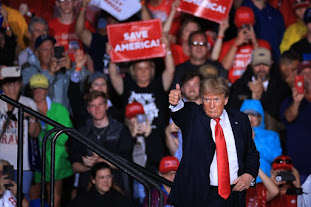
Trump promotes coronavirus vaccines and booster shots, still opposes Biden's vaccine-or-testing mandates

Trump at an Aug. 21 rally in Cullman, Ala., where he was booed
after encouraging vaccination for the coronavirus. (Photo by Chip
Somodevilla, Getty Images, via The Wall Street Journal)
Kentucky Health News

Former President Trump is promoting coronavirus vaccines, saying he has received a booster shot, but still opposes vaccine-or-test mandates like those President Biden is still trying to get through the courts.

In two interviews this week, Trump endorsed the vaccines and their booster shots, which experts say are key to thwarting widespread illness and death from the highly contagious Omicron variant of the virus.

"Some in and around Trump’s orbit have long pleaded with him to get behind vaccination pushes, if for no other reason than to remind Americans of the scientific achievements that advanced during his presidency," including rapid development of the vaccines, Rick Klein writes for ABC News.

Trump revealed Sunday, Dec. 19, that he had received a booster shot. At the Dallas stop of a speaking tour with Bill O'Reilly, the former talk-show host said they both “are vaxxed” and asked Trump, “Did you get the booster?”

“Yes,” Trump said. O'Reilly replied,  “I got it too,” Mr. O’Reilly said. Many boos were heard, and Trump waved his arms, saying, “Don’t, don’t, don’t, don’t,” and pointing to what he called “a very tiny group over there.”

Shortly before that exchange, Trump said his supporters should get vaccinated "because, he suggested, unwillingness to do so represented a victory for liberals," The New York Times reports. He said, “You're playing right into their hands.”

In a later interview with conservative commentator Candace Owens on the Daily Wire, Trump said the vaccine development “was one of the greatest achievements; we did it in less than nine months. . . . Some people aren't taking it; the ones that get very sick and go to the hospital are the ones that don't take the vaccine, but it's still their choice. And if you take the vaccine, you're protected.”

"This is good news that Donald Trump is delivering this message to his followers," USA Today Washington Bureau Chief Susan Page said Friday night on PBS's "Washington Week." Polls have shown lower vaccination rates in states and counties Trump carried; he beat Biden by 29 percentage points in Kentucky.

Trump spoke about vaccines after Owens cast doubt on them by saying that fewer people died of Covid-19 last year than this year, when they became available. By far, most Covid-19 deaths have been among the unvaccinated, and ABC notes that the vaccines were not "widely available until early spring 2021, after Biden had already assumed the presidency. . . . Other factors such as the end of masking and social distancing mandates in many local jurisdictions, as well as new variants of the virus, have contributed to Covid-19 deaths in 2021."

ABC adds, "Both Trump and Owens expressed their continued opposition to vaccine and mask mandates, and Trump also claimed that prior infection from Covid-19 protects in a similar way to the vaccine. That claim is disputed by medical experts who say that the protection from the vaccine and a booster shot is stronger than protection from prior infection."

Trump "has previously encouraged his supporters to get vaccinated," notes The Wall Street Journal. He was briefly booed at a rally in Alabama in August after urging attendees to get a Covid-19 shot. “You got to do what you have to do, but I recommend: Take the vaccines,” he said. “I did it. It’s good.” In September, he told the Journal that he probably wouldn't get a booster shot. But that was before the Omicron variant appeared.  

Tuesday, January 27, 2015

Medicare starts to overhaul the way it pays providers, rewarding them for quality, penalizing them for shortcomings

By Molly Burchett
Kentucky Health News

The Obama administration on Monday set a timeline for historic changes in how it pays doctors, hospitals and other health providers under Medicare, shifting away from the program's traditional fee-for-service model and towards a model that rewards care quality.

Rather than give the usual yearly fee increases to Medicare doctors for every procedure or service, the Department of Health and Human Services will tie 30 percent of traditional, fee-for-service payments to models like "accountable care organizations," which base payments (and penalties) on patients' health outcomes. The goal is for half of all Medicare payments to be handled this way by 2018, reports Jason Millman of The Washington Post.

"Today's announcement is about improving the quality of care we receive when we are sick, while at the same time spending our health-care dollars more wisely," said HHS Secretary Sylvia Burwell. "We believe these goals can drive transformative change, help us manage and track progress and create accountability for measurable improvement."

Medicare is the country's largest payer for health-care services, so these payment changes will affect doctors' offices and hospitals across the country. Many experts have viewed this broader shift to rewarding care quality as long overdue, but it's still uncertain how well the approach will work.

"We still know very little about how best to design and implement [value-based payment] programs to achieve stated goals and what constitutes a successful program," concluded a 2014 Rand Corp. study funded by HHS, Millman reports.

Some health-care professionals said Medicare is just aligning with what is already working in the private sector by moving away from fee-for-service, reports Alex Wayne of Bloomberg Businessweek.  “The private sector is further ahead than Medicare right now,” said Justine Handelman, vice president for legislative and regulatory policy at the Blue Cross and Blue Shield Association.

Since Medicare is already limiting payments as part of the 2010 health-reform law, the government must “ensure that only reforms proven to be efficient and effective are put in place,” Chip Kahn, CEO of the Federation of American Hospitals, told Wayne. “Further cuts would undermine our ability to invest in delivery system innovations needed to continue this trend.”

The announcement marks the first time that goals have been set to fundamentally change the way Medicare pays for health care, giving providers incentives to reduce unnecessary services.

Dr. Douglas Henley, CEO of the American Academy of Family Physicians, told CNBC: "We're all partners in this effort focused on a shared goal. Ultimately, this is about improving the health of each person by making the best use of our resources for patient good. We're on board, and we're committed to changing how we pay for and deliver care to achieve better health."

Tuesday, April 3, 2012

2012 county health rankings released; meant to spur local change

By Tara Kaprowy
Kentucky Health News

Meant to be a conversation starter to fuel change for better health, the third-annual County Health Rankings were released today, a health-evaluation tool that assesses the country's counties on everything from their smoking to early mortality rates. Kentucky's rankings did not change significantly from last year, with Oldham and Boone counties at the top and Owsley, Magoffin and Wolfe counties at the bottom of the list.

Kentuckians who are the least healthy live in the Appalachian swath of the state, the rankings show. Fulton County in Kentucky's southwestern tip ranks low, though is not surrounded by other low-ranked areas. Counties that hug urban centers — Louisville, Lexington and Cincinnati — have the highest rankings. The data are compiled by the University of Wisconsin Population Health Institute in collaboration with the Robert Wood Johnson Foundation.

Kentucky's breakdown is not unusual, but part of a nationwide pattern in which the least healthy counties are often in rural, sparsely populated areas, said Dr. Patrick Remington, lead researcher and associate dean for public health at UW's School of Medicine and Public Health. "At the other end, you see urban centers as having similar problems and often ranking at the bottom of the list," he said. "Another pattern is some of the suburban communities, ring communities, are some of the healthiest communities."

Counties are ranked in two ways: health outcomes (such as premature death rates, low birthweight, how good or bad people feel physically and mentally) and health factors (such as smoking, obesity and binge-drinking rates). In health outcomes, graphic above, Oldham, Boone and Calloway ranked first, second and third respectively. Owsley County was ranked last, preceded by Martin and Wolfe counties.

In health factors, left, Woodford County ranked first, followed by Oldham and Boone. Clay County (labeled CY) was in last place, preceded by Magoffin and Wolfe counties (MG and WO).

Though Kentucky's counties are ranked from 1 to 120, because of the small sample sizes in many of them, the rankings do not "represent statistically significant differences from county to county," the rankings website reads. Sources for the data also change, so direct comparisons from year to year are also inexact, Remington said. This year, researchers tracked the number of fast-food restaurants in a county and levels of physical inactivity. They also used premature death rate trends over 10 years, a hard number that alone can indicate progress, Remington said.

Though Remington said he would "be naive to say the competitive element doesn't pique interest in the rankings," they are "not really intended to be a race to the top." Instead, rankings should be used as a "Polaroid snapshot of community health," Remington said. The data should be used by officials to pinpoint problem areas, drill down and make policy changes in turn, he said.

That's what Chip Johnson, mayor of Hernando, Miss., did. Participating in a teleconference about the rankings, Johnson talked about how policies aimed at improving health have changed his city. Officials have required sidewalks in all new and re-developments, he said. All new streets should be biking and pedestrian accessible. The city has partnered with schools so people can use their gyms to work out. And Johnson encouraged a local bank to donate land for a 37-acre park. "Banks are sitting on land they've repossessed and don't know what to do with it," he said. "We're naming the park after the bank."

The goal is to create infrastructure that will make it easier for people to make healthy decisions, he said, pointing out, "You can't exercise your personal responsible for good health if your city or county does not give you that atmosphere or opportunity." Johnson said he responded to this reality by strategically placing the city's only farmers' market, community garden and community center in its lowest-income area.

As indicated by the data assessed and Johnson's efforts, "Much of what influences our health happens outside of the doctor's office," foundation President Risa Lavizzo-Mourey said, and factors like education rates, income levels and access to healthy food all play a part, researchers found. Data also show where someone lives can influence health. Excessive drinking, for example, is highest in Northern states. Rates of teen births, sexually transmitted infections and children living in poverty are highest in Southern states.

The rankings are based on several sources of data, from vital statistics to the Centers for Disease Control and Prevention's Behavioral Risk Factor Surveillance System, the world's largest, on-going telephone health survey. "We found even though the data are available nationally, it requires a lot of time and effort," Remington said. "This is one-stop shopping, not just for death and disease rates but for all of the factors that lead to a healthy community. Combining them allows people to start the conversation pretty easily."

Susan Zepeda, CEO of the Foundation for a Healthy Kentucky, applauded the effort. "Local health data can spur communities to action to create better health outcomes for all Kentuckians," she said.

Wednesday, March 21, 2012

Conflicting interpretations abound regarding CBO's report about cost, coverage of Affordable Care Act

By Tara Kaprowy
Kentucky Health News

Since the Congressional Budget Office released a report with revised estimates about how many people the Affordable Care Act will cover and how much it will cost, it has spawned a whirlwind of op-ed pieces with vastly opposing interpretations.

According to Julian Pecquet in The Hill, the estimate showed the federal health-care reform law will allow 30 million more people to get insurance coverage by 2016, down from the previous estimate of 32 million. Thus, the law's coverage provisions are now estimated to cost $1.083 trillion over the next 10 years, $50 billion less than last year's projection.

The CBO also estimates that 4 million Americans will lose their employer-sponsored health insurance by 2016, not the mere 1 million figure projected last year. It also estimates that 1 to 2 million fewer people will qualify for state health-insurance exchanges than initially thought, but an additional 1 million will qualify for Medicaid or the Children's Health Insurance Provision, known in Kentucky as K-CHIP.

"CBO faults a slower than anticipated recovery for the soft numbers, along with technical changes to CBO's estimating procedures and legislative changes adopted over the past year," Pecquet reports. The changes in cost estimates are "due in part to slower growth in health-care spending resulting in an 8 percent drop in premiums, as well as taxes and penalties paid by employers and their workers as struggling businesses cut down on employer-sponsored coverage," Pecquet writes.

Conn Carroll, senior editorial writer for The Washington Examiner, has an entirely different view, saying the cost has doubled. "The gross cost of President Obama's health care law has risen from $940 billion when the bill was passed, to $1.76 trillion today. This did not sit well with Obamacare's leftist apologists," he writes. Carroll uses gross figures to arrive at his calculations.

Carroll is comparing apples to oranges, and the estimate hasn't doubled, writes Ezra Klein of The Washington Post. "The disparity in the cost estimates only comes when you take a different sample of years, in which the law is doing different things, in an economy of a different size. And even then, costs went up only if you take "gross" costs rather than "net" costs, which is a rather unusual way to think about the budget."

Paul Krugman of The New York Times weighs in too, but not on the numbers. He does say, "For all its imperfections, this reform would do an enormous amount of good. And one indicator of just how good it is comes from the apparent inability of its opponents to make an honest case against it."

Krugman said "most of the disinformation" about the reform is about costs. "Each new report from the Congressional Budget Office is touted as proof that the true cost of Obamacare is exploding, even when — as was the case with the latest report — the document says on its very first page that projected costs have actually fallen slightly."

CBO Director Douglas Elmendorf defended in his blog the changes in estimates. "We will continue to update our estimates regarding health insurance coverage as new information becomes available about the implementation of the ACA, underlying trends in the health-care and health financial systems, and the probable responses to the legislation by businesses, families and others."