Showing posts sorted by relevance for query smoking cessation Medicaid. Sort by date Show all posts

Friday, December 22, 2017

Poor adults on Medicaid more likely to quit smoking in expansion states like Ky.; 26 % of Ky. smokers use cessation benefit

Corrective Notice: If your publication has used this story, please use this revised story or post a correction on the original to reflect that 26 percent of Kentucky's Medicaid smokers used the smoking cessation benefit during the 2016-17 fiscal year, and not 15 percent as originally reported. The original calculation did not take into account that of the 1.4 million Kentuckians on Medicaid, only about 800,000 of them are adults. Please note that the headline has also been corrected. 

By Melissa Patrick
Kentucky Health News

Low-income adults who gained health insurance under the expansion of Medicaid like Kentucky and most other states were more likely to quit smoking than those in states that didn't expand the program.

So says a study by the University of Pittsburgh Graduate School of Public Health, published in the journal Medical Care. Researchers examined smoking-related responses from more than 36,000 low-income adults without dependent children using data from the federal Centers for Disease Control and Prevention's Behavioral Risk Factor Surveillance Survey for the years 2011 to 2015.

It found that in the 31 states that expanded Medicaid, 8.1 percent of those newly covered said they had quit smoking in the past year, compared with 6 percent of low-income adults in states that did not expand Medicaid. (This was after the researchers factored in the effects of smoking rates from demographics, differences in cigarette taxes and states' indoor-air smoking policies.)

“Smoking cessation is notoriously difficult to achieve,” Marian Jarlenski, senior author and assistant professor in Pitt's Department of Health Policy and Management, said in a news release. “The sizable increase we found in smoking cessation might lead to significant reductions in death and diseases caused by smoking, and the taxpayer-funded health care expenditures that come with treating them.”

The report notes that smoking is responsible for 9 percent of annual health-care spending in the U.S. The annual cost of smoking related health care costs to Kentucky is estimated to be $1.92 billion.

J. Wyatt Koma, a lead author of the study, said there are many ways that engaging with health-care services could motivate new Medicaid enrollees to stop smoking.

“During the Medicaid enrollment process, people are asked whether they smoke, so it’s possible that this question might prompt them to start contemplating smoking cessation," he said in the release. "After enrollment, they have access to primary-care visits, where their clinician is likely to counsel them about quitting. And studies have shown that people in states with Medicaid expansion are much more likely to get prescriptions for smoking-cessation medications, which are covered by Medicaid.”

The researchers say the study provides evidence that Medicaid coverage can help people stop smoking. Koma said the quit rate of 8.1 percent is low, especially compared to the almost 70 percent of adults who say they want to quit.

What about Kentucky?

About 30 percent of low-income adults in the United States are smokers, which is double the national average. That rate is even higher among Kentucky's Medicaid population -- almost 44 percent, according to a survey conducted by the federal Center for Medicare and Medicaid Services.

That means 616,000 of the approximately 1.4 million Kentuckians on Medicaid are smokers. In the 2016-17 fiscal year, 90,013 of them used the smoking-cessation benefit -- about 15 percent of the smokers.

Correction: That means 349,840 of the approximately 800,000 Kentucky adults on Medicaid are smokers. In the 2016-17 fiscal year, 90,013 of them used the smoking-cessation benefit -- about 26 percent of the smokers. 

Of those, 49,319 were on Medicaid due to the expansion, which covers about 480,000 people, and 40,694 were on traditional Medicaid, according to the state Department of Medicaid Services. The expansion took effect in 2014.

The figures shows only how many Medicaid beneficiaries used the smoking-cessation benefit and not how many of them were successful at quitting.

A similar look at Medicaid claims data from 2015 found that only 17.2 percent of Medicaid smokers used a smoking-cessation medication and a mere 1.4 percent received smoking-cessation counseling. The 2015 Cabinet for Health and Family Services report cited a much smaller number of Kentuckians on Medicaid dependent on tobacco, only 10 percent, but that data was based partly on records that were likely incomplete.

New law and advocacy could lead to higher participation

When the numbers for the current fiscal year are compiled, they could show increased use of the smoking-cessation benefit, because Kentucky passed a law in the 2017 legislative session to require all health insurers, including Medicaid managed-care companies, to remove barriers to coverage for all federally approved tobacco-cessation medications and programs. The law took effect June 29, the day before the fiscal year ended.

Why was the law needed, if the Patient Protection and Affordable Care Act requires all insurance policies to cover smoking-cessation treatments? Insurers erected several barriers to treatment, such as co-payments, prior-authorization requirements and limits on length of treatment.

One of the goals of the newly formed Coalition for a Smoke-Free Tomorrow, staffed by the Foundation for a Healthy Kentucky, is to educate the public and health-care providers about the new law.

“We are all working to educate physicians, community health workers and residents to ensure they know that counseling and nicotine-replacement therapies are available free of charge," said Ben Chandler, president and CEO of the foundation. "The starting points for smokers vary; it may be a talk with their doctor, or seeing one of the ads for the Kentucky QuitLine campaign. Our goal is to make sure that every Kentuckian who is addicted to nicotine knows where they can get the help they need to successfully kick the habit.”

Resources to help Kentuckians quit smoking can be found at www.quitnowkentucky.org and www.smokefreetomorrow.org. Kentucky's Tobacco Quitline is 1-800-QUIT-NOW (1-800-784-8669). Also, many local health departments offer smoking cessation classes.

Wednesday, January 3, 2018

Poor adults on Medicaid more likely to quit smoking in expansion states like Ky.; 26% of Ky. smokers use cessation benefit

Corrective Notice: This is a corrected version of a story published Dec. 22, revised to reflect that 26 percent of Kentucky's Medicaid smokers used the smoking cessation benefit during the 2016-17 fiscal year, and not 15 percent as originally reported. The original calculation did not take into account that of the 1.4 million Kentuckians on Medicaid, only about 800,000 of them are adults. If you are a publisher that has used this story, please replace it with this revised story or post a correction on the original. We regret the error. 

By Melissa Patrick
Kentucky Health News

Low-income adults who gained health insurance under the expansion of Medicaid like Kentucky and most other states were more likely to quit smoking than those in states that didn't expand the program.

So says a study by the University of Pittsburgh Graduate School of Public Health, published in the journal Medical Care. Researchers examined smoking-related responses from more than 36,000 low-income adults without dependent children using data from the federal Centers for Disease Control and Prevention's Behavioral Risk Factor Surveillance Survey for the years 2011 to 2015.

It found that in the 31 states that expanded Medicaid, 8.1 percent of those newly covered said they had quit smoking in the past year, compared with 6 percent of low-income adults in states that did not expand Medicaid. (This was after the researchers factored in the effects of smoking rates from demographics, differences in cigarette taxes and states' indoor-air smoking policies.)

“Smoking cessation is notoriously difficult to achieve,” Marian Jarlenski, senior author and assistant professor in Pitt's Department of Health Policy and Management, said in a news release. “The sizable increase we found in smoking cessation might lead to significant reductions in death and diseases caused by smoking, and the taxpayer-funded health care expenditures that come with treating them.”

The report notes that smoking is responsible for 9 percent of annual health-care spending in the U.S. The annual cost of smoking related health care costs to Kentucky is estimated to be $1.92 billion.

J. Wyatt Koma, a lead author of the study, said there are many ways that engaging with health-care services could motivate new Medicaid enrollees to stop smoking.

“During the Medicaid enrollment process, people are asked whether they smoke, so it’s possible that this question might prompt them to start contemplating smoking cessation," he said in the release. "After enrollment, they have access to primary-care visits, where their clinician is likely to counsel them about quitting. And studies have shown that people in states with Medicaid expansion are much more likely to get prescriptions for smoking-cessation medications, which are covered by Medicaid.”

The researchers say the study provides evidence that Medicaid coverage can help people stop smoking. Koma said the quit rate of 8.1 percent is low, especially compared to the almost 70 percent of adults who say they want to quit.

What about Kentucky?

About 30 percent of low-income adults in the United States are smokers, which is double the national average. That rate is even higher among Kentucky's Medicaid population -- almost 44 percent, according to a survey conducted by the federal Center for Medicare and Medicaid Services.

That means 349,840 of the approximately 800,000 Kentucky adults on Medicaid are smokers. In the 2016-17 fiscal year, 90,013 of them used the smoking-cessation benefit -- about 26 percent of the smokers.

Of those, 49,319 were on Medicaid due to the expansion, which covers about 480,000 people, and 40,694 were on traditional Medicaid, according to the state Department of Medicaid Services. The expansion took effect in 2014.

The figures shows only how many Medicaid beneficiaries used the smoking-cessation benefit and not how many of them were successful at quitting.

A similar look at Medicaid claims data from 2015 found that only 17.2 percent of Medicaid smokers used a smoking-cessation medication and a mere 1.4 percent received smoking-cessation counseling. The 2015 Cabinet for Health and Family Services report cited a much smaller number of Kentuckians on Medicaid dependent on tobacco, only 10 percent, but that data was based partly on records that were likely incomplete.

New law and advocacy could lead to higher participation

When the numbers for the current fiscal year are compiled, they could show increased use of the smoking-cessation benefit, because Kentucky passed a law in the 2017 legislative session to require all health insurers, including Medicaid managed-care companies, to remove barriers to coverage for all federally approved tobacco-cessation medications and programs. The law took effect June 29, the day before the fiscal year ended.

Why was the law needed, if the Patient Protection and Affordable Care Act requires all insurance policies to cover smoking-cessation treatments? Insurers erected several barriers to treatment, such as co-payments, prior-authorization requirements and limits on length of treatment.

One of the goals of the newly formed Coalition for a Smoke-Free Tomorrow, staffed by the Foundation for a Healthy Kentucky, is to educate the public and health-care providers about the new law.

“We are all working to educate physicians, community health workers and residents to ensure they know that counseling and nicotine-replacement therapies are available free of charge," said Ben Chandler, president and CEO of the foundation. "The starting points for smokers vary; it may be a talk with their doctor, or seeing one of the ads for the Kentucky QuitLine campaign. Our goal is to make sure that every Kentuckian who is addicted to nicotine knows where they can get the help they need to successfully kick the habit.”

Resources to help Kentuckians quit smoking can be found at www.quitnowkentucky.org and www.smokefreetomorrow.org. Kentucky's Tobacco Quitline is 1-800-QUIT-NOW (1-800-784-8669). Also, many local health departments offer smoking cessation classes.

Sunday, January 10, 2016

162,000 Ky. Medicaid members are slaves to tobacco, but only 17% of them use their smoking-cessation benefits

By Melissa Patrick and Al Cross
Kentucky Health News

Ten percent of Kentuckians on Medicaid are dependent on tobacco, but fewer than 2 percent -- less than one in five of those who are dependent -- are using Medicaid to quit. Those statistics could play a role in how Kentucky changes its version of Medicaid.

In 2015, only 17.2 percent of Medicaid recipients used smoking-cessation medications, even though such meds are available to them at little to no cost. Only 1.4 percent of received smoking-cessation counseling, according to data from the state Cabinet for Health and Family Services.
Smoking is the leading cause of premature death and preventable disease in the U.S. and Kentucky, which leads the nation in lung cancer and deaths from it. Treatment for smoking-related illness is expensive, and taxpayers are footing the bill for Medicaid recipients, more than one-fourth of Kentuckians.

Almost $600 million of Kentucky's annual Medicaid expenses are for smoking-related illnesses, Ashli Watts, director of public affairs for the Kentucky Chamber of Commerce, said on Kentucky Educational Television in October.

The chamber wants the General Assembly to pass a statewide ban on smoking in workplaces as a way to save money for taxpayers and employers. "We can simply no longer afford to ignore this issue," Watts said. "Smoking is not only killing us, it is bankrupting us."

Medicaid expansion added to burden caused by tobacco

Gov. Matt Bevin plans to revise Medicaid to reduce its costs, perhaps by requiring better-off recipients to pay premiums, co-payments or deductibles. State Senate President Robert Stivers, a fellow Republican, says the program should include incentives to stop smoking, as private health insurance does, by charging smokers higher premiums.

Tobacco has a bigger impact on Medicaid than it did before 2014 because of then-Gov. Steve Beshear's expansion of Medicaid eligibility to 138 percent of the federal poverty level. Among the 558,000 people covered by the expansion, 16 percent are tobacco-dependent. Among traditional Medicaid, which covers poorer people, only 7 percent are.

The federal government is paying the entire cost of the expansion through this year. Next year, states will begin paying 5 percent, rising in annual steps to the reform law's maximum of 10 percent in 2020. Bevin and Stivers say the state can't afford that.

Federal health reform required all state Medicaid programs to cover at least some counseling and federally approved therapies such as nicotine gum and drugs like bupropion and varenicline (brand names Welbutrin and Chantix, respectively).

But in Kentucky and other states, smoking-cessation medications are being under-utilized nationwide, according to a recent study at the George Washington University Milken Institute School of Public Health. The study, published in the journal Health Affairs, found that only 10 percent of all Medicaid participants took advantage of the medications in 2013. About one-third of U.S. adults with Medicaid smoke, a GWU news release said.

"The utilization of anti-smoking drugs varied widely from a high of about 30 percent of Medicaid smokers in Minnesota to less than 1 percent in Texas," the release said.

Association of Health Care Journalists map; click on it to enlarge
The use of the medications was more extensive in Kentucky and other states that expanded Medciaid, NPR notes.

"These data show that most Medicaid programs could do much more to help smokers quit," Leighton Ku, lead author of the study, said in the news release. "Data from the Centers for Disease Control and Prevention suggests that medical treatments for smoking-related diseases will cost the Medicaid program about $75 billion in 2016 but we spend less than one-quarter of one percent of that amount to help smokers quit."

Another study estimated that $1 invested in tobacco cessation lowered Medicaid expenditures by about $3 because of a rapid reduction in hospital visits for cardiovascular disease, says the report.

Audrey Darville, a certified tobacco treatment specialist with UK HealthCare, said on KET that only three to five people out of 100 are successful when trying to stop “cold turkey" and emphasized the importance of getting evidence based help.

People who engage in cessation counseling, tobacco cessation medications and individual counseling are the most successful, with a 40 to 60 percent success rate of “staying quit," she said. For more information about tobacco cessation treatment through Medicaid in Kentucky, click here.

Thursday, September 28, 2017

'Kick It, Kentucky' spends week encouraging smoking cessation in a state with the nation's highest smoking rate


By Melissa Patrick
Kentucky Health News

Kentuckians who want to stop smoking can take advantage of the many cessation tools offered by the state, including a new law that requires insurance companies to cover smoking-cessation treatments and counseling without imposing barriers.

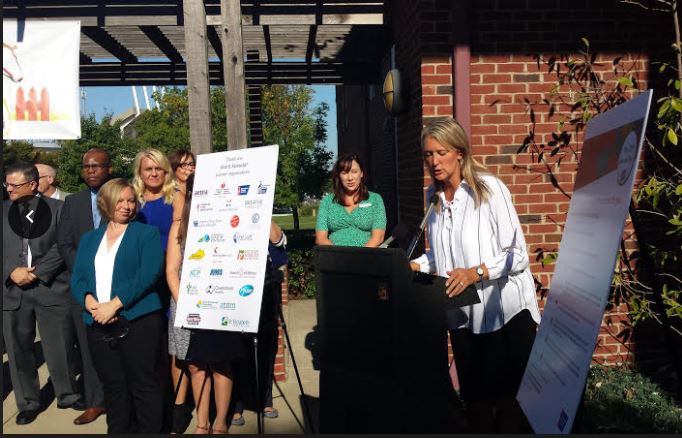
That was the message at the Sept. 27 announcement of the first ever "Kick It, Kentucky" week, where more than two dozen organizations gathered in Lexington to promote smoking cessation.

"More adults in Kentucky smoke than in any other state in the nation and we also have the second-highest youth smoking rate in the country, but the good news is there has never been a better time to quit," said Erica Palmer Smith, Kentucky government relations director for the American Cancer Society's Cancer Action Network, one of the supporting organizations.

Several of the health advocates noted a long list of health benefits that come to a person who stops smoking: Within 20 minutes of quitting, a person's heart rate and blood pressure drop; within a couple of weeks, their lung function improves; and within a year, their risk of a heart attack drops by half. These benefits are listed on a poster that will be placed in doctors' office waiting rooms and public buildings as part of the Kick It, Kentucky effort.

Sen. Julie Raque Adams
Sen. Julie Raque Adams, R-Louisville, who was the primary sponsor of the smoking-cessation bill, told the group that smoking kills more than 9,000 Kentuckians a year, and stressed that "tobacco continues to be the leading cause of preventable death in the commonwealth."

The new law requires all insurance policies sold in Kentucky, and Medicaid, to cover all smoking-cessation treatments and counseling approved by the U.S. Food and Drug Administration with no barriers to access. For example, the law bans co-payments or deductibles for cessation products.

"There's never been a better time to quit," said Adams, who is also the chairwoman of the Senate Health and Welfare Committee. "Kentuckians who decide to quit will reap immense and immediate health benefits."

The president and CEO of the Foundation for a Healthy Kentucky, Ben Chandler, told the group that in addition to leading the nation in cancer and deaths from it, Kentucky ranks near the bottom of states for heart disease deaths, adult asthma and chronic obstructive pulmonary disease (COPD) -- which are all related to smoking.

"Therefore, I submit to you that the single most effective thing that we can do to improve the health of the people in this commonwealth is to reduce those smoking rates," he said. "Ladies and gentlemen,we've just simply got to do it. We've got to do it. It's a crisis and the need is dire."

He noted that this can be accomplished on a community and statewide level through smoke-free laws and raising the cigarette tax, or on an individual level, as Cheryl Weiss did.

Weiss, 36, said she smoked 20 years before quitting this year. "I got to where smoking was taking my time, my money and my energy," she said.

The Lexington woman credited her decision to quit smoking to an incentive program at her work that directed her to an eight-week smoking cessation program called "Freedom from Smoking" through the American Lung Association.

She said that by not smoking, she will save $26 every two weeks on her health insurance, plus the savings from not buying cigarettes -- and she said, "I feel healthier."

Other resources to help quit smoking can be found at www.quitnowkentucky.org and www.smokefreetomorrow.org. Kentucky's Tobacco Quitline is 1-800-QUIT-NOW (1-800-784-8669). In addition, many local health departments offer smoking cessation classes.

Sunday, July 23, 2023

European quit-smoking drug proven safe, effective in U.S. study

European cystine product (Medpage Today photo)
By Melissa Patrick
Kentucky Health News

Cytisinicline, a drug to help people stop smoking, was found to be safe and effective when used at a higher concentration than is traditionally used in Europe, where it is currently being used. It is not yet available in the United States. 

“Cigarette smoking remains the leading preventable cause of death worldwide, yet no new smoking-cessation medication has been approved by the U.S. Food and Drug Administration for nearly two decades,” Dr. Nancy Rigotti,  director of Massachusetts General Hospital's Tobacco Research and Treatment Center, and lead author of the study, said in a press release. “There is an urgent need for new medications to treat tobacco smoking because existing products don’t help all smokers to quit and can have unacceptable side effects. If approved by regulators, cytisinicline could be a valuable new option to treat tobacco dependence.”

Cytisinicline, which is historically known as cytisine, is a naturally derived, plant-based medication that has been developed as a treatment for nicotine dependence and smoking cessation. It is not licensed in the U.S., but is used in some European countries for smoking cessation. Some researchers have questioned whether the recommended dose and treatment duration are appropriate. 

The study, published in the Journal of the American Medical Association, found that both a six-week and a 12-week treatment of cytisinicline in 810 adults who smoke cigarettes daily and wanted to quit produced "significantly higher continuous smoking-abstinence rates" compared with a placebo during the last four weeks of treatment and from the end of treatment to 24 weeks. 

"Participants in the cytisinicline groups had six- to eight-fold higher odds of continuous smoking abstinence at the end of treatment than participants receiving placebo plus behavioral support," says the study report. 

The study involved a three-group, double-blind, placebo-controlled, randomized trial that compared a six-week and a 12-week duration of either cytisinicline treatment or a placebo, with follow-up through 24 weeks. It was conducted at 17 U.S. sites from October 2020 to December 2021. 

It found that in the six-week course of treatment, in weeks 3-6, continuous abstinence rates with cytisinicline were 25.3% and 4.4%. In the 12-week trial, the rates were 32.6% for cytisinicline and 7% for placebo in weeks 9-12.

Participants taking cytisinicline also experienced a rapid and sustained decline in cravings and smoking urges during the first six weeks of treatment, the researchers said.

The study also found a statistically significant increase in continuous abstinence through six months for both treatment durations.

The manufacturer's recommendation for the drug is for a 1.5-milligram tablet to be taken initially six times a day, and then gradually reduced over a 25-day course of treatment. However, the researchers found that 3 mg of cytisinicline three times a day produced the highest continuous abstinence.

The researchers reported "no adverse events" from taking the drug, with less than 10% of the participants experiencing nausea, abnormal dreams and insomnia.

The researchers concluded, "Both six- and 12-week cytisinicline schedules, with behavioral support, demonstrated smoking-cessation efficacy and excellent tolerability, offering a new nicotine-dependence treatment option." They also noted that no smoking-cessation drug has received FDA approval since 2006. 

“Cytisinicline demonstrated impressive results as a smoking-cessation medication in a rigorous clinical trial that used a new, scientifically based dosing regimen as well as a longer duration of treatment than traditionally done,” said Rigotti. “This agent has the potential to help countless numbers of people quit smoking and, in the process, reduce the enormous toll of premature deaths and disability due to cigarette smoking in the U.S. and worldwide.”

In 2015, nearly 70% of adult smokers said they want to quit. In 2018, about 55% said they had made an attempt to quit in the previous year, but only about 8% were successful in quitting for six to 12 months, according to the latest data available from the Centers for Disease Control and Prevention.

In 2020, the latest year for which statistics are available, 21.4% of Kentucky adults were smokers. 

Many health-insurance plans, including Medicaid, cover FDA-approved smoking-cessation medicines with no copayments. Kentucky offers a free quit line at 1-800-QUIT-NOW that provides personalized coaching to help people quit smoking.

Wednesday, February 15, 2017

State Senate committee approves bill to remove insurance-company barriers to smoking-cessation treatments

Feb. 22 Update: SB89 passed 35-2 out of the full Senate and now heads to the House for consideration. March 14: SB89 passed 90-1 out of the full House. March 21: SB 89 was signed by Gov. Matt Bevin. 

By Melissa Patrick
Kentucky Health News

FRANKFORT, Ky. – Kentuckians could get treatments to help them quit smoking without facing obstacles from their insurance companies, under a bill that a state Senate committee approved unanimously Feb. 15.

Sen. Julie Raque Adams
Senate Bill 89 would require all insurance policies sold in Kentucky to cover all smoking-cessation medications and counseling approved by the U.S. Food and Drug Administration "with no barriers to access," said Sen. Julie Raque Adams, the bill's sponsor. "The choice is simple: If Kentuckians want to quit smoking, they will have true access to the necessary tools. If they don't, no money or effort is expended."

The Patient Protection and Affordable Care Act requires all insurance policies to cover smoking-cessation treatment, but Adams said that doesn't mean they are readily available. The Louisville Republican said many insurers have barriers to treatment such as co-payments, prior authorization, limits on length of treatment, annual and lifetime limits on attempts to quit, and step-therapy requirements that dictate the order in which physicians can prescribe treatments. SB 89 would provide barrier-free access to all U.S. Preventive Services Task Force-recommended smoking cessation treatments in all Kentucky health plans, including Medicaid.

Dr. Shawn Jones, senior physician in the Ear, Nose and Throat Group at Baptist Health Paducah and past-president of the Kentucky Medical Association, said in a telephone interview that he runs into these barriers "all the time."

"A lot of times we will want to try certain medications, whether it is a medication that has been out for a long time, like Wellbutrin or [a newer one like] Chantix, and a lot of insurers won't pay for that, even though the studies say they are much more effective than the nicotine-replacement-therapy that the patient may have already tried over-the-counter, and that doesn't count because it wasn't from a prescription from the physician," he said.

Asked if he ran into annual limits on quit attempt barriers, Jones laughed and said, "I haven't been able to get a whole lot of people covered the first time, so I haven't had the trouble of getting them covered the second time. My experience has been more with the Medicaid population and it's very difficult to get them the treatment they need."

Dr. Shawn Jones
Jones, who spoke in favor of the bill at the Senate Health and Welfare Committee meeting, said smoking costs the state $1.92 billion in annual health-care costs, of which $590 million goes to Medicaid (most of which is federally funded), and kills almost 9,000 Kentuckians a year. The state leads the nation in smoking; 26 percent of Kentucky adults smoke.

"If we are going to use the word crisis with respect to the opioid epidemic in Kentucky, and I think we should, then we must do the same with regard to smoking," he said, noting that smoking kills many more people. "Smoking in Kentucky is nothing short of a catastrophic pandemic of gargantuan proportions, and that does not do it justice."

Jones said 70 percent of U.S. smokers say they want to quit, and 34 percent of those try to quit, but only about 10 percent are successful. "It's not easy to quit smoking," he said. "Many smokers simply cannot quit without true, barrier-free access to the treatments prescribed by their doctors, and physicians play a critical role in helping people quit."

Jones wrote in an op-ed in the Lexington Herald-Leader that the insurance companies' set of obstacles "makes it extremely difficult for smokers to stay motivated to quit."

Erica Palmer Smith, speaking on behalf of the American Cancer Society Cancer Action Network and other patient advocacy groups, told the committee that insurance companies' barriers to access "cause confusion among providers and patients about the availability of treatment, meaning fewer Kentuckians don't attempt to quit smoking."

Adams said after the meeting that the bill has the support of the state Cabinet for Health and Family Services, and noted that the state Department of Insurance estimated the financial impact of SB 89 to be minimal, $1.10 a year for the average policyholder. She said it will save insurance companies and Medicaid money in the long run.

Ben Chandler, president and CEO of the Foundation for a Healthy Kentucky, applauded the committee's vote. "If anyone wants to quit smoking, we ought to help them do it, instead of throwing up roadblocks," he said in a news release. "Senate Bill 89 will improve health in Kentucky and save taxpayer money."

Thursday, August 18, 2016

Philosophical divide evident at Medicaid oversight meeting; Bevin officials say revised plan will be sent to feds 'shortly'

By Melissa Patrick
Kentucky Health News

As Gov. Matt Bevin prepared to ask federal officials to let him change the state's Medicaid program, a discussion at a legislative committee meeting offered a glimpse of the philosophical differences between the political parties, through a window that showed the two mindsets at work.

Most of the Medicaid Oversight Committee meeting involved an overview of Bevin's draft proposal, which is designed to assure that "able bodied adults" have a higher level of involvement in their health care, through things like premiums and "community engagement" requirements.

Most who would be affected by the proposal have gained health insurance under then-Gov. Steve Beshear's expansion of Medicaid to those who earn up to 138 percent of the federal poverty level. The changes would not affect pregnant women, children or those who are deemed medically frail.

"We will be making some changes" in the draft request for a waiver of some Medicaid rules, Health Secretary Vickie Yates Brown Glisson told the committee. "We anticipate that shortly we will be getting a revised waiver to" the U.S. Department of Health and Human Services.

Comments after the presentation offered some insight into the deep philosophical divide between the political parties about how to provide health insurance to the state's poorest citizens.

Rep. Benvenuti
Rep. Robert Benvenuti, a Lexington Republican, shared a story that supports his belief that many able bodied Kentucky adults are taking advantage of the system. He said employers have called him and said they were having difficulty filling jobs because people didn't want to work full time because then they would lose the "free health care" they get from Medicaid.

"Have you all looked at that?" he asked. "The whole issue of people who voluntarily -- in other words, they are not vulnerable -- they voluntarily decided that it is simply not worth the effort to go work because the benefits of not working have outstripped the benefits of work?"

Adam Meier, the governor's deputy chief of staff, sympathized with Benvenuti and said the issue was of "serious concern." He said the fact that four of 10 Kentuckians are not working suggests "We have in some instances created a culture, or an environment where it is sometimes easier to not work and the benefits will be able to sustain you."

Meier said the work and community-engagement requirements in the draft Medicaid plan would help able-bodied Kentuckians have the tools and incentives they need "to go out and be engaged in their communities, be engaged with their employer."

Sen. McGarvey
Sen. Morgan McGarvey, a Louisville Democrat, asked the Republicans, "Do you guys have any evidence or numbers of people who have quit work to get Medicaid?

"I think that would be pretty anecdotal, it would be pretty hard to capture that," Meier said.

To which McGarvey said, "I think it would be too, especially with the roughly 5 percent unemployment rate right now."

Earlier in the meeting, Medicaid Commissioner Stephen Miller said Bevin's plan would save approximately $2.2 billion over five years, of which the state portion would be $331 million. The federal government is paying the full cost of Medicaid expansion through this year; next year the state will start paying 5 percent, rising in annual steps to the law's limit of 10 percent in 2020.

McGarvey asked the administration officials why they thought giving up nearly $2 billion in federal spending on Kentucky health care was a good idea, especially if their shared goal was to "get the best health care for the most number of Kentuckians in the cheapest way possible."

"We are going to save $331.3 million, but we are essentially giving up $1.9 billion coming into the state to get that savings," he said. "I am just wondering whether that is a good trade-off."

Meier said the administration didn't look at this as giving up money, but rather that it was a savings of taxpayer's money.

"Our administration's position is that a taxpayer dollar is a taxpayer dollar," he said.

McGarvey replied, "Under what you said, that is not necessarily true, because for every dollar we give the federal government, we get a dollar-fifty back. . . . It just looks like we are giving that up."

Meier responded, "I think from a philosophical standpoint, maybe we are going to have to disagree on that, that's the best way to use taxpayer dollars and if we can do it in a way that is more efficient and increase outcomes, then that is the approach that our administration is going to take."

McGarvey countered, "I don't disagree with that. I think we should do something in the most efficient (way), that gets the best outcomes in the state, I completely agree. I am just wondering when you look at these numbers which one actually gives us that best return. That's the question that I don't think I have enough data under the plans being proposed from the governor right now to differentiate, or to make that case."

Moving the needle

McGarvey said money spent on health care in Kentucky is money well spent, especially because this "is the first thing that has moved that needle effectively in 25 years."

Glisson disagreed: "The more we've spent, we have not moved the needle, we have not seen movement in those outcomes. . . . Our figures do not show that that needle has been improved as we have spent more on Medicaid. Those outcomes did not improve."

McGarvey asked for data supporting Glisson's claim, saying there is conflicting evidence. A study published last week found that Medicaid-eligible people in Kentucky and Arkansas, which also expanded Medicaid, are reporting that they are in "excellent" health in increasing numbers.

Emily Beauregard, executive director of Kentucky Voices for Health, noted the study in an interview. She said, "It's been really disappointing to hear the administration continue to say that we haven't moved the needle on health with Medicaid expansion, because we absolutely have. . . . We see that in the fact that preventive screenings have doubled, that chronic-disease management has increased by 15 percent, and that emergency department visits have decreased. And all of that points to expanded coverage having a real impact."

Sen. Alvarado
One area that McGarvey and Sen. Ralph Alvarado, a Republican and physician from Winchester, agreed on was the need for a statewide smoking ban, which both said would improve the state's dismal health outcomes.

"While we are debating dollars and taxpayer money up here, which is incredibly, incredibly important and certainly a large part of this debate, there are certain policies that we can do that cost nothing to improve the health of Kentuckians," McGarvey said. "We could all advocate for a smoking ban in the next legislative session." Bevin opposes such a ban, saying it is a local issue.

Agreeing with McGarvey, Alvarado said, "I think that would be a wise choice for our state going forward." He also urged the Cabinet to allow managed care organizations to pay for all smoking cessation medications, telling them that "the rates on that are tremendous."

Glisson noted that every health department in the state has a smoking cessation program, but said they would have to work with the actuaries to determine if MCOs could include all cessation medications. Meier noted that smoking cessation is one of the reward incentives in the new Medicaid plan.

Saturday, October 24, 2015

KET's Clearing the Smoke' explores smoking issues in Kentucky; guests called for smoking ban, note concerns about teens

An old tobacco barn in Magoffin County, seen by thousands daily
on the Mountain Parkway, has found a new purpose – to help people
stop smoking. Tobacco barns It once advertised Mail Pouch tobacco.

Abbie Conley, tobacco coordinator for the county health department,
told KET, “Alot of parents feel like, well, it's not as bad as drug use or
not as bad asalcohol. I've even heard of parents buying cigarettes for
their kids.”Shelia Salyer, the owner of the barn, said that the last
tobacco grownon her farm was 12 years ago and smoking has taken a toll
on thecounty: “I have lost a lot of people I know to smoking, to lung cancer.”
By Melissa Patrick
Kentucky Health News

About one in four Kentuckians smoke, but the habit affects everyone in the state -- if not directly through the many diseases associated with smoking or second-hand smoke, then economically: through increased taxes, higher insurance premiums and decreased worker productivity. The best way to address this is a comprehensive ban on smoking in workplaces.

That was the message of “Clearing the Smoke,” a Kentucky Educational Television "Health Three60" episode that first aired Oct. 19.

Host Renee Shaw opened the program with state Health Commissioner Stephanie Mayfield and Dr. Chizimuzo Okoli, director of the Division of Tobacco Treatment and Prevention at the University of Kentucky.

Smoking in Kentucky

Mayfield told Shaw that while Kentucky's smoking rate has been trending down, it still has the second highest rate in the country at 26 percent, well above the national rate of 19 percent, prompting her to say, “We have a lot of work to do."

At least 70 percent of smokers want to quit, Okoli told Shaw, but said, "It is important to remember that smoking is actually an addictive disorder," and smokers need access to smoking cessation tools to be successful.

Mayfield jumped in and said with enthusiasm, "That is exactly what we have done with enhanced health-insurance access," noting that the state's embrace of federal health reform has allowed more Kentuckians to have access to smoking cessation programs. "Health insurance helps tremendously," she said.

The two also touched on the many diseases linked to smoking: diabetes type 2, rheumatoid arthritis, lung cancer, colon cancer, leukemia, birth defects, respiratory diseases, asthma, breast cancer, oral cancers, other organ cancers, bone loss... with Mayfield noting that these diseases are associated with both smoking and second-hand smoke.

"Second-hand smoke can kill you," Mayfield said.

Okoli pointed out that smoking has a direct impact on unborn children. He said 70 percent of women quit smoking when they find out they are pregnant, and some studies show that those who continue to smoke sometimes have mental illness or addictive disorders.

Mayfield agreed, saying, "Those with pre-existing behavioral health and mental disorders, we find that their smoking rates can be as high as 50 percent compared to our general population."

Support for smoke-free legislation

Mayfield and Okoli said they support statewide smoke-free legislation to ban smoking in enclosed public places.

“I think our people deserve this,” Okoli said, noting that a ban would protect against the preventable diseases associated with smoking, decrease cigarette consumption and discourage young people from starting to smoke.

Ashli Watts, director of public affairs for the Kentucky Chamber of Commerce, said 92 percent of the chamber's members support statewide smoke-free legislation.

“This is not just a health care issue, it is an economic development issue,” Watts told Shaw, noting that businesses look at the health of the workforce, productivity levels and the cost of insurance when they are deciding where to locate.

Watts also pointed out that almost $600 million of Medicaid taxpayer money went directly to pay for smoking related issues and said, "We can simply no longer afford to ignore the issue. Smoking is not only killing us, it is bankrupting us."

The importance of tobacco cessation programs

Audrey Darville, a certified tobacco treatment specialist with UK HealthCare, told Shaw that it is important to get evidence-based help to stop smoking, with only three to five people out of 100 successful when trying to stop “cold turkey.”

Darville said that people who engage in cessation counseling, tobacco cessation medications and individual counseling have a 40 to 60 percent success rate of “staying quit.”

She explained that nicotine hits the brain within 10 seconds of smoking and causes a release of dopamine, which stimulates pleasure, making it hard to quit.

“We tend to place a lot of the responsibility for quitting or being successful with quitting on the person or some personal characteristics, but we have to have a healthier respect for how addictive this drug (is) and how miserable people feel when they don't have it when they are trying to quit,” Darville said.

Bobbye Gray, tobacco cessation administrator for the state Department of Public Health, said the Kentucky Quit Line is available to those 15 and older who are ready to quit smoking. Smoking cessation coaching is also available through the Quit Line for those without insurance, who, Gray said, can get nicotine replacement products free of charge. Smoking cessation programs are also available through local health departments.

Smoking and Teens

“Some people are more addicted (than others), especially young people and teenagers,” Gray said, “They are more sensitive to the nicotine, therefore more susceptible to the addiction.”

About 18 percent of high school students smoke traditional cigarettes, and 24 percent use e-cigarettes, said Elizabeth Hoagland, youth tobacco-policy specialist with the state health department, adding that 30 percent of youth who experiment with smoking will go on to become daily smokers.

Hoagland said that most people aren't aware that even teenagers have health consequences from smoking, even if they aren't daily smokers, including insulin resistance and reduced lung growth.

“You have reduced lung growth. The lung is kind of like the brain, the lungs keep maturing and growing until the age of 25. So, if you are a smoker, your lungs don't grow to their full capacity, and they don't work as well as they would for a non-smoker,” she said.

Hoagland expressed concern about the growing use of electronic cigarettes, saying that there was “a lot of misinformation” out there. She made it clear that the vapor off of an e-cigarette is not a water vapor, but is an aerosol, “And these are completely unregulated products so we don't know what is in them,” she said.

She said that we know e-cigarettes contain nicotine and formaldehyde, in addition to ultra-fine particles, which can cause “lung inflammation and lung damage,” and noted that some flavorings like diacetyl, which is used in microwave popcorn, is used in 60 percent of e-cigarettes and has been proven not safe to breathe.

Programs like Teens Against Tobacco Use at Tates Creek High School in Lexington allow high school students to visit elementary and middle schools and talk to the students about the dangerous effects of tobacco use using hands on activities.

At Bourbon County High School, students brought e-cigarettes to the staff and school board's attention, leading the effort to have them included in their tobacco-free policy at school. Lynlea Kiser, a student in the school who is involved in smoke-fee education, said that many of the staff didn't know what e-cigarettes were until the students brought them to their attention.

Cyndi Steele of the Bourbon County Health Department said that because the schools already had a tobacco-free policy in place, the culture has shifted. “The students were not willing to tolerate the vapor from the second-hand smoke,” she said.

Hoagland said that schools that are smoke-free have a 30 percent reduction in youth smoking, “So every school district should have one,” she said, also noting the importance of a statewide comprehensive smoke-free law, which would “really have a huge impact on our youth smoking.”

Monday, January 16, 2012

Spend $1 on smoking cessation, save $3 in health costs, Massachusetts study finds

Every $1 spent on smoking cessation in Massachusetts, saved $3 in health costs, a study of low-income Bay State residents found. That could bode well for the impact of a new smoking-cessation benefit in Kentucky's Medicaid program.

Massachusetts added a smoking-cessation benefit to its Medicaid program in 2006 and "let members choose from any FDA-approved options," reports Martha Bebinger for National Public Radio.

Researchers at George Washington University "found that members who quit saved three times the cost of the program in fewer heart-related hospitalizations after just over one year," Bebinger reports. "The study does not take into account the benefits of avoiding cancer or other long term smoking related illnesses."

Kentucky ranked 36th in the nation for tobacco prevention spending. Though it received $389 million in tobacco-settlment funds in fiscal year 2012, and ranks first or second in tobacco use, Kentucky spent just $2.2 million of that on prevention of tobacco use. It recently added a smoking-cessation benefit to Medicaid, a program that is funded mainly by the federal government but administered by individual states.

Sunday, September 11, 2022

Cutting barriers to tobacco-quit treatment helped, but not enough; Ky. has wide differences among regions, and not enough money

Photo: healthyplace.com
By Melissa Patrick

Kentucky Health News

Since Kentucky passed a law in 2017 that reduced barriers to tobacco treatment and counseling, Kentucky Medicaid providers have diagnosed more people with tobacco use and there has been a 30 percent increase in counseling, but in several parts of the state these improvements remain very modest, according to a new policy brief. 

"The good news is that the state law has increased access to counseling and medication. However, we have more to do. We need to invest in implementing this law so that more people have access to tobacco treatment.," said Ellen Hahn, a University of Kentucky nursing professor and the director of the university's BREATHE (Bridging Research Efforts and Advocacy Toward Healthy Environments) initiative. 

The 2017 law requires insurers, including Medicaid, to cover all seven tobacco-cessation medications approved by the U.S. Food and Drug Administration, and counseling services recommended by the U.S. Preventive Services Task Force. It also eliminated co-payments for medication and counseling, requirements tying medication coverage to counseling, and limits on length of treatment. 

The law is meant to reduce barriers to smoking-cessation help for the 23.4% of Kentuckians who smoke, a rate that is even higher among Medicaid participants. Nationally, the overall smoking rate is 14%.

The researchers analyzed Medicaid claims to see how often Kentucky health-care providers diagnosed tobacco use and treatment. The analysis looked at Medicaid claims from November 2014 to December 2019, before and after the law took effect.  

The study found that there was a slight but statistically significant decline, from before the law to after the law, in the prevalence of tobacco use among Medicaid patients.

But it also found that even though health-care providers regularly used codes to indicate tobacco use by Medicaid patients, they didn't use counseling codes as often, indicating a shortage of counseling.

Regional differences

The decline in tobacco use among Medicaid patients was not consistent across the state's 15 area development districts. For example, the brief notes that tobacco use increased significantly in the Pennyrile district (Caldwell, Christian, Crittenden, Hopkins, Livingston, Lyon, Muhlenberg, Todd and Trigg counties) while it decreased significantly in the Kentucky River district (Breathitt, Knott, Lee, Leslie, Letcher, Owsley, Perry and Wolfe counties).

But the Kentucky River district showed a significant decline of 37% use of counseling services, while statewide use of those services was rising 30%.

Hahn added that there was great variability between ADDs when it came to claims for counseling services. For example, she noted that claims rose 79% in the Fivco district (Boyd, Carter, Greenup, Lawrence and Elliott counties) while the Cumberland Valley district (Bell, Clay, Harlan, Knox, Laurel, Rockcastle and Whitley counties), saw just a 5% increase. Hahn said others had "very minimal" increases.

The brief points out that benefits for evidence-based tobacco treatment are underutilized in Kentucky. Hahn said health-care providers may need a better understanding of what they can bill for. For example, she said, providers may not know that they can be reimbursed for tobacco counseling. 

The brief recommends that Medicaid providers need to receive systematic and standardized training on tobacco treatment-related diagnosis, including what billing codes to use. It also recommends increased training in evidence-based tobacco treatment, particularly in ADDs with low tobacco-cessation claims.

"Regular tracking and monitoring claims data for counseling interventions will ensure Medicaid beneficiaries receive the full scope of evidence-based treatments (i.e., medications plus behavioral support)," the brief says. 

Hahn noted that a prior policy brief found a desire for more tobacco treatment and cessation training, but only about one-third of health-care practices report that their providers have received continuing education about tobacco treatment in the past two years. 

"Tobacco is such an important risk factor and the cause of so many chronic diseases; it affects literally every organ in the body; it really needs to be a priority for all providers," Hahn said. "And so they need that kind of ongoing training, to make sure they're using evidence-based practice and that they understand the medications as well as the treatment for behavioral-health modalities."

State's tobacco-control efforts relatively weak

Hahn said the state needs stronger tobacco-control policies to decrease its smoking rate. She noted that the state regularly gets failing grades from the American Lung Association in its "State of Tobacco Control" report. 

"If you go to states where the excise tax for tobacco products is high, where they spend closer to what the CDC recommends for tobacco prevention and treatment, and places that have restrictions on smoking, smoke free laws, and also have access to tobacco treatment -- those states do better and they have, therefore, lower smoking rates," Hahn said.

Kentucky offers a 1-800-QUIT-NOW hotline for free tobacco cessation services.  Hahn said this number is under-utilized mainly due to lack of funding to promote it, so Kentuckians don't know about it. She said Oklahoma spends $3 million a year on media campaigns to promote its quit line and they get 30,000 callers a year. Kentucky's quit line gets only 3,000 calls a year, she said. 

"We've had a 43% cut in tobacco funding since fiscal year '21," she said. "So that doesn't help." 

The brief was issued by the University of Kentucky College of Nursing, with support from the Cabinet for Health and Family Services on behalf of the Department for Medicaid Services.  

It is the third in a series of four. The other ones address tobacco dependence treatment, increasing treatment capacity and practice recommendations for managed care organizations, which provide care for Kentuckians on Medicaid. 

Friday, April 21, 2017

Somerset doctor convicted of Medicaid fraud; sentenced to five years for falsifying smoking-cessation counseling sessions

Dr. Ezekiel Akande
(Photo from Twitter)
A Pulaski County judge sentenced a Somerset doctor on Friday, April 21, to five years in prison for felony Medicaid fraud.

A Pulaski County jury convicted Ezekiel Akande, who ran the Somerset Regional Pain Center, in March for receiving Medicaid payments for tobacco-cessation counseling sessions that he did not perform. The jury also convicted Akande of theft and ordered that he pay $10,000 in restitution.

The state Office of Medicaid Fraud and Abuse accused Akande of billing Medicaid for counseling sessions with patients who were not smokers, and smokers who did not wish to quit.

"Holding accountable those who defraud the government and Kentuckians is a responsibility my office takes very seriously," Attorney General Andy Beshear said in a news release. "We are working every day to protect Kentucky families from those who seek to exploit our health services for personal gain."

Only 1.4 percent of Kentucky Medicaid members who smoke received smoking-cessation counseling in 2015, the state said last year; 17 percent received smoking-cessation medications.

Friday, August 10, 2018

All Kentucky public housing under smoking ban as of July 31; some housing authorities are offering help with cessation

Northern Kentucky Health Department poster in federally subsidized
housing; blank space is for local information about cessation programs
As of July 31, all federally funded housing projects are supposed to be smoke-free, a rule that has caused some controversy, but one that has helped some residents to quit smoking -- or move.

Smokers ask, “Why are you targeting smokers?” Non-smokers say, “It’s about time,” Andrea Wilson of the Lexington Housing Authority told Hillary Thornton of WKYT-TV.

“I don't think it's fair for them to stop us from smoking in our apartments . . . and come outside, because a lot of us have disabilities,” Michael Taylor told Gil Corsey of WDRB-TV, while smoking a cigarette in his wheelchair outside his public housing unit in downtown Louisville.

In Owensboro, “The question posed to me most is whether people are moving out because of it,” Shauna Boom, executive director of the Housing Authority of Owensboro, told Jacob Dick of the Messenger-Inquirer. “I don’t think it's specifically been about the smoking ban. It might have been the last straw that pushed them toward a decision they were already thinking about.”

The ban was set two years ago by the U.S. Department of Housing and Urban Development. The rule prohibits the use of cigarettes, cigars and pipes, but does not ban electronic cigarettes, although individual housing authorities can ban them. HUD also bans the use of tobacco products within 25 feet of the buildings. Click here for a question-and-answer sheet about the new policy.

The ban is meant to protect residents and visitors from secondhand smoke. "Eliminating smoking indoors and close to buildings is the only way to fully protect people from secondhand smoke," says a fact sheet about the policy.

The U.S. surgeon general said in 2006 that scientific evidence shows that "separating smokers from nonsmokers, cleaning the air, and ventilating buildings cannot eliminate exposures of nonsmokers to secondhand smoke.”

The Centers for Disease Control and Prevention says about 41,000 Americans die each year from secondhand smoke, with about 1,000 of those deaths in Kentucky, according to the Kentucky Center for Smoke-free Policy.

Boom told the Messenger-Inquirer that the Owensboro housing authority, which has 560 residential units at six locations, used the two-year lead time to educate their clients about the process.

“We did a lot of education to explain where this regulation came from and how it was to be enforced,” Boom said. “We also partnered with the American Lung Association and had a grant where we could provide smoking cessation classes.” She added that the new rule have resulted in some people quitting.

The Lexington housing officials told WKYT that they also had worked with the health department to help those who want to quit smoking. "They can attend the cessation classes for free," Wilson said.

HUD says the ban will save an estimated $153 million per year in costs associated with health care, repairs and fire damage" to almost 1 million subsidized housing units.

How are violations of the new policy handled? It varies by housing authority.

A first-time violation in Owensboro will result in a warning, followed by a letter reminding the violator that certain actions, including eviction, are within the power of the agency, Dick reports.

The first violation in Lexington will result in a warning, a second could mean a cleaning fee and a third could result in eviction, WKYT reports.

In Louisville, first-time violators will be warned, second-timers fined $15, third-timers $30, followed by several $45 fines, WDRB reports. Repeat violators can be evicted, Louisville's leases say.

Kentucky offers the Kentucky Quitline program called Quit Now Kentucky, which can be found at www.quitnowkentucky.org or by calling 1-800-QUIT-NOW (1-800-784-8669). Also, health departments, health organizations and many employers offer free or low-cost smoking cessation programs. State law also requires insurance companies, Medicaid and its managed-care organizations to cover the cost of smoking-cessation treatments and counseling without imposing any barriers.

Friday, May 27, 2016

Study says if Ky. cut its smoking rate to the national average, it could save $1.7 billion in health-care costs the very next year

Illustration from University of California-San Francisco
By Melissa Patrick
Kentucky Health News

If Kentucky could cut its smoking rate to the national average, it would save an estimated $1.7 billion on healthcare the following year, a study says.

Kentucky's smoking rate is 26 percent, and the national average is 18 percent.

The study at the University of California-San Francisco estimates that a 10 percent decline in the national rate would save $63 billion the next year in health-care costs.

"What it adds to our knowledge is that we can save money quickly," Ellen Hahn, University of Kentucky nursing professor and director of its smoke-free policy center, told Kentucky Health News. "We are not talking 18 to 20 years down the road. ... If we reduced our smoking rate at least 10 percent, we would see dramatic reductions in health-care cost in just one year."

The study also found that smoking makes Kentucky spend $399 more per person per year on health care than it would if the state's rate equaled the national rate. That was the highest figure of any state.

Conversely, low rates of smoking save Utah and California, respectively, $465 and $416 per person per year compared to what they would spend if their smoking rates were the national rate.

“Regions that have implemented public policies to reduce smoking have substantially lower medical costs,” the study's authors said in a news release. “Likewise, those that have failed to implement tobacco control policies have higher medical costs.”

Lexington's smoking rates dropped 32 percent in just one year after it enacted its smoking ban, which amounted to an estimated $21 million in smoking-related healthcare costs savings, according to a University of Kentucky study led by Hahn and published in the journal Preventive Medicine.

The UCSF study, published in PLOS Medicine, looked at health-care spending in each state and the District of Columbia from 1992 to 2009, and measured the year-to-year relationship between changes in smoking behavior and changes in medical costs.

Many studies have shown that smoking bans and other smoke-free policies decrease smoking rates, reduce smoking prevalence among workers and the general population, and keep youth from starting to smoke.

These have been some of the arguments for a statewide smoking ban, but efforts to pass one have stalled because new Republican Gov. Matt Bevin opposes a statewide ban and says smoke-free policies should be a local decision.

Bevin won big budget cuts from the legislature to set aside hundreds of millions of dollars for shoring up the state's pension systems, but the study hasn't made the administration look at a smoking ban as a source of savings. A ban passed the House last year but died in the Senate.

Asked how this study might affect the administration's position on a statewide smoking ban, Doug Hogan, acting communications director for the Cabinet for Health and Family Services, said in an e-mail, "Smoking bans are a local issue, rather than a one-size-fits-all solution." Bevin's office and Senate President Robert Stivers did not respond to requests for comment.

Hogan said the cabinet is committed to helping people quit smoking: "Education and proper policy incentives are critical tools that the state can use and as our commonwealth crafts its Medicaid wavier, it is looking very closely at ways to best incentivize smoking cessation to improve health and decrease cost to the commonwealth."

Dr. Ellen Hahn
Hahn said, "Kentucky has the dubious honor of leading the nation in cigarette smoking, and we have for many years. ... it is a major driver of health-care cost. And in a climate where we are trying to save every dollar ... I think that we should pay attention to this study because what it really says is that we can save a boatload of money if we help people quit and we can save it quickly."

Other possible tobacco-control measures include raising cigarette taxes, anti-smoking advertising campaigns and better access to smoking-cessation programs. Hahn said the state gets some money from the federal Centers for Disease Control and Prevention and the tobacco master settlement agreement for prevention and cessation efforts, but the state needs to do more.

"We spend very little on the things that we know work, like helping people quit smoking, like doing widespread media campaigns on television, radio and print," she said. "We just don't do that in our state. We never have. In fact, we spend very little, about 8 percent of what the CDC say we should."

The study says significant health-care savings could occur so quickly because the risks for smoke-related diseases decreases rapidly once a smoker quits.

"For example, the risk of heart attack and stroke drop by approximately half in the first year after the smoker quits, and the risk of having a low-birth-weight infant due to smoking almost entirely disappears if a pregnant woman quits smoking during the first trimester," says the report.

"These findings show that state and national policies that reduce smoking not only will improve health, but can be a key part of health care cost containment even in the short run," co-author Stanton Glantz, director of the UCSF Center for Tobacco Control Research and Education, said in the release.

Hahn said, "People don't realize how effective quitting smoking really is, how much money it really saves. So that is the value of this paper. It is a wake-up call for those of us doing this tobacco control work and for elected officials who are trying to save money and redirect funds and shore up the economic health of Kentucky. ... Doing all we can to reduce smoking saves lives and money. What's better than that?"

Wednesday, March 15, 2017

Bill sent to Bevin would remove insurance-company barriers that keep Kentuckians from getting smoking-cessation treatments

By Melissa Patrick
Kentucky Health News

FRANKFORT, Ky. – Kentuckians would have an easier time getting smoking-cessation treatments covered by insurance under a bill that is on its way to the governor's desk for final action.

"Senate Bill 89 is important so that Kentuckians are provided barrier-free access to proven smoking-cessation treatments," said Rep. Kim Poore Moser, R-Taylor-Mill, who presented the bill on the House floor.

The Patient Protection and Affordable Care Act requires all insurance companies to cover smoking-cessation medications and counseling, but they often erect barriers such co-payments and prior-approval requirements. The bill would remove barriers to all smoking-cessation treatments recommended by the U.S. Preventive Services Task Force.

Moser said passage of SB 89 would not only improve the health of Kentuckians, but would also save taxpayer dollars. Kentucky leads the nation in smoking, which she said cost the state $1.9 billion in annual health care costs and more than $500 million in Medicaid costs. She said the bill is preventive care "in its most basic form."

The bill is sponsored by Sen. Julie Raque Adams, R-Louisville, who is also the chair of the Senate Health and Welfare Committee. It passed the Senate 35-2 and the House 90-1.

Ben Chandler, president and CEO of the Foundation for a Healthy Kentucky, applauded the bill's passage, saying it would "break down roadblocks that have made it harder for smokers to get the treatment they need to quit."

"The evidence shows that the most effective way to improve Kentucky's health is to reduce our smoking rates, which are the absolute highest in the nation," Chandler said. "Reducing smoking in Kentucky also will save billions in both insurance-company expenditures and taxpayer dollars."

Tuesday, December 13, 2016

It's never too late to stop smoking, study finds; Kentucky offers help at 1-800-QUIT-NOW

By Melissa Patrick
Kentucky Health News

It's never too late to reap the health benefits of quitting smoking, a new study finds.

"Even participants who quit smoking as recently as in their 60s were 23 percent less likely to die during follow-up than those who continued to smoke into their 70s," epidemiologist Sarah Nash, one of the study's authors, told HealthDay News.

Kentucky leads the nation in smoking, at 26 percent of adults, well above the national rate of 15 percent. Kentucky seniors' smoking rate is 12.4 percent; the national average is 8.8 percent. Thus, it's no surprise that they rank in the bottom five states in the 2016 Senior America's Health Rankings Report.

The research, published in the American Journal of Preventive Medicine, is based on data from more than 160,000 participants older than 70 who were part of the NIH-AARP Diet and Health Study. Participants completed a questionnaire about their smoking habits in 2004 or 2005 and were then tracked until the end of 2011 to see who had died. Nearly 56 percent of the participants were former smokers and 6 percent were current smokers.

During the study, 16 percent of the participants died and 12 percent of them were non-smokers, compared to 33 percent current smokers. And though fewer people in the study died if they quit smoking earlier, even those who quit later in life benefited.

The study found that of those who smoked in their 30s, 16 percent died; of those who quit in their 40s, 20 percent died; of those who quit in their 50s, 24 percent died; and of those who quit in their 60s, 28 percent died.

"This study makes it clear that you can't hide behind the usual smokescreen [that] 'The damage has already been done, I may as well continue smoking.' If you quit smoking, you will add years to your life," Dr. Norman Edelman, a senior medical consultant to the American Lung Association, told HealthDay News.

It also found that the earlier a person started smoking was linked to an increased risk of smoking-related death. Kentucky's teen smoking rate is 17 percent, and around 23 percent for electronic vapor products, according to the 2015 Kentucky Youth Risk Behavior Survey.

"Smokers who started smoking earlier in life were at increased risk of death, as were those who smoked more cigarettes per day over the age of 70," Nash said. "Regardless of their age, all smokers benefit from quitting."

Kentuckians who want some help to stop smoking can call 1-800-Quit-Now, which is available free to all Kentuckians age 15 or older.

"The uninsured can get eight weeks of free nicotine replacement therapy (NRT) through the quitline if they remain engaged with a quit coach," Bobbye Gray, tobacco cessation administrator at the state's Tobacco Prevention and Cessation program, said in an e-mail. "We also offer 8 weeks of free NRT to anyone discharged from the state mental health facilities."

In addition, many local health departments offer the Freedom From Smoking classes through the American Lung Association, she said.

The Patient Protection and Affordable Care Act requires all health insurance plans sold after Sept. 23, 2010 to offer smoking-cessation therapy, including medications, at no out-of-pocket cost. Kentucky Medicaid also offers smoking-cessation medications and counseling, though data from earlier this year how that only 17 percent of participants had used it.

Saturday, December 16, 2017

10 states gave Medicaid clients incentives for prevention; Ky. was not among them, but pending waiver would include one

Under the Patient Protection and Affordable Care Act, 10 states participated in a program that offered incentives to Medicaid clients if they engaged in  targeted efforts to prevent chronic disease.

Patricia Alexander of California was a recipient of one of those incentives, which prompted her to get a mammogram. She told Anna Gorman of Kaiser Health News that every time she made an appointment, something came up, and it wasn't until her doctor's office promised her a $25 Target gift card that she was motivated to make the appointment and keep it. The mammogram was negative for breast cancer, but not all mammograms are.

Other states participating in the five-year demonstration projects were Connecticut, Hawaii, Minnesota, Montana, Nevada, New Hampshire, New York, Texas and Wisconsin. In all, they were awarded grants totaling $85 million, Gorman reports.

The practice of offering rewards as a motivation for patients to engage in more preventive care and to make healthier lifestyle choices has long been a practice of private health plans and the demonstration project was created to see if this practice would also work with the Medicaid population.

The states used the incentives for a variety of programs including ones to encourage people to enroll in diabetes prevention, weight management, smoking cessation and other preventive programs.

For example, California's program offered gift cards and nicotine replacement therapy to people who called the state's smoking cessation line and Minnesota's program gave cash to people who attended a diabetes prevention class and completed bloodwork, Gorman reports.

An evaluation of these programs, released in April, found that the incentives helped persuade the Medicaid beneficiaries to participate in preventive activities, but it wasn't able to show that the programs prevented chronic disease or save Medicaid money. The report noted that this was largely because the prevention of chronic diseases could take years to manifest.

Gorman reports that research on the effectiveness of financial incentives for the Medicaid population has been mixed.

She also points to a report released this year by the liberal-leaning Center on Budget and Policy Priorities that found incentives were good to change immediate behaviors like keeping a doctor's appointment or attending a class, but were less likely to change long-term behaviors, like weight loss.

“The thing that is most likely to help Medicaid beneficiaries utilize care appropriately is actually just giving them access to that care — and that includes providing transportation and child care,” Hannah Katch, an author of the center's report, told Gorman. She added that another barrier is being able to take time off work to go to the doctor.

The report says that these types of incentive programs have proven to pose administrative challenges as well as provider engagement and participation challenges. In addition, it says patient and provider education about the programs; identifying and engaging beneficiaries to participate; establishing the infrastructure to offer and provide the incentives; and the added costs to states to implement these programs have all provided challenges to such programs.

A huge motivator to these incentives programs is to help clients become healthier because insurers "know they can reduce their costs -- and increase their profits -- if their patients are healthier," Gorman writes.

Doug Hogan, spokesman for Kentucky's Cabinet for Health and Family Services, said the state doesn't have such an incentive program for its Medicaid beneficiaries, but if federal officials approve its new Medicaid program, which state officials call Kentucky HEALTH, it will have incentives to encourage members to improve their health and be active members of the community.

"The program would do so by offering My Rewards dollars for activities like accessing preventive-care services, taking health and financial literacy classes, and participating in job training programs," Hogan said. "Members can then use the dollars to access some services not covered by the Kentucky HEALTH plan. Furthermore, members can receive up to $500 from their My Rewards account once they transition to a commercial insurance plan for at least 18 months."

Gov. Matt Bevin proposed changes to Kentucky Medicaid by requesting a waiver from federal rules more than a year ago. The proposal largely targets "able-bodied" adults who qualify for Medicaid under the ACA's expansion of the program to those who earn up to 138 percent of the federal poverty level. It is expected to be approved.